Hemifacial Spasm
Hemifacial spasm causes involuntary twitching on one side of the face. Learn about its symptoms, causes, how it is diagnosed, and the treatment options available.
Quick answer
Hemifacial spasm is a neurological condition causing involuntary twitching or tightening of muscles on one side of the face, usually starting around the eye and spreading to the cheek and mouth. It is most often caused by a blood vessel pressing on the facial nerve. Treatment commonly involves botulinum toxin injections or, in selected cases, microvascular decompression surgery.
What is hemifacial spasm?
Hemifacial spasm is a nervous system condition in which the muscles on one side of the face twitch or tighten on their own. The word “hemi” means half, so the name simply describes a spasm affecting half of the face. The movements are involuntary, which means you cannot start or stop them at will, and they usually continue during sleep.
The problem lies with the facial nerve (also called the seventh cranial nerve), which carries the signals that move the muscles of facial expression. In hemifacial spasm the nerve fires when it should not, sending unwanted signals to the muscles around the eye, cheek, mouth, and sometimes the neck.
Hemifacial spasm is uncommon. It is most often diagnosed in middle-aged and older adults and is reported somewhat more often in women than in men. It is not life-threatening and it is not a form of epilepsy, but it can be distressing, affect how a person feels in social situations, and interfere with vision when the eye closes repeatedly. Hemifacial spasm is generally managed by a neurologist, and in some cases by a neurosurgeon.
Hemifacial spasm symptoms
Hemifacial spasm symptoms almost always begin gradually and on one side of the face only. Many people first notice a flicker in the lower eyelid that comes and goes. Over months or years the twitching often spreads downward to involve other muscles on the same side.
- Brief, repeated twitching of the eyelid, usually starting on one side
- Twitching that spreads to the cheek, the corner of the mouth, or the chin
- Periods where the eye squeezes shut and stays closed for a few seconds
- Pulling of the mouth toward the affected side during a spasm
- Tightening of the muscle in the neck on the same side
- Spasms that continue while resting and can persist during sleep
- A clicking sound in the ear on the affected side during a spasm, reported by some people
- Worsening with stress, tiredness, anxiety, talking, or chewing
Doctors sometimes describe two patterns. In the typical pattern, spasms start around the eye and move downward over time. In the less common atypical pattern, spasms begin in the cheek or mouth and travel upward toward the eye. Both patterns are considered the same condition.
In the early stage the twitches are usually mild and intermittent, and there may be long stretches with no symptoms at all. In later stages the spasms often become more frequent and sustained. Some people develop mild weakness of the affected side of the face over many years, which may be noticed as a slight droop between spasms. The condition does not normally cause pain, although the constant muscle activity can feel tiring or uncomfortable.
Causes and risk factors
The most widely accepted explanation for hemifacial spasm causes is neurovascular compression. This means a blood vessel, usually a small artery near the base of the brain, rests against and pulses on the facial nerve at the point where the nerve leaves the brainstem. The repeated pressure is thought to wear away part of the nerve’s protective coating, called myelin. Without this insulation, electrical signals can leak between nerve fibers, a bit like faulty wiring, and this misfiring is what produces the spasms.
Doctors group the causes into two categories:
- Primary hemifacial spasm: the most common form, caused by compression of the facial nerve by a nearby blood vessel, with no other underlying disease.
- Secondary hemifacial spasm: a less common form in which the nerve is irritated by something else, such as a benign (non-cancerous) tumor, a cyst, a tangle of abnormal blood vessels, damage from a past facial nerve injury or Bell’s palsy, multiple sclerosis, or in rare cases a stroke affecting the brainstem.
Bell’s palsy, mentioned above, is a temporary weakness of the facial nerve, usually on one side, that in most cases recovers. During recovery the nerve fibers occasionally regrow in a disorganized way, and this can sometimes lead to involuntary movements that resemble hemifacial spasm.
Known or suspected risk factors include the following. Many people with the condition have none of these, and having a risk factor does not mean you will develop it.
- Age, with most cases appearing in middle age or later
- Female sex
- High blood pressure, which may make arteries more likely to enlarge or become tortuous and press on the nerve
- A previous episode of Bell’s palsy or facial nerve injury
- Anatomical variations in how the arteries lie near the brainstem
Hemifacial spasm is not contagious and is not usually inherited, although very rare family clusters have been described. Stress and fatigue do not cause the condition, but they can make existing spasms more noticeable.
Hemifacial spasm diagnosis
There is no single laboratory test for hemifacial spasm. Diagnosis rests mainly on a careful description of your symptoms and a neurological examination, supported by imaging to look for an underlying cause. A doctor will usually ask when the twitching started, where it began, how it has spread, what makes it better or worse, and whether it continues during sleep.
During the examination the doctor watches the pattern of the movements. Features that point toward hemifacial spasm include spasms limited to one side, involvement of the eyelid and the mouth at the same time, and persistence at rest. The doctor will also check for other neurological signs, such as weakness, numbness, or hearing changes, that might suggest a secondary cause.
Tests that may be used include:
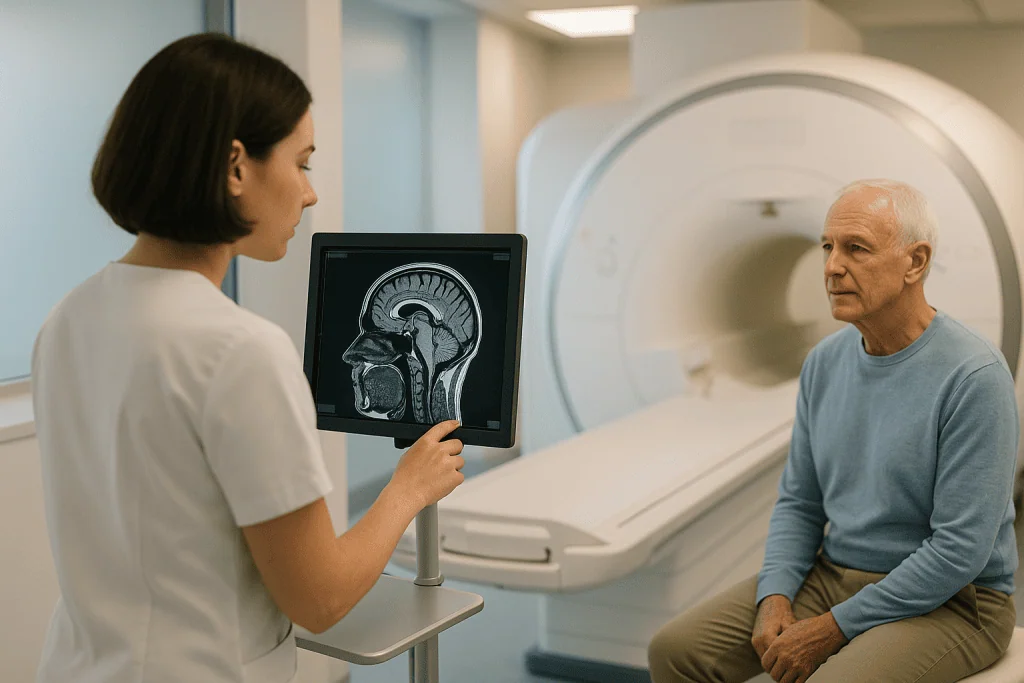
- Magnetic resonance imaging (MRI): a detailed scan of the brain that can show tumors, cysts, areas of multiple sclerosis, or other structural problems. Special MRI sequences focused on the brainstem can often show a blood vessel in contact with the facial nerve, although the vessel is not always visible even when compression is present.
- Magnetic resonance angiography (MRA): an MRI-based technique that maps the blood vessels and can help identify the artery involved.
- Electromyography (EMG): a test that records electrical activity in the facial muscles using small electrodes. It can show a characteristic pattern of abnormal signal spread that supports the diagnosis and helps distinguish hemifacial spasm from other movement disorders.
Part of the diagnostic process is ruling out conditions that look similar. These include blepharospasm (involuntary blinking or eye closure that usually affects both eyes), facial tics (movements that can be briefly suppressed), myokymia (a fine, rippling eyelid twitch that is usually harmless and short-lived), focal seizures involving the face, and the involuntary movements that can follow Bell’s palsy. Because the pattern of movement is so important, your doctor may ask you to record a short video of a typical episode if the spasms are not happening during the visit.
Hemifacial spasm treatment options
Hemifacial spasm rarely resolves on its own, so treatment is usually considered once the spasms are frequent or bothersome enough to affect daily life. The right approach depends on how severe the symptoms are, your general health, whether an underlying cause has been found, and your own preferences. The main options are outlined below.
Observation
When spasms are mild and infrequent, some people choose to monitor the condition without active treatment. Reducing fatigue, managing stress, and limiting caffeine may make the twitching less noticeable for some, although these measures do not address the underlying nerve irritation.
Botulinum toxin injections
Injections of botulinum toxin (a purified protein that temporarily blocks nerve signals to muscle) are the most commonly used treatment. Very small amounts are injected into the overactive facial muscles, weakening them just enough to calm the spasms. The effect usually starts within days and typically lasts around three to four months, after which the injections are repeated. Many people experience good symptom control with this approach. Possible side effects include temporary drooping of the eyelid, dry eye, double vision, or mild facial weakness or asymmetry; these generally wear off as the toxin fades. Injections manage the symptoms but do not cure the condition.
Medication
Oral medicines are sometimes tried, particularly when spasms are mild or while other treatments are being arranged. Drugs used include certain anti-seizure medicines (such as carbamazepine) and muscle relaxants (such as baclofen or clonazepam). For many people the benefit is modest and side effects such as drowsiness, dizziness, or unsteadiness can be limiting. Medication is generally considered less effective than botulinum toxin for this condition.
Microvascular decompression surgery
Microvascular decompression is the only treatment that aims to correct the underlying cause of primary hemifacial spasm. Under general anesthesia, a neurosurgeon makes a small opening in the skull behind the ear, identifies the blood vessel pressing on the facial nerve, and places a small cushion of soft material between the vessel and the nerve. Many people who have this operation experience long-term relief, and in some cases the spasms stop completely, although improvement can be gradual and the condition returns in a minority of people. Because it involves surgery near the brainstem, there are risks, including hearing loss on that side, facial weakness, leakage of the fluid that surrounds the brain, infection, and, rarely, stroke. It is usually offered to people whose symptoms are significant, who have not had enough benefit from injections or who prefer not to have repeated injections, and who are fit for surgery.
Treating secondary causes
If imaging shows a tumor, cyst, or other structural cause, treatment is directed at that problem, which may involve surgery or other specialist care.
Supportive care
Eye care is important when spasms cause repeated forceful closure or, after treatment, incomplete closure. Lubricating drops or ointment may be recommended. Some people find counseling or support groups helpful in coping with the social and emotional impact. At Acibadem, hemifacial spasm is assessed and managed within the Neurology department, with neurosurgical input when surgery is being considered.
Living with hemifacial spasm and outlook
Hemifacial spasm is a chronic condition, meaning it tends to persist and often slowly progresses without treatment. It does not shorten life and does not spread to the other side of the face in the vast majority of cases. The main impact is on quality of life: repeated eye closure can interfere with reading, driving, or working, and visible facial movements can lead to embarrassment, anxiety, or avoidance of social situations.
With treatment, most people are able to keep the spasms under reasonable control. Botulinum toxin injections allow many people to continue their normal activities between sessions, and microvascular decompression offers the possibility of lasting relief for suitable candidates. No treatment can be guaranteed to work for every individual, and your doctor may need to adjust the plan over time.
Practical steps that some people find helpful include keeping a simple diary of when spasms are worse, getting enough sleep, and being open with family, friends, and colleagues about the condition so that the movements are understood rather than misinterpreted. Regular follow-up allows your care team to track any change in the pattern of spasms and to reassess treatment if needed.
Frequently asked questions
Is hemifacial spasm dangerous?
Hemifacial spasm itself is not dangerous or life-threatening. It is, however, a sign that the facial nerve is being irritated, and in a small number of people the irritation is caused by a tumor or another condition that needs attention. This is why doctors usually arrange an MRI scan when hemifacial spasm is suspected, so that any secondary cause can be identified and treated.
What are the first hemifacial spasm symptoms?
The earliest hemifacial spasm symptom is most often an intermittent twitch of the lower eyelid on one side. At this stage it can be easily confused with ordinary eyelid twitching from tiredness or caffeine. The key differences are that hemifacial spasm keeps coming back over weeks and months, stays on one side, and gradually spreads to involve the cheek or mouth.
What causes hemifacial spasm to get worse?
Without treatment, hemifacial spasm tends to worsen slowly because the pressure on the facial nerve continues. Day to day, many people notice that stress, anxiety, fatigue, bright light, talking, chewing, or caffeine make the spasms more frequent. These triggers do not cause the condition but can increase how often the irritated nerve fires.
How is hemifacial spasm diagnosis confirmed?
Hemifacial spasm diagnosis is mainly clinical, meaning it is based on the story of the symptoms and what the doctor observes during an examination. An MRI scan is commonly used to look for a blood vessel touching the nerve and to rule out other causes, and electromyography may be used to record the abnormal muscle activity. There is no blood test for the condition.
Can hemifacial spasm go away on its own?
Spontaneous recovery is uncommon. Mild cases can have long quiet periods, and some spasms that follow Bell’s palsy may settle as the nerve heals, but persistent hemifacial spasm caused by vessel compression usually continues unless it is treated. Your doctor can discuss whether observation, injections, or surgery is appropriate for your situation.
Which hemifacial spasm treatment is best?
There is no single best hemifacial spasm treatment for everyone. Botulinum toxin injections are usually offered first because they are effective for many people and carry relatively low risk, but they must be repeated every few months. Microvascular decompression surgery can provide longer-lasting relief by addressing the cause, but it carries the risks of an operation near the brainstem. The choice depends on symptom severity, health, age, and personal preference.
Is hemifacial spasm the same as blepharospasm?
No. Blepharospasm causes involuntary blinking or forceful closure of both eyes and does not usually involve the mouth or cheek. Hemifacial spasm affects one side of the face and typically involves both the eye and the lower face. The two conditions have different causes and are treated somewhat differently, so an accurate diagnosis matters.
When to see a doctor
Occasional eyelid twitching is common and usually harmless. It is reasonable to arrange a medical review if twitching on one side of the face has continued for several weeks, is spreading to other parts of the face, is forcing the eye shut, or is affecting your vision, work, or wellbeing. A neurologist can confirm the diagnosis and discuss treatment.
Seek urgent medical care if facial twitching or spasm occurs together with any of the following warning signs, because they may point to a different and more serious problem such as a stroke, a seizure, or a growing lesion in the brain:
- Sudden weakness or drooping of the face, especially if the arm or leg on the same side is also weak
- Difficulty speaking, slurred speech, or trouble understanding others
- Sudden loss of vision or double vision that does not clear
- Sudden, severe headache unlike any you have had before
- New hearing loss, ringing in the ear, or loss of balance on the affected side
- Numbness or loss of sensation in the face
- Spasms that spread to the other side of the face or to the limbs
- Loss of consciousness, confusion, or jerking of the whole body
Facial weakness that comes on suddenly should always be treated as an emergency until a stroke has been ruled out, even if you already have a diagnosis of hemifacial spasm.
Medically reviewed by the Acıbadem International Medical Board September 13, 2026
See our medical review board →
Update history
- PublishedSeptember 13, 2026
- Medical review approvedSeptember 13, 2026
- Last content updateSeptember 13, 2026