Quick answer
Bell’s palsy is a sudden, usually temporary weakness or paralysis of the muscles on one side of the face caused by dysfunction of the facial nerve. Treatment focuses on confirming the diagnosis and protecting the eye, then managing inflammation and symptoms with medication, rehabilitation, and follow-up to support recovery and rule out other causes.
What is bell’s palsy?
Bell’s palsy is a sudden weakness or paralysis of the muscles on one side of the face. It happens when the facial nerve, the nerve that controls the muscles of facial expression, becomes inflamed, swollen, or compressed. Because this nerve also carries signals involved in taste, tear production, saliva production, and the protection of the ear from loud sounds, bells palsy can affect more than just facial movement. The condition is classified under the code G51.0 in the international disease classification (ICD-10).
When people ask “what is bells palsy,” the simplest answer is that it is a temporary facial nerve problem that usually appears quickly, often over a period of hours to a couple of days, and in most cases improves over weeks to months. It is not a stroke, although the two can look similar at first, which is why sudden facial weakness always needs prompt medical assessment.
Bell’s palsy can affect people of any age, but it is seen most often in adults between roughly 15 and 60 years of age. It occurs in both men and women. Certain groups appear to be at somewhat higher risk, including pregnant women (particularly in the third trimester and shortly after delivery), people with diabetes, and people with high blood pressure or recent viral infections. In most people it happens only once, although a small number experience a recurrence later in life.
Symptoms of bell’s palsy
Bells palsy symptoms typically come on suddenly. Many people first notice the problem when they wake up in the morning, look in the mirror, or find they cannot sip a drink without it leaking from one side of the mouth. The weakness usually reaches its worst point within about 48 to 72 hours of starting.
Common symptoms include:
- Sudden weakness or drooping on one side of the facethe mouth may sag and the face may look flattened or asymmetrical.
- Difficulty closing one eye or blinking fully on the affected side.
- Loss of the forehead wrinkles on the affected side and difficulty raising the eyebrow.
- Drooling or difficulty keeping food and liquids in the mouth.
- Changes in taste, often described as food tasting odd or muted on the front part of the tongue.
- Increased sensitivity to sound in one ear (called hyperacusis), because the nerve helps dampen loud noises.
- Pain or discomfort around the jaw or behind the ear on the affected side, which sometimes appears a day or two before the weakness.
- Dry eye or excessive tearing, and sometimes a dry mouth, because the nerve influences tear and saliva production.
- Difficulty with facial expressions such as smiling, frowning, or puffing out the cheeks.
Symptoms can range from mild weakness to complete paralysis of one side of the face. An important feature that helps doctors distinguish bells palsy from a stroke is that in Bell’s palsy the forehead is usually affected toothe person cannot wrinkle the forehead on the weak side. In many strokes, the forehead muscles are relatively spared. This distinction is a general guide, not a rule patients should rely on themselves; any sudden facial weakness needs urgent evaluation by a medical professional.
Symptoms also change over the course of the illness. In the early (acute) stage, weakness, ear pain, and eye-closure problems dominate. In the recovery stage, which often begins within two to three weeks, movement gradually returns. In a minority of people, the late stage can bring lingering effects such as mild residual weakness, involuntary muscle movements (for example, the eye closing when the person smiles, known as synkinesis), or tearing while eating. These late effects are more likely in people who had complete paralysis at the outset.
Causes and risk factors
The exact cause of Bell’s palsy is not fully understood, which is why doctors sometimes describe it as “idiopathic”, meaning arising without a clearly identified cause. However, the most widely accepted explanation for bells palsy causes is viral inflammation of the facial nerve. Reactivation of the herpes simplex virus (the common cold-sore virus) is thought to be involved in many cases. When the nerve becomes inflamed, it swells inside the narrow bony canal it travels through in the skull. Because there is little room for swelling, the nerve becomes compressed and temporarily stops working properly.
Other viruses have also been linked to facial nerve inflammation, including the varicella-zoster virus (the chickenpox and shingles virus), Epstein-Barr virus, and certain respiratory viruses. When the varicella-zoster virus is the cause and a painful rash appears in or around the ear, doctors call the condition Ramsay Hunt syndrome, which is treated somewhat differently and often has a slower recovery.
Factors that appear to increase the risk of developing Bell’s palsy include:
- Pregnancy, especially the third trimester and the first week after delivery.
- Diabetes, which can make nerves more vulnerable to injury.
- High blood pressure.
- Recent upper respiratory infection, such as a cold or flu-like illness.
- Obesity.
- A family history of Bell’s palsy, in a small proportion of cases.
It is important to understand that Bell’s palsy is not caused by stress alone, is not contagious in itself, and is not a sign of a brain tumor in the typical case. However, because other conditions, including stroke, Lyme disease (a bacterial infection spread by ticks), ear infections, and tumors pressing on the nerve, can also cause facial weakness, a doctor must rule these out before confirming the diagnosis.
Diagnosis
There is no single laboratory test that proves someone has Bell’s palsy. Instead, bells palsy diagnosis is what doctors call a “diagnosis of exclusion”: the physician confirms the typical pattern of facial weakness and rules out other explanations. The process usually involves the following steps.
Medical history and physical examination. The doctor asks how quickly the weakness developed, whether both sides of the face are involved, and whether there are other symptoms such as limb weakness, trouble speaking, hearing loss, rash, fever, or recent tick exposure. The examination focuses on the facial muscles: the doctor typically asks the patient to raise the eyebrows, close the eyes tightly, smile, and puff out the cheeks. Involvement of the forehead on the weak side supports a facial nerve problem rather than a stroke. Doctors often grade the severity of weakness using a standardized scale (the House-Brackmann scale is one commonly used system), which helps track recovery over time.
Neurological examination. The doctor checks strength, sensation, balance, and the other cranial nerves (the nerves that supply the head and face). If anything other than the facial nerve appears affected, further investigation is needed, because true Bell’s palsy involves only the facial nerve.
Blood tests may be ordered in selected cases, for example, to check blood sugar in people who may have undiagnosed diabetes, or to test for Lyme disease in regions where it is common or when the history suggests tick exposure.
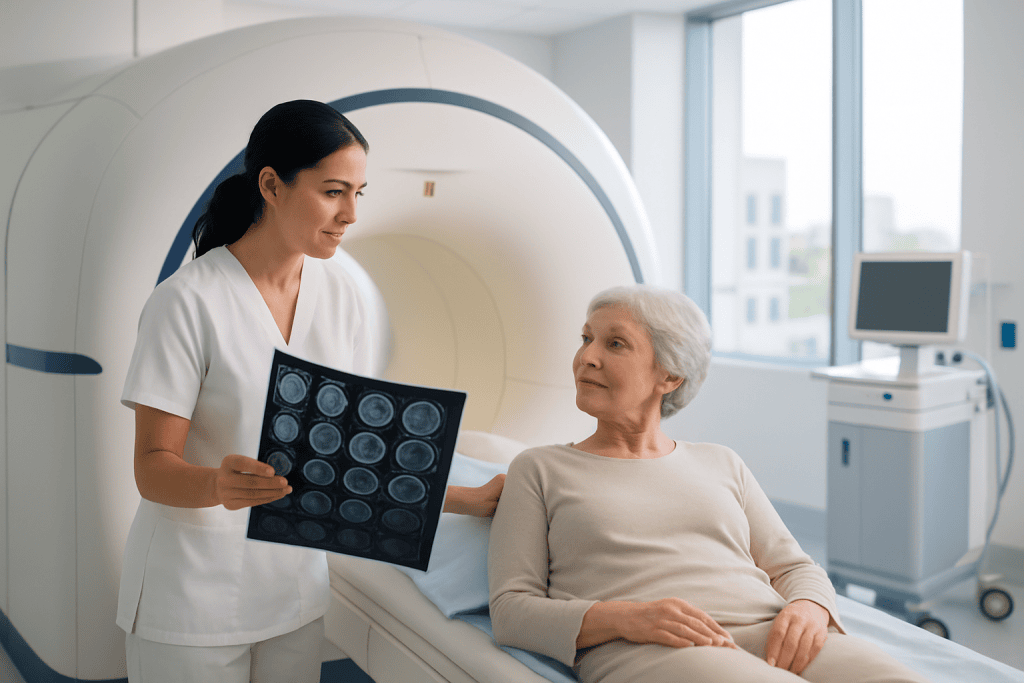
Imaging. Routine brain scans are not required for a typical case. However, your doctor may order magnetic resonance imaging (MRI) or a computed tomography (CT) scan if the presentation is unusual, for example, if the weakness came on very gradually, affects both sides, involves other nerves, fails to improve after several months, or recurs repeatedly on the same side. Imaging helps exclude stroke, tumors, infection, or structural problems along the course of the nerve.
Electrodiagnostic tests. In cases of complete paralysis, tests such as electromyography (EMG, which measures the electrical activity of muscles) or nerve conduction studies may occasionally be used to estimate how badly the nerve is affected and to help predict recovery. These tests are not needed for most patients.
Because facial weakness can signal several different conditions, the evaluation is usually coordinated by a neurologist: a doctor who specializes in disorders of the nerves and brain. At Acibadem, this condition is evaluated and managed within the Neurology department, often in cooperation with eye specialists and ear, nose, and throat specialists when needed.
Treatment options for bell’s palsy
Bells palsy treatment has two main goals: to reduce inflammation of the nerve as early as possible, and to protect the eye and support the face while the nerve recovers. The good news is that most people improve substantially even without treatment, but early medication appears to improve the chances of a full recovery.
Corticosteroid medication
Corticosteroids (anti-inflammatory steroid medicines such as prednisolone) are the mainstay of treatment. They reduce swelling of the facial nerve inside its bony canal. Evidence supports starting steroids as soon as possible, ideally within 72 hours of symptom onset, in adults without a reason to avoid them. Your doctor will decide on the dose and duration and will consider your other health conditions, such as diabetes, before prescribing.
Antiviral medication
Because a viral cause is suspected in many cases, doctors sometimes add an antiviral medicine (such as valacyclovir or acyclovir) to steroids, particularly in severe or complete paralysis. Antivirals on their own are not considered effective for Bell’s palsy; when used, they are given together with steroids. The benefit of adding antivirals is modest and debated, and your doctor will weigh it case by case. If a shingles-type rash suggests Ramsay Hunt syndrome, antivirals become a more central part of treatment.
Eye protection
Protecting the eye on the affected side is one of the most important parts of care, because an eye that cannot close properly can dry out and develop painful damage to the cornea (the clear front surface of the eye). Measures commonly recommended include:
- Lubricating eye drops (artificial tears) during the day.
- A thicker eye ointment at night.
- Taping the eyelid closed or wearing a protective eye shield or moisture chamber during sleep.
- Sunglasses or glasses outdoors to protect against wind and dust.
Any eye pain, redness, or change in vision on the affected side should be reported to a doctor promptly.
Watchful waiting and supportive care
Because most people recover on their own, part of treatment is simply structured follow-up: monitoring the face over the following weeks, protecting the eye, and reassessing if recovery does not begin as expected. Simple self-care measures, eating slowly, chewing on the stronger side, keeping the mouth clean because food can collect on the weak side, and gentle facial massage, can make daily life easier during recovery.
Physical therapy and facial exercises
Facial exercises, massage, and neuromuscular retraining (learning to reactivate and coordinate facial muscles) may help some patients, especially those with slower or incomplete recovery, and may help manage synkinesis, the unwanted linked movements that can develop later. A structured program guided by a trained therapist is generally preferred over unsupervised, forceful exercises. Rehabilitation of this kind can be arranged through a physical therapy program when a doctor considers it appropriate.
Botulinum toxin and other procedures
In people with long-term complications, small injections of botulinum toxin (a medicine that temporarily relaxes overactive muscles) are sometimes used to reduce synkinesis or to improve facial symmetry. This is a specialist treatment considered months after onset, not part of early care.
Surgery
Surgery has a limited and controversial role. Decompression surgery, an operation to relieve pressure on the nerve inside its bony canal, is rarely performed and remains debated because of uncertain benefit and potential risks, including hearing loss. For the small group of patients with severe, permanent facial weakness, reconstructive or “facial reanimation” procedures (such as nerve grafts or muscle transfers) may be discussed by specialized surgical teams, usually a year or more after onset. Cosmetic procedures such as eyelid weights can also help an eye that will not close. These options apply only to a minority of patients and are always individualized.
Living with bell’s palsy and outlook
The overall outlook for Bell’s palsy is favorable for most people. Improvement often begins within two to three weeks of onset, and many people recover fully within three to six months. People with only partial weakness at the start tend to do especially well. Those who begin with complete paralysis, are older, or have conditions such as diabetes may recover more slowly or less completely, though many still improve considerably. No doctor can guarantee a specific outcome, and recovery timelines vary widely from person to person.
A minority of people are left with some long-term effects, such as mild weakness, facial tightness, synkinesis, or tearing while eating (sometimes called “crocodile tears”). These effects can often be improved with rehabilitation and, in selected cases, botulinum toxin treatment.
Living with facial weakness, even temporarily, can be emotionally difficult. The face is central to how we communicate, and changes in appearance or speech may cause self-consciousness, frustration, or low mood. It can help to explain the condition to family, friends, and colleagues, to allow extra time for meals, and to seek support from a healthcare professional if mood is significantly affected. Practical adjustments, such as using a straw carefully for drinks (some people find this harder, others easier), keeping lubricating drops at hand, and protecting the eye consistently, make day-to-day life more manageable during recovery.
Recurrence is uncommon but possible. Anyone who experiences a second episode, or an episode that behaves unusually, should be re-evaluated, as repeated facial weakness may point to a different underlying condition.
Frequently asked questions
What is bells palsy in simple terms?
Bell’s palsy is a sudden, usually temporary weakness of the muscles on one side of the face, caused by inflammation of the facial nerve. It typically develops within hours to a couple of days, often after a viral illness, and in most cases the face gradually recovers over weeks to months. It is not a stroke, although the two can look alike at first and urgent medical assessment is always needed to tell them apart.
Can bells palsy heal on its own?
In many cases, yes. A large proportion of people recover well even without treatment, particularly if the weakness was only partial. However, starting corticosteroid medication within about 72 hours of onset appears to improve the chance of a complete recovery, so seeing a doctor early is strongly advised rather than simply waiting.
How long does recovery from bells palsy take?
Recovery times vary. Improvement often begins within two to three weeks, and many people recover fully within three to six months. Some people, especially those who started with complete paralysis, may take longer or may be left with mild residual effects. If no improvement at all is seen within three to four months, doctors usually re-evaluate the diagnosis with further tests or imaging.
Is bells palsy serious or dangerous?
Bell’s palsy itself is generally not life-threatening, and most people recover well. The main early risk is damage to the eye on the affected side if it cannot close properly, which is why eye protection is emphasized. The more serious concern is that other conditions, such as stroke, can mimic it, so sudden facial weakness should always be assessed urgently by a medical professional rather than self-diagnosed.
What triggers bells palsy?
The exact trigger is often unknown, but reactivation of common viruses, especially the herpes simplex (cold-sore) virus, is thought to inflame the facial nerve in many cases. Pregnancy, diabetes, high blood pressure, and recent respiratory infections are associated with a higher risk. Everyday stress alone has not been proven to cause the condition, although illness and physical strain may play an indirect role in some people.
Can bells palsy come back?
Most people have only one episode in their lifetime, but a small number experience a recurrence, sometimes years later and sometimes on the other side of the face. Repeated episodes, or facial weakness that keeps affecting the same side, should prompt a thorough re-evaluation, because recurrent weakness can occasionally signal a different underlying problem that needs its own investigation.
How do doctors confirm a bells palsy diagnosis?
Doctors confirm it mainly through the history and physical examination, checking that the weakness affects one entire side of the face, including the forehead, and that no other nerves or body functions are involved. Blood tests, MRI or CT scans, and nerve tests are used selectively, chiefly to rule out other causes such as stroke, Lyme disease, ear disease, or tumors when the picture is not typical.
When to see a doctor
Anyone who develops sudden facial weakness should be seen by a doctor promptly, ideally the same day, both to rule out more serious conditions and because early treatment works best when started within about 72 hours. Seek emergency care immediately if facial weakness occurs together with any of the following red flags, which may indicate a stroke or another serious condition:
- Weakness or numbness in an arm or leg, especially on one side of the body.
- Slurred speech, confusion, or difficulty understanding others.
- Sudden severe headache unlike any previous headache.
- Loss of vision, double vision, or sudden trouble with balance or walking.
- Loss of consciousness, fainting, or a seizure.
- Difficulty swallowing beyond mild lip weakness, or trouble breathing.
You should also arrange a medical review, urgently, though not necessarily as an emergency, if you notice a painful rash or blisters in or around the ear (which may suggest Ramsay Hunt syndrome), new hearing loss or severe ear pain, fever with facial weakness, weakness that develops slowly over weeks rather than hours, weakness affecting both sides of the face, or eye pain, redness, or blurred vision on the affected side. Finally, if a diagnosed case of Bell’s palsy shows no sign of improvement after several weeks, or seems to be getting worse after initially improving, a follow-up assessment is important so that your doctor can reconsider the diagnosis and adjust your care.
Medically reviewed by the Acıbadem International Medical Board September 3, 2026
See our medical review board →
Update history
- PublishedJune 14, 2026
- Medical review approvedSeptember 3, 2026
- Last content updateSeptember 2, 2026