Jaw Cysts
Learn about jaw cysts: what they are, common symptoms and causes, how doctors confirm the diagnosis with imaging, and the main treatment options available.
Quick answer
Jaw cysts are benign fluid-filled sacs that form inside the upper or lower jawbone, most often from tissues linked to tooth development or from a tooth whose inner pulp has died. Many cause no symptoms and are found on dental X-rays. Treatment is usually surgical removal, and the outlook is generally good, though some types can recur.
What is jaw cysts?
A jaw cyst is a closed sac that forms inside the bone of the upper jaw (the maxilla) or the lower jaw (the mandible). The sac has a lining of cells and is usually filled with fluid, semi-solid material, or air. Jaw cysts are generally benign, meaning they are not cancer, but they can slowly enlarge over months or years and press on nearby teeth, nerves, and bone.
Most jaw cysts are described as odontogenic, a term that means they arise from the tissues that form teeth. A smaller group are non-odontogenic and develop from other tissues in the head and face. Common types include the radicular cyst (also called a periapical cyst), which forms at the tip of a tooth root after the tooth’s inner tissue has died; the dentigerous cyst, which forms around the crown of a tooth that has not yet come through the gum, most often a wisdom tooth; and the odontogenic keratocyst, a type known for its tendency to grow along the jaw and to return after treatment.
Jaw cysts can affect people of any age. Radicular cysts are seen most often in adults with untreated tooth decay or dental injury, while dentigerous cysts are more common in teenagers and young adults whose wisdom teeth are still developing. Many jaw cysts are discovered by chance on routine dental X-rays before they cause any noticeable problems. In many hospital groups, including Acibadem, jaw cysts are managed by oral and maxillofacial surgeons within Dental & Oral Health services, often working alongside dentists and radiologists.
Jaw cysts symptoms
Many jaw cysts produce no symptoms at all, particularly when they are small. As a cyst grows, it can begin to affect the surrounding bone and teeth, and signs may gradually appear. Jaw cysts symptoms can include:
- A slowly growing, usually painless swelling of the jaw, gum, or face
- Aching or pressure in the jaw, especially if the cyst becomes infected
- Teeth that feel loose, move position, or become tilted
- A tooth that has not come through the gum when expected
- Numbness or tingling of the lower lip or chin when a cyst presses on a nerve
- Discharge of fluid or pus into the mouth, sometimes with a bad taste
- A feeling that the teeth do not meet in the usual way when biting
- In large cysts, a thinning of the jawbone that can make it more likely to break
Symptoms often depend on the type of cyst and how far it has progressed. A radicular cyst may follow a history of toothache, a dark or discolored tooth, or a tooth that was previously injured; the cyst itself is usually painless unless infection sets in. A dentigerous cyst is often silent and may only be suspected when a wisdom tooth or other tooth fails to appear. Odontogenic keratocysts tend to spread along the length of the jaw rather than expanding outward, so they can reach a considerable size before any swelling is visible. Non-odontogenic cysts, such as the nasopalatine duct cyst behind the upper front teeth, may cause a small bulge in the roof of the mouth or a salty taste from occasional drainage.
Jaw cysts causes and risk factors
Jaw cysts causes vary with the type of cyst, but most are linked either to developing teeth or to problems with existing teeth. Understanding the likely origin helps your dental team plan treatment.
- Infection or death of the tooth pulp: when deep decay, a crack, or an injury allows bacteria to reach the soft tissue inside a tooth, the tissue can die. Inflammation at the root tip may stimulate leftover cells from tooth development to form a radicular cyst.
- Teeth that fail to erupt: a tooth that stays buried in the bone, often a wisdom tooth or an upper canine, can develop a dentigerous cyst around its crown as fluid collects between the tooth and the tissue that surrounds it.
- Remnants of tooth-forming tissue: tiny groups of cells left behind after the teeth form can, for reasons that are not fully understood, begin to grow and create cysts such as the odontogenic keratocyst.
- Developmental factors: some non-odontogenic cysts arise from tissue trapped where different parts of the face joined together during growth before birth.
- Inherited conditions: a rare genetic condition known as Gorlin syndrome (nevoid basal cell carcinoma syndrome) is associated with multiple odontogenic keratocysts, often appearing at a young age.
Risk factors that may make a jaw cyst more likely include untreated tooth decay, a history of dental trauma, impacted or missing teeth that have not been checked with X-rays, poor access to routine dental care, and a family history of Gorlin syndrome. Jaw cysts are not caused by anything a person eats, and they are not contagious.
Jaw cysts diagnosis
Jaw cysts diagnosis usually begins with a dental or medical history and a careful examination of the mouth and face. Your dentist or surgeon will look for swelling, check whether teeth are loose or discolored, and may gently tap or apply cold to teeth to assess whether the nerve inside is still alive. Because cysts sit inside bone, imaging is essential.
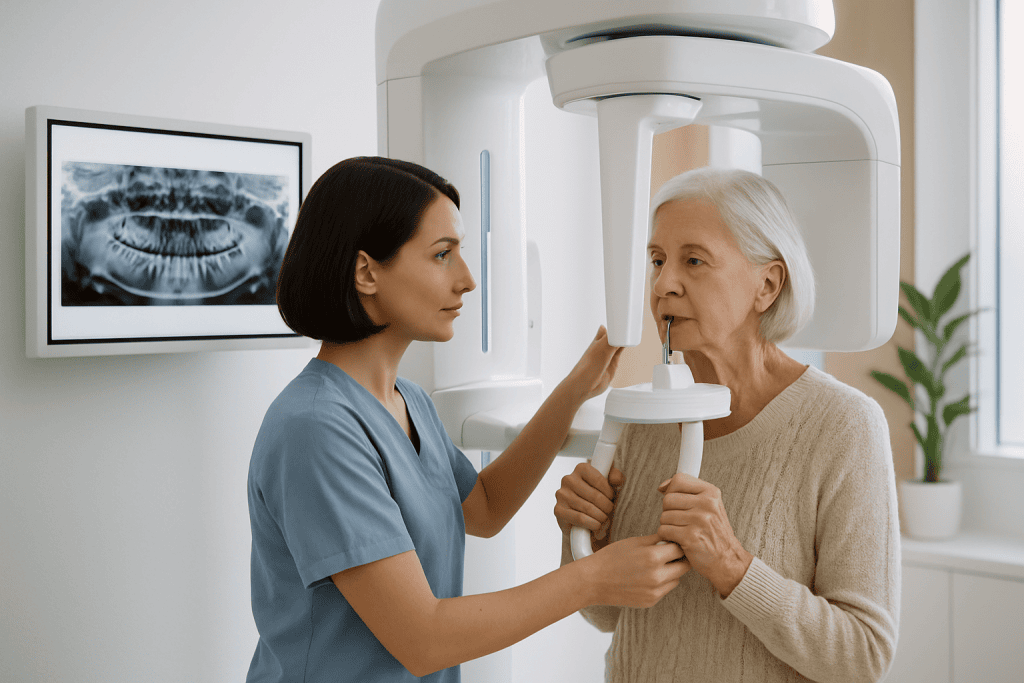
- Dental X-rays: a periapical X-ray (showing one or two teeth and their roots) or a panoramic X-ray (showing both jaws in one image) often reveals a cyst as a rounded dark area with a well-defined border.
- Cone beam computed tomography (CBCT): a three-dimensional X-ray scan that shows the exact size and position of a cyst and its relationship to nerves, sinuses, and tooth roots. It is commonly used to plan surgery.
- CT or MRI scanning: for very large lesions or when the picture is unclear, standard CT (computed tomography) or MRI (magnetic resonance imaging) may be requested to look at soft tissue and bone in more detail.
- Aspiration: in some cases a needle is used to draw fluid from the cyst. The color and consistency of the fluid can offer clues about the type of cyst and help rule out other conditions.
- Biopsy and histopathology: the only way to confirm the exact type of cyst is to examine its lining under a microscope. Often this is done on the tissue removed during treatment, although a small sample may be taken beforehand for larger or unusual lesions.
Imaging alone cannot always distinguish a cyst from other jaw lesions, including benign tumors such as ameloblastoma or, rarely, cancer. This is why microscopic examination of the removed tissue is considered standard practice. Your care team may also test the vitality of nearby teeth to decide whether a root canal treatment or extraction is needed as part of the plan.
Jaw cysts treatment options
Jaw cysts treatment options depend on the type of cyst, its size and location, the condition of the teeth involved, and your general health. Because cysts rarely disappear on their own and tend to enlarge over time, some form of active treatment is usually recommended, although the approach can be tailored to each situation.
- Observation: for very small, symptom-free lesions where the diagnosis is uncertain, a surgeon may suggest monitoring with repeat X-rays over several months to see whether the area changes. This is not a long-term substitute for treatment when a cyst is confirmed.
- Medication: antibiotics may be prescribed if a cyst has become infected, and pain relievers can ease discomfort. Medication treats the infection or symptoms but does not remove the cyst itself.
- Root canal treatment: for a small radicular cyst attached to a tooth that can be saved, cleaning and sealing the inside of the tooth may allow the surrounding bone to heal. If healing does not occur, surgery may follow.
- Enucleation: the most common surgical procedure, in which the whole cyst and its lining are removed through an opening in the gum and bone. It is usually performed under local anesthesia, sometimes with sedation or general anesthesia for larger cysts. Teeth that cannot be saved, such as an impacted wisdom tooth inside a dentigerous cyst, are often removed at the same time.
- Marsupialization or decompression: for very large cysts, or when full removal would risk damaging a nerve or fracturing the jaw, the surgeon may create a small opening and place a tube or plug so the cyst can drain and shrink over several months. A second, smaller operation is often needed afterward to remove what remains.
- Additional measures for keratocysts: because odontogenic keratocysts have a higher chance of returning, surgeons may treat the bony cavity with a chemical solution or remove a thin margin of surrounding bone in addition to enucleation.
- Bone grafting and reconstruction: when a cyst has hollowed out a large section of jaw, a graft of bone or bone substitute may be placed to support healing. In rare cases where a section of jaw must be removed, reconstructive surgery may be considered.
Recovery after surgery typically involves swelling and mild to moderate discomfort for several days, a soft diet, and careful mouth hygiene. Stitches are usually dissolvable or removed within one to two weeks. The bone in the cavity gradually fills in over months, and follow-up X-rays are used to check this process. Where teeth have been removed, replacement options such as bridges or implants may be discussed once the bone has healed.
Living with jaw cysts and outlook
For most people, the outlook after treatment of a jaw cyst is good. Radicular and dentigerous cysts generally do not return once fully removed and the associated tooth problem has been addressed. Odontogenic keratocysts carry a recognized risk of recurrence, sometimes years later, so long-term follow-up with periodic X-rays is usually advised. People with Gorlin syndrome may develop new cysts over time and often need ongoing surveillance.
Possible complications of treatment include temporary or, less commonly, lasting numbness of the lip or chin if a nerve was stretched or injured, infection of the surgical site, damage to neighboring teeth, and, with very large cysts, a weakened jaw that needs protection from heavy chewing or contact sports during healing. Your surgeon will explain the risks relevant to your particular cyst before any procedure.
Day to day, living well after a jaw cyst mostly means keeping up with routine dental care. Regular check-ups and X-rays help detect any recurrence early, when it is easiest to manage. Treating tooth decay promptly and having impacted teeth assessed can lower the chance of a new cyst forming. It is helpful to report any new swelling, numbness, or change in how your teeth fit together rather than waiting for a scheduled visit.
Frequently asked questions
What is jaw cysts and are they dangerous?
A jaw cyst is a fluid-filled sac that forms within the jawbone, most often from tissues related to tooth development. The vast majority are benign and not life-threatening. However, because they can grow, weaken bone, damage teeth, and occasionally become infected, they are usually treated rather than left alone. Very rarely, a jaw lesion that looks like a cyst turns out to be something else, which is why removed tissue is examined under a microscope.
What are the first jaw cysts symptoms people notice?
In many cases there are no early symptoms and the cyst is found on a routine dental X-ray. When symptoms do appear, the most common first sign is a slow, painless swelling of the jaw or gum. Some people notice a tooth becoming loose or shifting, a tooth that never came through, or a tingling feeling in the lip. Pain usually only develops if the cyst becomes infected.
What are the main jaw cysts causes?
The most common causes are a tooth whose inner tissue has died from decay or injury, leading to a cyst at the root tip, and a tooth that remains buried in the bone and develops a cyst around its crown. Other cysts arise from leftover tooth-forming cells or from tissue trapped during facial development before birth. A rare inherited condition, Gorlin syndrome, can cause multiple cysts.
How is jaw cysts diagnosis confirmed?
Diagnosis starts with an examination and dental X-rays, which typically show a well-defined dark area in the bone. A three-dimensional cone beam CT scan is often used to measure the cyst and plan treatment. The exact type of cyst can only be confirmed by examining its lining under a microscope, usually after it has been removed. In some cases, fluid may be drawn with a needle beforehand for testing.
What jaw cysts treatment options are available without surgery?
Non-surgical options are limited. A small cyst linked to a tooth that can be saved may respond to root canal treatment, and antibiotics can control an infection, but they do not remove the cyst. For most confirmed cysts, some form of minor surgery is recommended, often as a day procedure under local anesthesia. Your surgeon can explain which approach fits your situation.
Can jaw cysts come back after treatment?
Most common jaw cysts, such as radicular and dentigerous cysts, rarely return once they are completely removed. Odontogenic keratocysts are known to recur more often, sometimes years after surgery, so ongoing follow-up with periodic X-rays is generally advised. Attending review appointments is the best way to catch any recurrence at an early, more easily treated stage.
Can jaw cysts turn into cancer?
Jaw cysts are benign, and change into cancer is considered extremely rare. The greater concern is that a lesion that appears to be a cyst on an X-ray may actually be a different type of growth, including a benign tumor or, uncommonly, a malignant one. This is one reason why tissue removed during treatment is routinely sent for microscopic examination.
When to see a doctor
Any new lump or swelling in the jaw, a tooth that becomes loose without an obvious reason, or a tooth that has not come through when expected should be assessed by a dentist or oral surgeon. Early evaluation allows smaller, simpler treatment. Seek prompt medical or dental attention if you notice any of the following warning signs:
- Rapidly increasing swelling of the jaw or face, especially with fever
- Severe or worsening jaw pain that is not relieved by usual pain medicine
- Difficulty opening your mouth, swallowing, or breathing
- New numbness or tingling of the lip, chin, or tongue
- Pus or foul-tasting discharge in the mouth
- A cracking sensation or sudden change in how your teeth meet after minor trauma, which could indicate a fracture through weakened bone
- Bleeding from the gum that does not stop
Swelling that spreads toward the eye or neck, or that interferes with breathing or swallowing, may indicate a spreading infection and should be treated as an emergency.
Medically reviewed by the Acıbadem International Medical Board September 9, 2026
See our medical review board →
Update history
- PublishedSeptember 9, 2026
- Medical review approvedSeptember 9, 2026
- Last content updateSeptember 9, 2026