Quick answer
Migraine is a neurological condition that causes recurring headache attacks, often with nausea and sensitivity to light, sound, or movement, and sometimes visual or sensory warning symptoms called aura. At Acibadem in Turkey, migraine care focuses on confirming the diagnosis, identifying triggers, and managing attacks with a personalized plan that may include lifestyle measures, medication, and specialist follow-up.
What is migraine?
Migraine is a common neurological condition, a condition that affects the brain and nervous system, that causes repeated attacks of headache, often together with other symptoms such as nausea, vomiting, and unusual sensitivity to light and sound. A migraine headache is typically moderate to severe, often felt on one side of the head, and frequently described as throbbing or pulsating. Attacks can last from a few hours to several days if untreated.
When people ask “what is migraine,” it helps to understand that it is more than a bad headache. Migraine is thought to involve temporary changes in brain activity that affect nerve signals, chemicals, and blood vessels in the brain. Because the condition involves the nervous system itself, it can affect thinking, vision, digestion, and mood during an attack, not just the head.
Migraine can affect people of any age, including children, but it most often begins in adolescence or early adulthood. It is more common in women than in men, and many people notice that attacks change in frequency or intensity over their lifetime, for example, around puberty, pregnancy, or menopause. Migraine often runs in families, which suggests that genetics play an important role.
Doctors describe migraine as either episodic (attacks occur on fewer than 15 days per month) or chronic (headache occurs on 15 or more days per month, with migraine features on at least 8 of those days, for more than three months). Some people experience migraine with auratemporary warning symptoms, usually visual, that occur before or during the headache, while others have migraine without aura.
Symptoms of migraine
Migraine symptoms vary from person to person and even from one attack to the next. A typical migraine attack can move through up to four stages, although not everyone experiences all of them.
- Prodrome (warning phase): subtle changes that begin hours or even a day or two before the headache, such as mood changes, food cravings, neck stiffness, frequent yawning, increased urination, or unusual tiredness.
- Aura: temporary nervous-system symptoms that usually develop gradually over several minutes and last less than an hour. The most common auras are visual, flashing lights, zigzag lines, or blind spots. Some people experience tingling or numbness in a hand or the face, or temporary difficulty speaking. Only some people with migraine have aura.
- Headache phase: pain that is often on one side of the head, throbbing or pulsating in quality, moderate to severe in intensity, and made worse by routine physical activity such as climbing stairs. This phase can last from about 4 hours up to 72 hours if untreated.
- Postdrome (recovery phase): after the pain fades, many people feel drained, foggy, or unusually sensitive for up to a day. Some people describe this as a “migraine hangover.”
During the headache phase, common accompanying symptoms include:
- Nausea, with or without vomiting
- Sensitivity to light (photophobia), meaning ordinary light feels uncomfortably bright
- Sensitivity to sound (phonophobia), meaning ordinary noise feels painfully loud
- Sensitivity to smells in some people
- Difficulty concentrating or thinking clearly
- Dizziness or a feeling of being lightheaded
- A strong need to lie down in a dark, quiet room
Symptoms can also differ by migraine type. In migraine without aura, the headache and its accompanying symptoms occur without warning signs. In migraine with aura, the visual or sensory disturbances usually come first. Less common forms exist as well: for example, vestibular migraine is dominated by episodes of dizziness or vertigo (a spinning sensation), and some people, more often children, experience migraine variants with prominent abdominal pain or vomiting. Rarely, a person may have aura symptoms without any headache at all, which should always be evaluated by a doctor because similar symptoms can have other causes.
Causes and risk factors
The exact migraine causes are not fully understood, but research points to a combination of inherited susceptibility and temporary changes in the way the brain processes signals. During an attack, waves of altered electrical activity and the release of chemical messengers are believed to activate pain pathways connected to the trigeminal nerve, the main sensory nerve of the face and head, and to affect blood vessels around the brain.
Several factors are known to increase the likelihood of having migraine:
- Family history: migraine often runs in families, and having a parent or sibling with migraine raises your risk.
- Sex and hormones: migraine is more common in women, and hormonal changes, such as those around menstruation, pregnancy, or menopause, can influence attacks.
- Age: migraine often begins in the teenage years or early adulthood and, for many people, becomes less frequent later in life.
Separately from these underlying risk factors, many people can identify triggerscircumstances that make an individual attack more likely. Triggers vary widely between people and may include:
- Stress, or the “let-down” period after stress ends
- Too little or too much sleep, or an irregular sleep schedule
- Skipped meals or dehydration
- Certain foods and drinks, such as alcohol (especially red wine), aged cheeses, or foods containing certain additives, in some people
- Caffeine, either too much, or sudden withdrawal
- Bright or flickering lights, loud noise, and strong smells
- Weather or barometric pressure changes
- Hormonal fluctuations, including those related to the menstrual cycle
- Overuse of pain-relief medication, which can lead to a separate problem called medication-overuse headache
It is important to know that triggers do not cause migraine in the sense of creating the condition; they act on a nervous system that is already predisposed. Not everyone can identify clear triggers, and avoiding triggers alone does not always prevent attacks.
Diagnosis
Migraine diagnosis is primarily clinical, meaning it is based on your medical history and a physical and neurological examination rather than on a specific laboratory test. There is no blood test or scan that can confirm migraine on its own.
To make the diagnosis, doctors typically:
- Take a detailed headache history. Your doctor will ask how often headaches occur, how long they last, where the pain is located, what it feels like, what other symptoms accompany it, what seems to trigger or relieve it, and whether close relatives have similar headaches.
- Apply established diagnostic criteria. Neurologists commonly use the criteria of the International Classification of Headache Disorders (ICHD), which define migraine by features such as attack duration (4 to 72 hours untreated), pain characteristics (one-sided, pulsating, moderate to severe, worsened by activity), and accompanying symptoms (nausea, or sensitivity to light and sound).
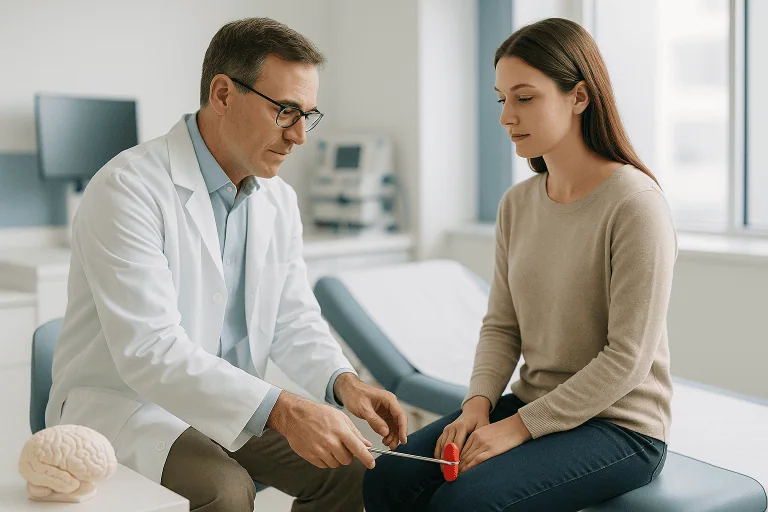
- Perform a neurological examination. This checks vision, strength, reflexes, coordination, and sensation. In migraine, this examination is normal between attacks.
- Ask you to keep a headache diary. Recording attacks, symptoms, medication use, and possible triggers over several weeks often clarifies the pattern and supports an accurate diagnosis.
Imaging studies such as MRI (magnetic resonance imaging, a scan that uses magnets and radio waves) or CT (computed tomography, an X-ray–based scan) are not needed for typical migraine. However, your doctor may order imaging if there are unusual features, for example, a sudden severe headache, headaches that steadily worsen, new headaches after age 50, abnormal findings on the neurological examination, or a significant change in your usual headache pattern. In these situations, imaging is used to rule out other causes rather than to confirm migraine.
Migraine and other headache disorders are usually evaluated and managed by a neurology department, where specialists in nervous-system disorders can distinguish migraine from other headache types such as tension-type headache or cluster headache.
Treatment options for migraine
There is currently no cure for migraine, but effective migraine treatment can reduce how often attacks occur, shorten them, and lessen their severity. Treatment plans are individual and usually combine several approaches. An overview of care pathways for this condition is available on the migraine treatment page.
Acute (attack) treatment
Acute treatment aims to stop or ease an attack once it has started. Options your doctor may discuss include:
- Simple pain relievers, such as acetaminophen (paracetamol) or nonsteroidal anti-inflammatory drugs (NSAIDs) like ibuprofen, which often help milder attacks when taken early.
- Triptansmigraine-specific medications that act on serotonin receptors to calm the pain pathways involved in an attack. They are not suitable for everyone, particularly people with certain heart or blood-vessel conditions.
- Newer migraine-specific medications, including gepants (drugs that block a pain-signaling molecule called CGRP) and ditans, which may be options when triptans do not work or cannot be used.
- Anti-nausea medications, which relieve nausea and can also help other migraine symptoms.
Acute medications generally work best when taken early in the attack. Using them too frequently, typically on more than about 10 to 15 days per month, depending on the medication, can lead to medication-overuse headache, so your doctor will advise on safe limits.
Preventive treatment
If attacks are frequent, long-lasting, or disabling, your doctor may recommend daily or regular preventive treatment to reduce the number of attacks. Options include:
- Oral preventive medications, such as certain blood-pressure medications (beta-blockers), some antidepressants, and some anti-seizure medications, all of which have evidence for migraine prevention independent of their original use.
- CGRP-targeted therapies, including monoclonal antibody injections and certain gepant tablets designed specifically for migraine prevention.
- Botulinum toxin (Botox) injections, which are an established option for chronic migraine, that is, headache on 15 or more days per month, given as a series of small injections around the head and neck, usually every 12 weeks.
Preventive treatments often take several weeks to show their full effect, and it may take some adjustment to find the option that suits you best.
Non-drug approaches and procedures
- Lifestyle measures: regular sleep, regular meals, hydration, routine physical activity, and stress management can meaningfully reduce attack frequency in many people.
- Behavioral therapies: relaxation training, biofeedback (a technique that teaches control over body responses such as muscle tension), and cognitive behavioral therapy may help, especially alongside medication.
- Neuromodulation devices: some noninvasive devices that stimulate nerves electrically or magnetically are approved in some regions for treating or preventing migraine; your doctor can advise whether these are appropriate.
- Nerve block injections: in selected cases, injections of local anesthetic around specific scalp nerves may provide temporary relief.
Watchful waiting and surgery
For people with infrequent, mild attacks, a reasonable plan may simply be trigger awareness, lifestyle adjustment, and occasional use of over-the-counter pain relief: a form of watchful waiting with periodic review. Surgery is not a standard treatment for migraine. Some surgical procedures targeting nerves have been studied, but they are not routinely recommended, and most people with migraine are managed successfully without any surgical intervention. Within hospital settings such as Acibadem, migraine care is coordinated primarily through neurology specialists rather than surgical departments.
Living with migraine / outlook
Migraine is a long-term condition, and its course varies. For many people, attacks can be brought under reasonable control with a combination of preventive strategies, well-timed acute treatment, and lifestyle adjustments. Some people experience long periods with few or no attacks; others need ongoing preventive treatment. Migraine frequency often changes over a lifetime, and in many cases attacks become less frequent or less severe with age, although this is not guaranteed.
Practical steps that often help include keeping a headache diary to spot patterns, maintaining consistent sleep and meal routines, staying hydrated, managing stress where possible, and reviewing your treatment plan with your doctor regularly, especially if attacks change in character or frequency. It is also worth telling your doctor about all medications you use, since frequent pain-reliever use can itself worsen headaches over time.
Migraine itself is not usually life-threatening, but it can significantly affect work, family life, and mood. If migraine is limiting your daily activities despite treatment, or if you notice low mood or anxiety connected to your attacks, raise this with your care team; adjusting the treatment plan or adding supportive therapies may help.
Frequently asked questions
What is migraine, in simple terms?
Migraine is a brain-related condition that causes repeated attacks of moderate to severe headache, often on one side of the head, usually with nausea and sensitivity to light and sound. It is not simply a strong headache; it involves temporary changes in how the brain processes signals, which is why it can also affect vision, digestion, and concentration during an attack.
Can migraine be cured or heal on its own?
There is currently no cure for migraine, but the condition can often be managed effectively. Many people find that attacks become less frequent with the right combination of preventive treatment, acute medication, and lifestyle changes, and some notice improvement with age. Because the pattern varies from person to person, no outcome can be guaranteed, and treatment plans usually need periodic adjustment.
How serious is a migraine?
Migraine is generally not dangerous in itself, although attacks can be very disabling while they last. The main concerns are the impact on daily life and, less commonly, complications such as medication-overuse headache from frequent pain-reliever use. Certain warning signs, such as a sudden, extremely severe headache or new neurological symptoms, need urgent medical assessment because they may indicate a different, more serious problem.
How is migraine diagnosis confirmed?
Migraine diagnosis is based on your description of the attacks and a normal neurological examination, matched against internationally accepted criteria. There is no single confirmatory test. Brain scans such as MRI or CT are not routinely needed and are ordered mainly to rule out other conditions when the headache pattern is unusual or the examination shows abnormalities.
What is the fastest migraine treatment during an attack?
Acute treatments generally work best when taken early in the attack. Depending on your situation, this may be a simple pain reliever, a triptan, or a newer migraine-specific medication, sometimes combined with an anti-nausea medication. Resting in a dark, quiet room often helps as well. Your doctor can recommend which option is safest and most likely to work for you, and how often it can be used without risking medication-overuse headache.
What are common migraine triggers I should watch for?
Common triggers include stress, irregular sleep, skipped meals, dehydration, alcohol, caffeine changes, bright or flickering lights, strong smells, weather changes, and hormonal fluctuations. Triggers are highly individual, and not everyone can identify them. A headache diary kept over several weeks is often the most reliable way to discover your personal pattern.
Can children get migraine?
Yes. Migraine can begin in childhood, although attacks in children are often shorter and the pain may be felt on both sides of the head. Some children have migraine variants with prominent abdominal pain or vomiting rather than headache. Any recurrent or severe headache in a child should be evaluated by a doctor to confirm the diagnosis and plan age-appropriate treatment.
When to see a doctor
See a doctor if you have frequent or disabling headaches, if over-the-counter pain relief no longer works, if you need pain relievers on many days each month, or if your usual headache pattern changes noticeably. A proper diagnosis is important because effective preventive treatments exist and because other headache types are treated differently.
Seek urgent medical care immediately if you experience any of the following red-flag warning signs, which may indicate a condition other than migraine:
- A sudden, extremely severe headache that reaches maximum intensity within seconds to minutes (“thunderclap” headache)
- Headache with fever, stiff neck, confusion, or a rash
- Headache after a head injury
- New weakness, numbness, difficulty speaking, or vision loss, especially if these symptoms do not resolve within an hour
- Headache with a seizure or loss of consciousness
- A headache that steadily worsens over days or weeks
- A new type of headache beginning after age 50
- New or changed headaches during pregnancy, or in someone with cancer or a weakened immune system
- An aura that lasts much longer than usual, or aura symptoms occurring for the first time
These symptoms do not necessarily mean something serious is happening, but they require prompt medical evaluation so that dangerous causes can be ruled out safely.
Medically reviewed by the Acıbadem International Medical Board September 2, 2026
See our medical review board →
Update history
- PublishedJune 14, 2026
- Medical review approvedSeptember 2, 2026
- Last content updateSeptember 2, 2026