Multiple Sclerosis
Quick answer
Multiple sclerosis is a chronic disease in which the immune system attacks the protective covering of nerves in the brain and spinal cord, disrupting communication and causing symptoms such as weakness, numbness, vision problems, and balance difficulties. Treatment focuses on confirming the diagnosis, managing relapses, slowing disease activity with medication, and supporting long-term function through rehabilitation and coordinated neurological care.
What is multiple sclerosis?
Multiple sclerosis (often shortened to MS) is a long-term condition that affects the central nervous system, which is made up of the brain and the spinal cord. In multiple sclerosis, the body’s immune system, the system that normally protects you from infection, mistakenly attacks the protective covering around nerve fibers. This covering is called myelin, a fatty layer that insulates nerves in much the same way that plastic insulation surrounds an electrical wire. When myelin is damaged, the messages traveling along the nerves can slow down, become distorted, or stop altogether. Over time, the nerve fibers themselves may also be injured.
The word “sclerosis” refers to the areas of scarring, sometimes called lesions or plaques, that form where the myelin has been damaged. “Multiple” reflects the fact that these areas of damage typically appear in more than one place in the brain and spinal cord, and often at different points in time.
Multiple sclerosis is usually diagnosed in adults between the ages of about 20 and 40, although it can begin earlier or later in life. It is more common in women than in men. The condition affects each person differently: some people have long periods with few or no symptoms, while others experience a more steady progression of problems. For many people, understanding what is multiple sclerosis and how it behaves is the first step toward managing it well with a medical team.
There are several recognized patterns, or types, of the disease. The most common is relapsing-remitting multiple sclerosis, in which episodes of new or worsening symptoms (relapses) are followed by periods of partial or complete recovery (remissions). Some people later develop secondary progressive multiple sclerosis, in which disability gradually increases over time with fewer clear relapses. A smaller group of people has primary progressive multiple sclerosis, where symptoms worsen steadily from the beginning without distinct relapses.
Symptoms of multiple sclerosis
Multiple sclerosis symptoms vary widely from person to person because they depend on which parts of the brain and spinal cord are affected. Symptoms may come and go, change over time, or persist. Common multiple sclerosis symptoms include:
- Vision problemsblurred or double vision, pain when moving one eye, or partial loss of vision. Inflammation of the nerve that connects the eye to the brain (optic neuritis) is often one of the first signs.
- Numbness or tinglingunusual sensations in the face, arms, legs, or trunk, sometimes described as pins and needles.
- Fatiguea deep, persistent tiredness that is not fully relieved by rest and can interfere with daily activities.
- Muscle weakness and stiffnessincluding muscle spasms or a feeling of heaviness in the limbs. Doctors call this stiffness spasticity.
- Problems with balance and coordinationdizziness, unsteadiness when walking, or clumsiness.
- Bladder and bowel changesneeding to urinate urgently or frequently, difficulty emptying the bladder, or constipation.
- Cognitive changesdifficulty with memory, concentration, or processing information quickly.
- Painincluding nerve-related pain such as brief, sharp facial pain or an electric-shock sensation down the spine when bending the neck.
- Mood changesdepression and anxiety are common and are considered part of the condition, not a personal weakness.
How symptoms behave often depends on the type of multiple sclerosis. In relapsing-remitting disease, symptoms typically flare up over days, last for weeks, and then improve partly or fully. In progressive forms, problems such as walking difficulty tend to build up gradually over months and years. Many people also notice that symptoms temporarily worsen with heat, fever, or exhaustion: a well-known phenomenon that usually settles once the trigger passes and does not necessarily mean the disease is getting worse.
Because these symptoms overlap with many other conditions, having one or more of them does not mean a person has multiple sclerosis. Only a careful medical evaluation can determine the cause.
Causes and risk factors
The exact multiple sclerosis causes are not fully understood. Researchers believe the disease develops through a combination of genetic susceptibility and environmental factors, rather than a single cause. Key factors that are widely accepted to influence risk include:
- Immune system dysfunctionmultiple sclerosis is considered an immune-mediated disease, meaning the immune system attacks the body’s own tissue (in this case, myelin). Why this happens is still being studied.
- Geneticsmultiple sclerosis is not directly inherited, but having a close relative with the condition modestly increases risk. Many genes each contribute a small amount to susceptibility.
- Viral infectionsinfection with the Epstein-Barr virus, the virus that causes glandular fever (infectious mononucleosis), has been strongly associated with later development of multiple sclerosis, although most people infected with this very common virus never develop MS.
- Low vitamin D and limited sunlightthe condition is more common in regions farther from the equator, and low vitamin D levels have been linked to higher risk.
- Smokingsmoking increases the risk of developing multiple sclerosis and may be associated with faster progression.
- Sex and agewomen are affected more often than men, and onset is most common in young adulthood.
- Obesity in early lifebeing significantly overweight during adolescence has been associated with increased risk in some research.
It is important to know that multiple sclerosis is not contagious, and nothing a person did or failed to do caused the disease. It also is not a form of mental illness, although it can affect mood and thinking.
Diagnosis
There is no single test that confirms multiple sclerosis. Instead, a multiple sclerosis diagnosis is made by a neurologist, a doctor who specializes in conditions of the brain and nervous system, using a combination of your medical history, a physical examination, and specific tests. Doctors also need to rule out other conditions that can look similar.
The evaluation typically includes:
- Medical history and neurological examinationthe doctor asks about current and past symptoms, including episodes you may not have connected to a neurological problem, and tests your vision, strength, reflexes, sensation, coordination, and balance.
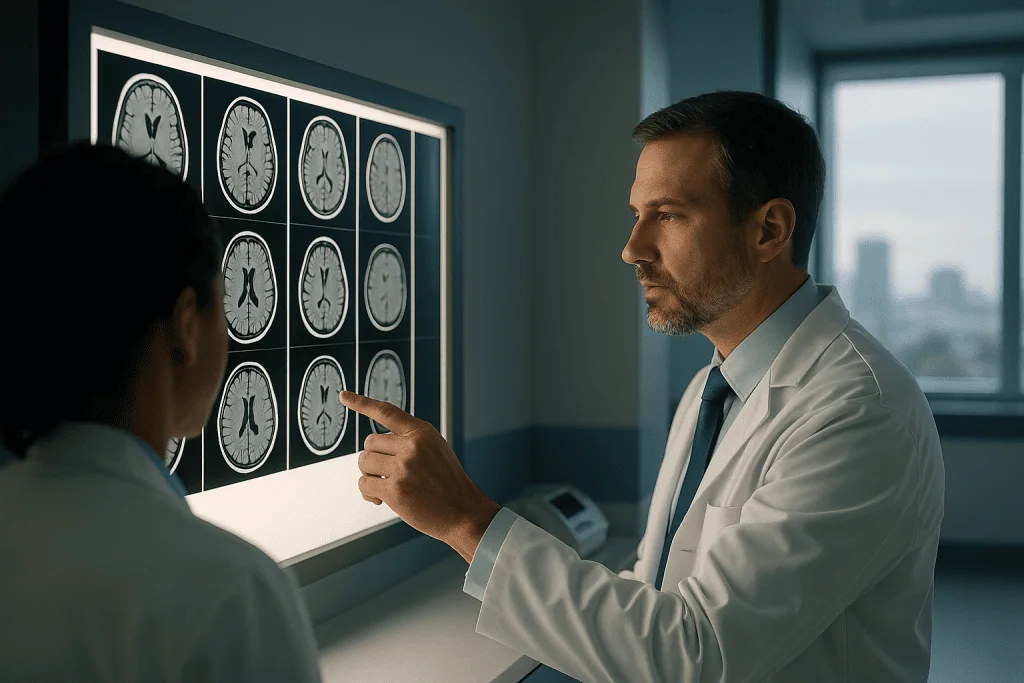
- Magnetic resonance imaging (MRI)an MRI scan uses magnetic fields to create detailed pictures of the brain and spinal cord. It is the most important imaging test for multiple sclerosis, because it can show areas of myelin damage (lesions). A contrast dye is sometimes injected to help show which lesions are new or active.
- Lumbar puncture (spinal tap)in this procedure, a small sample of the fluid surrounding the spinal cord (cerebrospinal fluid) is taken with a thin needle from the lower back. The fluid is examined for signs of immune activity, such as proteins called oligoclonal bands, which are found in many people with multiple sclerosis.
- Evoked potential teststhese painless tests measure how quickly the nerves carry electrical signals, for example from the eyes to the brain. Slowed signals can reveal damage that is not causing obvious symptoms.
- Blood testsblood tests cannot confirm multiple sclerosis, but they help exclude other conditions with similar symptoms, such as vitamin deficiencies, thyroid problems, infections, and other autoimmune diseases.
To confirm the diagnosis, neurologists apply internationally accepted criteria (known as the McDonald criteria). In simple terms, these require evidence that damage has occurred in more than one area of the central nervous system and at more than one point in time, and that no other condition better explains the findings. Because the diagnosis can be complex, some people need repeated examinations or scans over time before a definite answer is possible.
Treatment options
There is currently no cure for multiple sclerosis, but multiple sclerosis treatment has advanced considerably, and many people can manage the condition effectively for years. Treatment generally has three goals: shortening and easing relapses, reducing the number of future relapses and slowing the buildup of damage, and relieving day-to-day symptoms. Care is usually coordinated by a neurology department, often working together with physical therapists, eye specialists, urologists, and mental health professionals. At Acibadem, for example, the condition is evaluated and managed within the neurology specialty; a general overview of the hospital group’s approach is available on its multiple sclerosis page.
Treating relapses
When a clear relapse causes significant new symptoms, doctors often prescribe a short course of high-dose corticosteroids, anti-inflammatory medicines given by vein or by mouth. Steroids can help symptoms settle more quickly, although they do not change the long-term course of the disease. In some cases where steroids do not help, a procedure called plasma exchange (plasmapheresis) may be considered; this filters certain immune components out of the blood.
Disease-modifying therapies
Disease-modifying therapies (often abbreviated DMTs) are medicines designed to reduce how often relapses occur and to slow the development of new lesions and disability. They work by calming or redirecting the immune system. There are many options, including regular injections, tablets, and infusions given in a clinic. The choice depends on the type and activity of the disease, other health conditions, family planning, lifestyle, and personal preference, and it involves weighing benefits against possible side effects such as increased infection risk. Most current therapies work best for relapsing forms of multiple sclerosis; options for progressive forms are more limited, although some are available. People taking these medicines need regular monitoring with blood tests and MRI scans.
Watchful waiting and monitoring
In a small number of situations, for example, when disease activity appears very mild or the diagnosis is not yet certain: a neurologist may recommend careful monitoring with periodic MRI scans before starting long-term medication. This is a deliberate medical strategy, not neglect, and the plan is revisited if the picture changes. In many cases, however, doctors now favor starting effective treatment early, because damage prevented is generally better than damage treated later.
Managing symptoms
Alongside disease-modifying therapy, treatment focuses on the symptoms that affect daily life. This may include:
- Medications for muscle stiffness, nerve pain, bladder problems, fatigue, and depression.
- Physical therapy and rehabilitation to maintain strength, balance, and mobility, and to learn strategies and aids that make daily tasks easier.
- Occupational therapy to adapt work and home routines.
- Psychological support, since mood changes are common and treatable.
What about surgery?
Surgery is not a treatment for multiple sclerosis itself. Occasionally, procedures may be used for specific complications, for example, an implanted pump to deliver muscle-relaxing medicine for severe spasticity, or procedures for certain types of facial nerve pain, but these are decisions made case by case with a specialist team.
Lifestyle measures
Although lifestyle changes do not replace medical treatment, doctors often recommend not smoking, staying physically active within your abilities, maintaining a balanced diet, correcting low vitamin D under medical guidance, managing heat exposure, and keeping vaccinations up to date as advised by your care team.
Living with multiple sclerosis and outlook
Multiple sclerosis is a lifelong condition, but it is rarely fatal in itself, and life expectancy for most people is only modestly affected, particularly with modern care. The course of the disease is difficult to predict for any individual. Some people experience mild disease for decades; others develop significant disability over time. Early diagnosis, appropriate disease-modifying treatment, and regular follow-up are generally associated with better long-term outcomes, although no treatment can guarantee a particular result.
Many people with multiple sclerosis continue to work, raise families, travel, and stay active, often with adjustments along the way. Practical steps that often help include pacing activities to manage fatigue, planning around heat sensitivity, building a relationship with a consistent neurology team, and seeking support for mood changes early. Pregnancy is possible for most women with multiple sclerosis, but medication plans usually need to be reviewed before conception, so it is important to discuss family planning with your neurologist in advance.
Living well with the condition is usually a matter of ongoing partnership between you and your medical team: monitoring the disease, adjusting treatment when needed, and addressing new symptoms as they arise rather than waiting for them to become severe.
Frequently asked questions
What is multiple sclerosis in simple terms?
Multiple sclerosis is a condition in which the immune system damages the protective coating (myelin) around nerves in the brain and spinal cord. This disrupts the signals traveling along those nerves, causing symptoms such as vision problems, numbness, weakness, and fatigue. The damage occurs in multiple places and often at different times, which is where the name comes from.
Can multiple sclerosis be cured or heal on its own?
There is currently no cure for multiple sclerosis, and the underlying condition does not heal on its own. However, individual relapses often improve partly or fully as inflammation settles, and modern disease-modifying therapies can substantially reduce relapses and slow progression in many people. Research into repairing myelin and stopping the disease is ongoing.
How serious is multiple sclerosis?
Seriousness varies greatly from person to person. Some people have mild disease with long stable periods, while others develop meaningful disability over the years. Multiple sclerosis itself is rarely a direct cause of death, and with current treatments many people maintain a good quality of life for a long time. Your neurologist can discuss what your own test results and disease pattern suggest, though no one can predict the future course with certainty.
What are the first symptoms of multiple sclerosis?
Early multiple sclerosis symptoms often include blurred or painful vision in one eye, numbness or tingling in a limb or the face, unusual fatigue, dizziness, or problems with balance. These symptoms typically develop over days rather than seconds and may improve after some weeks. Because many other conditions cause similar problems, a medical evaluation is needed to find the cause.
How is multiple sclerosis diagnosed?
Doctors combine your symptom history, a neurological examination, MRI scans of the brain and spinal cord, and often a lumbar puncture and evoked potential tests. A diagnosis requires evidence of nerve damage in more than one location and at more than one time, once other explanations have been excluded. Sometimes repeat scans over months are needed before the diagnosis is certain.
Is multiple sclerosis hereditary?
Multiple sclerosis is not passed down in a simple, predictable way like some genetic diseases. Having a parent or sibling with the condition increases risk somewhat, but the large majority of children of people with multiple sclerosis never develop it. Genes appear to create susceptibility, while environmental factors such as viral infection, vitamin D levels, and smoking also play roles.
Can people recover after a multiple sclerosis relapse?
Many people recover well after a relapse, especially early in the disease, as inflammation subsides and the nervous system partly compensates. Recovery may be complete or partial, and it can take weeks to months. Steroid treatment can speed improvement in significant relapses, and rehabilitation can help restore function. Some symptoms may persist, which is one reason doctors aim to prevent relapses with long-term therapy.
When to see a doctor
See a doctor promptly if you develop new neurological symptoms that last more than a day or two, especially if they appear without an obvious cause. If you already have a multiple sclerosis diagnosis, contact your care team when new or worsening symptoms persist beyond 24 to 48 hours, since this could indicate a relapse that may benefit from treatment.
Seek urgent medical attention if you experience any of the following red-flag warning signs:
- Sudden loss of vision or severe eye pain, particularly in one eye.
- Sudden weakness, numbness, or paralysis of the face, an arm, or a leg, especially on one side of the body, as this can also signal a stroke, which is a medical emergency.
- Sudden difficulty speaking, understanding speech, or swallowing.
- Inability to urinate or complete loss of bladder or bowel control.
- Severe, rapidly worsening balance problems or inability to walk.
- High fever with a marked worsening of neurological symptoms, which may indicate an infection that needs treatment.
- Thoughts of self-harm or overwhelming depression, which require immediate support.
Even when symptoms are less dramatic, do not wait for them to become severe. Early evaluation by a neurologist gives the best chance of an accurate diagnosis and, where needed, timely multiple sclerosis treatment.
Medically reviewed by the Acıbadem International Medical Board September 2, 2026
See our medical review board →
Update history
- PublishedJune 14, 2026
- Medical review approvedSeptember 2, 2026
- Last content updateSeptember 2, 2026