Optic Neuritis
Optic Neuritis is inflammation of the optic nerve causing eye pain and vision changes. Learn symptoms, causes, diagnosis and treatment.
Quick answer
Optic neuritis is inflammation of the optic nerve that can cause eye pain, blurred vision, and sudden vision loss, often linked to infections, autoimmune conditions, or disorders such as multiple sclerosis. At Acibadem in Turkey, evaluation focuses on identifying the underlying cause with ophthalmic and neurologic assessment, and treatment may include corticosteroids and care for the associated condition.
What is optic neuritis?
Optic neuritis is inflammation of the optic nerve, the cable of nerve fibers that carries visual information from the eye to the brain. When this nerve becomes inflamed, the protective coating around the nerve fibers, a fatty layer called myelin, can be damaged, and the signals traveling along the nerve are slowed or disrupted. The result is usually a sudden or rapidly developing loss of vision in one eye, often accompanied by pain when moving the eye.
To answer the common question “what is optic neuritis” in the simplest terms: it is a condition in which the nerve of sight becomes swollen and irritated, temporarily, and sometimes permanently, interfering with how well the eye can see. It most often affects one eye at a time, although in some cases both eyes can be involved.
Optic neuritis most commonly occurs in adults between roughly 20 and 45 years of age, and it affects women more often than men. It is one of the more frequent causes of sudden vision loss in younger adults. Children can also develop optic neuritis, although the pattern of the disease in children can differ somewhat from that seen in adults. The condition is closely linked to certain diseases of the immune system, most notably multiple sclerosis, which is why an episode of optic neuritis often prompts doctors to look carefully at the brain and nervous system as a whole.
Symptoms of optic neuritis
Optic neuritis symptoms usually develop over hours to a few days, rather than over weeks or months. In many cases the person notices that vision in one eye has become blurred, dim, or “washed out,” and that moving the eye is uncomfortable or painful. The most frequently reported optic neuritis symptoms include:
- Vision loss in one eyethis can range from mild blurring to severe loss of sight, and it typically worsens over a few days before stabilizing.
- Pain with eye movementa dull ache behind or around the eye that becomes worse when looking side to side or up and down. This is one of the most characteristic features.
- Loss of color visioncolors, especially red, may look faded, gray, or “washed out” in the affected eye. Doctors call this dyschromatopsia.
- A dim or dark patch in the visual fieldoften in the center of vision (a central scotoma), although other patterns of visual field loss can occur.
- Flashing or flickering lightssome people describe brief flashes of light (photopsias), particularly with eye movement.
- Worsening of vision with heat or exercisea temporary dimming of vision after a hot shower, exercise, or fever. This is known as Uhthoff phenomenon and reflects how heat affects damaged nerve fibers.
The pattern of symptoms can vary by stage. In the acute stagethe first days of the episode, pain and progressive dimming of vision dominate. Vision often reaches its lowest point within one to two weeks. In the recovery stage, which usually begins within a few weeks, vision gradually improves in many people, although subtle problems with color perception, contrast (the ability to distinguish shades), and depth perception may linger even after standard eye-chart vision returns to normal.
Symptoms can also differ by underlying type. Optic neuritis associated with multiple sclerosis is typically one-sided, painful, and tends to recover well. Optic neuritis linked to other immune conditions, such as neuromyelitis optica spectrum disorder (an immune disease that targets the optic nerves and spinal cord) or MOG antibody–associated disease (an immune reaction against a protein on the myelin coating), may involve both eyes, cause more severe vision loss, or recur, and it may recover less completely without prompt treatment. These distinctions matter for treatment decisions, which is one reason careful diagnosis is important.
Causes and risk factors
In most cases, optic neuritis causes trace back to the immune system mistakenly attacking the myelin that insulates the optic nerve. Why this happens in a particular person is often not fully understood. Recognized causes and associations include:
- Multiple sclerosis (MS)a disease in which the immune system attacks myelin in the brain and spinal cord. Optic neuritis is often the first noticeable sign of MS, and people who have had an episode of optic neuritis carry an increased long-term risk of developing MS, particularly if brain imaging shows characteristic lesions.
- Neuromyelitis optica spectrum disorder (NMOSD)an immune condition that preferentially damages the optic nerves and spinal cord and is associated with a specific antibody (aquaporin-4) in the blood.
- MOG antibody–associated disease (MOGAD)a more recently recognized immune condition defined by antibodies against myelin oligodendrocyte glycoprotein, a protein on the surface of myelin.
- Infectionscertain viral or bacterial infections, such as Lyme disease, syphilis, or viral illnesses, can occasionally trigger inflammation of the optic nerve, either directly or through the immune response.
- Other inflammatory diseasesconditions such as sarcoidosis (an inflammatory disease that can affect many organs) or lupus can sometimes involve the optic nerve.
- Certain medications and toxinsrarely, some drugs have been associated with optic nerve inflammation.
In a significant proportion of cases, no underlying disease is ever identified; doctors then describe the episode as idiopathic, meaning of unknown cause.
Risk factors include age (young adulthood), female sex, and a personal or family history of autoimmune disease. Geographic and genetic factors that influence the risk of multiple sclerosis, for example, living farther from the equator, are also thought to influence the likelihood of optic neuritis, since the two conditions are so closely linked.
Diagnosis
Optic neuritis diagnosis is primarily clinical, meaning it rests on the pattern of symptoms and the findings of a careful eye and neurological examination, supported by imaging and laboratory tests. A typical evaluation may include:
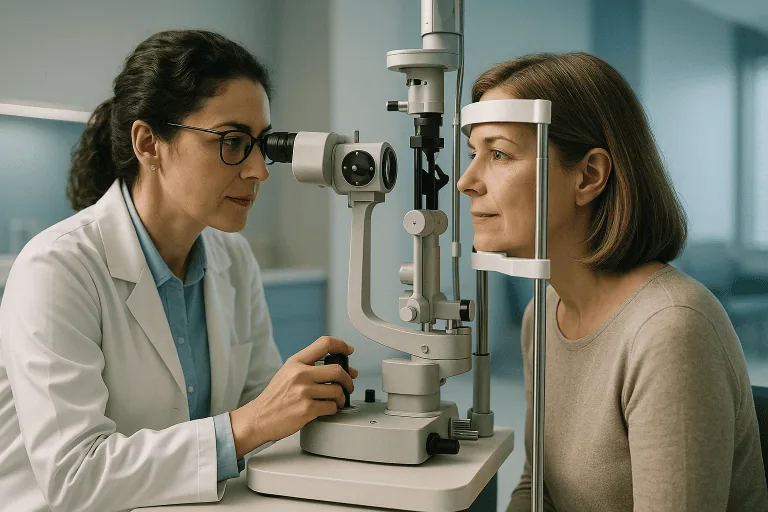
- Detailed eye examinationan ophthalmologist (a physician specializing in eye disease) checks visual acuity (sharpness of vision on an eye chart), color vision, and the visual field, and examines the back of the eye with an ophthalmoscope. In some cases the optic nerve head looks swollen; in many others it appears normal at first because the inflammation lies farther back along the nerve.
- Pupil testinga key finding is a relative afferent pupillary defect (RAPD), in which the pupil of the affected eye reacts less briskly to light than the healthy eye when a light is swung between them. This simple bedside test provides strong evidence that the optic nerve is not conducting signals normally.
- Magnetic resonance imaging (MRI)an MRI scan of the brain and orbits (eye sockets), often with contrast dye, can show inflammation of the optic nerve itself and, importantly, can reveal lesions in the brain that indicate a higher risk of multiple sclerosis or point to another diagnosis. MRI is central to modern management of optic neuritis.
- Optical coherence tomography (OCT)a painless scan that measures the thickness of the nerve fiber layers in the retina. OCT can document swelling in the acute stage and later thinning that reflects permanent nerve fiber loss.
- Blood testsyour doctor may order tests for aquaporin-4 and MOG antibodies, as well as tests for infections and other inflammatory diseases, especially when the picture is severe, affects both eyes, or is otherwise unusual.
- Lumbar puncturein selected cases, a sample of the fluid surrounding the brain and spinal cord (cerebrospinal fluid) is examined for signs of inflammation that support a diagnosis such as multiple sclerosis.
- Visual evoked potentialsa test that measures how quickly electrical signals travel from the eye to the brain; slowed conduction supports optic nerve damage, including past episodes the person may not have noticed.
Part of the diagnostic process is ruling out other causes of sudden vision loss, such as problems with the retina, blockage of the blood vessels supplying the optic nerve (ischemic optic neuropathy), or compression of the nerve by a mass. Features that do not fit the typical picture, such as no pain, no recovery over time, or vision loss in an older adult, usually prompt additional investigation.
Treatment options for optic neuritis
Optic neuritis treatment depends on how severe the vision loss is, what the underlying cause appears to be, and the results of imaging and antibody testing. The main approaches are:
- Observation (watchful waiting)in typical, mild cases, especially when MS-related optic neuritis is suspected, vision often begins to recover on its own within a few weeks. Because of this, some patients and doctors choose careful monitoring without medication, with follow-up examinations to confirm improvement.
- Corticosteroidshigh-dose corticosteroids (powerful anti-inflammatory medicines), usually given intravenously (into a vein) over several days and sometimes followed by a short course of oral steroids, are the standard medical treatment for the acute episode. Evidence suggests that steroids speed up the recovery of vision, although they have not been shown to change the final level of vision reached in typical cases. Steroids can have side effects, such as sleep disturbance, mood changes, stomach irritation, and raised blood sugar, which your doctor will discuss with you.
- Plasma exchange (plasmapheresis)a procedure that filters certain antibodies and inflammatory proteins out of the blood. It may be considered when vision loss is severe and does not respond to steroids, particularly in antibody-mediated forms such as NMOSD or MOGAD.
- Treating the underlying conditionwhen optic neuritis is the first sign of multiple sclerosis, NMOSD, MOGAD, an infection, or another inflammatory disease, long-term treatment is directed at that condition rather than at the optic nerve alone. For example, disease-modifying therapies for MS aim to reduce the risk of future attacks throughout the nervous system, and long-term immune-suppressing treatment is often recommended in NMOSD to prevent relapses. These decisions are usually made together with a neurologist (a physician specializing in the nervous system).
Surgery is not a treatment for optic neuritis. Because the problem is inflammation of a nerve rather than a structural blockage or cataract, there is no operation that can repair the inflamed nerve. Management is medical, and glasses cannot correct vision loss caused by nerve damage, although low-vision aids may help people whose vision does not fully recover.
Care for optic neuritis typically involves close cooperation between eye specialists and neurologists. In hospital settings such as Acibadem, the initial eye evaluation is generally carried out within the ophthalmology department, with referral to neurology when brain imaging or antibody testing points to a wider neurological condition.
Living with optic neuritis and outlook
For many people, the outlook after a single episode of typical optic neuritis is reassuring. Vision often starts to improve within two to four weeks and continues to recover over several months. In many cases, eye-chart vision returns to normal or near normal. However, subtle deficits, reduced contrast sensitivity, slightly faded colors, or dimming of vision in the heat, can persist even when the eye chart looks good, and some people describe the affected eye as never feeling quite the same.
Recovery is less predictable in severe episodes and in antibody-mediated forms such as NMOSD, where permanent vision loss is more common without prompt treatment. Recurrence is also possible: optic neuritis can return in the same eye or affect the other eye, particularly in people with an underlying immune condition.
Living with the aftermath of optic neuritis may involve:
- Regular follow-up with an ophthalmologist and, when indicated, a neurologist, including periodic MRI scans if the risk of multiple sclerosis is being monitored.
- Managing heat sensitivityavoiding overheating, using cooling strategies during exercise, and understanding that heat-related dimming of vision is usually temporary.
- Adjusting to visual changesallowing extra caution with driving, night vision, and tasks requiring fine depth perception until vision has stabilized, and asking about low-vision support if deficits persist.
- Attending to overall healthgeneral measures such as not smoking and maintaining adequate vitamin D are often discussed in the context of MS risk, although your doctor can advise what is relevant in your situation.
No doctor can guarantee a particular outcome after optic neuritis. What can be said honestly is that most typical episodes improve substantially, that early evaluation helps identify the cases that need aggressive treatment, and that ongoing follow-up allows any underlying condition to be found and managed as early as possible.
Frequently asked questions
What is optic neuritis in simple terms?
Optic neuritis is inflammation of the optic nerve, the nerve that connects the eye to the brain. The inflammation damages the nerve’s insulating coating, so visual signals travel poorly. This typically causes blurred or dim vision in one eye, faded colors, and pain when moving the eye. It is most common in young adults and is often linked to immune-system conditions such as multiple sclerosis, although in many cases no underlying cause is found.
Can optic neuritis heal on its own?
In many typical cases, yes, vision often begins to improve within a few weeks even without treatment, and recovery continues over several months. This is why observation alone is a reasonable option in some mild cases. However, steroids can speed up recovery, and severe or antibody-mediated forms may need prompt, more intensive treatment to protect vision. Only a doctor who has examined you can advise which approach is appropriate.
How serious is optic neuritis?
The seriousness varies. A single, typical episode often recovers well, and many people regain normal or near-normal vision. That said, optic neuritis can be the first sign of a broader neurological condition such as multiple sclerosis or neuromyelitis optica spectrum disorder, and severe episodes can leave lasting vision loss. For these reasons, every episode of suspected optic neuritis deserves a thorough medical evaluation, including brain imaging in most cases.
What do optic neuritis symptoms feel like at the start?
Most people first notice that vision in one eye has become blurred, dim, or gray over hours to a few days, often together with an ache behind the eye that worsens with eye movement. Colors, especially red, may look washed out, and there may be a dark or blurry patch in the center of vision. Some people also notice brief flashes of light or that vision dims temporarily after exercise or a hot shower.
Does optic neuritis always mean I have multiple sclerosis?
No. Optic neuritis is strongly associated with multiple sclerosis, and an episode does increase the long-term risk, particularly when an MRI of the brain shows characteristic lesions. But many people who have optic neuritis never develop MS, and the condition can also be caused by other immune diseases, infections, or remain unexplained. MRI and antibody testing help your doctors estimate your individual risk and plan follow-up.
How long does recovery from optic neuritis take?
Vision usually reaches its worst point within about one to two weeks and then, in many cases, begins to improve within two to four weeks. Most of the recovery typically occurs over the first few months, though gradual improvement can continue for up to a year. Some people are left with subtle changes in color or contrast perception even after their eye-chart vision returns to normal. Recovery timelines vary from person to person and depend on the underlying cause.
What is the standard optic neuritis treatment?
The standard acute treatment is a course of high-dose intravenous corticosteroids, which reduce inflammation and often shorten the recovery period, though they may not change the final visual outcome in typical cases. In severe episodes that do not respond to steroids, plasma exchange may be considered. Long-term treatment, when needed, targets the underlying condition, for example, disease-modifying therapy for multiple sclerosis or immune-suppressing treatment for NMOSD. There is no surgical treatment for optic neuritis.
When to see a doctor
Sudden changes in vision should never be ignored, because several serious conditions, not only optic neuritis, can cause them, and some require urgent treatment. Seek prompt medical attention, ideally the same day, if you notice:
- Sudden loss or dimming of vision in one or both eyes, even if it seems mild or partial.
- Eye pain, especially pain that worsens when you move the eye.
- Colors that suddenly look faded or gray in one eye compared with the other.
- A new blind spot or dark patch in your field of vision.
- Vision loss accompanied by other neurological symptoms, such as numbness, weakness, difficulty walking, double vision, or problems with bladder control: these may signal involvement of the brain or spinal cord and need urgent assessment.
- Worsening vision during or after treatment for a previously diagnosed episode of optic neuritis.
- A previous episode of optic neuritis and new visual symptoms in either eye, which may indicate a recurrence.
Early evaluation allows doctors to confirm the diagnosis, rule out other causes of vision loss, begin treatment when it is needed, and identify any underlying condition at the earliest possible stage. If your vision changes suddenly and no eye specialist is immediately available, an emergency department can arrange the urgent assessments required.
Medically reviewed by the Acıbadem International Medical Board September 3, 2026
See our medical review board →
Update history
- PublishedJune 8, 2026
- Medical review approvedSeptember 3, 2026
- Last content updateSeptember 2, 2026