Parkinson Disease
Learn what Parkinson disease is, its common symptoms and causes, how doctors diagnose it, and the treatment options that may help manage symptoms.
Quick answer
Parkinson disease is a slowly progressive brain condition in which nerve cells that produce dopamine gradually die, causing tremor, slowness of movement, stiffness and balance problems, often with sleep, mood and digestive changes. It usually appears after age 60. There is no cure, but medication, rehabilitation and, for some, surgery can control symptoms for many years.
What is Parkinson disease?
Parkinson disease is a long-term, slowly progressive condition of the brain that mainly affects movement. It develops when nerve cells in a part of the brain called the substantia nigra (a small area deep in the brain) gradually stop working or die. These cells normally produce dopamine, a chemical messenger that helps the brain control smooth, coordinated movement. As dopamine levels fall, movements become slower, stiffer and harder to start, and a tremor (rhythmic shaking) often appears.
Parkinson disease is one of the most common neurodegenerative disorders, meaning conditions in which nerve cells break down over time. It is usually diagnosed in people over the age of 60, although a smaller number of people develop symptoms before 50, which is often called young-onset Parkinson disease. Men are diagnosed somewhat more often than women. The condition is chronic, which means it lasts for life, but it progresses at very different speeds in different people, and many people live for many years with a good quality of life while managing their symptoms.
Parkinson disease is often grouped with related conditions under the broader term parkinsonism, which describes the combination of slowness, stiffness and tremor from any cause. Not everyone with parkinsonism has Parkinson disease, which is one reason careful assessment by a neurologist (a doctor who specializes in the brain and nervous system) is important.
Parkinson disease symptoms
Parkinson disease symptoms usually start gradually and often on one side of the body before spreading to the other. Early signs can be subtle and are sometimes mistaken for normal aging. The main movement-related (motor) symptoms are:
- Tremor: shaking that typically begins in a hand, finger or thumb and is most noticeable when the limb is at rest. A classic form is called a pill-rolling tremor, where the thumb and forefinger rub together.
- Bradykinesia: the medical term for slowness of movement. Tasks such as buttoning a shirt, getting out of a chair or walking may take longer and feel effortful.
- Rigidity: stiffness in the arms, legs or trunk that can limit range of motion and cause aching muscles.
- Postural instability: problems with balance and posture that can lead to a stooped stance and, in later stages, a higher risk of falls.
- Changes in walking: shorter, shuffling steps, reduced arm swing, and sometimes a feeling of the feet being stuck to the floor, known as freezing.
- Reduced facial expression: sometimes described as a masked face, along with less frequent blinking.
- Small handwriting: writing that becomes cramped and smaller over the course of a sentence (micrographia).
- Soft or monotone speech: a quieter voice that may lose its normal rhythm and emphasis.
Many people also experience non-motor symptoms, which are not related to movement but can affect daily life just as much. These may include loss of sense of smell, constipation, sleep problems such as acting out dreams during sleep, depression, anxiety, fatigue, dizziness on standing, urinary urgency, pain, and, especially in later years, difficulties with memory and thinking. Some of these non-motor symptoms can appear years before movement problems are noticed.
Doctors sometimes describe Parkinson disease in stages. In early stages, symptoms are usually mild and affect one side of the body, with little effect on daily activities. In middle stages, both sides are affected, balance may become a concern and daily tasks take more effort. In advanced stages, walking without support may become difficult and more help with daily care is often needed. Progression through these stages is highly individual, and many people remain in the earlier stages for a long time.
Causes and risk factors
The exact Parkinson disease causes are not fully understood. What is known is that dopamine-producing nerve cells are lost and that many of the remaining cells contain abnormal clumps of a protein called alpha-synuclein, known as Lewy bodies. Why this happens in a particular person is usually unclear, and researchers believe it results from a combination of genetic and environmental factors rather than a single cause.
- Age: risk rises with increasing age, and most people are diagnosed after 60.
- Genetics: in a minority of cases, particularly with young-onset disease or a strong family history, specific inherited gene changes play a role. Having a close relative with Parkinson disease modestly increases risk, but most people with the condition have no affected family members.
- Sex: men appear to be affected more often than women.
- Environmental exposures: long-term exposure to certain pesticides, herbicides and some industrial chemicals has been associated with a higher risk in population studies, though this does not mean exposure alone causes the disease.
- Head injury: a history of repeated or significant head trauma has been linked with increased risk in some studies.
It is important to distinguish Parkinson disease from other forms of parkinsonism. Certain medications, particularly some antipsychotic and anti-nausea drugs, can cause temporary Parkinson-like symptoms that improve when the drug is stopped. Repeated small strokes, other neurodegenerative disorders and, rarely, brain tumors or fluid buildup in the brain can also produce similar symptoms. Sorting out these possibilities is a central part of the diagnostic process.
Parkinson disease diagnosis
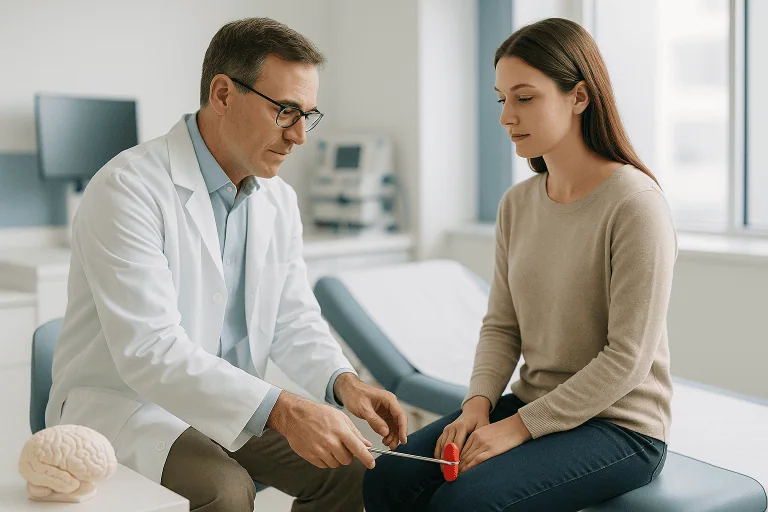
There is no single blood test or scan that confirms Parkinson disease in routine practice. Parkinson disease diagnosis is primarily clinical, meaning it is based on a doctor’s careful history and physical examination, usually performed by a neurologist. The doctor will ask when symptoms started, how they have changed, which side of the body is affected, and what medications you take. They will then look for the core features of the condition, especially slowness of movement together with tremor and/or rigidity, and may watch you walk, rise from a chair, tap your fingers and write.
Doctors often use established clinical criteria, such as those published by international movement disorder societies, to guide the diagnosis. These criteria list supportive features, such as a clear and sustained improvement with dopamine medication, and warning features that suggest a different diagnosis, such as very early and severe balance problems or lack of response to treatment.
Tests are used mainly to rule out other conditions rather than to prove Parkinson disease:
- Neurological examination: the cornerstone of diagnosis, assessing movement, reflexes, coordination, balance and eye movements.
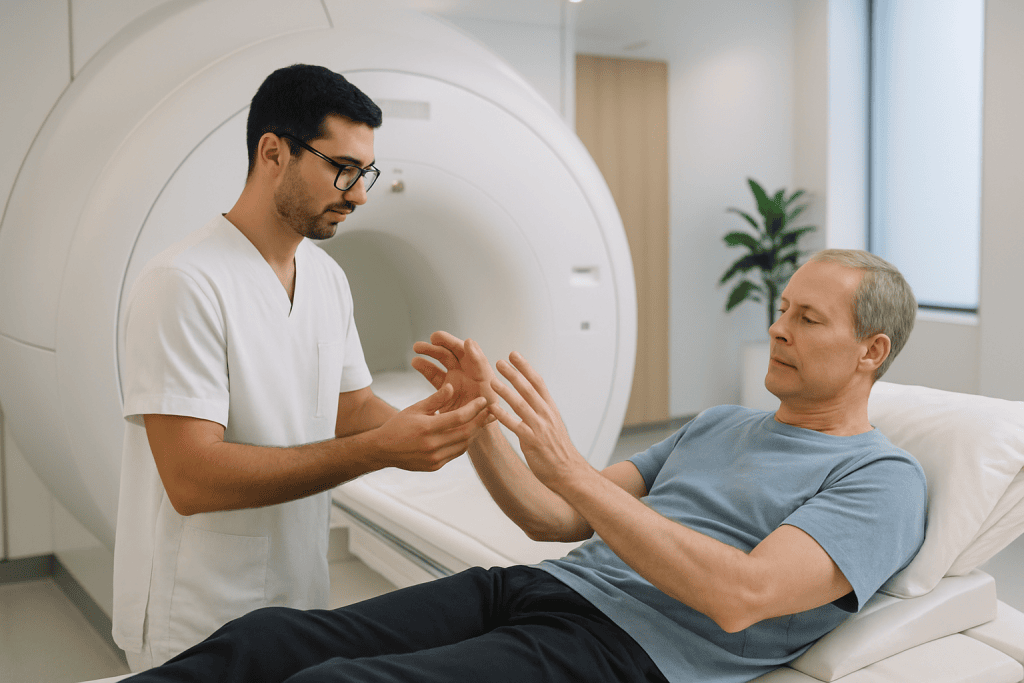
- MRI scan of the brain: usually normal in Parkinson disease, but helpful for detecting strokes, tumors or other structural causes of parkinsonism.
- Dopamine transporter (DaT) imaging: a specialized nuclear medicine scan that shows how well dopamine-producing nerve endings are working. It can help separate Parkinson disease from conditions such as essential tremor, but it cannot distinguish Parkinson disease from some other degenerative forms of parkinsonism.
- Response to levodopa: in some cases, a trial of dopamine medication is used; a clear improvement supports the diagnosis.
- Blood tests: may be ordered to check for thyroid problems, liver disease or other conditions that can mimic symptoms.
- Genetic testing: occasionally offered, particularly in young-onset disease or where several family members are affected.
Because early symptoms can be subtle and can overlap with other disorders, it is not unusual for the diagnosis to be revisited over time. Follow-up visits allow the doctor to see how symptoms evolve and how well they respond to treatment, which often clarifies the picture. In many hospitals, including Acibadem, Parkinson disease is assessed and managed within the Neurology department, often together with rehabilitation specialists.
Parkinson disease treatment options
There is currently no cure for Parkinson disease and no treatment has been proven to stop the underlying loss of nerve cells. However, a range of Parkinson disease treatment options can reduce symptoms, improve function and support independence for many years. Treatment is tailored to the individual, taking into account age, symptom severity, other health conditions and personal priorities, and it is adjusted as the condition changes.
Observation and lifestyle measures
When symptoms are very mild and not interfering with daily life, some people and their doctors choose to monitor the condition before starting medication. Regular physical activity is encouraged at every stage; exercise such as walking, cycling, swimming, dancing or tai chi may help maintain mobility, balance and mood. A healthy diet with adequate fluids and fiber can help with constipation, and good sleep habits are important.
Medication
Medication is the main treatment for most people. The options work in different ways to increase dopamine activity or to compensate for its loss:
- Levodopa: the most effective and widely used medicine. It is converted into dopamine in the brain and is usually combined with a second drug (carbidopa or benserazide) that reduces nausea and allows more levodopa to reach the brain. Over years of use, some people develop wearing-off (symptoms returning before the next dose) or dyskinesia (involuntary writhing movements), which the doctor may manage by adjusting doses or adding other medicines.
- Dopamine agonists: drugs that mimic dopamine’s action. They may be used alone in earlier disease or alongside levodopa. Side effects can include sleepiness, swelling, hallucinations and, in some people, impulse-control problems such as compulsive gambling or shopping, which should always be reported to the doctor.
- MAO-B inhibitors and COMT inhibitors: medicines that slow the breakdown of dopamine or levodopa, helping doses last longer.
- Amantadine: sometimes used to reduce dyskinesia or mild symptoms.
- Anticholinergics: occasionally used for tremor in younger people, but often avoided in older adults because of side effects on memory and bladder.
Medications for non-motor symptoms, such as antidepressants, sleep aids, bowel medications or drugs for low blood pressure on standing, may also be part of the plan. Any medicine changes should be made with the treating doctor, because stopping Parkinson drugs suddenly can be harmful.
Advanced therapies and surgery
When medication no longer controls symptoms smoothly, more advanced approaches may be considered:
- Deep brain stimulation (DBS): a surgical procedure in which thin electrodes are placed in specific movement-control areas of the brain and connected to a small device implanted under the skin of the chest, similar to a pacemaker. Electrical pulses help reduce tremor, stiffness and medication fluctuations in carefully selected people. It does not cure the disease or halt progression, and it carries surgical risks, so thorough assessment is needed.
- Continuous drug delivery: such as a pump that delivers levodopa gel directly into the small intestine or a pump giving a dopamine agonist under the skin, aimed at providing steadier symptom control.
- Focused ultrasound: a non-incision procedure that targets a small area of brain tissue to reduce tremor on one side, available in some centers for selected patients.
Rehabilitation and supportive care
Physical therapy can help with walking, balance, posture and preventing falls. Occupational therapy addresses everyday tasks such as dressing, eating and writing, and may suggest home adaptations. Speech and language therapy can improve voice volume and clarity and help with swallowing difficulties, which are common in later stages. Dietitians, psychologists, social workers and specialist nurses often form part of the wider care team. Support for family members and caregivers is also an important part of long-term care.
Living with Parkinson disease and outlook
Parkinson disease is a lifelong condition, but it is not in itself considered a fatal disease, and many people live for decades after diagnosis. The speed of progression varies widely and cannot be predicted precisely for an individual. In general, people whose main symptom is tremor tend to progress more slowly than those with early prominent balance and walking problems. Non-motor symptoms, such as cognitive changes, falls and swallowing difficulties, tend to have the greatest impact on quality of life in advanced disease.
Regular follow-up with a neurologist allows medication to be fine-tuned as needs change. Staying physically active, keeping socially engaged, addressing mood and sleep problems early, and planning ahead for practical matters such as work, driving and home safety can all help people maintain independence. Many people find it helpful to connect with patient organizations and support groups. Research into treatments that might slow or modify the disease is ongoing, but at present no such treatment is established.
Frequently asked questions
What is Parkinson disease in simple terms?
Parkinson disease is a brain condition in which the cells that make dopamine, a chemical needed for smooth movement, gradually die. This leads to tremor, slowness, stiffness and balance problems, along with symptoms such as sleep changes, constipation and mood changes. It progresses slowly, usually over many years, and its course differs from person to person.
What are the first Parkinson disease symptoms people notice?
The first sign is often a slight tremor in one hand at rest, or a feeling that one arm or leg is stiff or slow. Family members may notice reduced facial expression, a quieter voice, smaller handwriting or a slight drag of one foot. Loss of smell, constipation and vivid, physically active dreams can occur years earlier but are easy to overlook.
What are the main Parkinson disease causes?
The precise cause is unknown in most people. It is thought to involve a mix of genetic susceptibility and environmental factors, leading to the loss of dopamine-producing nerve cells and the buildup of abnormal alpha-synuclein protein. Only a small proportion of cases are linked to a single inherited gene change. Age is the strongest known risk factor.
How is a Parkinson disease diagnosis confirmed?
Diagnosis rests mainly on a neurologist’s examination and clinical criteria, looking for slowness of movement together with tremor or rigidity. Brain MRI may be used to rule out other causes, and a specialized DaT scan can support the diagnosis in uncertain cases. A good response to levodopa medication also supports it. The diagnosis may be reviewed over time as symptoms evolve.
What are the Parkinson disease treatment options if medication stops working well?
When medicines cause fluctuating control or involuntary movements, doctors may adjust doses, add other drug classes or consider advanced therapies such as deep brain stimulation, continuous levodopa or dopamine agonist infusion, or focused ultrasound for tremor. These options suit only some people and require careful assessment. Rehabilitation therapies remain important at every stage.
Is Parkinson disease hereditary?
In most cases it is not directly inherited. Having a parent or sibling with the condition modestly raises risk, and a minority of families carry specific gene changes that increase the likelihood of disease, particularly when symptoms begin at a young age. Genetic counseling may be offered in these situations, but for most people no genetic cause is found.
Can Parkinson disease be cured or prevented?
There is currently no cure and no proven way to prevent Parkinson disease. Treatments can control symptoms effectively for many years but do not stop the underlying process. Regular exercise and a healthy lifestyle are associated with better function and are encouraged, though they have not been shown to prevent the condition.
When to see a doctor
Anyone who notices a new tremor, persistent slowness or stiffness, changes in walking, or a combination of these with reduced facial expression or smaller handwriting should arrange an assessment with a doctor, who may refer to a neurologist. Early evaluation helps clarify the cause and allows treatment and support to begin when they can be most helpful. People already diagnosed should attend regular follow-up and report new or worsening symptoms.
Seek urgent medical attention if any of the following occur:
- A fall resulting in a head injury, a suspected fracture or inability to get up.
- Sudden weakness, numbness, facial drooping or slurred speech, which may indicate a stroke rather than Parkinson disease.
- Sudden confusion, severe agitation or hallucinations that are new or rapidly worsening, which can signal infection, medication effects or dehydration.
- High fever with severe muscle stiffness after Parkinson medication has been missed or stopped abruptly, which can be a medical emergency.
- Choking, inability to swallow, or coughing and breathlessness after eating or drinking, which may indicate food or fluid entering the airway.
- Fainting or repeated near-fainting on standing.
- Inability to pass urine or severe abdominal pain with constipation.
- Thoughts of self-harm or severe, worsening depression.
Medically reviewed by the Acıbadem International Medical Board September 9, 2026
See our medical review board →
Update history
- PublishedSeptember 8, 2026
- Medical review approvedSeptember 9, 2026
- Last content updateSeptember 8, 2026