Progressive Supranuclear Palsy
Learn about progressive supranuclear palsy, including early symptoms, possible causes, how doctors diagnose it, current treatment options and outlook.

Quick answer
Progressive supranuclear palsy (PSP) is a rare, progressive brain disorder caused by abnormal tau protein build-up. It typically begins after age 60 and causes balance problems with early backward falls, difficulty moving the eyes up and down, slurred speech, swallowing trouble and thinking changes. There is no cure; treatment focuses on managing symptoms and preventing complications.
What is progressive supranuclear palsy?
Progressive supranuclear palsy (PSP) is a rare brain disorder that gradually affects balance, walking, eye movement, speech, swallowing, mood and thinking. The name describes the condition: it is progressive because symptoms worsen over time, supranuclear because it damages the parts of the brain that sit above the nerve centers (nuclei) controlling eye movement, and palsy because it causes weakness or loss of control of certain movements.
PSP belongs to a group of conditions sometimes called atypical parkinsonian disorders or Parkinson-plus syndromes. Early on it can look very similar to Parkinson’s disease, which is why it is often mistaken for it at first. Unlike Parkinson’s disease, however, PSP tends to cause early falls, problems looking up and down, and a poor or short-lived response to the medications used for Parkinson’s disease.
Progressive supranuclear palsy usually begins in later adult life, most often after the age of 60. It affects men slightly more often than women. It is much less common than Parkinson’s disease and is not considered a hereditary condition in the vast majority of families. At Acibadem hospitals, progressive supranuclear palsy is managed by the Neurology department, often together with rehabilitation specialists, speech and swallowing therapists and other supportive services.
Progressive supranuclear palsy symptoms
Progressive supranuclear palsy symptoms develop slowly and vary from person to person. Many people first notice a change in balance, unexplained falls or a feeling that their eyes are not working properly. Because the earliest signs are subtle, the condition is often not recognized for a year or more after it begins.
Common symptoms include:
- Loss of balance and frequent falls, often backward, sometimes within the first year of the illness
- Difficulty moving the eyes, especially looking down or up; reading, eating and walking downstairs may become hard
- Blurred or double vision, light sensitivity and reduced blinking, which can cause dry or irritated eyes
- A stiff, upright posture and a tendency to lean back rather than stoop forward
- Slow movements and stiffness (bradykinesia and rigidity), similar to Parkinson’s disease
- Slurred, slow or quiet speech (dysarthria)
- Swallowing problems (dysphagia), with coughing or choking on food or liquids
- Changes in mood and behavior, such as apathy (loss of motivation), irritability, impulsiveness or laughing and crying without clear reason
- Slowed thinking, trouble planning, poor judgment and forgetfulness
- A fixed, surprised or worried facial expression, sometimes described as a staring look
- Sleep disturbances and daytime sleepiness
Doctors recognize several patterns, or subtypes, of PSP. The classic form, often called Richardson syndrome, features early falls, eye movement problems and thinking changes. In PSP-parkinsonism, tremor, stiffness and slowness dominate at first and may respond partly to Parkinson’s medication for a time, so the correct diagnosis is often delayed. Less common patterns begin mainly with speech and language problems, with freezing when starting to walk, or with behavior changes that resemble frontotemporal dementia. Over the years, most patterns come to share the same core features.
In later stages, walking without help usually becomes impossible, speech may be very hard to understand, and swallowing difficulties raise the risk of chest infections and poor nutrition. Support from family and health professionals becomes increasingly important at this point.
Causes and risk factors
The exact progressive supranuclear palsy causes are not fully understood. What is known is that PSP involves the abnormal build-up of a protein called tau inside brain cells. Tau normally helps maintain the internal structure of nerve cells. In PSP it clumps into tangles, and the affected cells stop working properly and eventually die. For this reason PSP is classified as a tauopathy, a group of diseases that also includes some forms of frontotemporal dementia.
The damage is concentrated in deep brain regions, including the brainstem, the basal ganglia (structures involved in movement control) and parts of the frontal lobes that support planning and behavior. This distribution explains the combination of movement, eye, speech and thinking problems seen in the condition.
Researchers do not know what triggers the tau protein to misfold in the first place. Current thinking is that a mix of factors may be involved:
- Age: PSP is rare before the age of 40 and becomes more common with advancing age, most often starting in the 60s or later.
- Genetic variation: certain common variations in the gene that produces tau appear to slightly increase susceptibility, but they do not cause the disease on their own. PSP is almost never passed directly from parent to child.
- Environmental factors: some studies have looked at possible exposures, but no environmental cause has been confirmed.
- Random cellular changes: it is possible that the disease begins with chance events in brain cells that accumulate over a lifetime.
Importantly, PSP is not considered contagious, is not caused by lifestyle choices, and is not the result of anything the person or their family did or failed to do.
Progressive supranuclear palsy diagnosis
There is no single blood test or scan that can prove someone has PSP during life. A definite diagnosis can only be made by examining brain tissue after death. In practice, progressive supranuclear palsy diagnosis is a clinical process: a neurologist (a doctor specializing in brain and nerve disorders) combines the person’s story, a detailed physical examination and tests that rule out other conditions.
Steps a doctor may take include:
- Medical history: asking about the timing of falls, eye and vision changes, speech and swallowing difficulties, mood and memory, and the response to any medications already tried.
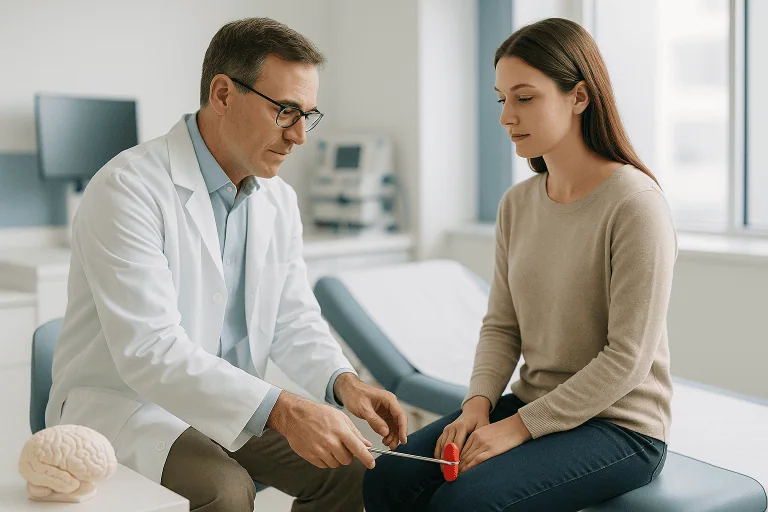
- Neurological examination: checking eye movements carefully, especially the ability to look down voluntarily; testing balance, posture, walking, muscle tone, speech and reflexes.
- Cognitive assessment: brief tests of memory, attention, planning and language.
- Magnetic resonance imaging (MRI): a detailed brain scan. In PSP the midbrain, a small part of the brainstem, is often shrunken, sometimes giving an appearance that radiologists compare to a hummingbird or a morning glory flower. MRI also helps exclude strokes, tumors and fluid build-up in the brain.
- Other imaging: in selected cases, scans that look at dopamine activity or brain metabolism (such as DaTscan or PET) may help distinguish PSP from Parkinson’s disease or other conditions, although they cannot confirm PSP by themselves.
- Blood tests: to rule out thyroid problems, vitamin deficiencies and other treatable causes of similar symptoms.
- Levodopa trial: the doctor may prescribe the main Parkinson’s medication for a period. A weak or absent response supports a diagnosis of PSP rather than Parkinson’s disease.
Neurologists use published clinical criteria that group the findings into levels of certainty, such as “probable” or “possible” PSP. Because the picture evolves, the diagnosis may be revised over time, and it is common for people to receive an initial label of Parkinson’s disease before PSP is recognized. Repeat assessments over months are a normal and expected part of reaching an accurate diagnosis.
Progressive supranuclear palsy treatment options
At present there is no cure for PSP and no treatment that has been proven to slow or stop the underlying disease. Progressive supranuclear palsy treatment therefore focuses on relieving symptoms, preventing complications and helping the person stay as safe, comfortable and independent as possible. Care is usually coordinated by a neurologist working with a wider team.
Medications. Levodopa and related Parkinson’s drugs are often tried. Some people, particularly those with the parkinsonism subtype, gain modest improvement in stiffness and slowness, but the benefit is usually smaller and shorter-lasting than in Parkinson’s disease. Other medications may be considered for specific problems: antidepressants for low mood or apathy, drugs to reduce excessive saliva, medication for sleep difficulties, and treatments for constipation or bladder symptoms. Botulinum toxin injections can help when the eyelids will not open properly (a condition called blepharospasm or eyelid-opening apraxia) or when a muscle is painfully contracted. Every medication carries possible side effects, and doctors generally start with low doses and review regularly.
Physical therapy and occupational therapy. A physical therapist can teach balance strategies, safer ways to turn and stand, and exercises that maintain strength and flexibility. Because falls in PSP are often backward and sudden, a weighted walker or wheelchair may be recommended earlier than in other conditions. An occupational therapist assesses the home for hazards, advises on grab rails, raised toilet seats and adapted utensils, and suggests ways to keep doing valued daily activities.
Speech and swallowing therapy. A speech-language pathologist helps with clearer speech and, when speech becomes very difficult, introduces communication aids ranging from simple alphabet boards to electronic devices. Swallowing assessments, sometimes including a video X-ray of swallowing, guide changes in food texture, drink thickness and eating posture to reduce the risk of choking and aspiration (food or liquid entering the lungs).
Eye and vision care. Prism glasses may partially compensate for the inability to look down. Artificial tears and eyelid care ease dryness caused by reduced blinking. Tinted lenses can help with light sensitivity.
Nutrition and feeding decisions. As swallowing worsens, weight loss and chest infections become a concern. Dietitians can advise on high-calorie, easy-to-swallow foods. At some point the care team may discuss a feeding tube placed through the abdominal wall into the stomach (a PEG tube). This is a personal decision that depends on the person’s wishes, overall condition and goals of care; it does not cure the disease and is not right for everyone.
Procedures and surgery. Deep brain stimulation, a surgical treatment used in some people with Parkinson’s disease, is generally not recommended for PSP because it has not been shown to help and may carry risk. Surgery in PSP is largely limited to supportive measures such as feeding tube placement.
Clinical trials. Several experimental therapies aimed at the tau protein are under investigation. Your doctor may be able to tell you whether a research study is available and suitable. Taking part is voluntary, and experimental treatments are not guaranteed to work.
Palliative care. Palliative care means specialist support focused on comfort and quality of life, and it can be involved at any stage, not only at the end of life. It often runs alongside active treatment and helps with symptom control, emotional support and planning ahead.
Living with progressive supranuclear palsy and outlook
PSP is a serious, life-limiting condition, and it is important to be honest about that. Symptoms steadily progress, and most people eventually need substantial help with walking, eating and daily care. The pace varies: some people decline over a few years, while others remain more stable for longer. Doctors cannot predict an individual’s course with certainty, and general figures quoted online may not apply to any one person.
The most common serious complications are related to falls (head injuries and fractures) and swallowing problems (pneumonia caused by aspiration and malnutrition). Much of the practical care in PSP is aimed at reducing these risks, and doing so can meaningfully improve both safety and quality of life.
Practical steps that many families find helpful include:
- Removing loose rugs and clutter, improving lighting and installing handrails at home
- Using recommended walking aids consistently, even when the person feels steady
- Following swallowing advice closely and allowing extra time for meals
- Keeping a symptom diary to share at appointments
- Planning ahead while the person can still express their wishes, including discussions about future medical decisions and legal arrangements
- Seeking support for caregivers, who often face physical and emotional strain
Patient organizations dedicated to PSP and related conditions offer information, peer support and guidance for caregivers. Emotional changes such as apathy, frustration and depression are part of the illness rather than a personal failing, and they can often be eased with the right support.
Frequently asked questions
What are the first signs of progressive supranuclear palsy?
The earliest sign is often a loss of balance with unexplained falls, frequently backward, that begins within the first year or two. Other early clues include difficulty reading or going downstairs because the eyes will not look down easily, a subtle change in personality such as loss of interest or motivation, slower thinking, and mildly slurred speech. Because these signs overlap with other conditions, a careful neurological assessment is needed rather than self-diagnosis.
How is progressive supranuclear palsy different from Parkinson’s disease?
Both conditions cause stiffness and slowness, but PSP typically leads to early falls, trouble moving the eyes up and down, a backward-leaning posture and earlier changes in thinking and speech. Tremor is less common in PSP. Parkinson’s medication usually helps far less in PSP. The underlying protein is also different: PSP involves tau, whereas Parkinson’s disease involves a protein called alpha-synuclein. These differences are why doctors may revise an initial diagnosis of Parkinson’s disease over time.
What causes progressive supranuclear palsy, and is it inherited?
Progressive supranuclear palsy causes are not fully known. The disease involves abnormal clumps of tau protein that damage brain cells in specific regions. In the great majority of cases PSP is sporadic, meaning it occurs without a family history, and it is very rarely inherited. Certain common genetic variations may slightly raise the risk but do not cause the disease on their own. Genetic testing is not routinely recommended for family members.
How is progressive supranuclear palsy diagnosed?
Progressive supranuclear palsy diagnosis is based on a neurologist’s clinical assessment, especially examination of eye movements, balance and thinking, together with an MRI scan of the brain and blood tests to rule out other causes. Doctors apply internationally used criteria and may observe how symptoms respond to a trial of Parkinson’s medication. There is no single confirmatory test during life, so the diagnosis is sometimes described as probable or possible and may be refined over time.
Is there a cure or effective treatment for progressive supranuclear palsy?
There is currently no cure and no proven way to slow the disease. Progressive supranuclear palsy treatment aims to ease symptoms and prevent complications through medications for specific problems, physical, occupational and speech therapy, swallowing and nutrition support, eye care and, when appropriate, palliative care. Research into treatments that target the tau protein is ongoing, and your doctor may be able to discuss whether a clinical trial is an option.
What is the life expectancy with progressive supranuclear palsy?
PSP shortens life expectancy, and the course is usually measured in years rather than decades from the start of symptoms. However, the rate of progression varies considerably between individuals, and no doctor can give an exact prediction for a particular person. Complications such as pneumonia from swallowing difficulties and injuries from falls are the main risks, and good supportive care may help reduce them.
Can progressive supranuclear palsy be prevented?
There is no known way to prevent PSP, because the trigger for the abnormal tau protein build-up has not been identified. It is not linked to lifestyle choices, and it is not contagious. General measures that support brain and heart health are sensible for everyone, but they have not been shown to prevent this specific condition.
When to see a doctor
Anyone who develops unexplained falls, particularly backward falls, new difficulty looking up or down, changes in speech or swallowing, or a noticeable change in personality or thinking should be assessed by a doctor. Early evaluation helps rule out treatable causes and allows supportive care to start sooner. People who already have a diagnosis of Parkinson’s disease but are not responding to medication or are falling early in their illness should also be reviewed.
Seek urgent medical attention if any of the following occur:
- A fall with a head injury, loss of consciousness, confusion, vomiting or a severe headache afterward
- A fall causing severe pain, inability to bear weight or an obviously deformed limb, which may indicate a fracture
- Choking that does not clear, or difficulty breathing during or after eating
- Signs of a chest infection, such as fever, a new or worsening cough, shortness of breath or increased drowsiness, especially in someone with swallowing problems
- Sudden worsening of confusion or alertness, which can signal infection, dehydration or medication side effects
- Inability to pass urine, or signs of a urinary infection such as burning, fever or new confusion
- Rapid weight loss or refusal to eat and drink over several days
- Sudden new weakness on one side of the body, facial drooping or sudden loss of speech, which may indicate a stroke and needs emergency care
Between routine appointments, any new or rapidly changing symptom should be reported to the care team so that the plan of care can be adjusted.
Medically reviewed by the Acıbadem International Medical Board September 13, 2026
See our medical review board →
Update history
- PublishedSeptember 13, 2026
- Medical review approvedSeptember 13, 2026
- Last content updateSeptember 13, 2026