Subacute Sclerosing Panencephalitis
Subacute sclerosing panencephalitis is a rare brain disorder from persistent measles virus. Learn its symptoms, causes, how doctors diagnose it, and treatment options.
Quick answer
Subacute sclerosing panencephalitis (SSPE) is a rare, progressive brain disorder caused by a persistent measles virus infection that reactivates years after the original illness. It mainly affects children and young adults, causing behavior changes, jerking movements, seizures, and declining function. There is no cure; treatment aims to slow progression and manage symptoms. Measles vaccination prevents it.
What is subacute sclerosing panencephalitis?
Subacute sclerosing panencephalitis (SSPE) is a rare, slowly progressive brain disorder caused by a long-lasting infection with the measles virus. The name describes what happens: “subacute” means the illness develops over months rather than hours or days, “sclerosing” refers to scarring and hardening of brain tissue, and “panencephalitis” means inflammation affecting the whole brain. In SSPE, the measles virus stays hidden in the brain after the original measles illness has passed and, years later, begins to damage nerve cells and the protective coating around them.
SSPE most often appears in children, teenagers, and young adults. The typical pattern is a child who had measles early in life, recovered fully, and then, usually several years later, begins to show changes in behavior, thinking, and movement. Because the condition is rare in countries with high measles vaccination coverage, many families have never heard of it before a diagnosis is made. It is a serious condition: it is progressive, meaning it gets worse over time, and there is currently no cure. However, some treatments may slow the course in certain people, and supportive care can help with comfort and quality of life.
This page explains subacute sclerosing panencephalitis symptoms, causes, diagnosis, and treatment in plain language. It is for general information and is not a substitute for advice from a doctor who knows your or your child’s medical history.
Subacute sclerosing panencephalitis symptoms
Subacute sclerosing panencephalitis symptoms usually begin gradually and are often mistaken at first for a learning problem, a mood change, or an ordinary childhood phase. Doctors commonly describe the illness in four stages, although the speed of change and the exact features vary from person to person.
- Behavior and personality changes, such as irritability, withdrawal, or acting out
- Declining school performance and trouble concentrating or remembering
- Myoclonussudden, brief, jerking movements of the limbs, head, or trunk that often occur in a repeating rhythm
- Seizures of various types
- Clumsiness, falls, and worsening coordination
- Speech difficulties and trouble understanding language
- Vision problems, sometimes from damage to the retina (the light-sensing layer at the back of the eye)
- Stiffness (rigidity) and abnormal posturing of the arms and legs
- Difficulty swallowing and problems with temperature or blood pressure control
- Reduced awareness, progressing toward unresponsiveness in the late stage
How symptoms change by stage
Stage 1 is dominated by mental and behavioral changes. A child may become forgetful, moody, or unusually quiet, and grades may slip. Because there are no obvious physical signs, this stage is frequently overlooked or attributed to other causes.
Stage 2 is when movement problems appear. Myoclonic jerks, which may happen every few seconds, are a hallmark of this stage and often prompt the first neurology referral. Seizures, unsteady walking, and worsening speech are also common.
Stage 3 brings increasing stiffness, loss of voluntary movement, and problems with automatic body functions such as swallowing, sweating, and blood pressure regulation. Awareness of surroundings declines.
Stage 4 is the final stage, in which the person becomes largely unresponsive. In many cases death results from complications such as pneumonia or other infections. The whole course often lasts one to three years, but in some people it is much faster, and in a smaller number it can be slower or may temporarily level off.
Causes and risk factors
The cause of subacute sclerosing panencephalitis is a persistent infection with the measles virus. Under normal circumstances, the immune system clears measles from the body within a few weeks. In SSPE, an altered form of the virus manages to survive inside brain cells. It spreads slowly from cell to cell without triggering the usual immune response that would remove it. Over years, this hidden infection, together with the body’s inflammatory reaction to it, damages neurons (nerve cells) and myelin (the fatty insulation around nerve fibers). Scientists do not fully understand why this happens in a small number of people and not in most, but the following risk factors are widely recognized:
- A history of natural measles infection. SSPE does not occur without prior exposure to wild measles virus.
- Measles at a very young age. Infection before about two years of age, and especially in infancy, carries a higher risk, possibly because the immune system is still immature.
- Being unvaccinated or incompletely vaccinated against measles. Vaccination prevents measles and therefore prevents SSPE.
- Male sex. Boys are affected somewhat more often than girls, though the reason is unclear.
- Living in or coming from an area with ongoing measles transmission.
It is important to understand what does not cause SSPE. The measles vaccine (given alone or as part of the measles, mumps, and rubella vaccine, MMR) uses a weakened virus that has not been shown to cause SSPE. Instead, widespread vaccination is credited with making SSPE rare in many parts of the world. SSPE is also not contagious; a person with SSPE cannot pass it to others, because the virus is confined to the brain.
Subacute sclerosing panencephalitis diagnosis
Subacute sclerosing panencephalitis diagnosis is based on a combination of the clinical picture, a history of measles or likely measles exposure, and specific test results. Because the early symptoms are vague, the diagnosis is often delayed until movement problems appear. Doctors, usually specialists in neurology, typically use the following tools:
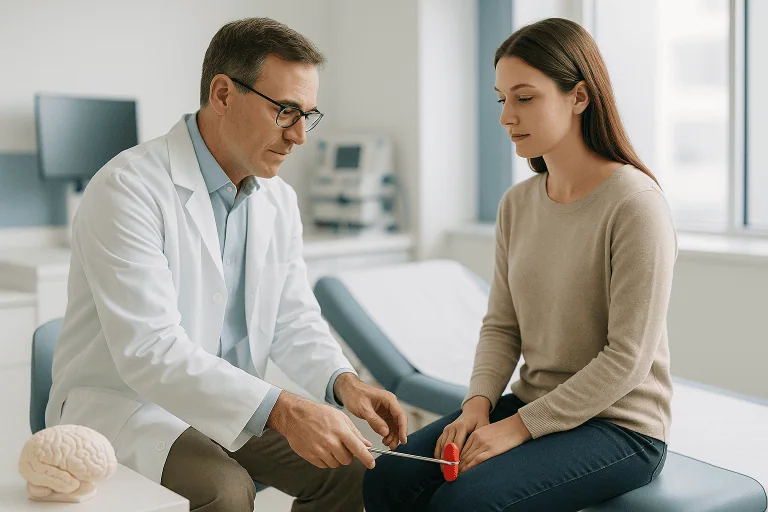
- Medical history and neurological examination. The doctor will ask about past measles infection, vaccination records, the timeline of behavioral and school changes, and any jerking movements or seizures, and will examine reflexes, coordination, and mental function.
- Electroencephalogram (EEG). This painless test records the brain’s electrical activity through small sensors on the scalp. In SSPE, the EEG often shows a distinctive pattern of high-voltage bursts that repeat at regular intervals, frequently timed with the myoclonic jerks. This pattern is one of the most characteristic findings.
- Blood and cerebrospinal fluid antibody tests. Cerebrospinal fluid (CSF) is the clear fluid surrounding the brain and spinal cord, collected by a lumbar puncture (a needle inserted into the lower back, sometimes called a spinal tap). In SSPE, levels of antibodies against measles are unusually high in both blood and CSF, and the ratio between them indicates that the antibodies are being produced inside the nervous system. This is usually the key confirmatory test.
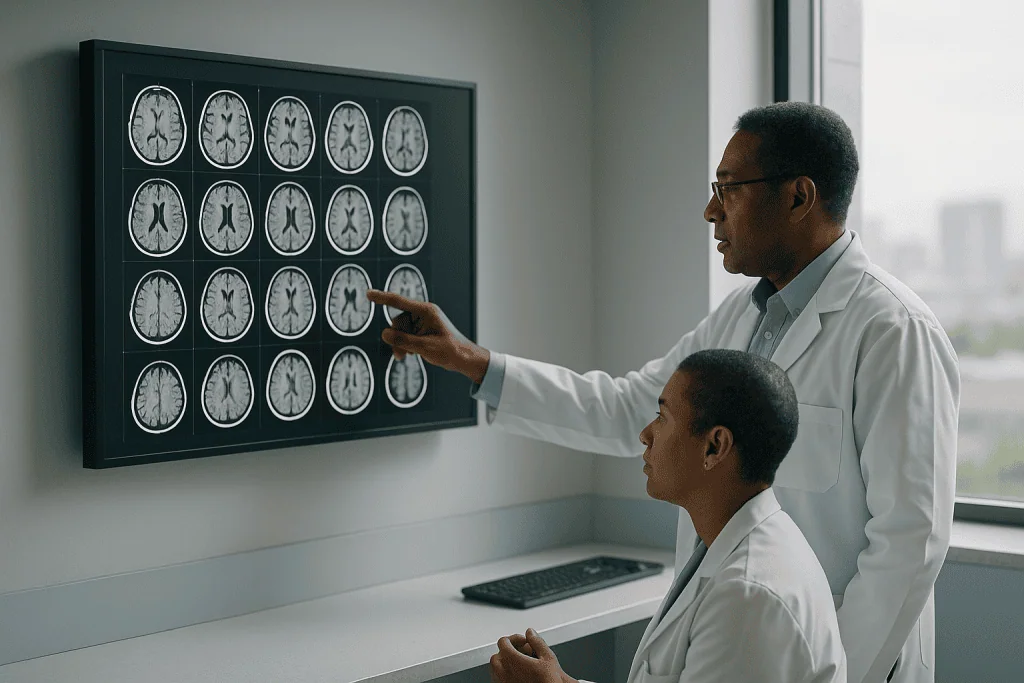
- Magnetic resonance imaging (MRI) of the brain. MRI uses magnets and radio waves to produce detailed pictures. Early in the illness the scan may look normal; later it may show changes in the white matter (the part of the brain rich in myelin) and shrinkage of brain tissue. MRI also helps rule out other causes such as tumors or other infections.
- Eye examination. An ophthalmologist may look for changes in the retina that can accompany SSPE.
- Brain biopsy. Removing a small sample of brain tissue is rarely needed today, because antibody and EEG findings are usually sufficient. It may be considered when results are unclear.
Doctors generally consider the diagnosis confirmed when the typical clinical course is combined with characteristic EEG findings and elevated measles antibodies in the CSF. Other conditions that can look similar, including other forms of encephalitis, metabolic disorders, and certain inherited degenerative diseases, are usually excluded during this process.
Subacute sclerosing panencephalitis treatment options
There is currently no treatment that cures subacute sclerosing panencephalitis or removes the measles virus from the brain. Subacute sclerosing panencephalitis treatment therefore has two main goals: to try to slow the progression of the disease where possible, and to control symptoms and maintain comfort and dignity. Treatment plans are individualized, and your doctor may recommend a combination of the following approaches.
Medications aimed at slowing the disease
Two medicines have been used for many years in an attempt to slow SSPE, alone or together:
- Inosine pranobex (isoprinosine). An oral medicine thought to boost the immune response and interfere with the virus. Some people appear to stabilize or progress more slowly while taking it, but responses vary and it does not work for everyone.
- Interferon alpha. A naturally occurring immune protein given as a medicine. In SSPE it is often delivered directly into the fluid around the brain through a small reservoir placed under the scalp (intraventricular administration), or sometimes by lumbar injection. This requires a minor surgical procedure to place the reservoir and repeated hospital visits.
Other antiviral or immune-modifying drugs, such as ribavirin, have been tried in some centers, and research into newer approaches continues. The evidence for all of these treatments comes largely from small studies and case series rather than large clinical trials, so doctors are honest that benefits are uncertain and that the disease may continue to advance despite treatment. Families are encouraged to discuss expected benefits, side effects, and the burden of treatment with the care team.
Medications to control symptoms
- Anti-seizure medicines are used to reduce seizures and myoclonic jerks. Some medicines in this group are frequently chosen because they may be particularly helpful against the jerks, although the choice depends on the individual.
- Muscle relaxants may ease stiffness and painful spasms in later stages.
- Medicines for agitation, sleep problems, or mood changes may be used with care, especially in the early stage.
- Treatment of infections, particularly chest and urinary infections, which become more common as swallowing and mobility decline.
Supportive and rehabilitative care
As the illness progresses, supportive care becomes the largest part of treatment. This may include physical therapy to keep joints mobile and reduce contractures (permanent tightening of muscles), occupational therapy to help with daily activities for as long as possible, and speech and swallowing therapy. When swallowing becomes unsafe, doctors may discuss a feeding tube placed through the abdominal wall into the stomach to reduce the risk of food entering the lungs. Regular repositioning, skin care, and nutritional support help prevent complications such as pressure sores and malnutrition.
Palliative care
Palliative care is specialized medical care focused on relieving symptoms and stress from a serious illness, at any stage, alongside other treatments. For a condition like SSPE, early involvement of a palliative care team can help manage pain, breathing difficulties, and distress, and can support families in making decisions about care goals. At Acibadem, care for SSPE is coordinated by the neurology department together with pediatric, rehabilitation, and palliative care teams as needed.
Living with subacute sclerosing panencephalitis and outlook
It is important to be honest about the outlook. Subacute sclerosing panencephalitis is considered a fatal disease in the great majority of cases. Most people die within a few years of the first symptoms, often from infections or breathing complications in the late stage. A small proportion experience a slower course, and in rare cases the disease appears to pause for a period, sometimes for years, before progressing again. Doctors cannot reliably predict at diagnosis which course a particular person will follow, and no treatment has been proven to change the outcome consistently.
For families, the diagnosis often comes as a profound shock, particularly because the child had recovered from measles long ago and seemed healthy. Practical support matters: coordinating appointments, learning safe feeding and positioning techniques, arranging equipment for the home, and understanding what to expect at each stage. Many families find it helpful to work with a single care coordinator or nurse specialist, to connect with social workers and counselors, and to seek support from rare-disease or patient organizations where available.
Caregivers often experience exhaustion, grief, and isolation. Respite care, mental health support, and clear conversations with the medical team about goals of care can help. Decisions about hospital admissions, feeding tubes, and resuscitation are deeply personal, and there is no single right answer; the care team’s role is to give clear information so that families can make choices that fit their values.
Frequently asked questions
What is the main cause of subacute sclerosing panencephalitis?
The cause is a persistent measles virus infection in the brain. After a person recovers from measles, an altered form of the virus can remain hidden in brain cells and reactivate years later, causing progressive inflammation and damage. It occurs only in people who previously had natural measles, and having measles in infancy or early childhood increases the risk.
What are the first subacute sclerosing panencephalitis symptoms?
The earliest signs are usually subtle changes in behavior and thinking, such as irritability, forgetfulness, declining school performance, or withdrawal. These can be mistaken for other problems. Movement symptoms, especially repeated jerking movements called myoclonus, typically appear later and are often what leads to a neurology referral.
How is subacute sclerosing panencephalitis diagnosis confirmed?
Doctors combine the clinical history, a neurological examination, an EEG showing a characteristic repeating pattern of electrical bursts, and tests showing unusually high levels of measles antibodies in the blood and cerebrospinal fluid. A brain MRI helps rule out other conditions. A brain biopsy is rarely needed.
Is there a cure or effective subacute sclerosing panencephalitis treatment?
There is no cure. Medicines such as inosine pranobex and interferon alpha may slow the disease in some people, but results vary and the evidence is limited. Treatment also includes anti-seizure medicines, supportive therapies, and palliative care to manage symptoms and maintain comfort. Your doctor can explain what is realistic to expect.
Can the measles vaccine cause SSPE?
The measles vaccine has not been shown to cause subacute sclerosing panencephalitis. The vaccine contains a weakened virus, and studies of SSPE cases have linked the disease to wild measles virus rather than vaccine virus. Vaccination is the main way to prevent measles and, as a result, to prevent SSPE.
Is subacute sclerosing panencephalitis contagious?
No. The measles virus in SSPE is confined to the brain and is not shed from the body, so a person with SSPE cannot pass either SSPE or measles to others. Family members and caregivers do not need to take isolation precautions because of the condition itself.
How long after measles does SSPE develop?
SSPE usually appears several years after the original measles infection, often in later childhood or the teenage years, though the interval can be shorter or considerably longer. Because of this gap, many families do not immediately connect the new symptoms to a measles illness in early childhood.
When to see a doctor
Anyone, especially a child or young adult with a history of measles or uncertain vaccination status, who develops gradual changes in behavior, thinking, or movement should be evaluated by a doctor. Early assessment allows other treatable conditions to be identified and, if SSPE is diagnosed, allows planning and supportive care to begin sooner.
Seek urgent medical attention if any of the following occur:
- A seizure, particularly a first seizure or one lasting more than a few minutes
- Sudden or rapidly worsening confusion, drowsiness, or unresponsiveness
- Repeated jerking movements of the limbs or body that are new or increasing
- Difficulty breathing, choking, or coughing during meals
- High fever, especially with a stiff neck, severe headache, or vomiting
- Signs of a chest infection such as fever, fast breathing, or a new cough in someone with swallowing problems
- Sudden loss of vision or new weakness on one side of the body
- Inability to take fluids or medicines by mouth
For people already diagnosed with subacute sclerosing panencephalitis, the care team will usually provide a specific plan describing which changes should prompt an urgent review and which can wait for a scheduled visit.
Medically reviewed by the Acıbadem International Medical Board September 13, 2026
See our medical review board →
Update history
- PublishedSeptember 13, 2026
- Medical review approvedSeptember 13, 2026
- Last content updateSeptember 13, 2026