Arm Parts: A Complete Medical Overview

The arm is commonly described as the upper arm, elbow, forearm, wrist and hand, although anatomical terminology defines the arm as the area between the shoulder and elbow. The humerus, radius and ulna form the main bones of the arm and forearm.
Key Takeaways
- The arm is commonly described as the upper arm, elbow, forearm, wrist and hand, although anatomical terminology defines the arm as the area between the shoulder and elbow.
- The humerus, radius and ulna form the main bones of the arm and forearm.
- Muscles, tendons and ligaments work together to move and stabilize the shoulder, elbow, wrist and fingers.
- Major nerves and blood vessels travel from the shoulder into the hand, supporting sensation, movement and circulation.
- Persistent pain, weakness, numbness, swelling or loss of movement should be assessed by a qualified healthcare professional.
Arm parts include the upper arm, elbow, forearm, wrist and hand. Together, their bones, joints, muscles, tendons, nerves and blood vessels allow the arm to reach, lift, rotate, feel and perform precise movements.
Overview: What Are the Main Arm Parts?
Arm parts include the upper arm, elbow, forearm, wrist and hand. In everyday language, “arm” often means the entire limb from the shoulder to the fingertips. In clinical anatomy, however, the arm specifically refers to the region between the shoulder and elbow, while the area between the elbow and wrist is called the forearm.
The upper limb is designed to position the hand in many different ways. Large joints provide broad movement for reaching, while smaller joints in the wrist and fingers allow detailed activities such as writing, fastening clothing, using tools and holding delicate objects.
Its function depends on several systems working together. Bones create a supporting framework; muscles create movement; tendons connect muscles to bones; ligaments steady joints; nerves carry messages for movement and sensation; and blood vessels supply oxygen and nutrients to tissues.
Because these structures lie close together, one injury or health condition may affect several functions at once. For example, swelling around a joint can limit movement, while nerve pressure may cause tingling or weakness in the hand.
Bones and Joints of the Arm
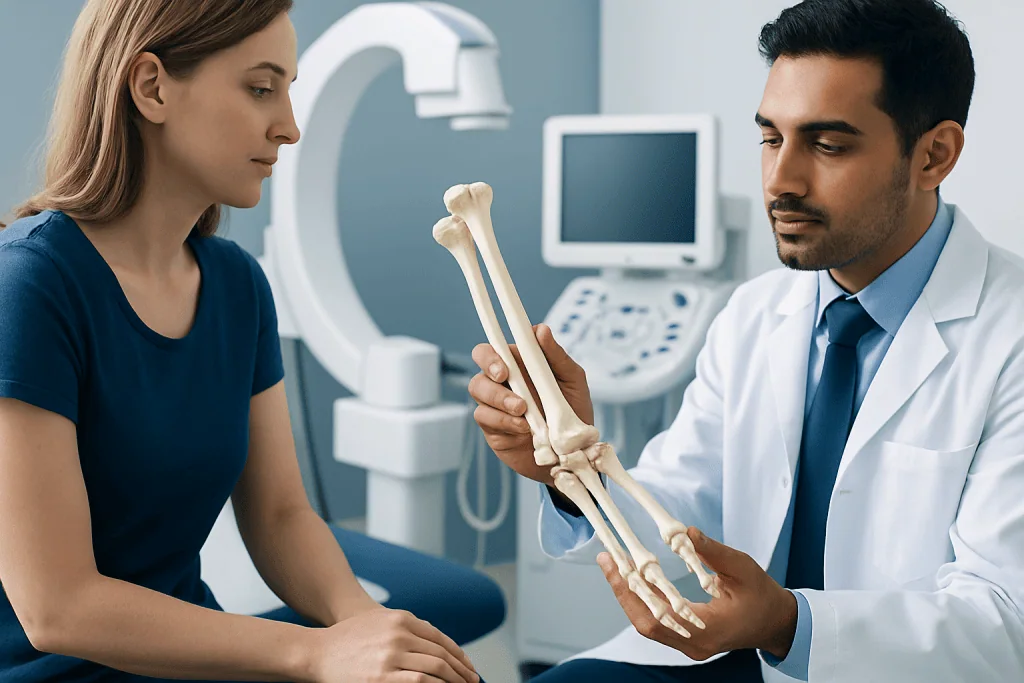
The main bone of the upper arm is the humerus. It runs from the shoulder to the elbow and connects with the shoulder blade, or scapula, at the shoulder joint. At its lower end, the humerus meets the two bones of the forearm: the radius and ulna.
The radius is on the thumb side of the forearm, and the ulna is on the little-finger side. These bones work together to allow the forearm to rotate. This rotation makes it possible to turn the palm upward, such as when holding a bowl, or downward, such as when placing the hand on a table.
The elbow is a complex joint involving the humerus, radius and ulna. It mainly bends and straightens the arm, but it also supports forearm rotation. The wrist contains eight small carpal bones arranged in two rows; these connect the forearm to the bones of the hand.
The shoulder is not technically part of the arm in strict anatomical language, but it is essential to arm function. Its wide range of motion helps position the hand, while the elbow, forearm and wrist refine the movement. Strong joint stability and coordinated muscle control are needed throughout the limb.
Muscles, Tendons and Ligaments

Muscles in the upper arm are commonly grouped by their main actions. The biceps brachii at the front of the upper arm helps bend the elbow and turn the palm upward. The brachialis, located underneath the biceps, is also an important elbow-flexing muscle. The triceps brachii at the back of the upper arm straightens the elbow.
The forearm contains many muscles that control the wrist, hand and fingers. Some flex the wrist and fingers, helping with gripping. Others extend the wrist and fingers, allowing the hand to open and lift. Smaller muscles within the hand contribute to finger coordination, thumb movement and fine control.
Tendons are strong bands of connective tissue that attach muscles to bones. They transfer the force made by muscles into movement. For instance, tendons from forearm muscles pass across the wrist to move the fingers. Repetitive strain, sudden overload or injury can irritate or damage a tendon.
Ligaments connect bone to bone and help prevent joints from moving beyond their normal range. At the elbow, wrist and fingers, ligaments provide stability during daily activities. A sprain occurs when a ligament is stretched or torn. Recovery depends on the location and severity of the injury, so proper assessment can be important.
Nerves and Blood Vessels in the Arm
The arm receives its nerve supply mainly from the brachial plexus, a network of nerves that begins in the neck and travels through the shoulder into the upper limb. The three major nerves commonly discussed in relation to arm and hand function are the median nerve, ulnar nerve and radial nerve.
The median nerve supports sensation in much of the palm side of the thumb, index finger, middle finger and part of the ring finger. The ulnar nerve supplies sensation to the little finger and the other side of the ring finger, and it helps control several small hand muscles. The radial nerve is important for straightening the wrist and fingers and for sensation over part of the back of the hand.
Arteries bring oxygen-rich blood into the arm. The subclavian artery becomes the axillary artery around the shoulder and then the brachial artery in the upper arm. Below the elbow, it divides into the radial and ulnar arteries, which contribute to blood flow in the hand. Veins return blood to the heart.
Numbness, burning, pins and needles, unusual coldness, color changes or weakness may sometimes relate to nerve or circulation concerns. These symptoms can also have other causes, so they should not be self-diagnosed. A clinician can assess the pattern of symptoms, physical findings and any relevant tests.
How Arm Movement and Sensation Work Together
Arm movement is the result of coordinated signals between the brain, spinal cord, nerves, muscles and joints. When a person reaches for an object, the shoulder first positions the limb. The elbow adjusts the distance, the forearm rotates the hand, and the wrist and fingers adapt to the shape and weight of the object.
Sensation is equally important. Touch, pressure, temperature, pain and joint-position awareness help the hand handle objects safely. For example, sensing heat allows a person to release a hot item, while awareness of finger position makes it easier to button a shirt without constantly looking at the hand.
Many routine tasks place repeated demands on arm parts. Computer work, lifting, sports, caregiving, manual work and hobbies may all involve repetitive gripping, bending or overhead movement. Balanced technique, rest and gradual increases in activity can help reduce avoidable strain.
Normal differences exist between individuals. Hand dominance, muscle mass, flexibility and joint shape can affect how the arm looks and moves. Mild clicking without pain or loss of function is often not serious, but new symptoms after an injury or changes that interfere with activities deserve medical attention.
Common Problems That Can Affect Arm Parts
Arm symptoms may result from injury, overuse, joint conditions, nerve compression or referred pain from another area, such as the neck. Common injuries include bruises, muscle strains, tendon irritation, ligament sprains, dislocations and fractures. Falls, sports injuries and sudden forceful movements are frequent causes.
Overuse conditions can develop when the same motion is repeated without enough recovery. Examples include tendon problems around the elbow or wrist and some forms of nerve pressure. Symptoms may include localized pain, tenderness, stiffness, tingling, reduced grip strength or pain during specific activities.
Joint inflammation and degenerative changes can also affect the elbow, wrist, thumb or fingers. In some people, neck-related nerve irritation may cause pain, tingling or weakness that travels into the shoulder, arm or hand. A careful assessment helps identify whether symptoms originate in the arm itself or elsewhere.
Initial care for a minor strain may include reducing the aggravating activity, gentle movement as tolerated and following advice from a healthcare professional. Persistent symptoms should be reviewed rather than repeatedly pushed through. Treatment may involve rehabilitation, activity modification, supportive devices, medicines or other approaches based on the diagnosis.
Protecting Arm Health in Daily Life
Regular movement can support healthy arm function. Strengthening exercises for the shoulder, upper arm, forearm and hand may improve control and endurance when they are appropriate for the individual. Flexibility and mobility exercises can be useful, especially after long periods of sitting or repetitive work.
Good ergonomics can reduce unnecessary stress on arm parts. When using a computer, the shoulders can remain relaxed, the elbows can be supported near the body, and the wrists can be kept as neutral as comfortably possible. During lifting, keeping objects close to the body and avoiding sudden twisting may help protect the arms and back.
For sports and physical work, gradual training progression is important. Warming up, using suitable technique, taking recovery days and responding early to pain can lower the risk of overuse injuries. Protective equipment may be appropriate for some activities.
People recovering from an arm injury or surgery should follow the specific plan given by their clinical team. Returning too quickly to demanding activity can delay healing, while avoiding movement for too long may contribute to stiffness. A tailored rehabilitation plan can help restore mobility, strength and confidence safely.
When to Seek Medical Care
Medical care is recommended for arm pain that is severe, persistent, worsening or interfering with sleep, work or daily activities. It is also sensible to seek assessment after a fall, direct blow, twisting injury or sudden loss of movement, especially if there is visible deformity, marked swelling or inability to use the arm.
Urgent evaluation is important if an arm or hand becomes pale, blue, unusually cold, severely swollen or difficult to move. New significant weakness, loss of sensation, increasing numbness, or pain with chest discomfort, shortness of breath, nausea or sweating should be treated as potentially urgent and assessed promptly through local emergency services.
A clinician may diagnose an arm problem through a medical history and physical examination. Depending on the concern, imaging such as X-ray, ultrasound or MRI, as well as nerve testing or blood tests, may be considered. The choice of test depends on the symptoms and suspected structure involved.
Acibadem International’s multidisciplinary specialists and JCI-accredited hospitals diagnose and treat bone, joint, nerve and soft-tissue conditions affecting the arm for international patients. A qualified healthcare professional can explain the likely cause of symptoms and recommend an appropriate care plan.
Frequently asked questions
What are the five main parts of the arm?
In everyday use, the main arm parts are the upper arm, elbow, forearm, wrist and hand. Anatomically, the word “arm” specifically means the segment between the shoulder and elbow, while the forearm extends from the elbow to the wrist.
What are the three bones in the arm?
The three major bones are the humerus in the upper arm and the radius and ulna in the forearm. The radius lies on the thumb side, and the ulna lies on the little-finger side when the palm faces forward.
Which muscles are found in the upper arm?
The best-known upper arm muscles are the biceps and triceps. The biceps helps bend the elbow and rotate the forearm, while the triceps straightens the elbow. Other deeper muscles also contribute to elbow movement and stability.
Why does the arm have two bones in the forearm?
The radius and ulna allow the forearm to rotate while maintaining support between the elbow and wrist. Their coordinated movement enables the palm to turn upward and downward, which is important for many everyday tasks.
What nerve causes tingling in the little finger?
Tingling in the little finger can involve the ulnar nerve, which provides sensation to that finger and part of the ring finger. However, symptoms may have different causes, including pressure at the elbow, wrist or neck, so persistent tingling should be assessed by a clinician.
When is arm pain a reason to seek urgent help?
Urgent help is needed for severe pain after an injury, obvious deformity, sudden weakness, loss of sensation, or an arm that becomes cold, pale or blue. Arm pain accompanied by chest discomfort, shortness of breath, sweating or nausea also needs immediate medical evaluation.
References
- MedlinePlus
- National Institute of Arthritis and Musculoskeletal and Skin Diseases
- American Academy of Orthopaedic Surgeons
- Merck Manual Consumer Version
- Cleveland Clinic
This article is for general information only and is not a substitute for professional medical advice. Please consult a qualified doctor about your individual situation.
Joint and spine care in Turkey — expert assessment & treatment
JCI-accredited · board-certified surgeons · reply within 24h
Add us as a Preferred Source to see more of our trusted health content across Google Search, AI Overviews and Discover.