Auditory Processing Disorder: Early Signs, Risk Factors, and How It Is Treated

Auditory processing disorder affects how the brain processes sounds, not how well the ears detect them. Common signs include trouble understanding speech in noisy places, following spoken directions, and telling similar sounds apart.
Key Takeaways
- Auditory processing disorder affects how the brain processes sounds, not how well the ears detect them.
- Common signs include trouble understanding speech in noisy places, following spoken directions, and telling similar sounds apart.
- Diagnosis usually involves audiology testing along with speech, language, and educational assessment.
- Treatment focuses on practical support, listening strategies, school accommodations, and therapy tailored to the person’s needs.
- Other conditions such as hearing loss, ADHD, language disorders, and learning differences may overlap and should be assessed carefully.
Auditory processing disorder is a listening difficulty in which the ears may hear normally, but the brain has trouble making sense of sounds, especially speech in noise. Early recognition, a careful hearing and language evaluation, and targeted support can improve communication, learning, and daily functioning.
Overview: what auditory processing disorder means
Auditory processing disorder, sometimes called central auditory processing disorder, is a condition in which the brain has difficulty interpreting and organizing the sounds that the ears receive. A person with auditory processing disorder may hear tones at a normal level on a standard hearing test, yet still struggle to understand spoken words, especially in noisy or fast-moving situations.
This is not simply a matter of “not paying attention.” The challenge lies in how sound information is analyzed, separated from background noise, remembered, and linked to meaning. Children are often identified when school demands increase, but adults can also experience similar symptoms, particularly if there is a history of language, learning, neurologic, or hearing-related concerns.
Auditory processing disorder can affect classroom learning, work performance, social interaction, and confidence. Because symptoms overlap with other conditions, a thorough evaluation is important. Clear diagnosis helps families and patients understand why listening feels unusually effortful and what kinds of support are most useful.
Early signs and symptoms
The most common early sign is difficulty understanding speech when there is background noise, such as in a classroom, cafeteria, busy office, or family gathering. A child or adult may say “what?” often, ask for repetition, or seem to miss parts of conversations even though hearing appears normal in quiet settings.
Another common pattern is trouble following spoken instructions, especially when several steps are given at once. People with auditory processing disorder may also mix up similar-sounding words, struggle to take notes while listening, need extra time to respond, or find it hard to remember what was just said. Listening may feel tiring, and concentration can fade quickly when verbal information is dense.
Some children show signs through school performance rather than obvious hearing complaints. They may have difficulty with phonics, spelling, reading, or understanding verbal explanations. Others may appear distracted or frustrated because they are working hard to decode speech. In adults, symptoms may become more noticeable in complex work environments or during phone calls and meetings.
- Difficulty hearing speech in noise
- Frequent requests for repetition
- Trouble following multi-step verbal directions
- Confusion between similar speech sounds
- Slow response to spoken questions
- Listening fatigue or reduced attention during verbal tasks
Why it happens and who may be at risk

There is not one single cause of auditory processing disorder. In some people, it may relate to differences in how the central nervous system handles sound signals. In others, it may be associated with a history of repeated ear infections during early childhood, developmental language difficulties, learning disorders, attention problems, traumatic brain injury, or neurologic conditions. Sometimes no clear cause is identified.
Risk can be higher when a person has had long periods of reduced sound input during early development, as can happen with persistent middle ear fluid or frequent ear infections. Even when hearing later returns to normal, the early listening experience may have affected how the brain learned to process speech details. That does not mean ear infections always cause auditory processing disorder, but they can be part of the overall history.
It is also important to recognize overlap with other conditions. Hearing loss, attention-deficit/hyperactivity disorder, autism spectrum disorder, speech and language disorders, dyslexia, and broader learning differences can all create similar listening or academic difficulties. A proper evaluation helps separate these possibilities and identify whether auditory processing disorder is present on its own or alongside another issue. If repeated ear problems are part of the picture, assessment for related ear infections may be relevant.
How auditory processing disorder is diagnosed
Diagnosis begins with a detailed history. The clinician asks about hearing, speech and language development, school or work challenges, birth and medical history, ear infections, attention, and learning concerns. Because many different issues can affect listening, diagnosis should not rely on one complaint or one screening result alone.
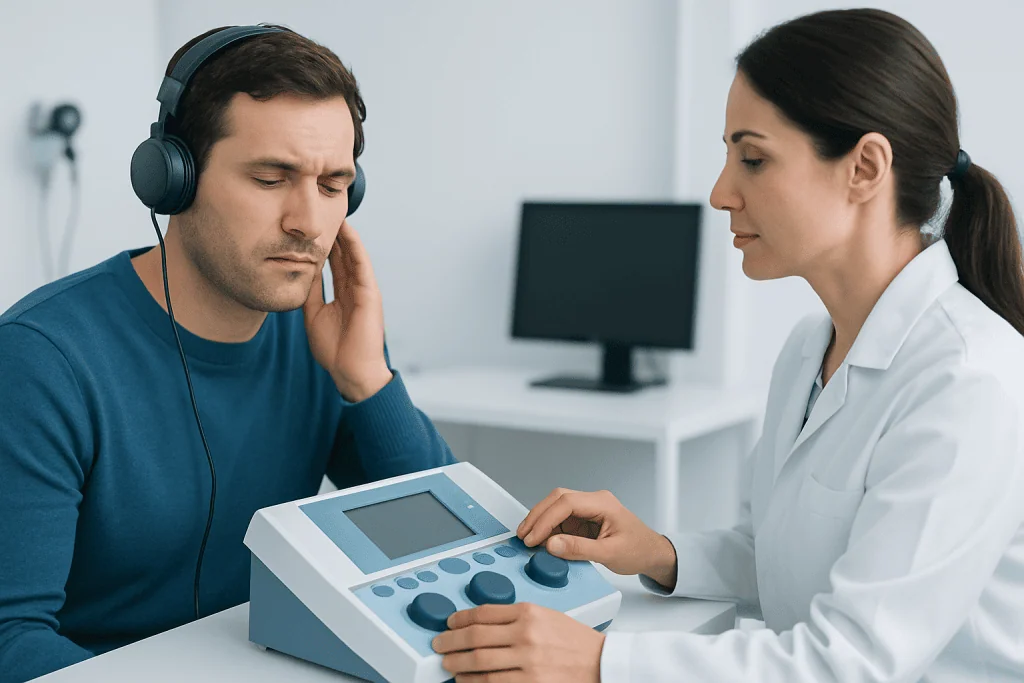
A complete hearing evaluation is usually the first step to rule out hearing loss or middle ear problems. From there, an audiologist may perform specialized auditory tests that assess how the person processes speech in noise, distinguishes sounds, identifies patterns, or integrates information presented to both ears. These tests are selected according to age, development, language ability, and the person’s specific symptoms. Comprehensive hearing testing is often central to this process.
Diagnosis is often multidisciplinary. Speech-language pathologists, pediatricians, neurologists, psychologists, teachers, and educational specialists may contribute information. Language skills, attention, memory, and reading ability may also be assessed so that the full pattern is understood. In some cases, clinicians may recommend further neurologic review, especially when symptoms are new, progressive, or associated with head injury or other nervous system concerns. When broader nervous system evaluation is needed, neurology consultation can help guide the workup.
There is ongoing discussion among experts about definitions and testing standards for auditory processing disorder. Even so, the practical goal remains the same: to identify the listening difficulties that are affecting daily life and to match them with targeted support. A thoughtful assessment can be valuable whether the final conclusion is auditory processing disorder, another diagnosis, or a combination of factors.
Treatment and everyday support
Treatment for auditory processing disorder is individualized. There is no single medicine or procedure that fixes the condition in all cases. Instead, care focuses on reducing listening barriers, strengthening related skills, and building practical strategies at home, school, or work. For many people, this combination approach leads to meaningful improvement.
Environmental changes are often very effective. These may include reducing background noise, improving classroom or meeting-room acoustics, using visual supports, speaking clearly at a moderate pace, and checking that instructions were understood. Preferential seating, written follow-up instructions, and breaking tasks into smaller steps can make listening easier and less tiring. Some patients may benefit from assistive listening technology recommended by an audiologist.
Therapy may involve auditory training exercises, speech-language therapy, and support for phonological awareness, language comprehension, or memory skills when needed. If another condition is also present, treatment should address that as well. For example, care may overlap with hearing loss management or interventions for attention and learning needs. In selected cases, clinicians may advise more specialized speech therapy or educational plans tailored to school performance.
The most helpful programs are specific and realistic. Rather than trying to train “better listening” in a general sense, treatment works best when aimed at the person’s actual difficulties, such as understanding teachers in noise, following verbal directions, or handling spoken information on the phone. Progress is usually gradual, and regular review helps adjust support over time.
Self-care, school strategies, and long-term outlook
Daily habits can make a noticeable difference. Families and patients can ask speakers to face them, reduce competing noise when possible, and request important information in both spoken and written form. Repeating back instructions, using planners or reminder apps, and taking brief listening breaks can help reduce mental fatigue and improve accuracy.
At school, practical accommodations are often more important than any single diagnosis label. A student may benefit from sitting near the teacher, receiving written homework instructions, getting extra time for verbally presented tasks, or using classroom audio systems if recommended. Teachers should know that a child with auditory processing disorder may understand better when information is presented slowly, clearly, and in short segments.
The outlook varies from person to person. Some children improve as language, attention, and auditory skills mature, while others continue to need support into adolescence or adulthood. Even when the listening challenge remains, many people learn effective coping strategies and function very well academically, socially, and professionally when their needs are recognized early.
For international patients who need coordinated assessment, Acibadem International’s multidisciplinary specialists and JCI-accredited hospitals evaluate and treat auditory and related communication disorders with individualized care plans.
When to seek medical care
Medical evaluation is appropriate when listening difficulties are frequent, affect school or work, or create ongoing frustration at home or in social settings. A child should be assessed if teachers report that they often miss instructions, struggle more in noisy classrooms, or seem to hear inconsistently despite no obvious hearing loss. Adults should also seek care if understanding speech becomes unusually effortful, especially in background noise.
Prompt medical review is especially important when symptoms are new, worsening, or accompanied by ear pain, repeated ear infections, tinnitus, dizziness, headaches, head injury, or suspected hearing loss. These features may point to another condition that needs treatment first. A clinician can help determine whether the main issue is auditory processing disorder, a hearing problem, or another neurologic or language-related cause.
Because symptoms can overlap with attention, language, and learning disorders, it is best not to self-diagnose. Early evaluation often leads to earlier accommodations and less frustration. If concerns arise, a qualified doctor, audiologist, or speech-language specialist can advise on the next steps and coordinate further testing when needed.
Frequently asked questions
Is auditory processing disorder the same as hearing loss?
No. In auditory processing disorder, the ears may detect sound normally, but the brain has difficulty interpreting what is heard. Hearing loss can cause similar symptoms, so a full hearing evaluation is important before confirming the diagnosis.
At what age can auditory processing disorder be diagnosed?
Many children are evaluated once they are old enough to complete reliable listening tests, often in early school years. The exact timing depends on development, language ability, and the concerns being assessed. Younger children may still be monitored and supported even if a formal diagnosis is not made immediately.
Can adults have auditory processing disorder?
Yes. Some adults have lifelong symptoms that were never fully recognized, while others develop similar processing difficulties after neurologic illness, head injury, or other medical issues. Adult assessment looks at hearing, language, attention, and the listening demands of daily life.
Does auditory processing disorder improve over time?
It can improve, especially when identified early and managed with targeted support. Some children develop stronger listening and language skills as they mature. Others continue to benefit from accommodations and strategies into adulthood.
What treatments help most?
The most helpful treatment depends on the person’s specific pattern of difficulty. Common supports include reducing background noise, using written instructions, classroom or workplace accommodations, auditory training, and speech-language therapy when indicated. Treating any coexisting hearing, language, or attention problems is also important.
Can auditory processing disorder be mistaken for ADHD or dyslexia?
Yes. These conditions can overlap and may produce similar signs, such as missed instructions, poor concentration during listening tasks, or reading difficulties. Careful evaluation is needed to understand whether one condition, several conditions, or another issue is responsible for the symptoms.
References
- American Speech-Language-Hearing Association
- American Academy of Audiology
- National Institute on Deafness and Other Communication Disorders
- American Academy of Pediatrics
- Centers for Disease Control and Prevention
This article is for general information only and is not a substitute for professional medical advice. Please consult a qualified doctor about your individual situation.
Explore treatments in Turkey — costs, top hospitals & a free quote
JCI-accredited · board-certified surgeons · reply within 24h
Add us as a Preferred Source to see more of our trusted health content across Google Search, AI Overviews and Discover.