Autosomala — Explained by Medical Evidence, Not Myths

Autosomala generally means autosomal, relating to genes on non-sex chromosomes. Autosomal conditions can be inherited in dominant or recessive patterns.
Key Takeaways
- Autosomala generally means autosomal, relating to genes on non-sex chromosomes.
- Autosomal conditions can be inherited in dominant or recessive patterns.
- People of any sex can inherit and pass on autosomal conditions.
- A detailed family history can help identify inherited health risks.
- Genetic counseling and testing may clarify diagnosis, carrier status, and family planning options.
Autosomala usually refers to autosomal inheritance, a genetics term describing traits or conditions linked to the 22 pairs of non-sex chromosomes. Understanding autosomal patterns can help explain why some conditions run in families, who may be affected, and when genetic counseling or testing may be helpful.
What autosomala means
Autosomala is commonly used to refer to autosomal, a medical genetics term. It describes genes located on the autosomes, which are the 22 pairs of chromosomes that are not the sex chromosomes. In practical terms, autosomal inheritance explains how certain traits and health conditions can be passed from parents to children regardless of whether the child is male or female.
This matters because many inherited conditions follow recognizable patterns. When a doctor says a condition is autosomal, they are usually discussing how it is inherited, how likely it is to appear in other family members, and whether genetic testing may help confirm the diagnosis.
Autosomal inheritance is not itself a disease. It is a framework used to understand a wide range of conditions, from relatively mild traits to more serious disorders. Some inherited nerve, kidney, blood, and metabolic conditions can follow autosomal patterns, and doctors may compare them with other hereditary disorders such as Huntington’s disease when explaining family risk.
How autosomal inheritance works
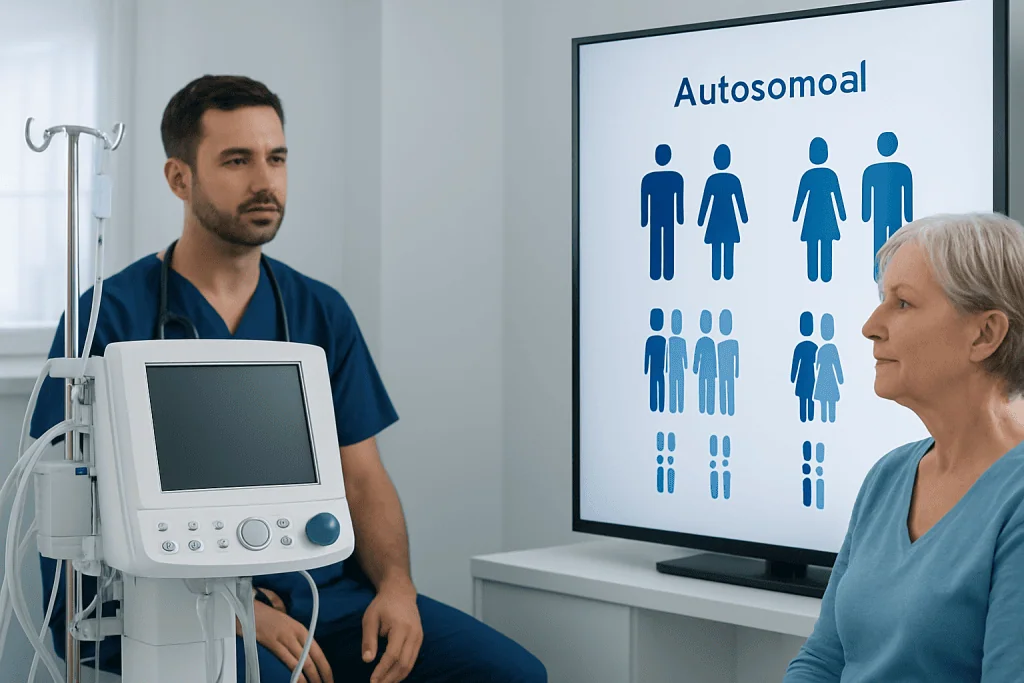
Each person usually has two copies of most autosomal genes, one inherited from each parent. A change, also called a variant or mutation, in one or both copies of a gene may affect how the body develops or functions. Whether that change causes a condition depends on the specific gene and the inheritance pattern.
The two main autosomal inheritance patterns are:
- Autosomal dominant: a change in just one copy of a gene can be enough to cause the condition. A parent with the condition may pass the altered gene to a child.
- Autosomal recessive: changes usually need to be present in both copies of the gene for the condition to develop. Parents may be healthy carriers and not know they carry the gene change.
These patterns help explain why some conditions appear in every generation, while others seem to appear unexpectedly in a child with no obvious family history. In recessive inheritance, for example, a condition may not be recognized until both parents happen to carry the same altered gene.
Doctors also consider less common situations, such as a new genetic change arising for the first time in one person, variable severity among relatives, or incomplete penetrance, where someone carries a gene change but has few or no symptoms. This is why inheritance is often more complex than a simple family tree suggests.
What signs or clues may suggest an autosomal condition

There is no single set of symptoms for “autosomala” because autosomal inheritance can apply to many different conditions. Instead, the clue is often the pattern within a family or a person’s health history. Repeated diagnoses in close relatives, symptoms starting at a young age, or similar medical problems affecting several generations may suggest an inherited condition.
Possible clues include:
- Multiple relatives with the same or related diagnosis
- Symptoms appearing earlier than expected for a common condition
- Developmental, neurologic, metabolic, kidney, or blood disorders without a clear external cause
- More than one affected child in a family when parents are unaffected
- A known genetic diagnosis in a parent, sibling, or extended relative
Some people discover an autosomal condition only after testing is done for unexplained symptoms. Others learn about it during pregnancy planning, newborn screening, or carrier screening. Because symptoms vary widely, diagnosis depends on the specific condition rather than on the inheritance term alone.
Causes, risk factors, and family patterns
Autosomal conditions are caused by changes in genes on the autosomes. These changes may be inherited from one or both parents or may begin newly in the affected person. A gene change does not always mean a person will become ill, but it can increase the chance of a specific disorder or of passing the change to children.
The main risk factor is family history. If a parent, sibling, or child has a confirmed inherited condition, other relatives may also carry the same genetic change. In autosomal recessive conditions, people can be carriers without symptoms. In autosomal dominant conditions, symptoms may be obvious in one side of the family, though severity can differ from person to person.
Risk is also influenced by the exact gene involved, whether the variant is dominant or recessive, and whether both parents carry the same recessive gene change. In some families, relatives may have been diagnosed with related problems rather than the exact same disorder, which can make the pattern less obvious until a genetics review is done.
Understanding these patterns can guide decisions about screening, follow-up, and specialist care. If the condition affects the nervous system, doctors may coordinate with specialists in neurology care to assess symptoms and monitor progression where needed.
How doctors diagnose autosomal disorders
Diagnosis begins with a careful medical and family history. A doctor may ask about relatives across several generations, age at diagnosis, miscarriages, childhood illnesses, unexplained deaths, developmental concerns, or chronic symptoms that may have a genetic basis. A physical examination and standard laboratory tests may also provide clues.
If an inherited condition is suspected, the next steps may include referral to a genetic counselor or medical geneticist. Genetic counseling helps patients understand what testing can and cannot show, the possible outcomes, and how results may affect relatives. Testing may be done with a blood sample or sometimes a saliva sample, depending on the method used.
Tests vary by situation and may include single-gene testing, targeted panels, chromosomal microarray, or broader sequencing. In some cases, imaging or organ-specific testing is also needed to understand the condition’s effects. For example, inherited brain or nerve disorders may require MRI imaging as part of the overall evaluation.
Results are interpreted carefully. A positive result may confirm a diagnosis, while a negative result does not always rule one out. Sometimes testing identifies a variant of uncertain significance, meaning more information is needed before the finding can be linked clearly to disease.
Treatment and long-term management
Treatment depends entirely on the specific autosomal condition. Some inherited disorders can be managed mainly through regular monitoring and supportive care, while others may require medication, rehabilitation, nutrition planning, or specialist procedures. In many cases, treatment focuses on controlling symptoms, preventing complications, and maintaining quality of life.
For some conditions, early diagnosis makes a meaningful difference. Children may benefit from developmental support, adults may need monitoring for organ involvement, and families may be advised about screening for at-risk relatives. Care often involves a team that may include primary care doctors, geneticists, pediatricians, neurologists, cardiologists, nephrologists, or other specialists depending on the disorder.
If seizures, movement changes, weakness, or other neurologic features are present, doctors may recommend specialist assessment and, when appropriate, neurosurgical evaluation or other advanced care. Not every inherited neurologic condition requires surgery, but coordinated specialist review can help define the safest treatment plan.
Near the end of the care pathway, some people also seek support for family planning, reproductive decisions, or testing of relatives. Acibadem International’s multidisciplinary specialists and JCI-accredited hospitals diagnose and treat inherited conditions for international patients when advanced evaluation is needed.
Prevention, self-care, and family planning
Genes themselves cannot be changed through lifestyle alone, so autosomal conditions are not usually preventable in the usual sense. However, people can often reduce complications through regular checkups, following treatment plans, and managing overall health. Good sleep, balanced nutrition, physical activity suited to the condition, and avoiding smoking are supportive steps for many chronic illnesses.
One of the most useful preventive steps is knowing the family history. Bringing a written family health record to appointments can help doctors identify patterns earlier. This is especially important before pregnancy or when a couple knows that a relative has a genetic disorder.
Carrier screening, reproductive counseling, and prenatal or preconception discussions may help families understand possible risks and options. These conversations are personal and should be guided by qualified professionals who can explain benefits, limitations, and emotional considerations in a balanced way.
Self-care also includes emotional support. Learning that a condition is inherited can be stressful, and families may benefit from counseling, patient organizations, or support groups. Clear information often helps reduce fear and replace myths with evidence-based understanding.
When to seek medical care
Medical advice should be sought if there is a strong family history of a known genetic condition, repeated unexplained health problems in relatives, or symptoms that suggest an inherited disorder. A doctor can help decide whether specialist referral or genetic testing is appropriate.
Prompt evaluation is also important if a child has developmental delay, unusual muscle weakness, seizures, recurrent unexplained illness, or multiple birth defects. Adults should seek care if they develop progressive neurologic symptoms, unexplained organ problems, or early-onset disease that seems unusual for their age.
Urgent medical care is needed for serious symptoms such as breathing difficulty, loss of consciousness, severe seizures, stroke-like symptoms, or sudden weakness. Even when a condition is inherited, emergencies should be treated immediately.
Frequently asked questions
What does autosomala mean in medicine?
Autosomala generally refers to autosomal, meaning related to the non-sex chromosomes. In medicine, it is most often used when explaining how a genetic trait or condition is inherited within a family.
Is autosomala the same as a disease?
No. It is not a diagnosis by itself. It is a term that helps describe the inheritance pattern of many different genetic conditions.
Can both males and females inherit autosomal conditions?
Yes. Because autosomal genes are not on the sex chromosomes, people of any sex can inherit and pass on these conditions. The chance of inheritance depends on the specific gene and whether the pattern is dominant or recessive.
What is the difference between autosomal dominant and autosomal recessive?
In autosomal dominant inheritance, one altered copy of a gene can be enough to cause the condition. In autosomal recessive inheritance, a person usually needs altered copies from both parents, while parents may be healthy carriers.
When is genetic testing helpful?
Genetic testing may be helpful when symptoms suggest an inherited disorder, when there is a strong family history, or when a couple wants to understand reproductive risks. It is usually most useful when combined with genetic counseling and clinical evaluation.
If no one in the family is affected, can an autosomal condition still occur?
Yes. Some recessive conditions can appear even if there is no known family history because parents may be unaffected carriers. In other cases, a new gene change can arise for the first time in one person.
This article is for general information only and is not a substitute for professional medical advice. Please consult a qualified doctor about your individual situation.
Explore treatments in Turkey — costs, top hospitals & a free quote
JCI-accredited · board-certified surgeons · reply within 24h
Add us as a Preferred Source to see more of our trusted health content across Google Search, AI Overviews and Discover.

More from the Health Library

Skene’s Gland: What Patients Need to Know

Disorganized Behavior: What Patients Need to Know

Celebrex: An Evidence-Based Guide for Patients

Viibryd: An Evidence-Based Guide for Patients

Singulair: An Evidence-Based Guide for Patients