Baby Walker: What Patients Need to Know

A baby walker with wheels can increase the risk of injury, especially from stairs, tipping, and reaching dangerous objects. Using a baby walker does not teach a baby to walk earlier and may encourage movement patterns that are not ideal for natural development.
Key Takeaways
- A baby walker with wheels can increase the risk of injury, especially from stairs, tipping, and reaching dangerous objects.
- Using a baby walker does not teach a baby to walk earlier and may encourage movement patterns that are not ideal for natural development.
- Most experts prefer supervised floor time, stationary activity centers, and push toys used at the right developmental stage.
- Any fall, head injury, limb pain, or reduced movement after walker use should be assessed by a qualified doctor.
- Home safety measures, including stair gates and close supervision, remain important even if a walker is not used.
A baby walker is generally not recommended because it can increase the risk of falls, head injuries, and access to hazards, while not helping a baby learn to walk sooner. Parents and caregivers can support healthy movement with supervised floor play and other safer alternatives.
Overview: what a baby walker is and why it matters
A baby walker usually refers to a mobile frame with wheels and a seat that allows a baby to move around by pushing with their feet. Although many families see walkers as a way to entertain a child or encourage mobility, pediatric safety experts generally advise against using them. The reason is simple: walkers can increase injury risk and do not help babies learn to walk sooner.
This is an important topic because walkers can let a baby move quickly before they have the judgment, balance, and coordination to stay safe. A child in a walker may reach stairs, hot drinks, sharp objects, cleaning products, or unstable furniture in seconds. Even in a home that seems safe, the added speed and height can create risks that are easy to underestimate.
It also helps to separate walkers from other baby equipment. A stationary activity center stays in one place and does not roll across the floor. Push toys, by contrast, are designed for babies who are already pulling to stand and beginning to cruise. These are different from wheeled seated walkers and are usually considered much safer when used appropriately and under close supervision.
How baby walkers affect development
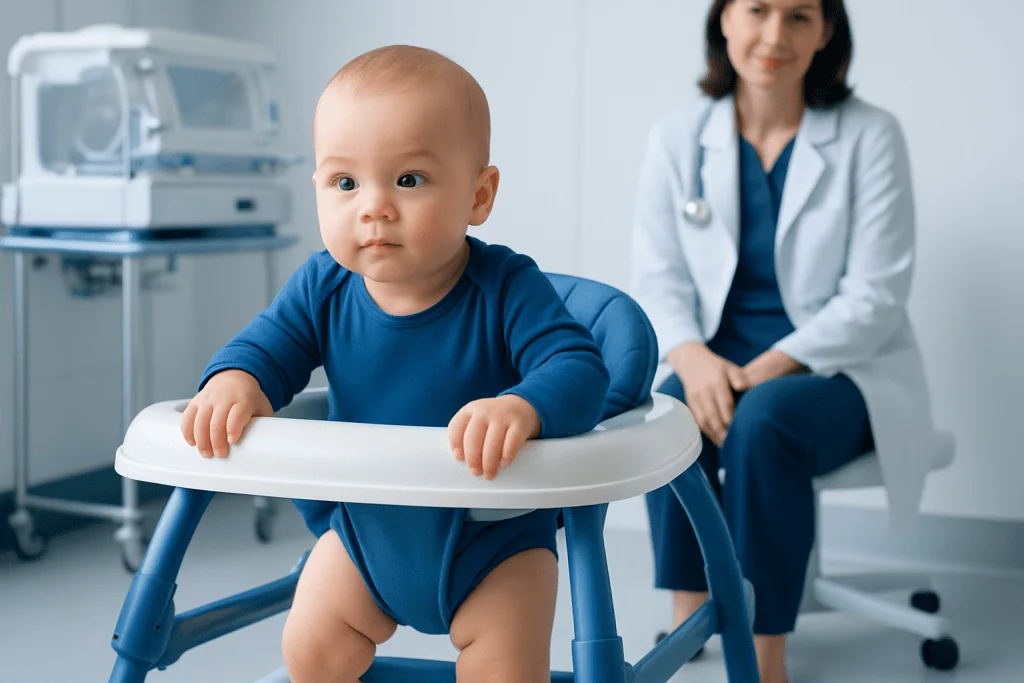
Families sometimes hope a walker will strengthen a baby’s legs or speed up walking. Current pediatric guidance does not support that idea. Learning to walk normally develops through a sequence that includes tummy time, rolling, sitting, crawling or scooting, pulling to stand, cruising along furniture, and then taking independent steps. Floor-based exploration gives babies repeated chances to practice balance, weight shifting, and protective reactions.
A walker changes that process. Because the seat supports part of the baby’s weight, the child may move in a more upright position before they are developmentally ready. This can encourage tiptoe pushing and rapid movement without the same opportunity to practice natural balance control. For that reason, walker use is not considered a helpful tool for motor development.
There is also a wider developmental picture. Babies benefit from supervised time on the floor where they can reach, turn, pivot, and interact with people and toys at their own level. This kind of play supports motor skills, body awareness, and exploration. If a parent has concerns about delayed movement milestones, an assessment by a pediatrician is more useful than trying a walker at home.
Main safety risks of a baby walker

The biggest concern with a baby walker is injury. Stairs are a well-known danger because a walker can roll quickly toward an edge before an adult can intervene. Falls down stairs can lead to bruises, cuts, fractures, or head injuries. Tipping is another hazard, especially on uneven surfaces, thresholds, or if a child leans to one side.
Walkers also increase a baby’s reach. A child who could not normally access a table, kitchen counter, heater, or shelf may suddenly be able to pull down a hot drink, grab a cord, or touch a dangerous object. Burns, poisoning, and trauma can happen when everyday household items become reachable from the walker seat.
Supervision helps, but it does not remove these risks. Injuries often happen very quickly and in familiar rooms. Even safety devices such as stair gates and door barriers should not be relied on as a reason to use a walker. The safest approach is usually to avoid wheeled walkers altogether and choose safer ways to support play and movement.
- Falls down stairs or steps
- Head injury from collisions or tipping
- Finger, arm, or leg injury from trapping or falls
- Burns from hot liquids, ovens, or heaters
- Poisoning or choking from newly reachable items
Signs a baby may be injured after walker use
After any walker-related fall or collision, it is important to observe the baby closely. Some injuries are obvious, such as swelling, bleeding, or a limb that the child will not move. Others can be less clear at first, especially after a bump to the head. A baby who becomes unusually sleepy, vomits repeatedly, cries inconsolably, or behaves differently than usual should be checked by a doctor urgently.
If a child refuses to crawl, stand, or bear weight after walker use, this can suggest pain or injury to the leg, hip, or foot. Swelling, bruising, or tenderness around a joint may point to a sprain or fracture. In some cases, a child may seem well immediately after a minor fall but later become irritable or develop reduced movement.
Head and bone injuries need careful medical assessment in infants and young children. Depending on the situation, a doctor may recommend examination, observation, or imaging such as MRI or X-ray to look for injury. For concerns related to the nervous system after trauma, doctors may also evaluate the child for concussion or other complications.
Safer alternatives to a baby walker
There are practical alternatives that support healthy development without the same level of risk. The most helpful option is usually supervised floor play in a safe area. Tummy time, reaching for toys, rolling, sitting, and crawling all help babies build strength and coordination in ways that fit their stage of development.
Stationary activity centers may be used for short, supervised periods if they match the child’s age and size, but they should not replace floor time. Push toys can be useful later, when a baby can already pull to stand and cruise along furniture. At that stage, the toy should be stable, used on a flat surface, and always supervised.
Parents can also create movement opportunities through simple routines. Placing toys just out of reach, encouraging turning and crawling, and allowing safe exploration on the floor can all support motor learning. If a parent notices persistent stiffness, floppy posture, one-sided movement, or delayed milestones, a pediatrician may recommend pediatric rehabilitation or another developmental assessment to guide next steps.
Practical prevention and home safety tips
Whether or not a family has considered a baby walker, general home safety remains essential. Babies become mobile quickly, and hazards can appear before adults expect them. Safety planning works best when done early, before a child starts rolling, crawling, cruising, or taking first steps.
Simple changes can greatly reduce the chance of injury. Floors should be clear of cords, unstable objects, and small items that could be swallowed. Hot drinks, pans, medicines, and cleaning products should stay well out of reach. Stair gates, window guards where appropriate, and secure furniture can help reduce household injuries, but they are not substitutes for supervision.
- Choose floor play over wheeled walkers
- Install stair gates at both the top and bottom of stairs
- Keep hot liquids and heavy objects away from edges
- Store medicines, batteries, and chemicals securely
- Anchor furniture and keep cords out of reach
- Supervise babies closely during all movement and play
If a child has an injury or a possible fracture after a fall, evaluation may include fracture assessment and supportive care. Near the end of the care journey, families may also benefit from advice on returning safely to normal activity after any minor injury.
When to seek medical care
Medical care should be sought promptly after any significant walker-related fall, especially if the baby hit their head, fell down stairs, or seems different from usual. Urgent evaluation is also important if there is repeated vomiting, unusual sleepiness, a seizure, trouble breathing, bleeding that does not stop, or a limb that looks deformed.
Parents should also arrange a medical review if a child is not moving one arm or leg normally, cannot bear weight, or appears to be in ongoing pain. Even without a major injury, it is worth discussing development with a pediatrician if parents are worried about delayed motor milestones, unusual muscle tone, or asymmetry in movement.
For international patients who need evaluation, Acibadem International’s multidisciplinary specialists and JCI-accredited hospitals diagnose and treat childhood injuries and developmental concerns. A qualified clinician can decide whether observation, imaging, or specialist follow-up is needed and offer guidance tailored to the child’s age and symptoms.
Frequently asked questions
Are baby walkers safe for babies?
Wheeled baby walkers are generally not considered safe because they can increase the risk of falls, head injuries, and access to hazards. They allow babies to move faster and reach places they could not reach on their own.
Do baby walkers help babies walk earlier?
No, a baby walker does not usually help a baby walk sooner. Natural motor development is better supported by supervised floor time, crawling, standing, cruising, and guided play.
At what age can a baby use a walker?
Because wheeled baby walkers are not recommended, the more useful question is which alternatives are safer at each stage. Babies benefit most from age-appropriate floor play, and later from stable push toys only when they can already pull to stand and cruise.
What is the difference between a walker and a push walker?
A seated walker has wheels and supports the baby inside a frame, allowing the child to move before walking independently. A push walker is held from behind by a baby who is already standing and taking supported steps, so it is used at a later developmental stage.
What should a parent do if a baby falls in a walker?
The baby should be checked immediately for head injury, bleeding, swelling, pain, or reduced movement. If there was a stair fall, a head impact, vomiting, unusual sleepiness, or any concern about a limb injury, the child should be seen by a doctor promptly.
What are safer alternatives to a baby walker?
Safer options include supervised tummy time, floor play, and a secure play area with age-appropriate toys. Later on, some babies may use stable push toys under close supervision once they are already pulling up and cruising.
This article is for general information only and is not a substitute for professional medical advice. Please consult a qualified doctor about your individual situation.
Explore treatments in Turkey — costs, top hospitals & a free quote
JCI-accredited · board-certified surgeons · reply within 24h
Add us as a Preferred Source to see more of our trusted health content across Google Search, AI Overviews and Discover.

More from the Health Library

WBC: A Complete Medical Overview

Immunoglobulin M: What Patients Need to Know

Coconut Oil for Dry Scalp: A Complete Medical Overview

Aortic Valve: What Patients Need to Know

Brachial Is: An Evidence-Based Guide for Patients