

Cancer of the Pancreas Screening: How It Works, Results and What to Expect

Routine pancreatic cancer screening is not recommended for most adults because the disease is uncommon and available tests can lead to unnecessary follow-up procedures. Screening may be appropriate for selected people with a strong family history or certain inherited genetic syndromes.
Key Takeaways
- Routine pancreatic cancer screening is not recommended for most adults because the disease is uncommon and available tests can lead to unnecessary follow-up procedures.
- Screening may be appropriate for selected people with a strong family history or certain inherited genetic syndromes.
- MRI/MRCP and endoscopic ultrasound are the main screening tools used in specialist surveillance programs.
- New jaundice, persistent abdominal or back pain, unexplained weight loss, or new-onset diabetes should be assessed promptly rather than waiting for a screening appointment.
- An abnormal screening result does not necessarily mean cancer; many findings are benign cysts or changes that require monitoring.
Cancer of the pancreas screening is a planned surveillance program for people with a substantially increased inherited or family-based risk of pancreatic cancer. It usually uses MRI-based imaging and endoscopic ultrasound to look for early changes before symptoms develop, while routine screening is not advised for people at average risk.
Overview: how cancer of the pancreas screening works
Cancer of the pancreas screening is not a single test offered to everyone. It is an ongoing, specialist-led program designed for people whose likelihood of pancreatic cancer is higher than average because of inherited gene changes, a strong family history, or specific medical conditions. The aim is to identify pancreatic abnormalities at a stage when they can be assessed and, when needed, treated more effectively.
The two main tests are magnetic resonance imaging with magnetic resonance cholangiopancreatography (MRI/MRCP) and endoscopic ultrasound (EUS). MRI/MRCP produces detailed images of the pancreas and its ducts without radiation. EUS combines a flexible camera tube with an ultrasound probe; it is performed through the mouth under sedation and can provide very close images of the pancreas.
There is currently no blood test reliable enough to serve as a stand-alone screening test for pancreatic cancer in people without symptoms. Tumor markers such as CA 19-9 can be helpful in selected diagnostic or follow-up situations, but they are not accurate enough for routine screening because non-cancerous conditions can also alter results.
Who may be a candidate for screening?
Most people do not need cancer of the pancreas screening. Pancreatic cancer remains relatively uncommon in the general population, and screening tests can detect harmless cysts or uncertain findings that may lead to extra imaging, invasive testing, anxiety, or surgery. For this reason, expert groups recommend surveillance only when the expected benefit is likely to outweigh these potential harms.
A specialist may discuss screening with people who have several close relatives with pancreatic cancer, particularly when affected relatives are on the same side of the family. It may also be considered for people with certain inherited conditions or gene variants, including those associated with BRCA-related cancer risk, PALB2, CDKN2A, STK11/Peutz-Jeghers syndrome, Lynch syndrome, or hereditary pancreatitis. Eligibility and the age to begin vary by the specific risk factor.
A genetics professional, gastroenterologist, pancreatic specialist, and oncologist may work together to clarify family history, consider genetic counseling and testing, and create an individualized surveillance plan. A family history of pancreatic cancer does not automatically mean that a person will develop the disease, but it is an important reason to ask a doctor whether specialist risk assessment is appropriate.
The screening procedure: step by step

Screening usually begins with a consultation. The care team reviews personal and family history, prior genetic test results, medications, other health conditions, and any symptoms. Symptoms such as jaundice or unexplained weight loss require diagnostic assessment rather than routine surveillance, since they may need more urgent investigation.
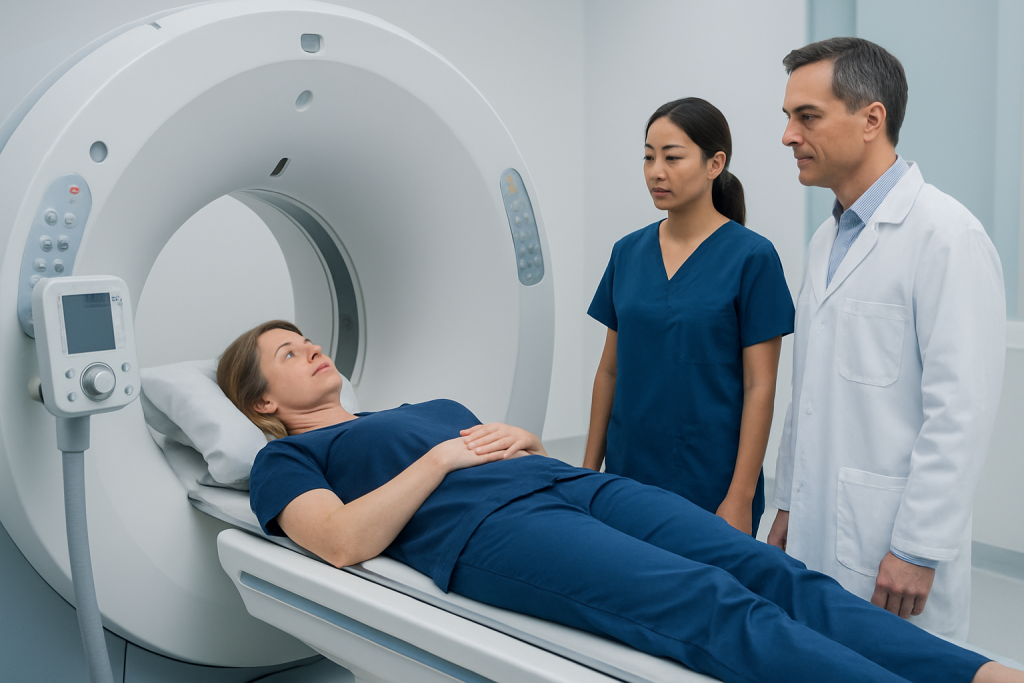
For MRI/MRCP, the person lies on a table that moves through the MRI scanner. The examination is painless, though remaining still in an enclosed space can be challenging for some people. Contrast material may sometimes be used to improve image detail. The scan commonly takes less than an hour, and normal activities can generally resume immediately afterward unless sedation has been used for another test.
For EUS, the person follows fasting instructions beforehand and receives sedation or anesthesia. A specialist passes a thin, flexible endoscope through the mouth into the stomach and first part of the small intestine, where ultrasound images of the pancreas are obtained. If an area needs closer evaluation, the doctor may collect a sample with a fine needle; this is not routinely required during every screening examination. After sedation, a responsible adult is usually needed to accompany the person home.
Many high-risk surveillance programs use MRI/MRCP and EUS at different intervals or alternate them over time. The schedule depends on the person’s risk profile, age, pancreatic findings, and the recommendations of the multidisciplinary team.
Results, benefits and possible risks
Results may be reported as normal, showing a finding that needs routine follow-up, or showing a change that needs further testing. Pancreatic cysts and minor duct changes are relatively common, especially with increasing age, and most do not become cancer. A concerning result may lead to repeat imaging, EUS with tissue sampling, or referral to a pancreatic multidisciplinary team for discussion.
The main potential benefit of surveillance is the opportunity to detect high-grade precancerous changes or early cancer in carefully selected high-risk individuals. However, screening cannot prevent every pancreatic cancer, and a normal scan does not completely eliminate future risk. Continued appointments matter because pancreatic changes can develop between examinations.
MRI does not use ionizing radiation, but it may not be suitable for everyone, such as some people with certain implanted devices or severe claustrophobia. EUS is generally safe in experienced hands, but sedation can cause short-lived effects and the procedure carries small risks including sore throat, bleeding, infection, perforation, or pancreatitis, particularly if a needle biopsy is performed. The clinical team explains individual risks before the test.
When cancer is suspected or confirmed, care may involve further imaging, pathology review, surgery, medical oncology, nutrition support, and symptom management. Depending on the diagnosis, the team may discuss pancreatic cancer treatment options tailored to the location and stage of the disease.
What is one of the first signs of pancreatic cancer?
One of the more recognizable early signs of pancreatic cancer, especially when a tumor affects the head of the pancreas, is jaundice. Jaundice causes yellowing of the skin or whites of the eyes and may occur with dark urine, pale or greasy stools, itching, or abdominal discomfort. It develops when bile flow is blocked and should be assessed promptly.
However, pancreatic cancer often causes no clear symptoms early on, and jaundice has many possible causes, including gallstones and liver conditions. Other early changes can be vague, such as reduced appetite, tiredness, nausea, upper abdominal discomfort, or unintentional weight loss. These symptoms are common and usually have causes other than cancer, but persistent or worsening symptoms deserve medical review.
New-onset diabetes in an older adult, or a sudden unexplained worsening of previously stable diabetes, may occasionally be associated with pancreatic disease. It is not by itself a sign of cancer, but clinicians may consider the overall pattern of symptoms, risk factors, examination findings, and test results.
What is the strongest predictor of pancreatic cancer?
For an individual, the strongest predictors are generally a significant inherited predisposition or a strong family history of pancreatic cancer. Having multiple close relatives affected by pancreatic cancer, particularly alongside a known cancer-related gene variant, can raise risk enough for a specialist to consider surveillance. Some rare inherited syndromes also carry a notably increased lifetime risk.
At the population level, cigarette smoking is an important modifiable risk factor. Chronic pancreatitis, long-standing diabetes, obesity, and older age are also associated with higher risk, although most people with these factors will not develop pancreatic cancer. Risk factors should be interpreted together rather than used to predict a person’s future with certainty.
Genetic counseling can help distinguish between a concerning family pattern and a lower-risk history. It can also guide testing for relatives where appropriate, inform screening decisions, and support informed discussions about risk reduction.
What are the 7 overlooked signs of pancreatic cancer?
There is no single set of seven symptoms that can diagnose pancreatic cancer, and many possible symptoms are caused by far more common conditions. Still, changes that are sometimes overlooked—especially if persistent, unexplained, or occurring together—include:
- Upper abdominal pain that may spread to the back
- Unintentional weight loss
- Loss of appetite or feeling full quickly
- New or unexpectedly worsening diabetes
- Oily, floating, pale, or unusually foul-smelling stools
- Persistent tiredness or reduced energy
- Jaundice, dark urine, itching, or pale stools
Digestive symptoms can occur when the pancreas does not release enough enzymes to digest food properly, while jaundice can result from blockage of the bile duct. A doctor may arrange blood tests and imaging to investigate persistent symptoms. It is important not to self-diagnose based on a symptom list.
People with symptoms should not rely on screening tests alone. Their clinician may recommend a diagnostic pathway that can include laboratory testing, ultrasound, CT, MRI, EUS, or other assessments based on the clinical situation.
Why don't doctors screen for pancreatic cancer? When to seek medical care
Doctors do not recommend pancreatic cancer screening for average-risk adults because there is no simple, highly accurate test proven to improve outcomes for the general population. The pancreas sits deep in the abdomen, early cancers may be difficult to detect, and scans can identify incidental findings that are not dangerous but may trigger repeat tests or invasive procedures. Screening is therefore concentrated in high-risk groups and performed at experienced centers.
Medical care should be sought promptly for jaundice, persistent upper abdominal or back pain, unexplained weight loss, ongoing vomiting, pale stools, dark urine, or a significant unexplained change in blood sugar control. These symptoms do not necessarily indicate pancreatic cancer, but timely assessment can identify the cause and support appropriate treatment.
People with a close family history of pancreatic cancer or a known inherited cancer-risk gene should arrange a non-urgent discussion with a qualified doctor or genetics professional, even when feeling well. Acibadem International’s multidisciplinary specialists and JCI-accredited hospitals can assess pancreatic conditions and coordinate care for international patients when needed.
Frequently asked questions
How often is pancreatic cancer screening performed?
The interval is individualized according to inherited risk, family history, age, and findings on prior tests. Many high-risk programs perform surveillance yearly when results are normal, while closer follow-up may be advised for certain cysts or other changes. A specialist team should determine the schedule.
Can a CT scan be used for pancreatic cancer screening?
CT can be very useful when pancreatic cancer is suspected and for staging a known cancer. For ongoing surveillance in high-risk people, MRI/MRCP and endoscopic ultrasound are generally preferred because they provide detailed information without repeated radiation exposure. The best test depends on the clinical question.
Does a normal MRI rule out pancreatic cancer?
No imaging test can completely rule out present or future pancreatic cancer. A normal MRI is reassuring, but people in a high-risk surveillance program should continue follow-up as advised. New symptoms should be assessed even after a recent normal scan.
Should someone with diabetes be screened for pancreatic cancer?
Diabetes alone does not usually qualify a person for pancreatic cancer screening. However, new-onset diabetes later in adulthood, unexplained worsening of diabetes, weight loss, or additional symptoms may prompt a doctor to investigate further. The decision is based on the overall clinical picture.
What happens if screening finds a pancreatic cyst?
Most pancreatic cysts are not cancer and can be monitored with repeat imaging. The care team considers cyst size, appearance, growth, duct changes, symptoms, and personal risk factors to decide whether observation, EUS, sampling, or treatment is appropriate. Surgery is considered only when the potential benefit outweighs its risks.
Can pancreatic cancer be prevented?
Not all pancreatic cancers can be prevented, particularly those linked to inherited risk. Avoiding tobacco, maintaining a healthy weight, limiting alcohol if advised, and managing diabetes and chronic pancreatitis may support overall pancreatic health. People with a strong family history can ask about genetic counseling and specialist surveillance.
References
- National Cancer Institute
- American Cancer Society
- American Gastroenterological Association
- International Cancer of the Pancreas Screening Consortium
- Pancreatic Cancer Action Network
This article is for general information only and is not a substitute for professional medical advice. Please consult a qualified doctor about your individual situation.
Oncology care in Turkey — second opinion and treatment plan
JCI-accredited · board-certified surgeons · reply within 24h

More from the Health Library



Related Specialists

Assoc. Prof. Dr. Yasemin Koyuncu
Dermatology
Prof. Dr. Serap Utaş
Dermatology
Fzt. Serkan Başkurt
Physical Medicine and Rehabilitation
Dr. Baran Şen
Orthopedic Surgery & Traumatology