Cerulean Cataract: An Evidence-Based Patient Guide

Cerulean cataracts are typically inherited and can affect one or both eyes. Their characteristic blue-white dots or radial opacities may be found during a routine eye examination.
Key Takeaways
- Cerulean cataracts are typically inherited and can affect one or both eyes.
- Their characteristic blue-white dots or radial opacities may be found during a routine eye examination.
- Some people retain useful vision for many years, while children with visually significant cataracts need prompt specialist assessment.
- Cataract surgery removes the cloudy natural lens and replaces its focusing function with an artificial lens in appropriate candidates.
- There is no proven vitamin supplement that prevents or reverses cerulean cataracts.
Cerulean cataract is an uncommon type of cataract marked by small bluish-white, often spoke-like opacities in the eye’s natural lens. It is commonly inherited and may be present in childhood, but treatment is only needed when the clouding interferes with vision or healthy visual development.
Cerulean cataract: the essential facts
A cerulean cataract is a distinctive lens opacity, or cloudy area within the eye’s natural lens. The name refers to its blue-white appearance: an eye specialist may see numerous small dots, flecks, or wedge-shaped markings arranged around the lens, sometimes in a radial or spoke-like pattern. The changes can be subtle and may not always reduce sight immediately.
This condition is generally congenital or developmental, meaning it is linked to lens development and often has a genetic basis. It may become noticeable in childhood or later in life. A cerulean cataract can occur in one eye or both, and its effect on vision varies considerably between individuals.
The important question is not simply whether lens opacities are present, but whether they obstruct the visual axis, cause blur or glare, or place a child at risk of amblyopia, sometimes called “lazy eye.” Regular assessment by an ophthalmologist helps determine the right follow-up and timing of treatment.
Cerulean cataract description, symptoms and visual impact
On examination, cerulean cataracts often appear as small bluish or gray-white opacities in the lens cortex, which is the outer portion of the lens. The exact pattern differs between families and individuals. The lens may otherwise remain relatively clear, particularly early on, so an affected person may have few symptoms.
When vision is affected, symptoms can include blurred or reduced sharpness of vision, glare from bright lights, reduced contrast, difficulty with reading or seeing details, and changes in spectacle prescription. Young children may not be able to describe blur. Signs may include poor eye contact, squinting, misaligned eyes, nystagmus (involuntary eye movements), or difficulty following objects.
Symptoms do not always reflect the visible size of a cataract. A small central opacity can have a greater visual effect than a more extensive opacity away from the center. For this reason, eye examinations assess both the lens appearance and how well each eye is functioning.
Causes, inheritance and cerulean cataract association

Most cerulean cataracts are inherited. They are often described as having autosomal dominant inheritance, which means a parent with a disease-causing genetic change can pass it on to a child. However, the severity and age at which visual symptoms develop may differ within the same family. In some people, there is no known family history because the genetic change may be new or relatives may have very mild findings.
Several genes involved in the structure and transparency of the lens have been associated with inherited cataract patterns, including cerulean cataracts. Genetic testing is not required for every person, but it may be useful when cataracts occur in childhood, affect several relatives, are accompanied by other health findings, or when a family would like genetic counseling.
A cerulean cataract association with another condition is not assumed simply from the lens appearance. Most cases are isolated eye findings. Still, pediatric ophthalmologists consider the child’s overall development, birth history, medications, and physical examination when evaluating any childhood cataract, since some cataracts can occur as part of broader medical or genetic conditions.
Diagnosis and monitoring
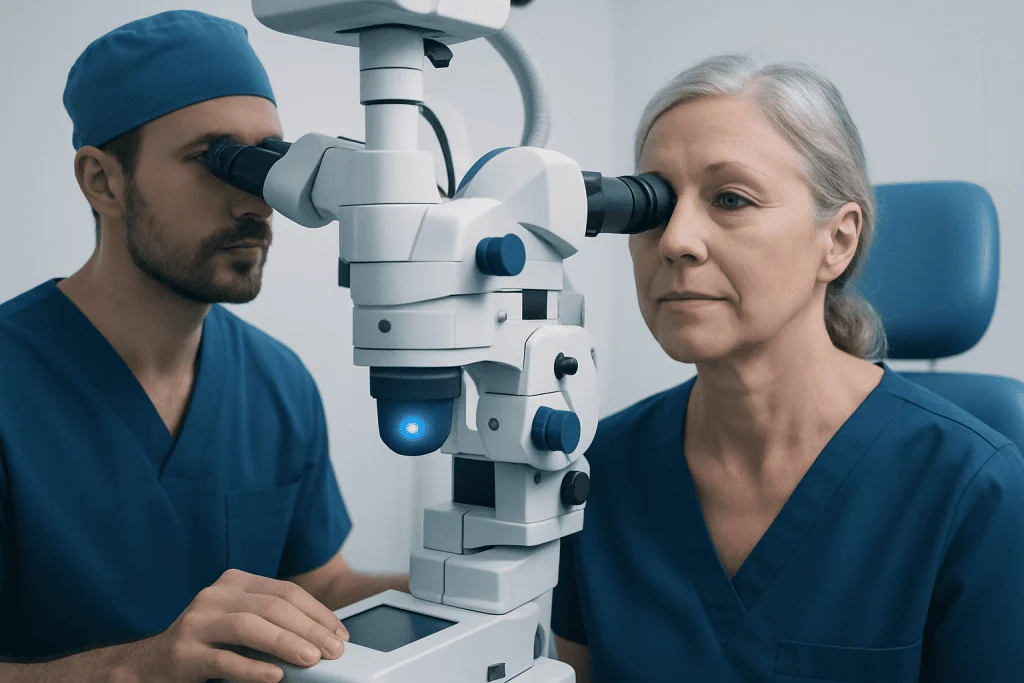
An ophthalmologist diagnoses cerulean cataract during a comprehensive eye examination. After checking vision in an age-appropriate way, the clinician examines the front of the eye and lens using magnification, often after dilating the pupils. Photographs or other measurements may be used to document the pattern and monitor change over time.
For infants and children, assessment also focuses on whether the cataract interferes with the development of normal vision. The specialist may check fixation behavior, eye alignment, refractive error, and whether one eye sees less well than the other. Testing may need to be repeated because visual development changes rapidly in early childhood.
In adults, the examination also helps identify other causes of visual change, such as refractive error, retinal disease, glaucoma, or dry eye. A person who sees information about cerulean cataract on resources such as EyeWiki should still seek an individualized ophthalmic assessment; online descriptions cannot determine whether surgery is needed.
Cerulean cataract surgery: how it works and who may benefit
Cataract surgery is considered when a cerulean cataract causes meaningful visual difficulty or, in a child, threatens visual development. Surgery is not automatically necessary for every visible lens opacity. People with stable, mild cataracts and good vision may be monitored with scheduled examinations and updated glasses where appropriate.
During modern cataract surgery, the surgeon makes very small incisions, breaks up and removes the cloudy lens, and usually places a clear artificial intraocular lens to restore focusing power. This procedure is commonly performed with ultrasound-assisted phacoemulsification in adults. The approach in infants and young children is individualized and may include additional steps to reduce the chance of the visual axis becoming cloudy again.
Candidacy is based on vision, symptoms, eye measurements, lens findings, general health, and personal visual needs. Children require particular urgency when a cataract blocks the central visual axis, because untreated blur during critical developmental periods can lead to lasting amblyopia. A discussion of cataract surgery should include the eye’s anatomy, lens options where relevant, and the expected need for glasses after surgery.
Procedure steps, recovery, benefits and possible risks
Before surgery, the eye is measured to help plan the artificial lens power and the surgeon reviews medications and medical history. On the day, anesthesia is selected according to age, health, and the procedure. Adults commonly receive local anesthesia with sedation when needed; children usually require general anesthesia so the eye can be treated safely and precisely.
The surgeon creates tiny openings in the cornea, removes the cloudy lens material, and inserts an intraocular lens in most suitable cases. The procedure itself is usually brief, but the overall visit and recovery arrangements may take longer. Afterward, prescribed eye drops are used to prevent infection and control inflammation, and follow-up visits check healing and vision.
Many adults notice clearer vision within days, although complete stabilization may take several weeks. Children need longer-term follow-up because their eyes grow and their visual system is still developing; glasses, contact lenses, patching therapy, or visual rehabilitation may be necessary. Benefits can include clearer sight, less glare, and improved daily functioning.
As with any eye operation, risks include infection, inflammation, raised eye pressure, retinal swelling or detachment, bleeding, lens-position concerns, and a need for further treatment. A cloudy membrane behind the artificial lens can also develop later and is often treatable with a laser procedure in appropriate patients. The surgical team explains the individual balance of benefit and risk before proceeding.
What is the new treatment for cataracts in 2026?
As of 2026, cataract surgery remains the only established treatment that removes a cataract and restores clarity to the optical pathway. No approved eye drop, vitamin, or medicine has been shown to reliably dissolve or reverse a cerulean cataract or other established cataracts in routine clinical practice.
Current advances focus mainly on surgical planning, imaging, incision techniques, laser-assisted steps in selected settings, and intraocular lens technology. These developments may help tailor treatment to a person’s eye measurements and visual goals, but they do not eliminate the need for a careful examination or make surgery necessary for mild cataracts.
People considering newer approaches should ask their ophthalmologist what evidence supports the option for their particular eye, what it can realistically improve, and what alternatives are available. The best choice is individualized rather than based on a single device or trend.
Which vitamins prevent cataracts?
No vitamin has been proven to prevent cerulean cataracts, which are usually genetic, or to clear an existing cataract. Antioxidant nutrients are important to general health, but supplements should not be presented as a replacement for eye examinations or recommended cataract treatment.
A balanced diet that includes fruits, vegetables, whole grains, legumes, and healthy protein sources supports overall health. For common age-related cataract risk, avoiding smoking, managing diabetes when present, protecting the eyes from excessive ultraviolet exposure with appropriate eyewear, and attending routine eye care are practical measures that may support eye health. These steps cannot guarantee prevention.
Anyone considering high-dose supplements should discuss them with a clinician, especially if they take prescription medicines, are pregnant, have kidney or liver disease, or are arranging surgery. Supplements can have side effects and interactions even when sold without a prescription.
What are the top 5 reasons patients regret cataract surgery?
Most people who have appropriately indicated cataract surgery are satisfied with the improvement in vision, but understanding possible sources of disappointment supports informed decisions. The “top five” is not a fixed medical ranking, and individual experiences vary. Common concerns can include:
- Expectations that surgery will correct every vision problem, including retinal or optic nerve disease.
- Unexpected dependence on glasses for reading, distance, or both after surgery.
- Glare, halos, starbursts, or reduced night-driving comfort, particularly with some lens designs.
- Dry-eye symptoms or slower-than-expected visual recovery.
- Uncommon complications or later treatment needs, such as posterior capsule clouding.
Careful preoperative testing and a candid conversation about lifestyle needs can reduce avoidable disappointment. Patients should mention night driving, close work, hobbies, previous eye surgery, dry-eye symptoms, and any preference about glasses. An ophthalmologist can explain which outcomes are realistic and whether a particular lens option is suitable.
When to seek medical care
Any child with a suspected cataract, a white or unusual pupil appearance, poor visual attention, eye wandering, or involuntary eye movements should be assessed promptly by an eye specialist. Early evaluation is important because visual development in childhood is time-sensitive, even if the child does not appear distressed.
Adults should arrange an eye examination for gradually worsening blur, glare, colors appearing less vivid, difficulty driving at night, or a noticeable decline in vision. Sudden vision loss, severe eye pain, marked redness, flashes of light, a new shower of floaters, or a curtain-like shadow requires urgent medical assessment, as these symptoms may have causes other than cataract.
Acibadem International’s multidisciplinary specialists and JCI-accredited hospitals diagnose and treat cataracts for international patients, with care plans based on each person’s eye findings and visual needs. A qualified ophthalmologist can advise whether observation, visual correction, or surgery is the appropriate next step.
Frequently asked questions
What is another name for a cerulean cataract?
Cerulean cataract is also called blue-dot cataract because of its characteristic bluish-white lens opacities. Some clinical descriptions use terms such as congenital cerulean cataract or developmental cerulean cataract, depending on when it is identified.
Is a cerulean cataract hereditary?
It is often hereditary and may occur in several members of a family. Many families show an autosomal dominant inheritance pattern, but severity can vary and some people have no known family history. Genetic counseling may be helpful in selected cases.
Can cerulean cataracts get worse over time?
They may remain mild and stable for years, or become more visually significant over time. The course differs from person to person. Regular examinations help detect changes in vision and identify when treatment may be needed.
Does every child with cerulean cataract need surgery?
No. Surgery is usually reserved for cataracts that significantly affect vision or obstruct normal visual development. A pediatric ophthalmologist assesses the cataract’s location and density, vision in each eye, and the risk of amblyopia before recommending treatment.
Can glasses treat a cerulean cataract?
Glasses can correct refractive errors and may improve vision when the lens opacity is mild, but they do not remove the cataract itself. If the cataract blocks light or causes important visual impairment, surgery may be the more effective option.
Are cataract eye drops available for cerulean cataract?
There are no approved eye drops that reliably reverse a cerulean cataract or remove an established cataract. Claims that drops can dissolve cataracts should be discussed with an ophthalmologist before use. Surgery remains the evidence-based treatment when a cataract is visually significant.
References
- American Academy of Ophthalmology
- National Eye Institute
- American Association for Pediatric Ophthalmology and Strabismus
- MedlinePlus Genetics
- Mayo Clinic
This article is for general information only and is not a substitute for professional medical advice. Please consult a qualified doctor about your individual situation.
Explore treatments in Turkey — costs, top hospitals & a free quote
JCI-accredited · board-certified surgeons · reply within 24h
Add us as a Preferred Source to see more of our trusted health content across Google Search, AI Overviews and Discover.