Child Vision Therapy Benefits: How It Works, Results and What to Expect

Vision therapy uses structured office-based activities and home practice to improve specific visual skills. Children may be candidates when a pediatric eye specialist identifies conditions such as convergence insufficiency or accommodative dysfunction.
Key Takeaways
- Vision therapy uses structured office-based activities and home practice to improve specific visual skills.
- Children may be candidates when a pediatric eye specialist identifies conditions such as convergence insufficiency or accommodative dysfunction.
- Progress is measured through symptoms, functional changes and repeat eye examinations rather than a single universal success rate.
- Results and treatment duration vary with the diagnosis, the child’s needs and consistent participation.
- A comprehensive eye examination is important before starting therapy to identify refractive errors, eye disease or other causes of symptoms.
Child vision therapy benefits can include improved eye teaming, focusing, tracking and visual processing skills when a child has a diagnosed visual-function problem. It is an individualized, supervised program and is not a replacement for glasses, treatment of eye disease, or standard care for conditions such as dyslexia.
Overview: What Are Child Vision Therapy Benefits?
Child vision therapy benefits may include better coordination between the eyes, more comfortable near vision, improved focusing control and more efficient tracking for children with specific diagnosed visual-function disorders. The program is designed around the child’s needs and typically combines guided activities in clinic with short home exercises. It is most useful when evaluation shows a problem that vision therapy is known to address.
Vision therapy is sometimes described as physical therapy for the visual system. It does not simply strengthen the eye muscles, and it is not the same as routine eye exercises found online. A pediatric ophthalmologist, optometrist with relevant training, or orthoptist first determines whether the child’s symptoms are related to eye alignment, focusing, binocular vision or another concern.
Importantly, vision therapy does not replace appropriate glasses, contact lenses, patching for amblyopia when indicated, or medical and surgical treatment for eye conditions. It also should not be presented as a proven standalone treatment for learning disabilities or dyslexia, although treating genuine visual discomfort may help a child use vision more comfortably during reading and schoolwork.
How Vision Therapy Works
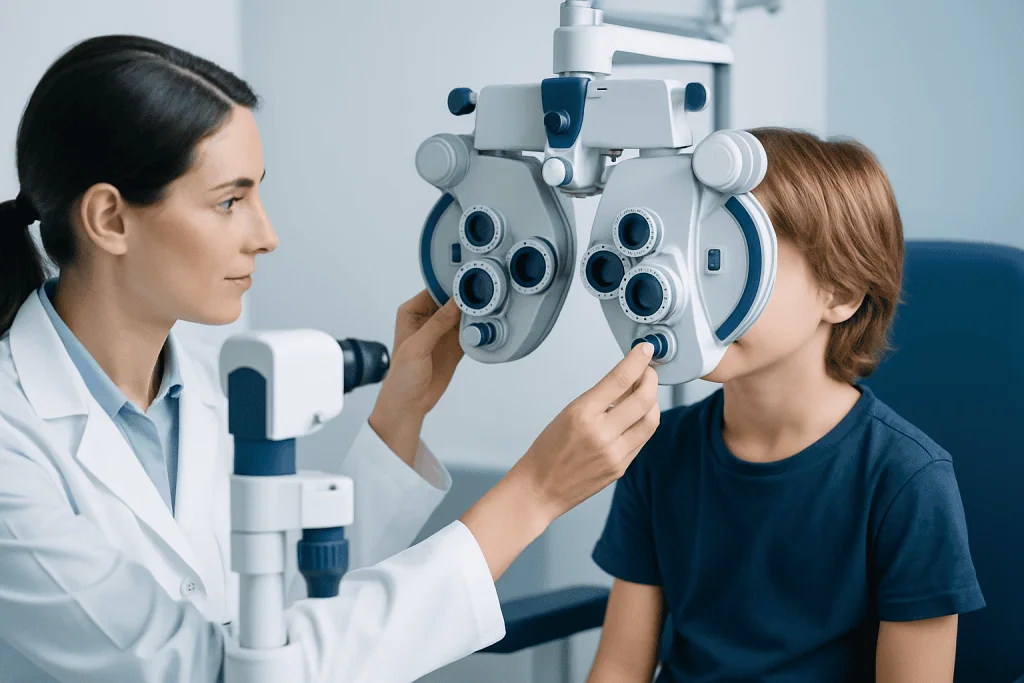
Clear, comfortable vision depends on more than visual sharpness. The eyes must point at the same place, move accurately across a page, adjust focus between distances and send coordinated information to the brain. Vision therapy uses repeated, graded tasks to develop these skills and to help a child apply them more comfortably in daily activities.
Sessions may involve lenses, prisms, filters, computer-based tasks, targets, balance activities or tools that require the eyes to converge, diverge, focus or follow moving information. The exact activities depend on the diagnosis. The clinician adjusts difficulty over time and explains which home exercises are appropriate.
For example, office-based therapy with home reinforcement has evidence of benefit for many children with symptomatic convergence insufficiency, a condition in which the eyes have difficulty turning inward for close work. A careful assessment can also identify related concerns, including amblyopia, which requires its own evidence-based treatment plan.
Who May Be a Candidate for Vision Therapy?

A child may be considered for vision therapy after a comprehensive eye and vision assessment identifies a treatable functional problem. Possible reasons for referral include eyestrain, headaches with close work, double vision, words appearing to move, losing place while reading, avoidance of near tasks, poor depth judgment or difficulty shifting focus from a board to a desk.
Conditions that may be evaluated include convergence insufficiency, accommodative insufficiency or excess, certain eye-movement difficulties, and selected binocular-vision disorders. Symptoms can also arise from uncorrected refractive errors, dry eye, migraine, neurological conditions or learning differences. This is why assessment should come before treatment.
A clinician will review visual acuity, eye health, refractive error, eye movements, alignment, focusing, depth perception and the child’s symptoms. Children who need glasses should generally wear the prescribed correction. If a misalignment or other eye condition is found, the care team may discuss monitoring, non-surgical care or strabismus surgery when clinically appropriate.
- Children should be able to participate safely in age-appropriate activities and follow simple instructions.
- Families should be prepared for regular appointments and supervised home practice when prescribed.
- Goals should be specific, measurable and related to the diagnosed visual problem.
What Happens During Vision Therapy? Step by Step
Before treatment begins, the clinician establishes a baseline. This includes the child’s symptoms, results of alignment and focusing tests, and practical concerns such as reading comfort or the ability to sustain near work. The family should receive an explanation of the diagnosis, expected goals, the planned schedule and how progress will be assessed.
During a typical session, the child performs short structured tasks with the clinician’s guidance. Activities may train eye convergence for near tasks, smooth tracking, rapid shifts of gaze, focusing flexibility or coordination between visual information and movement. Sessions are usually adapted to the child’s age and attention span, with rest breaks as needed.
Home practice often reinforces one or more skills learned in clinic. It should be clear, time-limited and reviewed regularly rather than becoming a stressful burden. At follow-up visits, the clinician checks symptoms and objective findings, adjusts activities, and decides whether the plan should continue, change or end.
Parents should ask what diagnosis is being treated, which outcomes will be tracked, and what evidence supports the recommended approach. A coordinated plan may include pediatric ophthalmology, optometry, orthoptics, neurology or educational support depending on the child’s needs.
How Long Does It Take to See Results From Vision Therapy?
Some children notice less eyestrain, fewer headaches or easier close work within several weeks, while meaningful improvement in measured visual skills may take longer. The timeline depends on the specific diagnosis, the severity of symptoms, the treatment plan, attendance and whether home activities are completed as recommended.
For conditions such as symptomatic convergence insufficiency, office-based programs often run over weeks to a few months, but there is no fixed schedule that suits every child. The clinician should set review points and discuss whether changes in symptoms and testing show that the program is helping.
Vision therapy is not usually associated with a physical recovery period. A child can generally return to school and usual activities after sessions. Mild temporary eye fatigue or headache can occur after demanding visual tasks, especially early in treatment; families should report persistent or worsening symptoms so the plan can be reassessed.
Is Vision Therapy Effective for Kids?
Vision therapy can be effective for children when it is used for selected, properly diagnosed visual-function conditions and delivered in a structured, supervised way. The strongest evidence supports office-based vergence and accommodative therapy, with home reinforcement, for symptomatic convergence insufficiency in children.
Its effectiveness is more variable for other complaints and diagnoses. A child who struggles with reading may have a visual problem, a learning difference, attention difficulties, language concerns, or more than one issue at the same time. Treating a confirmed visual disorder may reduce visual discomfort, but it should not delay a comprehensive educational or developmental assessment when that is needed.
Families should be cautious about broad claims that vision therapy can correct all school or behavior difficulties. Good care is diagnosis-led, uses measurable goals and includes ongoing review. If there is no objective or practical improvement after an agreed trial, the clinician should reconsider the diagnosis and next steps.
How to Tell if Vision Therapy Is Working
Improvement should be evaluated using both the child’s experience and repeat clinical measurements. A child may report fewer headaches, less double vision, more comfortable reading or better ability to maintain attention during close visual tasks. Parents and teachers may also notice fewer breaks, less rubbing of the eyes, or improved confidence with visually demanding activities.
At visits, the clinician can repeat tests of near point of convergence, focusing ability, eye alignment, eye movements and symptom questionnaires. These results help show whether the targeted skill is changing. Improvement in one area does not necessarily mean every learning or attention concern will resolve, so expectations should remain realistic.
A useful treatment plan identifies the starting problem, the intended functional goals and the criteria for discharge or referral. Families should let the care team know if activities consistently cause discomfort, if home practice is difficult to complete, or if new symptoms appear. Adjustments are often possible and may improve participation.
What Is the Success Rate of Vision Therapy?
There is no single reliable success rate for vision therapy because it covers different diagnoses, treatment formats, outcome measures and patient populations. A percentage quoted without stating the exact condition and type of therapy can be misleading. Outcomes should be discussed in relation to the child’s own diagnosis and baseline test results.
For symptomatic convergence insufficiency, well-designed clinical research has found that many children improve with office-based vergence and accommodative therapy combined with home reinforcement. However, individual outcomes vary, and improvement in measured eye coordination may not occur at the same pace as improvement in symptoms or school-related functioning.
The most meaningful question is whether the therapy is producing the agreed, measurable benefits for the individual child. Families can ask about the evidence for the proposed treatment, how response will be monitored, when progress will be reviewed and what alternatives are available if goals are not met.
Risks, Benefits and When to Seek Medical Care
Potential benefits are reduced visual discomfort and improved efficiency of eye teaming, focusing or tracking for an appropriate diagnosis. Risks are generally low when therapy is properly prescribed and supervised, but activities can cause temporary fatigue, eyestrain, headache, nausea or brief blur or double vision. These symptoms should be reported rather than pushed through.
Prompt medical assessment is important if a child develops sudden or persistent double vision, a new eye turn, reduced vision, eye pain, redness with light sensitivity, a drooping eyelid, severe headache, vomiting, weakness, problems with balance or symptoms after a head injury. These symptoms may need urgent evaluation and are not situations to manage with home exercises alone.
Parents should also arrange an eye examination for ongoing headaches, frequent blinking or squinting, difficulty with near work, suspected vision changes, or concerns raised by school. Acibadem International’s multidisciplinary specialists and JCI-accredited hospitals can assess visual symptoms and coordinate care for international patients when appropriate.
Regular eye care, correct use of prescribed glasses and open communication with the child’s school and healthcare team support visual comfort. Therapy should be one part of an individualized plan, not a substitute for medical evaluation or broader developmental support.
Frequently asked questions
What are the main child vision therapy benefits?
For children with a diagnosed binocular-vision, focusing or eye-movement problem, benefits may include less eyestrain, fewer near-work symptoms and better visual coordination. The expected benefit depends on the specific condition, not simply on the presence of reading or school difficulties.
How long does it take to see results from vision therapy?
Some children experience symptom improvement within a few weeks, but skill development commonly takes weeks to months. The exact timing depends on the diagnosis, treatment intensity, attendance and home practice. The care team should review progress at planned intervals.
Is vision therapy effective for kids?
Vision therapy can be effective for specific, properly diagnosed conditions, particularly symptomatic convergence insufficiency when office-based therapy and home reinforcement are used. Evidence is not equally strong for every condition or for claims that therapy treats learning disabilities. A comprehensive assessment helps determine whether it is suitable.
How can parents tell if vision therapy is working?
Parents may notice less discomfort during reading, fewer headaches, reduced avoidance of close work or fewer reports of double vision. The clinician should also repeat objective tests of eye alignment, focusing and convergence. Both everyday improvements and measured results are important.
What is the success rate of vision therapy?
There is no single success rate because vision therapy is used for different diagnoses and programs. Research supports improvement for many children with symptomatic convergence insufficiency in structured office-based therapy, but individual results vary. Families should ask how success is defined for their child’s diagnosis.
Can vision therapy replace glasses or treatment for amblyopia?
No. Glasses correct refractive errors, and amblyopia may require treatments such as appropriate optical correction, patching or other clinician-directed care. Vision therapy may be considered alongside other care only when there is a separate diagnosed need.
References
- American Academy of Ophthalmology
- American Association for Pediatric Ophthalmology and Strabismus
- National Eye Institute
- Convergence Insufficiency Treatment Trial Study Group
This article is for general information only and is not a substitute for professional medical advice. Please consult a qualified doctor about your individual situation.
Explore treatments in Turkey — costs, top hospitals & a free quote
JCI-accredited · board-certified surgeons · reply within 24h
Add us as a Preferred Source to see more of our trusted health content across Google Search, AI Overviews and Discover.

More from the Health Library


Related Specialists

Prof. Dr. Yavuz Baykal
Internal Medicine
Dr. Burak Boynuk
Orthopedic Surgery & Traumatology
Assoc. Prof. Dr. Onur Dülgeroğlu
General Surgery
Assoc. Prof. Dr. Şafak Yıldırım Dişli
Medical Oncology