Coronary angiography in Turkey: Hospitals, Safety & What to Expect

Coronary angiography uses a thin catheter, contrast dye and X-ray imaging to examine the heart’s arteries. It is usually performed through an artery in the wrist or groin under local anesthetic and light sedation when needed.
Key Takeaways
- Coronary angiography uses a thin catheter, contrast dye and X-ray imaging to examine the heart’s arteries.
- It is usually performed through an artery in the wrist or groin under local anesthetic and light sedation when needed.
- Most people are monitored for several hours after the procedure and can often return to usual gentle activities within a few days.
- The test can identify narrowed arteries and help cardiologists decide whether medicines, angioplasty, stenting or surgery may be appropriate.
- Although generally safe, coronary angiography has uncommon but important risks that should be discussed with the cardiology team.
Coronary angiography in Turkey is a hospital procedure used to show whether the coronary arteries supplying the heart are narrowed or blocked. It is commonly performed by an interventional cardiology team when symptoms, test results or medical history suggest coronary artery disease.
Overview: Coronary Angiography in Turkey
Coronary angiography in Turkey is a diagnostic cardiac procedure that provides detailed images of the coronary arteries, the blood vessels that supply oxygen-rich blood to the heart muscle. A cardiologist may recommend it when there is concern about narrowing or blockage in these arteries, particularly after symptoms such as exertional chest discomfort, breathlessness, or abnormal non-invasive heart test results.
The examination is also called coronary catheter angiography or cardiac catheterization. It is performed in a specialist catheterization laboratory, where an interventional cardiologist guides a very thin tube called a catheter into an artery, injects contrast dye and takes moving X-ray images. For an overview of the procedure and its role in heart care, see coronary angiography.
In Turkey, patients considering care should look for a hospital with an established cardiology service, experienced catheterization laboratory staff, clear communication about testing and follow-up, and robust safety processes. JCI accreditation, where applicable, is one indicator that a hospital has been assessed against internationally recognized quality and patient-safety standards; it does not replace an individual discussion about the team, the facility and the proposed care plan.
How Coronary Angiography Works
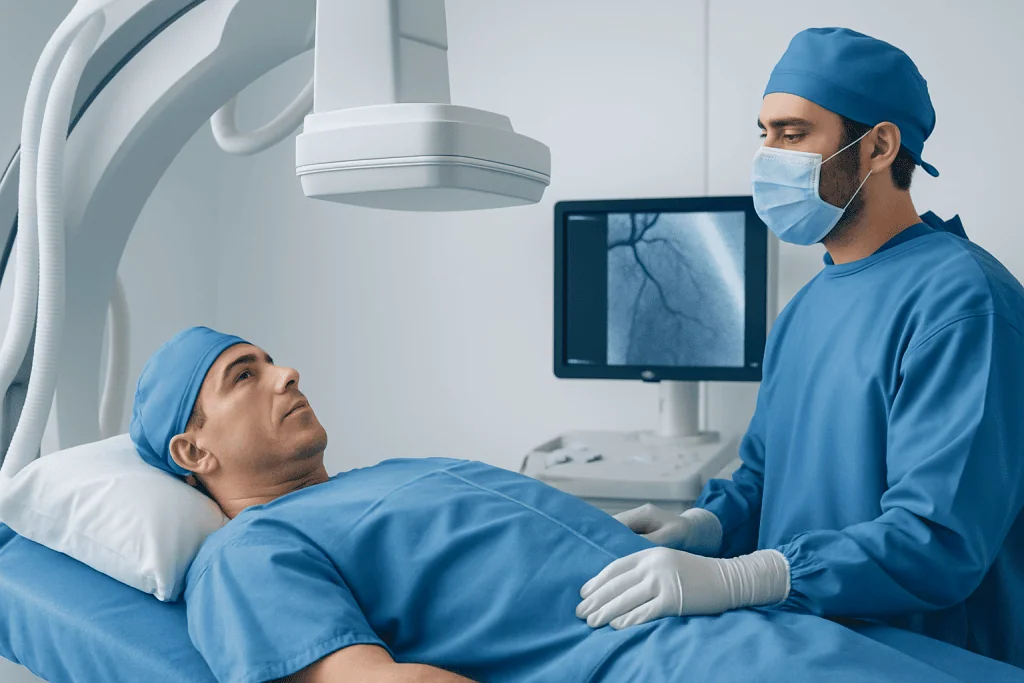
Coronary angiography allows clinicians to see the inside outline of the coronary arteries. After a catheter is placed through an artery, contrast dye is injected into the coronary circulation. The dye appears on X-ray, allowing the cardiologist to assess whether blood flow is reduced by plaque-related narrowing, a blockage, or less common artery abnormalities.
The procedure is different from a CT coronary angiogram, which is a non-invasive scan performed with a CT scanner. Conventional catheter angiography is invasive, but it gives real-time, high-detail images and can sometimes allow treatment during the same session if this has been discussed and is clinically suitable.
Results help the team understand whether symptoms may be related to coronary artery disease and guide the next step. Depending on the findings, this may be medical treatment and risk-factor management, further testing, or a revascularization procedure such as balloon angioplasty and stent placement.
Who May Need the Procedure

A cardiologist considers coronary angiography when the expected information is likely to influence treatment decisions. It may be recommended for people with persistent or concerning symptoms suggestive of reduced heart blood flow, such as pressure or tightness in the chest during activity, unexplained shortness of breath, or symptoms that have not improved with initial treatment.
It may also be used after an abnormal stress test, echocardiogram, CT coronary angiogram or other investigation. In urgent settings, it can be part of assessment and treatment for acute coronary syndromes, including a suspected heart attack. The timing and urgency depend on symptoms, electrocardiogram findings, blood tests and the person’s overall clinical condition.
Before recommending angiography, the cardiology team reviews medical history, medications, kidney function, allergies, bleeding risk and previous imaging. People should tell the team about pregnancy or a possibility of pregnancy, reactions to contrast dye, asthma, kidney disease, diabetes, blood-thinning medicines and any prior complications from procedures.
- Possible candidates include people with suspected significant coronary narrowing.
- It may be considered when non-invasive tests are unclear or suggest high-risk findings.
- It can help plan treatment in some people with known coronary disease or recurring symptoms after previous treatment.
What Happens Before, During and After the Test
Preparation begins with a clinical review, consent process and checks such as blood pressure, heart rhythm and blood tests when appropriate. The team gives individualized instructions about eating, drinking and medicines. Some medicines may need adjustment, but patients should not stop prescribed medication, especially antiplatelet or anticoagulant medicine, unless the clinician instructs them to do so.
During the procedure, the patient lies on an X-ray table. The wrist or groin is cleaned and numbed with local anesthetic. The cardiologist inserts the catheter into an artery and advances it to the heart under X-ray guidance. Contrast is injected while images are taken. A temporary warm sensation or metallic taste can occur with contrast injection and usually passes quickly. Patients are generally awake and can communicate with staff.
After imaging, the catheter is removed and pressure or a closure device is used to control bleeding at the access site. Monitoring continues in a recovery area, where staff check the pulse, blood pressure, heart rhythm and the wrist or groin. If a significant narrowing is found, the cardiologist may discuss whether angioplasty and stent treatment is appropriate, either during the same session or at a later time.
For international patients, planning should include sharing medical records in advance, allowing time for pre-procedure evaluation and arranging a companion when possible. Hospitals may assist with practical coordination such as interpreter services, local transport and accommodation guidance, while clinical decisions remain based on the person’s health needs.
Recovery Timeline, Benefits and Possible Risks
Many diagnostic angiography patients go home the same day after a period of observation, although some require overnight monitoring because of their health status, access site, test findings or travel considerations. Mild tenderness or bruising around the wrist or groin can occur. The care team provides instructions about wound care, bathing, driving, lifting, hydration and the appropriate time to resume work or exercise.
In general, gentle activity is possible soon after discharge, while strenuous activity and heavy lifting should be avoided for the period advised by the clinical team. Drinking fluids may help the body clear the contrast dye when this is medically appropriate. People with kidney or heart conditions should follow individualized fluid advice rather than increasing intake on their own.
The main benefit is accurate information that can clarify whether coronary artery narrowing is present and how extensive it may be. This can support timely, individualized treatment decisions. In some circumstances, the procedure can be followed immediately by an intervention to restore blood flow.
Complications are uncommon, but may include bleeding, bruising, blood-vessel injury, irregular heartbeat, contrast reaction, kidney problems or infection. Rare serious complications include heart attack, stroke or emergency surgery. The cardiologist explains the person’s individual risk, which can be influenced by age, kidney function, existing heart disease and other medical conditions.
Choosing a Hospital and Planning Care in Turkey
When arranging coronary angiography abroad, it is helpful to request a clear pathway for pre-assessment, the procedure day, results discussion, discharge planning and follow-up after returning home. Patients should provide recent test results, medication lists, allergy information and relevant medical reports before travel. A cardiology team can then assess whether angiography is appropriate and whether additional investigations are needed first.
Questions worth asking include who will perform the procedure, whether an interventional cardiologist and emergency support are available, how contrast and kidney risks are assessed, how results will be documented, and what follow-up is recommended. It is also sensible to avoid scheduling long-distance travel immediately after an invasive procedure without explicit clearance from the treating clinician.
Acibadem International’s multidisciplinary specialists and JCI-accredited hospitals diagnose and treat cardiovascular conditions for international patients, with care coordination tailored to clinical and travel needs. Any treatment decision should follow a personal consultation, review of imaging and discussion of benefits, alternatives and potential risks.
When to Seek Medical Care
Urgent medical assessment is needed for chest pressure, pain or discomfort that is severe, lasts more than a few minutes, occurs at rest, or is accompanied by shortness of breath, sweating, nausea, fainting or pain spreading to the arm, jaw, back or shoulder. These symptoms can have different causes, but they should not be assessed by waiting for a planned appointment or traveling for elective care. Local emergency services should be contacted immediately.
After coronary angiography, patients should seek urgent medical advice if there is bleeding that does not stop with firm pressure, rapidly increasing swelling, severe pain, numbness or coolness in the arm or leg used for access, fever, worsening redness at the site, chest pain, breathlessness or fainting. The treating hospital’s discharge instructions should be followed closely.
For non-urgent but recurring exertional chest symptoms, declining exercise tolerance, palpitations or unexplained breathlessness, arranging a timely consultation with a qualified doctor or cardiologist is appropriate. Early evaluation can help identify the cause and determine whether coronary angiography or a less invasive test is needed.
Frequently asked questions
Is coronary angiography painful?
The local anesthetic injection may briefly sting, but the catheter procedure itself is usually not painful. Some people notice pressure at the access site or a short-lived warm feeling when contrast dye is injected. The team monitors comfort throughout the procedure and can provide appropriate medication if needed.
How long does coronary angiography take?
The imaging portion often takes less than an hour, but the overall visit is longer because of preparation, consent, recovery and monitoring. The duration may vary if the anatomy is complex or if treatment is performed during the same session. The cardiology team can provide a more individualized estimate.
Can a patient fly after coronary angiography in Turkey?
Travel timing depends on the access site, recovery, test results and whether an intervention such as stenting was performed. A patient should not book or take a flight until the treating cardiologist confirms that it is medically safe. Longer journeys may require additional planning and follow-up arrangements.
What is the difference between angiography and angioplasty?
Angiography is primarily a diagnostic procedure that shows the coronary arteries using contrast dye and X-ray imaging. Angioplasty is a treatment that uses a balloon, and often a stent, to improve blood flow through a narrowed artery. If angioplasty may be needed, the cardiologist discusses this possibility before the procedure whenever circumstances allow.
Will coronary angiography show every cause of chest pain?
No. Coronary angiography is designed to assess the large coronary arteries and is very useful for identifying significant narrowing or blockage in them. Chest symptoms can also arise from small-vessel heart disease, heart rhythm problems, lung conditions, digestive conditions, muscles or anxiety, so further evaluation may sometimes be needed.
What should a patient bring for coronary angiography abroad?
Patients should bring a current medication list, allergy details, previous cardiology reports, imaging results, laboratory reports and identification documents. It is helpful to have these records translated into English when possible. A companion can also be useful, particularly for support after sedation and during travel planning.
References
- American Heart Association
- European Society of Cardiology
- National Heart, Lung, and Blood Institute
- Mayo Clinic
- Joint Commission International
This article is for general information only and is not a substitute for professional medical advice. Please consult a qualified doctor about your individual situation.
Coronary Angiography in Turkey — costs, top hospitals & a free quote
JCI-accredited · board-certified surgeons · reply within 24h
Add us as a Preferred Source to see more of our trusted health content across Google Search, AI Overviews and Discover.
Check your numbers in seconds
BMI, calories, due date, blood pressure and 30+ more clinical calculators — free, instant, doctor-reviewed ranges.

Cardiology Department
Diagnosis and treatment of heart and vascular conditions, from prevention to advanced interventional procedures.
91 specialists in this unitMore from the Health Library



Related Specialists

Dr. Yunus Çelik
Anesthesiology
Asst. Prof. Dr. Meltem Açıl
Anesthesiology
Prof. Dr. İkbal Esen Aydingöz
Dermatology
Assoc. Prof. Dr. Kamer Dere
Treatment of Pain Algology