Dhi hair transplant vs Fue hair transplant: Which Is Right for You?

DHI and FUE commonly use follicular unit extraction to collect grafts from the donor area. DHI refers mainly to the implantation method, using a specialized implanter pen to place grafts.
Key Takeaways
- DHI and FUE commonly use follicular unit extraction to collect grafts from the donor area.
- DHI refers mainly to the implantation method, using a specialized implanter pen to place grafts.
- FUE typically involves extracting grafts, creating recipient sites, and then placing the grafts with forceps or an implanter.
- Neither technique is automatically better; natural-looking results rely on planning, graft handling, donor preservation and aftercare.
- Transplanted hair usually sheds initially, then regrows gradually over several months.
- A consultation with a qualified hair-restoration clinician is important to confirm the cause and stability of hair loss.
DHI and FUE hair transplantation both move individual hair follicles from a donor area to thinning or bald areas. The main difference is how follicles are implanted: DHI uses a pen-like implanter, while FUE usually creates recipient sites before placement; suitability depends on the person’s hair-loss pattern, donor hair, goals and medical assessment.
DHI Hair Transplant vs FUE: The Main Difference
For people comparing DHI hair transplant vs FUE hair transplant, the key point is that both methods can transplant naturally occurring groups of hair follicles, called follicular units. In many clinics, both approaches begin with follicular unit extraction (FUE), in which grafts are individually removed from a donor area, most often the back or sides of the scalp.
The distinction is usually in the recipient-area stage. With DHI, a clinician may load extracted grafts into a pen-like implanter and place them directly into the scalp. In conventional FUE implantation, the clinician generally creates small channels or sites first and then inserts grafts using fine forceps or another placement device. The right method is not determined by a label alone: safe donor management, an appropriate hairline design, graft survival and experienced clinical care matter most.
People seeking a fuller explanation of the DHI approach can review DHI hair transplant treatment information. A personalized consultation can clarify whether DHI-style implantation, FUE implantation, medical treatment, or a combination of approaches is appropriate.
How Each Procedure Works
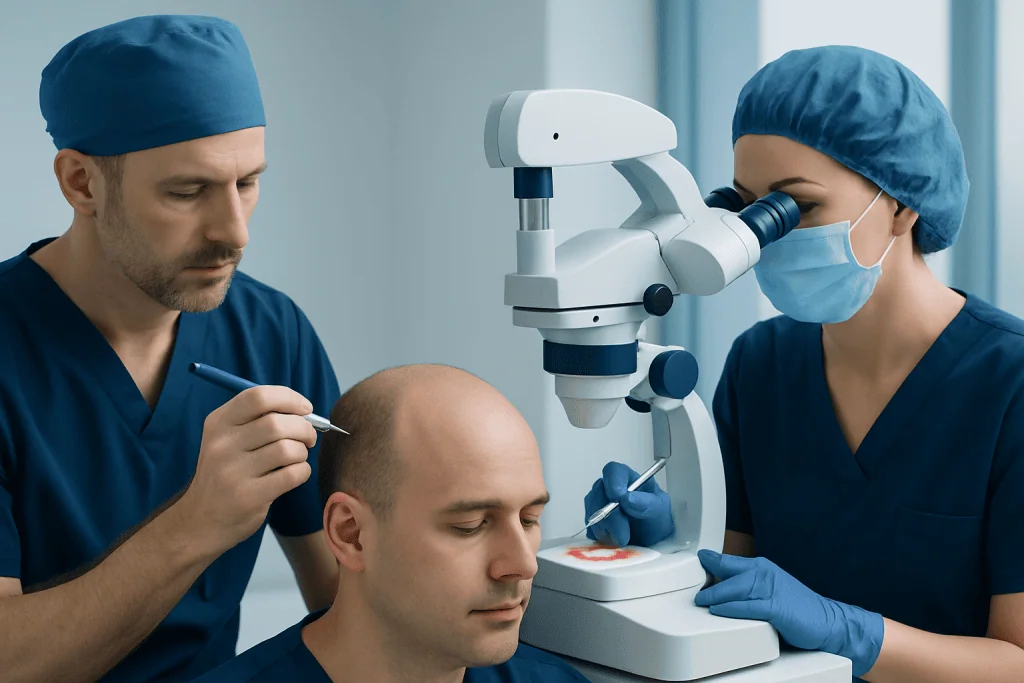
In FUE, the donor area is usually trimmed and numbed with local anesthetic. A small punch instrument is used to remove individual follicular units. These grafts are carefully sorted and kept in appropriate conditions while the recipient area is prepared. Tiny recipient sites are then made at angles and directions intended to match the person’s existing hair pattern before grafts are placed.
DHI also commonly uses FUE extraction, but implantation is performed with a specialized implanter. The device can create the placement opening and deliver the graft in one controlled action. This may allow the clinical team to focus closely on placement angle, direction and density in selected areas, such as the hairline or crown, when this is suitable for the patient.
It is important to understand that terminology varies between providers. DHI is often presented as separate from FUE, but it is more accurately understood as a particular implantation technique that may be used after FUE graft extraction. Patients can ask exactly how grafts will be extracted, handled and implanted, as well as who will perform each stage.
Who May Be a Candidate?

Potential candidates are adults with hair loss that has been assessed and is reasonably stable, adequate donor hair, and realistic expectations about density and coverage. The most common reason for transplantation is androgenetic alopecia, also called pattern hair loss. However, hair thinning can also occur because of autoimmune disease, nutritional deficiency, scalp inflammation, medication effects, hormonal changes or physical stress.
A clinician should examine the scalp and review the medical history before recommending surgery. The assessment may include hair-loss pattern, donor-area density and hair caliber, scalp characteristics, family history, current medicines, smoking status and previous procedures. Blood tests or dermatology assessment may be advised when the cause of hair loss is uncertain.
People with active scalp infection, uncontrolled medical conditions, ongoing severe inflammation or certain forms of scarring hair loss may need treatment or further evaluation before considering a transplant. A transplant also cannot create unlimited density; donor follicles are limited and should be used conservatively to preserve future options.
- DHI may be considered when detailed control of graft placement is a priority.
- FUE may be considered for a range of hair-loss patterns and recipient areas.
- Either approach may be unsuitable until an underlying scalp or medical condition is addressed.
- Medical therapy may help slow ongoing hair loss and protect non-transplanted hair when clinically appropriate.
What Happens During the Procedure?
Hair transplantation is generally performed as an outpatient procedure under local anesthesia. Before the procedure, the clinical team confirms the treatment plan, photographs the scalp, discusses the proposed hairline or coverage area, and prepares the donor and recipient sites. The exact duration varies with the number of grafts needed and the complexity of the plan.
First, follicles are extracted from the donor area, usually one follicular unit at a time. The grafts are examined and kept moist and protected. Next, the recipient region is prepared. In conventional FUE implantation, this usually includes making very small sites before graft placement. In DHI, grafts may be implanted using a pen-like device that places each follicular unit into the intended position.
After placement, the scalp is checked and patients receive instructions for washing, sleeping, activity and medicines if prescribed. The clinical team should explain which professional performs extraction, recipient-site creation and implantation. Careful coordination and sterile technique are important regardless of the method selected.
Benefits, Limits and Possible Risks
Both DHI and FUE can provide a long-lasting redistribution of hair follicles when candidates are chosen carefully and surgery is performed well. Because transplanted follicles are often taken from areas more resistant to pattern hair loss, they may continue to grow in their new location. Results are individual, and the visual outcome depends on donor characteristics, graft number, hair texture, contrast between hair and scalp, and future hair loss.
A potential benefit of DHI implantation is controlled placement of grafts without first making all recipient sites separately. Conventional FUE implantation can also allow precise hairline and directional planning. Neither method can reliably promise a particular density, eliminate the possibility of future thinning, or replace the need for medical management in everyone.
Temporary swelling, redness, itching, crusting and numbness can occur after either technique. Other possible complications include bleeding, infection, inflammation of hair follicles, shock loss of existing hair, uneven growth, visible donor-area thinning, scarring, poor graft growth or an unnatural-looking hairline. These risks are reduced, but not eliminated, by proper assessment, sterile technique, appropriate aftercare and realistic surgical planning.
Recovery Timeline and Self-Care
Small crusts and mild redness are common in the first days after transplantation. Patients are usually asked not to rub, scratch or pick at the grafts. Washing instructions vary by clinic but commonly involve gentle cleansing after the early healing period. The donor area also needs careful care while extraction sites heal.
Many people can return to desk-based activities within several days, depending on comfort and the visibility of redness or swelling. Strenuous exercise, swimming, direct sun exposure, helmets and other activities that may irritate the scalp may need to be avoided for a period advised by the treating team. Smoking and excessive alcohol use can interfere with healing and should be discussed before and after surgery.
It is common for transplanted hairs to shed in the weeks after the procedure; this does not necessarily mean the follicles have been lost. New growth often begins gradually after several months, and appearance continues to mature over the following months. Follow-up appointments allow the clinician to monitor healing, discuss ongoing hair loss and provide individualized guidance.
When to Seek Medical Care
Anyone noticing sudden, patchy, painful, itchy or rapidly worsening hair loss should seek medical evaluation before arranging a transplant. These features can suggest a condition that may need diagnosis and treatment rather than immediate surgery. Medical advice is also important when hair loss follows a new medicine, illness, major weight change, childbirth or a significant life stressor.
After a transplant, patients should contact their treating team promptly if they develop increasing pain, spreading redness, fever, pus-like drainage, significant bleeding, marked swelling, or any concern about the healing scalp. Early review can help identify whether care or treatment is needed.
For international patients, Acibadem International’s multidisciplinary specialists and JCI-accredited hospitals can assess hair loss and discuss suitable treatment options. A consultation should focus on the individual’s diagnosis, donor capacity, expected outcome and long-term hair-restoration plan rather than on choosing a procedure name alone.
Frequently asked questions
Is DHI better than FUE?
DHI is not automatically better than FUE. Both may use the same method of extracting individual follicular units, with the main difference being how grafts are implanted. The better choice depends on the scalp, donor supply, treatment area, hair-loss pattern and the clinical team’s plan.
Does DHI leave less scarring than FUE?
If both procedures use FUE for graft extraction, their donor-area scarring pattern is generally similar: small, dot-like extraction scars. Scarring risk also depends on healing, skin characteristics, punch size, the number of grafts taken and the technique used. A qualified clinician can assess individual risk.
How long does it take to see results after DHI or FUE?
Transplanted hairs often shed during the first few weeks, which is an expected part of the growth cycle. New hair growth usually becomes noticeable gradually after several months. Final maturation can continue for many months, and timing differs among individuals.
Is a hair transplant permanent?
Transplanted follicles may continue growing for many years because they are commonly taken from hair that is more resistant to pattern hair loss. However, existing non-transplanted hair can continue to thin over time. Ongoing medical care or treatment may be recommended to help manage progressive hair loss.
Is hair transplantation painful?
Local anesthetic is usually used so patients should not feel sharp pain during the main stages of the procedure. Some discomfort, tightness, tenderness or itching can occur as the anesthetic wears off and during early healing. The treating team can explain appropriate pain-relief and aftercare options.
Can women have DHI or FUE hair transplantation?
Some women may be suitable candidates, particularly when they have stable hair loss and a sufficient donor area. Because diffuse thinning and other medical causes of hair loss are common in women, careful assessment is especially important. A clinician may recommend blood tests, scalp assessment or medical treatment before surgery.
References
- American Academy of Dermatology
- International Society of Hair Restoration Surgery
- National Health Service
- Mayo Clinic
This article is for general information only and is not a substitute for professional medical advice. Please consult a qualified doctor about your individual situation.
FUE Hair Transplant in Turkey — costs, top hospitals & a free quote
JCI-accredited · board-certified surgeons · reply within 24h
Add us as a Preferred Source to see more of our trusted health content across Google Search, AI Overviews and Discover.

Hair Transplant
Modern FUE and DHI hair restoration with natural, lasting results.