Epstein Pearls: An Evidence-Based Guide for Patients

Epstein pearls are common, benign cysts in newborns. They usually appear as tiny white or yellow bumps on the gums or palate.
Key Takeaways
- Epstein pearls are common, benign cysts in newborns.
- They usually appear as tiny white or yellow bumps on the gums or palate.
- Most resolve naturally within a few weeks to a few months.
- They should not be squeezed, scraped, or treated at home.
- Medical advice is helpful if the baby has feeding trouble, mouth sores, fever, or lesions that do not improve.
Epstein pearls are small, harmless white or yellow cysts commonly seen in a newborn’s mouth, usually on the gums or roof of the mouth. They do not usually cause pain or feeding problems and almost always go away on their own without treatment.
What are Epstein pearls?
Epstein pearls are tiny white or yellowish cysts that can appear inside a newborn’s mouth. They are usually seen along the roof of the mouth or on the gums and are made of keratin, a normal protein found in skin and other tissues. Although they may look unfamiliar to parents, they are considered a normal and harmless finding in many babies.
These small cysts are not an infection, not a sign of poor feeding, and not a problem with tooth development. In most cases, they do not bother the baby at all. They are often noticed during routine newborn care, while feeding, or when a parent looks inside the mouth.
One reason Epstein pearls can cause concern is that they resemble other white spots in a baby’s mouth. However, unlike conditions such as oral thrush or mouth ulcers, Epstein pearls do not usually cause redness, irritation, or discomfort. A clinician can usually recognize them simply by examining the mouth.
What do Epstein pearls look like and where do they appear?
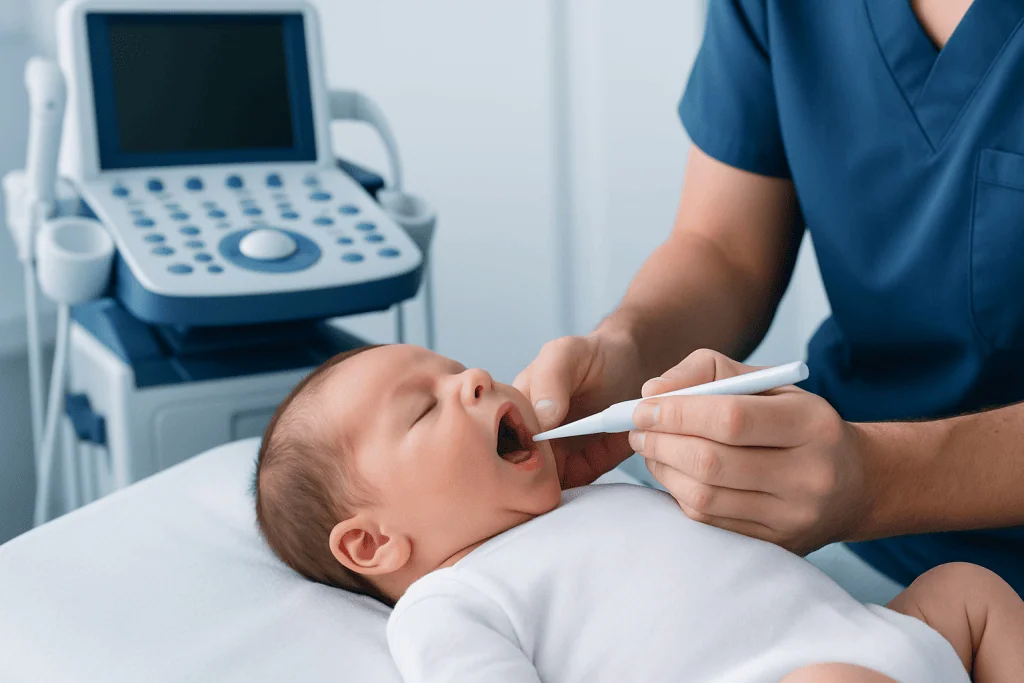
Epstein pearls are usually very small, often pinhead-sized, and appear smooth, round, and pale white or yellow. They may occur as a single bump or in small clusters. Their appearance is fairly distinctive once a clinician or experienced caregiver knows what to look for.
The most common location is the midline of the hard palate, which is the firm front part of the roof of the mouth. Similar harmless cysts can also appear on the gums. In everyday use, parents may describe all of these as white spots in a baby’s mouth, though clinicians may distinguish between Epstein pearls and closely related newborn oral cysts by location.
Because babies cannot describe symptoms, appearance and behavior matter. A baby with Epstein pearls usually feeds normally, cries normally, and does not show signs of pain when the mouth is touched gently. If the white patches seem wipeable, spread across the tongue and cheeks, or are linked with fussiness during feeding, another cause such as oral thrush may need to be considered.
Why do Epstein pearls happen?

Epstein pearls form during normal development before birth. As the tissues of the mouth develop and fuse, small pockets of epithelial tissue can become trapped. These pockets may fill with keratin and appear after birth as tiny cysts. This developmental process is common and does not mean anything went wrong during pregnancy.
They are not caused by an allergy, infection, vitamin deficiency, or trauma from feeding. They are also not related to how the baby was delivered or whether the baby is breastfed or formula-fed. In short, they are a normal newborn variation rather than a disease.
Parents often worry that these bumps might be early teeth. In most cases, Epstein pearls are clearly different from natal teeth or erupting teeth because they are small, superficial, and soft-looking rather than hard and tooth-like. If there is uncertainty, a pediatrician or pediatric dental specialist can confirm the cause with a simple examination.
How are Epstein pearls diagnosed?
Diagnosis is usually straightforward and based on the baby’s age, the location of the bumps, and their typical appearance. No blood test, scan, or biopsy is usually needed. A doctor, pediatrician, neonatologist, or pediatric dentist can often identify Epstein pearls in a routine visit.
The main goal of diagnosis is to tell Epstein pearls apart from other conditions that can affect the mouth. These include oral thrush, mucoceles, natal teeth, traumatic ulcers, or less commonly other cystic lesions. Thrush, for example, tends to create creamy white patches that may involve the tongue, inner cheeks, or lips and may be more diffuse than the isolated tiny bumps seen with Epstein pearls.
If a lesion looks unusual, lasts longer than expected, bleeds, grows, or seems to interfere with feeding, the clinician may look more closely for another explanation. In some situations, evaluation may involve a pediatric dental or ENT assessment, especially if the mouth findings do not fit the usual pattern of a benign newborn cyst.
Do Epstein pearls need treatment?
Epstein pearls do not usually need any treatment. They almost always disappear on their own as the cysts open or wear away naturally with normal mouth movement and feeding. This often happens within a few weeks, though some may remain visible a little longer before resolving.
The safest approach is observation and gentle routine infant care. Caregivers should not try to squeeze, scrape, rub, or pop the bumps. Home attempts to remove them can injure the delicate lining of the mouth, cause pain, or increase the risk of infection.
If a baby has separate feeding difficulties or another mouth condition, treatment depends on the actual cause rather than the Epstein pearls themselves. For example, if the concern turns out to be a different oral problem requiring specialist input, a doctor may recommend assessment through pediatric dentistry or, when airway or structural issues are suspected, ENT evaluation.
For families seeking coordinated care, Acibadem International’s multidisciplinary specialists in JCI-accredited hospitals evaluate newborn oral findings and related feeding concerns for international patients in an evidence-based, family-centered way.
Home care, feeding, and what parents should avoid
In most cases, no special home treatment is needed. Normal feeding and gentle daily care are enough. Parents can continue breastfeeding or bottle-feeding unless a healthcare professional advises otherwise. Since Epstein pearls are typically painless, babies usually feed as they normally would.
Good oral care for a newborn is simple. Caregivers may gently wipe the gums with a clean, damp soft cloth if advised by their clinician, but there is no need to scrub the cysts. Strong rubbing, using fingernails, or trying home remedies can irritate the mouth.
It may help to avoid these common mistakes:
- Do not try to burst or remove the bumps.
- Do not apply over-the-counter gels unless a doctor recommends them.
- Do not assume every white spot is thrush or needs medicine.
- Do not delay medical advice if the baby is not feeding well or seems unwell.
If there are ongoing concerns about latching, milk transfer, or oral comfort, a clinician may also evaluate for other issues affecting the mouth or feeding pattern. In selected cases, consultation through pediatrics can help clarify whether the baby’s symptoms are related to a normal newborn finding or another condition.
When to seek medical care
Although Epstein pearls are harmless, it is reasonable to seek medical advice if a parent is unsure what they are seeing. Newborn mouths can show several kinds of white lesions, and a professional exam can provide reassurance and make sure no treatment is needed.
A doctor should be consulted promptly if the baby has trouble feeding, seems to be in pain, develops fever, becomes unusually sleepy, or has poor weight gain. Medical review is also important if the white areas are widespread, appear on the tongue and inner cheeks, bleed, become red or swollen, or do not improve over time.
Parents should also seek evaluation if the lesion looks hard like a tooth, appears ulcerated, or is associated with other symptoms in the mouth. In that situation, the doctor may consider another diagnosis and, if appropriate, recommend assessment for related oral or upper airway conditions through mouth sores or specialist care.
Frequently asked questions
Are Epstein pearls normal in newborns?
Yes. Epstein pearls are a common and normal finding in many newborns. They are benign cysts and are not usually a sign of illness or a problem with development.
How long do Epstein pearls last?
They usually go away on their own within a few weeks, though some may remain visible for a little longer. Most resolve without any treatment as the mouth naturally changes with feeding and growth.
Do Epstein pearls hurt babies?
They do not usually cause pain or discomfort. Most babies with Epstein pearls feed and behave normally. If a baby seems uncomfortable, another cause may need to be checked.
Can Epstein pearls affect breastfeeding or bottle-feeding?
In most cases, no. Because they are typically small and painless, they do not interfere with sucking or swallowing. If feeding is difficult, a clinician should look for another reason.
Are Epstein pearls the same as thrush?
No. Epstein pearls are tiny keratin-filled cysts, while thrush is a yeast infection in the mouth. Thrush often causes patchy white areas on the tongue or cheeks and may be linked with irritation or feeding discomfort.
Should parents try to remove Epstein pearls at home?
No. They should not be squeezed, scraped, or rubbed off. Trying to remove them can injure the mouth and may lead to unnecessary pain or infection.
References
- American Academy of Pediatrics
- American Academy of Pediatric Dentistry
- Merck Manual Professional Edition
- National Health Service
- MSD Manual Consumer Version
This article is for general information only and is not a substitute for professional medical advice. Please consult a qualified doctor about your individual situation.
Explore treatments in Turkey — costs, top hospitals & a free quote
JCI-accredited · board-certified surgeons · reply within 24h
Add us as a Preferred Source to see more of our trusted health content across Google Search, AI Overviews and Discover.

More from the Health Library

Kegel Testicles — Explained by Medical Evidence, Not Myths

Haven’t Pooped in 3 Days But Passing Gas: A Complete Medical Overview

Cardiovascular Endurance: A Complete Medical Overview

Tazarotene: What Patients Need to Know

Obtunded: An Evidence-Based Guide for Patients