Finkelstein Test: A Complete Medical Overview

The Finkelstein test helps clinicians assess thumb-side wrist pain, especially when de Quervain’s tenosynovitis is suspected. A positive test usually causes pain over the tendons near the base of the thumb and wrist.
Key Takeaways
- The Finkelstein test helps clinicians assess thumb-side wrist pain, especially when de Quervain’s tenosynovitis is suspected.
- A positive test usually causes pain over the tendons near the base of the thumb and wrist.
- The test is not perfect and should be interpreted together with symptoms, medical history, and examination findings.
- Treatment depends on the cause and may include rest, splinting, anti-inflammatory measures, hand therapy, or procedures in selected cases.
- Persistent, severe, or uncertain wrist pain should be evaluated by a qualified healthcare professional.
The Finkelstein test is a physical examination maneuver used to assess pain on the thumb side of the wrist, most often when de Quervain’s tenosynovitis is suspected. It is quick and useful, but it works best as one part of a full clinical evaluation rather than as a stand-alone diagnosis.
Overview: what the Finkelstein test is
The Finkelstein test is a clinical wrist examination used to help identify irritation of the tendons that move the thumb, especially a condition called de Quervain’s tenosynovitis. During the test, the thumb is placed into the palm and the wrist is gently bent toward the little-finger side. If this movement reproduces pain along the thumb side of the wrist, the test may be considered positive.
This maneuver is commonly used in clinics because it is simple, quick, and does not require special equipment. It is most helpful when a person has pain near the base of the thumb, discomfort with gripping or lifting, or tenderness over the first dorsal compartment of the wrist, where specific thumb tendons pass through a tight sheath.
Even though the test is well known, it is not a diagnosis by itself. Many wrist conditions can cause similar symptoms, and the result must be interpreted in context. A clinician usually combines the Finkelstein test with a medical history, a physical examination, and sometimes imaging to better understand the cause of the pain.
How the test is performed and what a positive result means
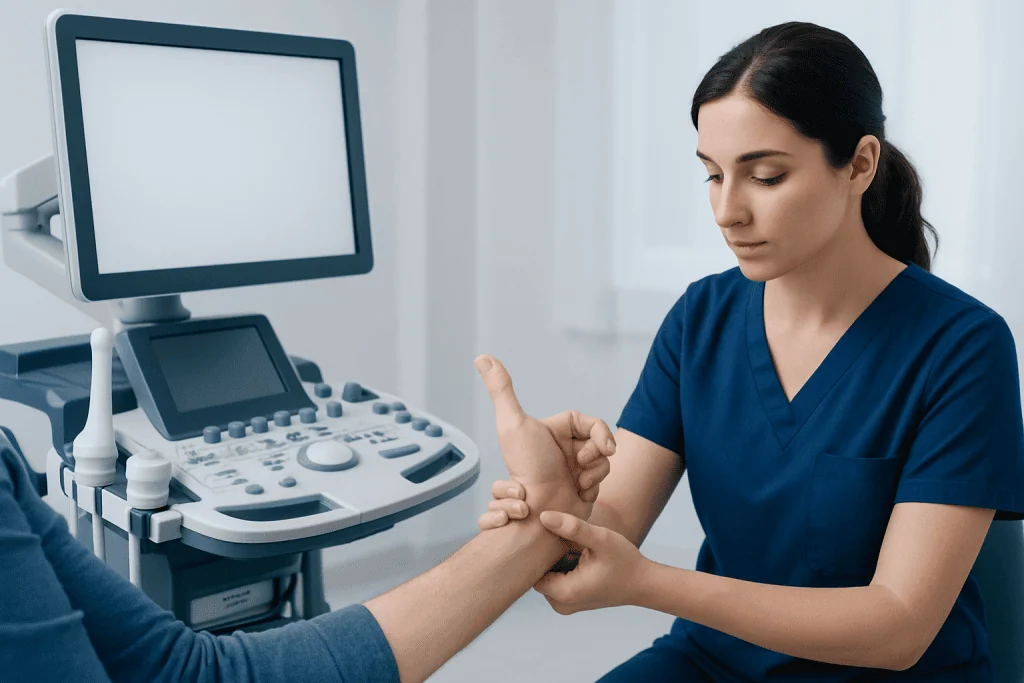
In the classic form of the test, the person makes a fist with the thumb tucked inside the fingers. The examiner then gently moves the wrist into ulnar deviation, which means bending the hand toward the little-finger side. This stretches the tendons at the thumb side of the wrist.
A positive Finkelstein test usually causes sharp or localized pain over the radial side of the wrist, near the base of the thumb. This can suggest inflammation or irritation involving the abductor pollicis longus and extensor pollicis brevis tendons, which are commonly affected in de Quervain’s tenosynovitis.
There are related maneuvers, such as the Eichhoff test, that may look similar but are performed slightly differently. In practice, the names are sometimes used interchangeably, which can create confusion. For patients, the most important point is that this is a provocative test used to reproduce symptoms in a controlled way so the clinician can better identify the painful structure.
The test should be done gently. Forcing the movement may cause unnecessary discomfort and can make the result harder to interpret. If pain is severe, the clinician may stop the maneuver and rely on other examination findings instead.
Why doctors use the Finkelstein test

The main reason doctors use the Finkelstein test is to evaluate possible de Quervain’s tenosynovitis, a painful condition affecting the tendon sheath on the thumb side of the wrist. This condition often develops from repetitive thumb or wrist use, lifting, gripping, or activities that strain the area over time.
Typical symptoms that may lead a clinician to perform the test include pain when turning a key, opening jars, lifting a child, texting, typing, or carrying bags. Some people also notice swelling, tenderness, a catching sensation, or pain that travels up the forearm.
The test is also useful because thumb-side wrist pain has more than one possible explanation. Depending on the pattern of symptoms, a clinician may also think about osteoarthritis at the base of the thumb, tendon injuries, nerve irritation, inflammatory arthritis, or other wrist disorders. The Finkelstein test helps narrow the possibilities, but it does not replace a careful examination.
When symptoms continue or the diagnosis remains uncertain, the clinician may look for overlapping problems. For example, pain in the hand and wrist can sometimes coexist with tendon irritation or nerve-related conditions that also affect function. In that setting, a broader assessment is important before deciding on treatment.
Conditions related to a positive test
A positive result most often points toward de Quervain’s tenosynovitis, but it is not specific enough to confirm that condition in every case. Pain may also come from nearby joints, ligaments, or tendons. This is why location of tenderness, symptom history, hand use patterns, and the rest of the examination matter.
Doctors often consider several related conditions when someone has pain near the thumb and wrist. These may include:
- De Quervain’s tenosynovitis
- Thumb carpometacarpal osteoarthritis
- Wrist sprain or overuse injury
- Intersection syndrome
- Tendon irritation or partial tendon injury
- Inflammatory joint disease
If numbness, tingling, or nighttime hand symptoms are also present, a clinician may investigate a nerve-related problem such as carpal tunnel syndrome, although this usually causes a different symptom pattern than a positive Finkelstein test alone. Distinguishing between tendon pain and nerve compression helps guide the next steps.
In some cases, imaging may be useful if symptoms are unusual, if trauma occurred, or if treatment is not helping. The goal is not only to confirm the likely cause but also to rule out less common conditions that can mimic tendon pain.
Diagnosis: what happens after the test
If the Finkelstein test reproduces symptoms, the clinician usually examines the wrist and thumb more closely. They may press over the tender area, assess swelling, check thumb motion and grip, and look for creaking or catching of the tendons. Questions about work, sports, childcare, phone use, and other repetitive activities can be important because they often explain why symptoms developed.
Imaging is not always needed. However, it may be considered when symptoms do not fit the usual pattern, when a fracture or arthritis is possible, or when pain has lasted despite treatment. X-rays can help evaluate bone and joint problems, while ultrasound or MRI can show tendon sheath thickening, fluid, or other soft-tissue changes.
The overall diagnosis is based on the full picture rather than one test result. This matters because many people can have wrist pain from more than one source at the same time. A careful assessment helps avoid overtreatment and supports a more targeted plan.
When specialized evaluation is needed, a patient may be referred to orthopedics, physical medicine and rehabilitation, rheumatology, or hand therapy. In selected cases, clinicians may also discuss options such as hand surgery if non-surgical treatment does not relieve persistent symptoms and the diagnosis is clear.
Treatment options when the Finkelstein test is positive
Treatment depends on the cause of the pain, its severity, and how long it has been present. For de Quervain’s tenosynovitis, first-line care often includes activity modification, temporary rest from repeated gripping or thumb movements, ice as advised by a clinician, and a thumb spica splint to reduce tendon strain. Many people also benefit from guided exercises and education on joint protection.
Doctors may recommend anti-inflammatory strategies, which can include medicines when appropriate for the individual’s overall health. In some cases, a corticosteroid injection into the tendon sheath is used to reduce inflammation and pain, particularly if symptoms are limiting daily function. A clinician can explain the benefits and possible risks based on the person’s needs.
Rehabilitation can be very helpful. Physical therapy and rehabilitation may focus on reducing pain, restoring movement, improving grip mechanics, and lowering repeated stress on the thumb and wrist. Ergonomic changes at work or during childcare, household tasks, and device use can also make a meaningful difference.
If symptoms continue despite conservative treatment, surgery may be considered to release the tight tendon sheath. This is usually reserved for carefully selected cases after proper evaluation. In experienced centers, treatment planning may involve orthopedics, rehabilitation, and imaging specialists working together. Acibadem International’s multidisciplinary specialists in JCI-accredited hospitals diagnose and treat wrist and hand conditions for international patients, including evaluation with orthopedics and traumatology when needed.
Self-care and prevention
Self-care aims to reduce tendon irritation and give the wrist time to recover. A person may be advised to avoid repeated pinching, forceful gripping, and frequent twisting movements for a period of time. Holding the wrist in a more neutral position and taking short breaks during repetitive tasks can help lower strain.
Practical prevention strategies may include adjusting workstation setup, changing lifting technique, alternating hands when possible, and reducing prolonged smartphone or gaming use if these motions worsen symptoms. New parents, caregivers, and people whose work requires repeated thumb motion may especially benefit from learning gentler ways to lift and carry.
Simple strengthening and stretching exercises can be useful, but they should be started at the right time. Exercising an actively inflamed tendon too early may aggravate symptoms. For this reason, exercises are best guided by a clinician or therapist who can match them to the stage of recovery.
People should also remember that not all wrist pain is caused by overuse alone. If swelling, warmth, joint stiffness, weakness, or symptoms in several joints are present, a medical review is important to look for other causes.
When to seek medical care
Medical care should be sought if wrist or thumb pain lasts more than a few days, returns repeatedly, or begins to interfere with work, sleep, childcare, sports, or daily activities. Evaluation is also important if there is swelling, reduced grip strength, limited thumb motion, or tenderness that is getting worse rather than better.
Prompt assessment is especially important after an injury, if there is visible deformity, significant bruising, fever, spreading redness, numbness, or persistent tingling. These signs may point to a different problem that needs faster attention than a simple overuse injury.
It is generally best not to self-diagnose based only on a home version of the Finkelstein test. The maneuver can reproduce pain, but only a qualified clinician can determine whether the symptoms fit de Quervain’s tenosynovitis or another condition. Early assessment can often lead to simpler treatment and a smoother recovery.
Frequently asked questions
What is the Finkelstein test used for?
The Finkelstein test is used to help assess pain on the thumb side of the wrist. It is most commonly performed when a clinician suspects de Quervain’s tenosynovitis, a condition involving irritated thumb tendons and their sheath.
Does a positive Finkelstein test always mean de Quervain’s tenosynovitis?
No. A positive test can strongly suggest de Quervain’s tenosynovitis, but it does not confirm the diagnosis on its own. Other wrist or thumb conditions can also cause pain during the maneuver, so the result must be interpreted with the full examination.
Can the Finkelstein test be done at home?
Some people try it at home, but self-testing has limits. It may reproduce pain, but it cannot identify the exact cause, and doing it too forcefully may increase discomfort. Persistent or unclear symptoms should be evaluated by a healthcare professional.
Is the Finkelstein test painful?
It can be uncomfortable if the affected tendons are inflamed. In people with a positive result, the movement may cause sharp or localized pain near the base of the thumb and the wrist. A clinician usually performs it gently and stops if the pain is too intense.
What treatments are usually recommended if the test is positive?
Treatment often starts with rest, activity modification, splinting, and anti-inflammatory measures when appropriate. Depending on the cause and severity, hand therapy or a corticosteroid injection may also be considered. Surgery is usually reserved for symptoms that do not improve with conservative care.
When should someone see a doctor for thumb-side wrist pain?
A doctor should be seen if the pain lasts, keeps returning, or interferes with normal activities. Medical review is also important after injury or if there is swelling, weakness, numbness, significant bruising, fever, or worsening pain.
References
- American Academy of Orthopaedic Surgeons
- National Institute of Arthritis and Musculoskeletal and Skin Diseases
- American Society for Surgery of the Hand
- MedlinePlus
- Mayo Clinic
This article is for general information only and is not a substitute for professional medical advice. Please consult a qualified doctor about your individual situation.
Explore treatments in Turkey — costs, top hospitals & a free quote
JCI-accredited · board-certified surgeons · reply within 24h
Add us as a Preferred Source to see more of our trusted health content across Google Search, AI Overviews and Discover.

More from the Health Library

Burned by Nair — Explained by Medical Evidence, Not Myths

Mexiletine: A Complete Medical Overview

Pfo Heart: What Patients Need to Know

Brain Aneurysm Survival Rate — Explained by Medical Evidence, Not Myths

Pore Strips: What Patients Need to Know