

Hearing Doctor — Explained by Medical Evidence, Not Myths

The term hearing doctor can describe an audiologist, an ENT specialist, or a coordinated hearing-care team. Audiologists perform detailed hearing assessments and help people use hearing aids and other hearing-support technologies.
Key Takeaways
- The term hearing doctor can describe an audiologist, an ENT specialist, or a coordinated hearing-care team.
- Audiologists perform detailed hearing assessments and help people use hearing aids and other hearing-support technologies.
- ENT specialists investigate medical causes of hearing changes, including ear infections, eardrum problems, and conditions of the inner ear.
- Sudden hearing loss, hearing loss with severe dizziness, or hearing changes after a head injury need prompt medical assessment.
- Early evaluation can identify treatable causes and help reduce the practical effects of long-term hearing loss.
A hearing doctor is usually an audiologist, an ear, nose and throat (ENT) specialist, or both working together. An audiologist evaluates hearing and balance and provides rehabilitation, while an ENT specialist diagnoses and treats medical or surgical conditions affecting the ears and related structures.
What Does a Hearing Doctor Do?
A hearing doctor is a general term for a healthcare professional who assesses hearing concerns. In many cases, this means an audiologist, an ear, nose and throat specialist (ENT, also called an otolaryngologist), or both. The most appropriate professional depends on whether the main need is hearing testing and support, diagnosis of an ear condition, or treatment for a potentially medical cause of hearing loss.
Hearing is a complex process. Sound travels through the outer and middle ear, is converted into nerve signals within the inner ear, and is interpreted by the brain. A concern at any point along this pathway can affect hearing. Hearing-care professionals also consider communication needs, exposure to loud noise, medications, overall health, and symptoms such as ear pain, pressure, ringing, dizziness, or discharge.
Not every hearing change is permanent, and not every ear symptom means serious disease. For example, wax buildup, fluid behind the eardrum, or an ear infection may cause temporary muffled hearing. However, gradual hearing loss is also common with aging and long-term noise exposure. A structured assessment helps distinguish these possibilities and guides practical next steps.
Audiologist, ENT Specialist, or Hearing Aid Specialist?
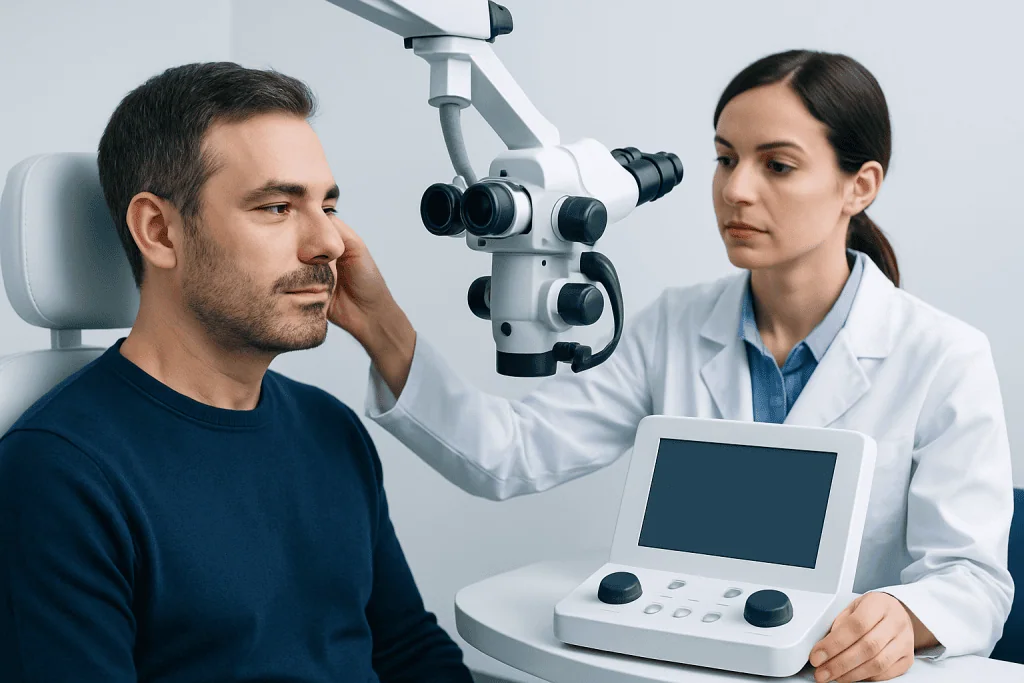
An audiologist is a university-trained healthcare professional specializing in hearing and balance assessment and rehabilitation. Audiologists perform hearing tests, explain results, assess how hearing affects daily communication, and recommend appropriate support. This may include hearing aids, assistive listening devices, communication strategies, hearing protection, and follow-up adjustments.
An ENT specialist is a medical doctor who diagnoses and treats conditions of the ear, nose, throat, head, and neck. An ENT may examine the ear canal and eardrum, assess infections and structural concerns, review medical factors, request imaging or laboratory tests when needed, prescribe treatment, and perform procedures or surgery. ENT review is particularly important for sudden, one-sided, fluctuating, or unexplained hearing loss, as well as hearing loss associated with pain, drainage, or significant balance symptoms.
A hearing aid specialist or dispenser may provide hearing tests and fit hearing aids within the scope permitted by local regulations. Their role can be helpful for straightforward hearing-aid needs, but they do not replace medical assessment where symptoms suggest an ear disease or another medical cause. Many people benefit from coordinated care: an ENT identifies or manages medical issues, while an audiologist provides detailed testing and longer-term hearing rehabilitation.
- Audiologist: testing, rehabilitation, hearing aids, communication support, and balance assessment in some settings.
- ENT specialist: medical diagnosis, medication, procedures, surgery, and investigation of complex ear symptoms.
- Primary care clinician: an initial examination, wax management where appropriate, and referral to the right hearing professional.
Symptoms a Hearing Doctor Can Assess

People may arrange a hearing assessment when conversations become difficult, particularly in restaurants, groups, or other noisy environments. Other common signs include frequently asking others to repeat themselves, increasing television volume, mishearing words, relying on lip-reading, or feeling tired after social interactions because listening requires extra concentration.
Hearing changes may affect one ear or both. They can be gradual or sudden, constant or intermittent. A hearing doctor can also assess tinnitus, which is the perception of ringing, buzzing, humming, or another sound without an external source. Tinnitus is common and often occurs alongside hearing loss, although it can have other contributing factors.
Additional symptoms help direct the assessment. Ear fullness, pain, itching, discharge, recurrent infections, dizziness, imbalance, nausea, or a spinning sensation may point toward conditions involving the outer, middle, or inner ear. These symptoms are not diagnostic on their own, but they are important to report clearly. A person should also mention recent infections, head trauma, noise exposure, new medications, and any family history of hearing loss.
Children should be assessed if they do not respond consistently to sound, have delayed speech or language development, struggle to follow instructions, or have frequent ear infections. Hearing concerns in children deserve timely professional review because hearing supports speech, learning, and social development.
How Hearing Problems Are Diagnosed
An appointment commonly begins with a discussion of symptoms and medical history. The clinician may ask when the concern started, whether it affects one or both ears, and whether it appeared suddenly. They may also ask about workplace or recreational noise, ear surgery, infections, balance symptoms, medications, and the impact of hearing difficulty at home, work, or school.
An ear examination uses a lighted instrument called an otoscope to view the ear canal and eardrum. This can identify wax, inflammation, infection, a perforated eardrum, fluid, or other visible changes. An ENT may also examine the nose, throat, jaw, and nearby nerves when symptoms suggest that these areas could be relevant.
The main hearing assessment is usually pure-tone audiometry. During this test, a person listens through earphones or inserts and signals when sounds are heard at different pitches and volumes. Speech testing measures how well words are understood, sometimes in quiet and sometimes with background noise. Tympanometry measures how the eardrum moves and can help identify pressure or fluid in the middle ear.
Further tests are selected based on the findings. These may include tests of inner-ear or auditory-nerve function, balance testing, imaging, or blood tests. Results are interpreted in context rather than by one measurement alone. A hearing test can show the degree and pattern of hearing loss, but a medical evaluation may still be needed to determine why it has occurred.
Common Causes and Types of Hearing Loss
Hearing loss is often described by where the problem occurs. Conductive hearing loss happens when sound cannot pass efficiently through the outer or middle ear. Causes can include wax buildup, outer-ear infection, middle-ear fluid, eardrum perforation, or changes in the small middle-ear bones. Some conductive causes can be temporary or medically treatable.
Sensorineural hearing loss involves the inner ear, particularly the cochlea, or the hearing nerve. It is commonly linked with aging, repeated loud-noise exposure, genetic factors, certain infections, and some medications that can affect the ear. This type is often permanent, but hearing aids, communication strategies, and in selected cases implantable hearing technology can improve access to sound and spoken communication.
Mixed hearing loss includes conductive and sensorineural components. Some people also have difficulty understanding speech in noise despite hearing sounds at a basic level. This may occur with hearing loss, changes in how the brain processes sound, or both. A detailed assessment helps identify the pattern and the support most likely to help.
Tinnitus and dizziness can accompany hearing conditions but may also arise for other reasons. For example, tinnitus may be associated with noise exposure, hearing loss, jaw problems, stress, or medication effects. Dizziness can have ear-related and non-ear-related causes. A clinician can assess these symptoms carefully and recommend referral when appropriate.
Treatment and Hearing Rehabilitation
Treatment depends on the cause, severity, and effect of the hearing problem. When hearing loss is due to wax, infection, fluid, or another treatable ear condition, management may focus on resolving that condition. It is safest to avoid placing cotton swabs, hairpins, or other objects into the ear canal, as these can push wax deeper or injure the ear.
For ongoing sensorineural hearing loss, hearing aids are a common evidence-based option. Modern devices can be programmed according to an individual’s hearing-test results and communication needs. Successful use often involves a period of adjustment, follow-up fitting changes, and realistic expectations. Hearing aids amplify and shape sound; they do not restore natural hearing in every situation, particularly in complex background noise.
Some people with severe hearing loss may be assessed for cochlear implants or other implantable hearing devices. These are specialist decisions based on hearing test results, speech understanding, medical assessment, and personal goals. Rehabilitation after fitting a device can include listening practice, communication counseling, and support for family members.
Communication strategies are an important part of care. Facing the speaker, reducing background noise where possible, requesting clear speech rather than louder speech, choosing good lighting, and using captions for calls or media can all help. For international patients, Acibadem International’s multidisciplinary specialists and JCI-accredited hospitals can assess hearing concerns and coordinate appropriate ENT and audiology care.
Protecting Hearing and Managing Everyday Life
Many forms of hearing loss cannot be fully prevented, but protecting the ears from excessive noise is worthwhile at every age. Noise risk depends on both loudness and duration. Using well-fitted earplugs or earmuffs during loud work, concerts, sporting events, or power-tool use can reduce exposure. Taking listening breaks and lowering the volume on headphones also helps limit sound-related strain.
People should follow medical advice when using medications and should tell their clinician about any new hearing changes after starting a medicine. They should not stop prescribed treatment without professional guidance. For those working in noisy environments, occupational hearing-conservation programs and periodic hearing checks can identify early changes.
Living with hearing loss can affect confidence, relationships, work, and participation in social activities. Discussing these effects openly with a hearing doctor can make care more useful. Support may involve hearing technology, workplace accommodations, communication training, and involvement of a partner, family member, or trusted friend.
Regular hearing review is reasonable for people who notice changes, use hearing aids, have ongoing noise exposure, or have conditions that can affect hearing. The timing of follow-up varies by age, symptoms, and previous results, so it should be individualized with a qualified clinician.
When to Seek Medical Care
A person should arrange a routine appointment with a hearing doctor if hearing becomes gradually less clear, tinnitus is persistent or troublesome, repeated ear infections occur, or hearing difficulty is affecting communication, work, school, or well-being. Early assessment can identify reversible problems and provide support before hearing difficulties become more disruptive.
Prompt medical care is important for sudden hearing loss, especially if it occurs in one ear or develops over hours to a few days. This can require urgent assessment because some causes may benefit from time-sensitive treatment. Prompt care is also appropriate for new hearing loss with severe dizziness, facial weakness, a severe headache, confusion, or symptoms after a head injury.
Urgent review is advised for ear pain with fever, swelling or redness around the ear, blood or pus-like drainage, or a foreign object in the ear. Parents and caregivers should seek timely assessment for a child with suspected hearing difficulty, delayed speech, or repeated middle-ear problems. If there is uncertainty about the urgency of symptoms, contacting a local medical service or clinician for advice is appropriate.
Frequently asked questions
What kind of doctor should someone see for hearing loss?
An audiologist is usually the main professional for comprehensive hearing testing and hearing rehabilitation. An ENT specialist is particularly appropriate when hearing loss is sudden, affects one ear, occurs with ear pain or drainage, or may have a medical or surgical cause. Many people receive care from both professionals.
Can a hearing doctor remove earwax?
An ENT specialist or another appropriately trained clinician can assess and remove problematic earwax safely. Audiologists may also provide wax management in some healthcare settings, depending on local practice rules. It is best to avoid inserting objects into the ear canal at home.
Do people need a referral to see an audiologist?
Referral requirements vary by country, health system, insurance arrangement, and clinic. Some audiologists accept self-referrals, while others work through a primary care clinician or ENT specialist. A referral may be especially useful when symptoms could indicate an underlying medical ear condition.
Is ringing in the ears a reason to see a hearing doctor?
Yes. Tinnitus can be assessed by an audiologist or ENT specialist, particularly when it is persistent, bothersome, affects sleep or concentration, or occurs with hearing changes. Sudden tinnitus in one ear, pulsating sounds that follow the heartbeat, or tinnitus with neurological symptoms should be medically reviewed promptly.
Can hearing loss improve after treatment?
It depends on the cause. Hearing loss from wax buildup, infection, fluid, or some middle-ear problems may improve when the underlying condition is treated. Inner-ear hearing loss is often permanent, but hearing aids, implants for selected people, and communication support can provide meaningful benefit.
How often should hearing be tested?
The right interval depends on age, symptoms, noise exposure, medical history, and whether hearing devices are used. A person who notices a new change should not wait for a routine check and should arrange an assessment. After an initial evaluation, the hearing professional can recommend an individualized follow-up schedule.
This article is for general information only and is not a substitute for professional medical advice. Please consult a qualified doctor about your individual situation.
Explore treatments in Turkey — costs, top hospitals & a free quote
JCI-accredited · board-certified surgeons · reply within 24h
Add us as a Preferred Source to see more of our trusted health content across Google Search, AI Overviews and Discover.

More from the Health Library

Tremfya Dosing: What Patients Need to Know

Black Gums: What Patients Need to Know

Central Heterochromia: What Patients Need to Know

Throat with Bumps on Back: An Evidence-Based Guide for Patients

Ecg vs echocardiogram: A Complete Medical Guide for Patients

Flagyl and — Explained by Medical Evidence, Not Myths
Otorhinolaryngology Specialists at Acibadem

Assoc. Prof. Dr. Akif İşlek
Ear Nose & Throat
Dr. Alaaddin Zirek
Otorhinolaryngology
Assoc. Prof. Dr. Ali Titiz
Otorhinolaryngology
Prof. Dr. Alp Demireller
Otorhinolaryngology