Hearing Tests Explained: What Audiograms Show and When You May Need One

An audiogram is a graph that shows the quietest sounds a person can hear at different pitches. Hearing tests can help identify whether hearing loss is conductive, sensorineural, or mixed.
Key Takeaways
- An audiogram is a graph that shows the quietest sounds a person can hear at different pitches.
- Hearing tests can help identify whether hearing loss is conductive, sensorineural, or mixed.
- People may need a hearing test for symptoms such as muffled hearing, tinnitus, dizziness, or trouble understanding speech.
- Common hearing assessments are painless and usually include pure-tone testing, speech testing, and sometimes middle-ear checks.
- Early evaluation can support timely treatment, hearing protection, and better communication.
Hearing tests help measure how well a person hears sounds of different pitches and volumes. An audiogram is the main chart used to show hearing ability and guide the next steps in diagnosis, monitoring, or treatment.
Overview: What hearing tests and audiograms are
Hearing tests are assessments used to understand how well a person hears sounds, speech, and changes in pitch. They are commonly performed by an audiologist, often with support from an ear, nose, and throat specialist when needed. These tests are noninvasive, structured, and designed to identify whether hearing is within the expected range or whether there may be hearing loss.
An audiogram is the chart created from a hearing test. It records the softest sounds a person can hear at different frequencies, from low-pitched sounds to high-pitched sounds. This visual result helps explain patterns of hearing ability and can show whether one ear is affected more than the other.
Hearing changes can happen gradually or suddenly. Some people notice they need the television louder, ask others to repeat themselves, or struggle to follow conversations in noisy places. Others may have ringing in the ears, pressure, or balance symptoms. In these situations, a hearing test can be an important step toward understanding the cause.
Audiograms do not only confirm hearing loss. They also help classify the type and degree of the problem and guide decisions about observation, medical treatment, hearing devices, or further evaluation. When interpreted alongside symptoms and ear examination findings, they are a valuable part of ear care.
What an audiogram shows
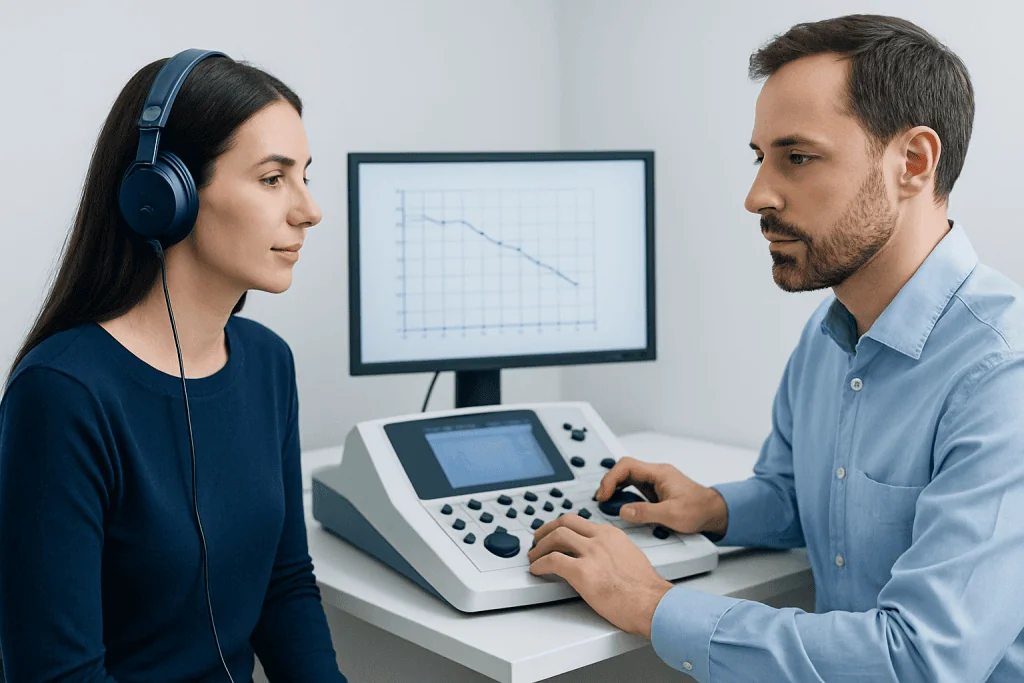
An audiogram is read like a graph. The horizontal axis shows frequency, measured in hertz, which reflects pitch. Lower frequencies represent deeper sounds, while higher frequencies represent sharper sounds such as consonants in speech. The vertical axis shows intensity, measured in decibels, which reflects loudness. The lower the threshold on the chart, the louder a sound had to be before it was heard.
During pure-tone testing, tones are presented through headphones and sometimes through a small device placed behind the ear on the bone. The results are marked separately for each ear. Comparing air conduction and bone conduction results helps clinicians understand whether sound is being blocked in the outer or middle ear, or whether the inner ear or hearing nerve is affected.
An audiogram can suggest several broad patterns:
- Normal hearing: thresholds are within the expected range across tested frequencies.
- Conductive hearing loss: sound has trouble reaching the inner ear, often due to earwax, fluid, or eardrum or middle-ear problems.
- Sensorineural hearing loss: the inner ear or auditory nerve is affected, often from aging, noise exposure, infection, or certain medical conditions.
- Mixed hearing loss: there is a combination of conductive and sensorineural changes.
The shape of the audiogram also matters. Some people lose hearing mainly in the high frequencies, which can make speech sound unclear even if overall volume seems adequate. Others may have a flatter pattern affecting many pitches. Speech testing often adds more detail by showing how well a person detects and understands spoken words.
When a person may need a hearing test

A hearing test may be helpful whenever hearing seems different from usual. Common reasons include muffled hearing, difficulty understanding conversations, frequently asking people to repeat themselves, or feeling that one ear hears less well than the other. Trouble hearing in restaurants, meetings, or crowded spaces is another common reason for testing.
Symptoms beyond reduced hearing can also prompt an evaluation. These include tinnitus, ear fullness, dizziness, imbalance, ear pain, or repeated ear infections. A hearing test may be part of the assessment for people with sudden hearing changes, as well as those being checked for conditions such as vertigo or persistent tinnitus.
Some people need hearing monitoring even before they notice symptoms. This includes those exposed to loud noise at work or during hobbies, people taking medicines that may affect hearing, and adults at higher risk of age-related hearing loss. Children may also need testing if there are concerns about speech development, learning, attention, or recurrent ear problems.
Testing is especially important if hearing loss develops suddenly, affects one ear more than the other, or occurs with facial weakness, severe dizziness, or drainage from the ear. These situations need prompt medical assessment to identify the cause and protect hearing whenever possible.
Common types of hearing tests
Several tests may be used together because hearing involves different parts of the ear and brain. Pure-tone audiometry is the most familiar. The person listens for beeps at different pitches and volumes and responds when a sound is heard. This forms the main audiogram result.
Speech audiometry looks at how a person hears and understands spoken words. It may measure the softest speech a person can detect and how clearly words are repeated at a comfortable listening level. This can help explain why some people hear sounds but still struggle with conversation, especially in noise.
Other tests check middle-ear function. Tympanometry measures how the eardrum moves in response to air pressure changes and can suggest fluid behind the eardrum, eustachian tube dysfunction, or other middle-ear problems. Acoustic reflex testing may provide additional information about the ear pathway.
In some situations, more specialized tests are used. Otoacoustic emissions can help assess inner ear hair cell function, while auditory brainstem response testing examines how sound signals travel along the hearing nerve and brainstem. These may be useful for newborns, people who cannot complete standard testing, or when there is concern about nerve-related causes of hearing change.
How hearing loss is diagnosed
Diagnosis does not rely on the audiogram alone. A clinician usually begins by asking about symptoms, how long they have been present, and whether the hearing change happened gradually or suddenly. Questions may cover noise exposure, past infections, trauma, family history, medication use, and associated symptoms such as tinnitus or dizziness.
The ears are then examined to look for simple and treatable causes such as earwax blockage, inflammation, or visible eardrum changes. Depending on symptoms, the next step may include hearing testing, balance assessment, or referral to an ENT specialist. This helps connect the audiogram pattern with what is happening in the ear.
Results may point toward temporary or reversible problems, such as wax buildup or middle-ear fluid. In other cases, they may suggest longer-term inner ear changes, such as age-related hearing loss or noise-related damage. Some patterns may lead to further tests, especially if hearing loss is asymmetric, sudden, or associated with neurological symptoms.
Imaging or laboratory tests are not needed for everyone, but they may be considered in selected cases. For example, an ENT specialist may recommend further evaluation if there is concern about structural ear disease, chronic infection, or an uncommon cause affecting the hearing nerve. The goal is to identify the reason for hearing loss and choose the most appropriate management plan.
Treatment options and what happens after the test
Treatment depends on the cause and type of hearing loss shown by the test. If the issue is conductive, treatment may focus on removing earwax, treating infection, or addressing middle-ear fluid or eardrum problems. If the hearing loss is sensorineural, the goal may shift toward improving hearing function, communication, and quality of life.
Many people benefit from hearing aids when hearing loss affects daily activities. These devices amplify sounds in a more tailored way than simply increasing volume and are chosen based on the audiogram, speech test results, and the person’s needs. For some individuals with severe hearing loss, specialist assessment may include options such as cochlear implant evaluation.
Medical or surgical care may be considered in specific situations. Examples include treatment for ear infections, repair of eardrum or middle-ear problems, and management of conditions affecting the ear canal or hearing bones. If hearing changes are linked to another ear condition, treatment may address that underlying problem first.
Follow-up is often part of care. A repeat hearing test may be recommended to monitor changes over time, check recovery after an ear problem, or reassess benefit from treatment. Near the end of the care pathway, patients may also be supported by multidisciplinary services; Acibadem International’s JCI-accredited hospitals and specialists diagnose and treat hearing conditions for international patients, including options such as hearing aid support and selected ear surgery when appropriate.
Prevention, self-care, and protecting hearing
Not all hearing loss can be prevented, but many people can reduce risk by protecting their ears from loud noise. This includes using earplugs or earmuffs in noisy workplaces, concerts, or while using power tools. Personal listening devices are safest when used at moderate volume with regular listening breaks.
Good ear care also matters. Cotton swabs and other objects should not be placed inside the ear canal because they can push wax deeper, irritate the skin, or damage the eardrum. If earwax seems to be affecting hearing, it is safer to ask a healthcare professional for advice rather than trying to remove it at home with instruments.
Managing overall health may support hearing as well. Conditions such as diabetes, vascular disease, and repeated ear infections can influence ear health. Taking medicines only as prescribed and discussing any hearing changes after starting a new medicine can also be helpful.
People who already have hearing loss often benefit from simple communication strategies. Facing the speaker, reducing background noise, asking others to speak clearly rather than louder, and attending regular hearing follow-up visits can make everyday communication easier. Early support often reduces frustration and helps people stay connected socially and professionally.
When to see a doctor
A person should consider medical advice if hearing seems reduced, speech becomes harder to understand, or ringing in the ears persists. It is also sensible to seek assessment for recurrent ear infections, pressure, or dizziness, especially if these symptoms interfere with daily life.
Urgent medical attention is important if hearing loss happens suddenly, especially in one ear, or if it is accompanied by severe vertigo, facial weakness, intense ear pain, head injury, or ear discharge. These symptoms do not always indicate a serious problem, but they should be evaluated quickly because timely treatment can matter.
Parents should seek advice if a child does not respond consistently to sounds, has delayed speech, turns the volume up unusually high, or struggles at school with listening tasks. Older adults should not assume hearing changes are simply part of aging without evaluation, since testing can clarify what is happening and what support may help.
Hearing tests are straightforward, painless, and often reassuring. Even when hearing loss is present, understanding the audiogram can make the next steps clearer and more manageable. A qualified clinician can explain the results in context and recommend the best plan for the individual.
Frequently asked questions
Is a hearing test painful?
No. Standard hearing tests are painless and noninvasive. Most involve listening to sounds through headphones, repeating words, and sometimes having gentle air pressure changes measured in the ear.
What does an audiogram tell a doctor?
An audiogram shows the softest sounds a person can hear at different pitches in each ear. It helps doctors and audiologists identify the degree and likely type of hearing loss and decide whether more testing or treatment is needed.
How long does a hearing test usually take?
A routine hearing evaluation often takes less than an hour, though timing varies with age, symptoms, and the number of tests needed. If additional balance or specialized nerve-related testing is required, the visit may take longer.
Can earwax affect hearing test results?
Yes. Earwax can block sound and cause temporary conductive hearing loss, which may change hearing test results. That is why clinicians often examine the ears before or alongside hearing testing.
How often should hearing be checked?
There is no single schedule for everyone. Testing may be recommended when symptoms appear, after noise exposure, during monitoring of known hearing loss, or as advised for age, occupation, or certain medical conditions.
Does hearing loss always mean a person needs a hearing aid?
No. Treatment depends on the cause and severity of hearing loss and how much it affects daily life. Some causes are temporary or medically treatable, while others are best managed with hearing aids or other supportive options.
References
- World Health Organization
- National Institute on Deafness and Other Communication Disorders
- American Speech-Language-Hearing Association
- American Academy of Otolaryngology–Head and Neck Surgery
- Centers for Disease Control and Prevention
This article is for general information only and is not a substitute for professional medical advice. Please consult a qualified doctor about your individual situation.
Explore treatments in Turkey — costs, top hospitals & a free quote
JCI-accredited · board-certified surgeons · reply within 24h
Add us as a Preferred Source to see more of our trusted health content across Google Search, AI Overviews and Discover.

Otorhinolaryngology (ENT)
Care for ear, nose, throat and head-and-neck conditions, including hearing and balance disorders.
126 specialists in this unitMore from the Health Library



Related Specialists

Dr. Harun Yaşar
Physical Medicine & Rehabilitation
Dr. Nurcan Öztürk Yumuk
Anesthesiology
Prof. Dr. Ersin Özaslan
Medical Oncology
Prof. Dr. Kahraman Öztürk
Orthopedic Surgery & Traumatology