

Hip Brace Newborn: An Evidence-Based Patient Guide

A newborn hip brace is most often a Pavlik harness used for developmental dysplasia of the hip (DDH). Babies may be referred for examination and ultrasound after an abnormal newborn hip check or because of risk factors such as breech position.
Key Takeaways
- A newborn hip brace is most often a Pavlik harness used for developmental dysplasia of the hip (DDH).
- Babies may be referred for examination and ultrasound after an abnormal newborn hip check or because of risk factors such as breech position.
- The harness holds the hips in a safe flexed, outward position; parents should not adjust its straps unless instructed.
- Wear time varies with the baby's age and hip stability, but many babies wear the harness full-time initially and need repeated imaging checks.
- Early treatment is often effective, while hips that remain unstable may need other specialist treatments.
- Contact the clinical team promptly if the baby seems unwell, the feet change color, movement decreases, or the harness causes skin problems.
A hip brace newborn usually refers to a Pavlik harness, a soft positioning device used to treat developmental dysplasia of the hip (DDH). When prescribed early and checked regularly, it can help guide the hip joint into a stable position while a baby grows.
Hip brace newborn: what it is and why it is used
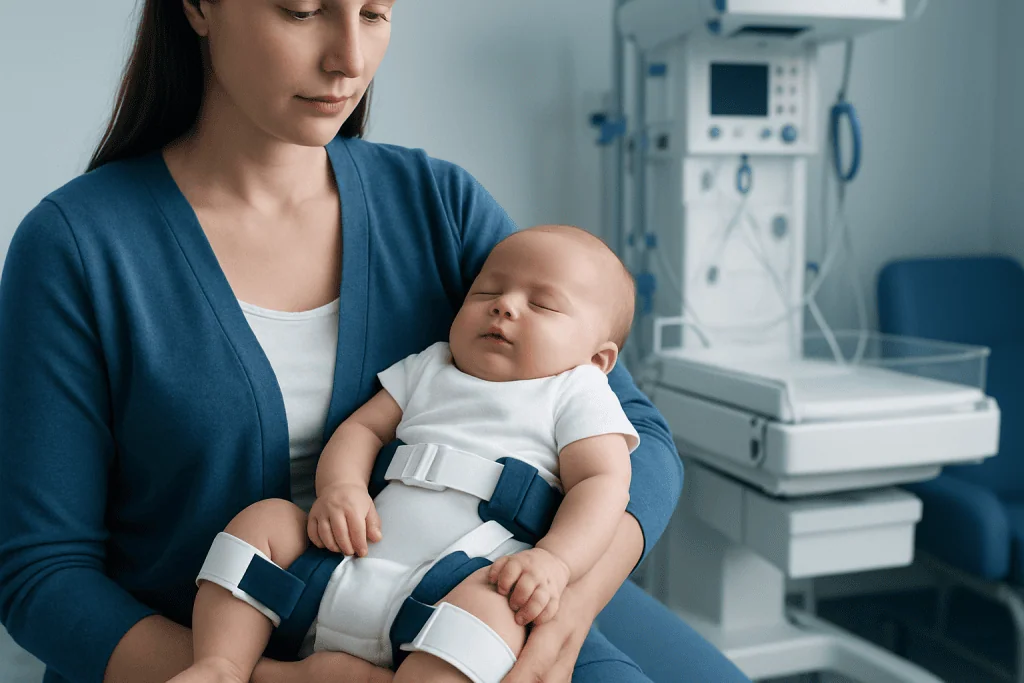
A hip brace newborn treatment usually means a Pavlik harness: a soft fabric device that positions a baby’s legs with the hips bent and gently apart. It is used for developmental dysplasia of the hip (DDH), a condition in which the ball-and-socket hip joint has not formed, fitted, or remained stable as expected. The aim is to support normal hip development while the tissues are still flexible and growing.
DDH ranges from a mildly shallow hip socket to a hip that can move partly or fully out of position. Many babies with DDH appear comfortable and otherwise well. Treatment is recommended because an unstable or poorly developed hip may lead to walking problems, pain, or early joint wear later in life if it is not addressed.
A harness is not a rigid cast and should only be fitted and adjusted by a pediatric orthopedic team. Parents can find more background about the condition in hip dysplasia information.
How do you know if your baby needs a hip brace?
A baby needs a hip brace only after assessment by an experienced clinician, usually a pediatric orthopedist. In many countries, clinicians examine a baby’s hips soon after birth and again at routine checkups. They use gentle maneuvers to assess whether the hip feels unstable or can move out of its socket; these tests should not be attempted by parents at home.
An ultrasound is commonly used in young babies because it shows the cartilage structures of the developing hip. In older infants, an X-ray may be more useful. A scan can identify a shallow socket, incomplete hip development, or a hip that is not centered correctly, and it helps the team decide whether observation, a harness, or another approach is appropriate.
Risk factors that may lead to closer screening include breech position late in pregnancy or at birth, a close family history of DDH, limited space in the womb, and certain foot or neck positioning conditions. Being female is also associated with a higher likelihood of DDH. Risk factors do not mean a baby will need treatment, and DDH can occur without any known risk factor.
Parents may occasionally notice one leg seeming less able to move outward during diaper changes, uneven thigh folds, or a leg-length difference. These signs are not diagnostic, especially in newborns, but they should be discussed with a doctor promptly.
How a hip brace for a newborn baby works

The Pavlik harness uses straps around the chest, shoulders, and legs to maintain a position in which the hips are flexed and allowed to move outward. This position can help keep the top of the thigh bone centered in the socket and encourage the socket to deepen as the baby grows. The harness allows some leg movement, which is important for healthy development.
The device is most often considered for babies in the first months of life when a hip is unstable, dislocated but reducible, or significantly immature. It is not suitable for every pattern of DDH. For example, a very stiff dislocation or a hip that does not remain centered in the harness may need a different treatment plan.
The expected benefit is a stable, normally developing hip without surgery. Success depends on several factors, including the baby’s age, the degree and type of hip instability, and whether the hip remains well positioned during follow-up imaging. The team will explain what the scan shows and why a particular plan is recommended.
- Potential benefits: supports early hip development, may avoid more invasive treatment, and is designed for infant movement.
- Possible limitations: frequent visits are necessary, the harness can be challenging during feeding and diapering, and it does not correct every type of DDH.
Candidacy and step-by-step fitting process
Before fitting hip brace infants treatment, the specialist reviews the baby’s clinical examination and imaging. They consider the baby’s age, whether the hip can be placed safely in the socket, and the appearance of the socket. Some mildly immature hips improve with repeat imaging rather than immediate harness treatment, whereas a clearly unstable hip may need treatment without delay.
At the fitting visit, a trained clinician selects the correct harness size and places it over the baby’s clothing or directly against the skin according to local advice. The straps are adjusted to the prescribed position. Families are shown how to feed, diaper, dress, bathe, and settle their baby without changing the strap settings. Marking the strap positions may help the team identify accidental movement at later visits.
Follow-up ultrasound is often arranged soon after fitting and repeated during treatment. These checks confirm that the hip is centered and developing appropriately. The team may adjust the harness at appointments as the baby grows. Parents should not loosen, tighten, remove, or reposition straps independently unless their clinician has given specific instructions.
If imaging shows the hip is not centered, clinicians may stop the harness rather than continue an ineffective position. Depending on age and the hip findings, the next step can include a period in a different brace, a gentle procedure to place the hip under anesthesia, or casting. These decisions are individualized and managed by pediatric orthopedic specialists.
How long do babies need to wear a brace for hip dysplasia?
The length of treatment varies. Many babies wear a Pavlik harness nearly full-time at first, including during sleep, with only the care breaks advised by their team. Treatment may last several weeks to a few months, but there is no single schedule that is right for every baby. The duration depends on how quickly the hip becomes stable and how the ultrasound findings change.
Once the hip is stable and imaging is reassuring, the specialist may reduce the number of hours the harness is worn or stop it altogether. Some teams use a gradual reduction plan, while others stop after a final satisfactory assessment. Continued surveillance is important because the hip socket may need time to develop fully even after the harness is no longer needed.
Appointments are a central part of recovery rather than an optional extra. They allow the clinical team to monitor hip position, skin condition, fit of the device, and leg movement. Families should keep all scheduled scans and ask the team which activities, clothing choices, and bathing routine are suitable for their baby.
Can babies crawl with a hip dysplasia brace?
Most babies begin harness treatment before they are developmentally ready to crawl. A Pavlik harness permits some movement, but it naturally changes how freely a baby kicks, rolls, and moves the legs. If a baby is old enough to start rolling, sitting, or attempting to crawl, the pediatric orthopedic team can give tailored guidance based on the harness settings and the stability of the hip.
Parents should continue age-appropriate interaction, feeding, comforting, and supervised play as advised. Avoid forcing the legs together, swaddling tightly around the hips, or using devices that restrict the hips. When a baby is out of the harness for an approved care interval, the hips should still be allowed to rest in a natural, flexed, open position.
Developmental milestones vary widely, and short-term differences in movement during treatment do not necessarily indicate a lasting delay. If a baby is not moving one or both legs as usual, seems distressed when a leg is moved, or has a sudden change in activity, parents should contact the treating team rather than waiting for the next appointment.
How to fix hip dysplasia in a 6 month old?
Hip dysplasia in a 6-month-old should be assessed promptly by a pediatric orthopedic specialist. At this age, the best treatment depends on whether the hip is stable, partly displaced, or dislocated, as well as the shape of the socket on imaging. A harness may still be considered in selected cases, but it becomes less likely to be effective as a baby gets older or when the hip is firmly out of place.
For some infants, clinicians recommend a different abduction brace. If the hip cannot be positioned and maintained in the socket with bracing, treatment may involve a closed reduction, where the hip is gently placed in position under anesthesia, followed by a hip spica cast. More complex cases may require surgery to obtain and maintain a stable hip position. The care plan is based on imaging and specialist examination, not on age alone.
Early review matters because treatment options can become more involved as a child grows. Even after successful treatment, follow-up X-rays may continue through childhood to confirm that the hip socket is developing well and to identify any residual dysplasia early.
Daily care, recovery timeline, and when to seek medical care
During harness treatment, parents can usually breastfeed or bottle-feed, hold, and comfort their baby normally. Diapers are typically placed underneath the harness straps, and loose clothing that opens at the front or has room around the legs can make changes easier. Skin should be checked daily, particularly in skin folds and under straps. The treating team will explain whether bathing is permitted with the harness on or whether a sponge-bath routine is preferred.
A typical recovery timeline includes early imaging to confirm hip position, regular adjustments as the baby grows, and repeat scans or X-rays after treatment ends. Most babies adapt to the harness, although the first few days can require patience. Parents should follow only the instructions given for their baby and bring the harness to every appointment.
When to seek medical care: Contact the treating clinic promptly if the baby’s feet or toes look pale, blue, swollen, or cold; if the baby moves a leg much less than usual; if there are blisters, open sores, or persistent redness; if the harness appears damaged or has slipped; or if the baby seems unusually distressed. Seek urgent medical assessment if the baby is seriously unwell, has breathing difficulty, or has other emergency symptoms.
Acibadem International’s multidisciplinary specialists and JCI-accredited hospitals assess and treat DDH for international patients, with coordinated pediatric orthopedic imaging and follow-up when needed.
Frequently asked questions
Is a hip brace painful for a newborn?
A correctly fitted Pavlik harness should not be painful, though a baby may need a short period to adjust to the new position. Parents should contact the clinical team if the baby seems persistently distressed, is moving a leg less than usual, or develops skin irritation.
Can I take my baby’s Pavlik harness off for bathing?
This depends on the treatment plan and the stability of the hip. Some babies need the harness on continuously, while others may have supervised breaks. Parents should only remove it if their pediatric orthopedic team has specifically instructed them to do so.
Can a newborn hip problem resolve without a brace?
Some mildly immature hips seen on early ultrasound mature normally with observation and repeat imaging. However, an unstable or dislocated hip may require prompt treatment. The decision is based on the examination and imaging findings, not on symptoms alone.
What should a baby wear under a hip brace?
The clinical team may recommend a thin cotton layer or may advise that the harness be worn directly against the skin, depending on the device and local practice. Loose, front-opening clothing is often easiest over the harness. Avoid tight garments that pull the legs together or interfere with the straps.
Can hip dysplasia return after harness treatment?
A hip that becomes stable with treatment can still need monitoring while the socket continues to develop. Follow-up scans or X-rays help identify residual dysplasia or recurrent instability early. Keeping scheduled appointments is important even when the baby appears comfortable and active.
Does double diapering treat hip dysplasia?
Double diapering is not considered a reliable treatment for developmental dysplasia of the hip. It should not replace specialist assessment, prescribed bracing, or imaging follow-up. Parents should use the positioning and care plan recommended by their baby’s clinical team.
References
- American Academy of Orthopaedic Surgeons
- American Academy of Pediatrics
- International Hip Dysplasia Institute
- National Institute for Health and Care Excellence
- Pediatric Orthopaedic Society of North America
This article is for general information only and is not a substitute for professional medical advice. Please consult a qualified doctor about your individual situation.
Joint and spine care in Turkey — expert assessment & treatment
JCI-accredited · board-certified surgeons · reply within 24h
Add us as a Preferred Source to see more of our trusted health content across Google Search, AI Overviews and Discover.

More from the Health Library



Related Specialists

Dr. Fatih Kaya
General Surgery
Prof. Dr. Nadir Kaya
Gastroenterology
Embriyolog Sadık Doğan
Vitro Fertilization and Reproductive Medicine Center
Assoc. Prof. Dr. Murat Sezer
Pulmonary Medicine