How Many Units of Botox for Forehead? Here Is What the Evidence Says

There is no single correct number of Botox units for every forehead. Many treatment plans use roughly 10 to 30 total units across forehead-related areas, depending on anatomy and goals.
Key Takeaways
- There is no single correct number of Botox units for every forehead.
- Many treatment plans use roughly 10 to 30 total units across forehead-related areas, depending on anatomy and goals.
- The horizontal forehead lines and the frown lines between the eyebrows are often treated as separate but related areas.
- Using too much in the wrong place can increase the risk of a heavy brow or uneven expression.
- A trained medical professional decides the dose after examining muscle movement, symmetry, and skin quality.
- Urgent medical review is needed for symptoms such as trouble breathing, swallowing difficulty, or significant eyelid drooping after injections.
How many units of botox for forehead depends on the treatment area, muscle strength, and the result a person wants. For many adults, the total commonly falls around 10 to 30 units across the forehead and glabella, but the safest and most effective dose is individualized by a qualified clinician.
Overview: the usual range and why it varies
For people asking how many units of botox for forehead, the evidence-based answer is that there is a range rather than one fixed number. In routine aesthetic practice, many adults receive about 10 to 30 units in total across the forehead region, often including both the horizontal forehead lines and the vertical frown lines between the eyebrows. Some people need less, and others need more, depending on how strongly their muscles move and what result they hope to achieve.
This is usually a harmless cosmetic decision when it is done by an experienced, qualified injector using an approved botulinum toxin product. The most important point is that the forehead cannot be assessed in isolation. The upper forehead works together with the muscles between the brows and around the eyes, so a balanced plan matters more than chasing a specific number.
It also helps to know that “Botox units” are product-specific. Units for one botulinum toxin brand are not automatically interchangeable with another brand, so quoted numbers should always be interpreted in the context of the exact product being used. A doctor or other qualified clinician can explain whether the planned dose refers specifically to onabotulinumtoxinA or another formulation.
Which forehead area is being treated?
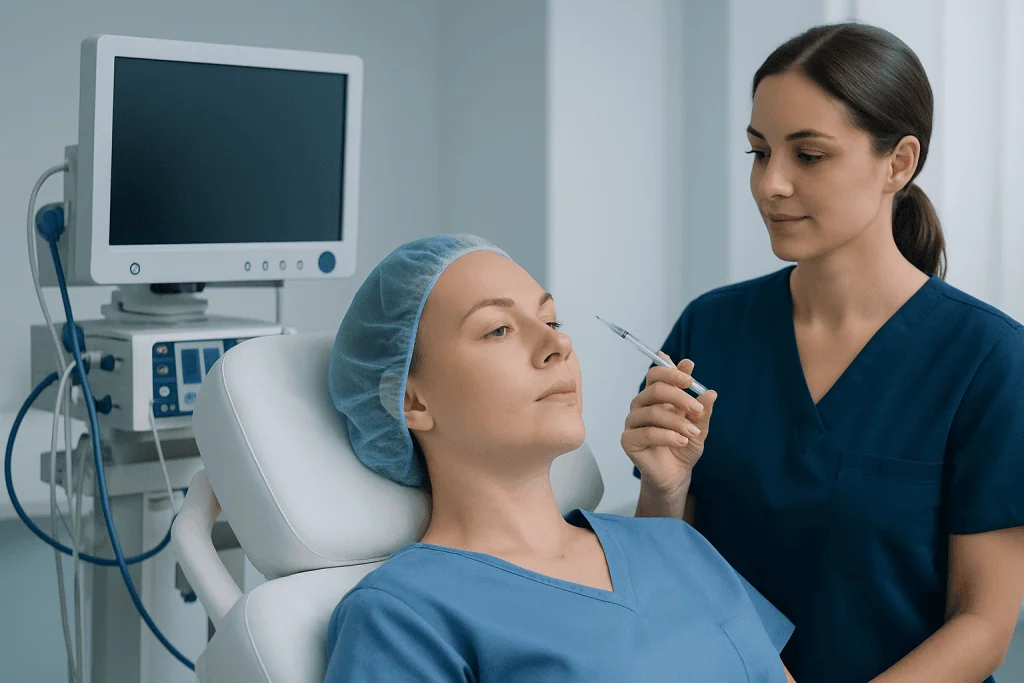
When people talk about forehead Botox, they may mean one of two common areas, or both together. The first is the frontalis muscle, which causes horizontal lines across the forehead when the eyebrows lift. The second is the glabellar complex, the group of muscles between the eyebrows that creates vertical frown lines, often called “11 lines.”
These areas are related but not identical. Treating only the frontalis can relax horizontal lines, but if the glabellar muscles remain very strong, the brows may still pull downward or create imbalance. Treating the glabella without considering the forehead can also affect expression in a way that does not match the person’s goals.
In practice, clinicians often estimate units by area and by muscle activity. A relatively modest forehead dose may be enough for someone with mild lines and gentle movement, while a stronger glabellar pattern may require more units in the frown area than in the upper forehead itself. This is one reason published ranges vary.
- Horizontal forehead lines: often treated with smaller, carefully spaced doses across the frontalis
- Frown lines between the brows: often need a separate dose because these muscles can be stronger
- Combination treatment: commonly used to improve balance and reduce the risk of an unnatural look
What determines how many units are right?

The right number of units is based on clinical assessment, not only on age or the depth of visible lines. Doctors look at how the muscles move during expression, whether one side is stronger than the other, the resting position of the eyebrows, the height of the forehead, and the thickness of the skin and soft tissue. People with stronger muscle contraction often need more units than those with finer movement.
Treatment goals also matter. Some people want a very soft reduction in movement while keeping natural expression. Others prefer a smoother, more noticeable effect. A conservative first treatment is common because it allows the clinician to see how the individual responds and to avoid over-treatment.
Past treatment history is another factor. If a person has had prior botulinum toxin injections, the injector will usually ask how long the result lasted, whether any side effects occurred, and whether the previous outcome felt too weak, too strong, or uneven. This helps guide future planning.
Forehead anatomy can be complex, especially in people who already have mild brow heaviness or eyelid hooding. In these cases, the clinician may deliberately use fewer units or change injection points to protect brow position. This is why personalized assessment is safer than following a standard online chart.
What the evidence says about safety and results
Clinical studies and expert guidelines support botulinum toxin as an effective treatment for dynamic forehead and glabellar lines when used appropriately. It works by temporarily reducing the activity of targeted muscles, which softens expression lines and can also help prevent them from becoming more deeply etched over time.
Evidence also shows that more is not always better. Excess dosing or poor injection placement can lead to a heavy forehead, uneven brows, a “frozen” expression, or eyelid drooping. For that reason, skilled technique and thoughtful dose selection matter as much as the number of units itself.
Results are temporary and usually develop gradually over several days. The full effect is often assessed after about 1 to 2 weeks, when a clinician can judge symmetry, degree of movement, and whether a small adjustment is appropriate. Treatment decisions should be made by a qualified medical professional familiar with facial anatomy and with Botox treatment planning.
Someone considering injectables may also benefit from a broader discussion of skin quality, facial aging, and other options. In selected cases, wrinkle concerns can overlap with issues such as sun damage, laxity, or volume loss, which may be better addressed with a combination approach rather than more toxin alone.
Possible side effects and when to seek medical care
Most side effects are mild and temporary. Common examples include slight redness, tenderness, swelling, a small bruise, or a temporary headache after the injections. These usually settle on their own within a short time. Mild asymmetry can occasionally happen and may improve as the effect stabilizes.
Specific red flags are less common but deserve medical review. A person should contact the treating clinician promptly if there is marked eyelid drooping, a very uneven smile or brow position, significant eye irritation, or symptoms that interfere with normal daily activities. These concerns are often manageable, but they should be assessed rather than ignored.
Urgent medical care is important if symptoms suggest a more serious reaction or toxin spread, such as difficulty breathing, trouble swallowing, hoarseness, generalized muscle weakness, or vision changes that are sudden or severe. These events are uncommon in cosmetic forehead treatment, but they require prompt attention.
People who are uncertain whether symptoms are from Botox itself or from another condition may need a broader assessment. For example, a new severe headache or facial weakness should not automatically be assumed to be a routine injection effect, because other neurological or eye conditions may need to be ruled out.
How a doctor assesses the forehead before treatment
Medical evaluation is usually straightforward and focused on safety, anatomy, and expectations. The clinician first asks about medications, prior botulinum toxin treatments, allergies, pregnancy or breastfeeding status, neuromuscular disorders, and any previous facial surgery. This helps identify whether treatment is suitable and whether any precautions are needed.
Next comes a facial movement exam. The person may be asked to raise the eyebrows, frown, close the eyes tightly, and relax the face. This shows which muscles are creating the lines, how strong they are, and whether one side behaves differently. The doctor also checks brow position and eyelid support to reduce the risk of post-treatment heaviness.
If symptoms such as eyelid drooping, facial asymmetry, or unusual headaches existed before the planned injections, the doctor may look for other causes instead of proceeding immediately. In that setting, a fuller evaluation can be more important than a cosmetic treatment plan. Related concerns may sometimes overlap with migraine or other facial movement disorders that need separate care.
Photography is often used to document the resting face and expression. This helps the patient and clinician compare results fairly at follow-up and decide whether the initial number of units was appropriate.
Practical self-care, expectations, and follow-up
After treatment, most people can return to normal daily activities quickly, but it is sensible to follow the treating clinician’s instructions. General advice may include avoiding rubbing the injected area, delaying strenuous exercise for a short period if recommended, and watching for unusual symptoms. These steps help support a smooth recovery.
Expectations are important. Botox usually improves dynamic lines best, meaning the lines that appear with movement. Very deep lines that are visible even at rest may soften but not fully disappear. In these cases, additional measures such as skin resurfacing or filler may sometimes be discussed, depending on the person’s anatomy and goals.
Follow-up allows small refinements rather than guessing the ideal dose from the start. A review visit after the effect has fully developed gives the clinician a chance to see whether the movement was reduced as planned and whether symmetry is satisfactory. For some people, a gentle adjustment approach provides the most natural outcome over time.
When wrinkles are part of broader skin or contour concerns, other procedures may sometimes be considered, such as dermal filler treatment or specialist assessment in medical dermatology. At Acibadem International, multidisciplinary specialists in JCI-accredited hospitals evaluate and treat aesthetic and skin concerns for international patients when a medical consultation is appropriate.
When to see a doctor before deciding on forehead Botox
A medical opinion is especially helpful before treatment if a person has drooping eyelids, significant brow asymmetry, a history of facial nerve problems, neuromuscular disease, troublesome dry eyes, or previous unexpected reactions to botulinum toxin. These factors do not always rule out treatment, but they can change the plan or make another option safer.
It is also wise to seek medical advice if the main concern is not only cosmetic wrinkles but also frequent headaches, muscle spasms, or facial pain. In those cases, the issue may need diagnosis first rather than a purely aesthetic approach. Some people asking about forehead injections are actually dealing with symptoms that deserve evaluation in their own right.
If there is uncertainty about whether forehead lines are dynamic, age-related, sun-related, or linked to another skin condition, a specialist assessment can clarify the cause and set realistic expectations. For patients with recurring headache-related concerns, clinicians may also consider broader pathways that overlap with migraine treatment in appropriate cases.
The most reliable way to decide how many units of botox for forehead is through an in-person assessment by a qualified clinician who understands facial anatomy, product-specific dosing, and safety. Personalized planning is more useful than relying on a universal unit count found online.
Frequently asked questions
How many units of Botox are usually used for the forehead?
There is no single standard dose for everyone. Many adults are treated with roughly 10 to 30 units in total across the forehead region, often including both horizontal forehead lines and the frown lines between the eyebrows. The exact amount depends on anatomy, muscle strength, and treatment goals.
Are forehead lines and frown lines treated with the same number of units?
Not necessarily. The horizontal forehead area and the glabellar frown area are different muscle groups, and the glabellar muscles are often stronger. That means a person may need different amounts in each area to achieve a balanced result.
Can too many Botox units in the forehead cause problems?
Yes, too much product or poor injection placement can lead to a heavy brow, uneven eyebrows, limited expression, or eyelid drooping. This is why conservative dosing and careful facial assessment are important. A qualified injector will usually aim for balance rather than the highest possible dose.
How long does forehead Botox take to work and how long does it last?
The effect does not appear instantly. Many people start to notice a change within a few days, with fuller results often seen after about 1 to 2 weeks. The effect is temporary, and the duration varies from person to person.
Is Botox for the forehead safe?
For most healthy adults, it is generally considered safe when performed by a trained medical professional using an approved product. Mild redness, bruising, or a temporary headache can happen. Serious reactions are uncommon, but breathing problems, swallowing difficulty, or severe weakness need urgent medical care.
Why do some people need fewer or more units than others?
Dose needs vary because faces vary. Muscle strength, forehead size, brow position, skin thickness, prior treatment history, and the desired amount of movement all affect the plan. A personalized exam is more accurate than comparing doses with friends or online examples.
References
- American Society of Plastic Surgeons
- American Academy of Dermatology
- U.S. Food and Drug Administration
- National Health Service
- International Society of Aesthetic Plastic Surgery
This article is for general information only and is not a substitute for professional medical advice. Please consult a qualified doctor about your individual situation.
Explore treatments in Turkey — costs, top hospitals & a free quote
JCI-accredited · board-certified surgeons · reply within 24h
Add us as a Preferred Source to see more of our trusted health content across Google Search, AI Overviews and Discover.

More from the Health Library



Related Specialists

Dr. Nıgar Alıyeva
Pediatric & Adolescent Psychiatry
Assoc. Prof. Dr. Ayşe Ebru Bahadır
Ophthalmology
Prof. Dr. Tugan Beşe
Gynecology & Obstetrics
Dr. Hacer Tuğça Malişi
Pediatrics