How to Read a Neurophysiology Referral: Symptoms, Tests, and Next Steps

A neurophysiology referral is used to investigate symptoms affecting the nervous system and muscles. Common tests include EEG, EMG, nerve conduction studies, evoked potentials, and sleep-related neurophysiology tests.
Key Takeaways
- A neurophysiology referral is used to investigate symptoms affecting the nervous system and muscles.
- Common tests include EEG, EMG, nerve conduction studies, evoked potentials, and sleep-related neurophysiology tests.
- The referral usually lists symptoms, the question the doctor wants answered, and the test being requested.
- These tests help guide diagnosis but are interpreted alongside the medical history and examination.
- Patients can prepare by bringing previous results, medication lists, and details about their symptoms.
A neurophysiology referral is a request for specialized testing to understand symptoms related to the brain, nerves, spinal cord, or muscles. Reading the referral can help patients know why the test was ordered, what to expect, and what the next steps may be.
Overview: What a Neurophysiology Referral Means
A neurophysiology referral is a doctor’s request for tests that measure how the nervous system is working. These tests can assess electrical activity in the brain, the function of nerves, communication between nerves and muscles, and sometimes pathways involving vision, hearing, or sensation. The goal is to move from a symptom, such as weakness or fainting, toward a clearer explanation.
Many people feel uncertain when they see unfamiliar terms on a referral form. In most cases, the referral includes three key parts: the symptoms or problem, the suspected area of the nervous system involved, and the specific test requested. It does not always mean that a serious disease is expected. Often, it is simply the next step in a careful evaluation.
Neurophysiology is commonly used within neurology, neurosurgery, rehabilitation, sleep medicine, and other specialties. A referral may be requested for symptoms that come and go, symptoms that are difficult to explain with routine blood tests or imaging, or to confirm whether a nerve or muscle problem is present. It can also help monitor known conditions over time.
Why Someone May Be Referred: Common Symptoms and Clinical Questions
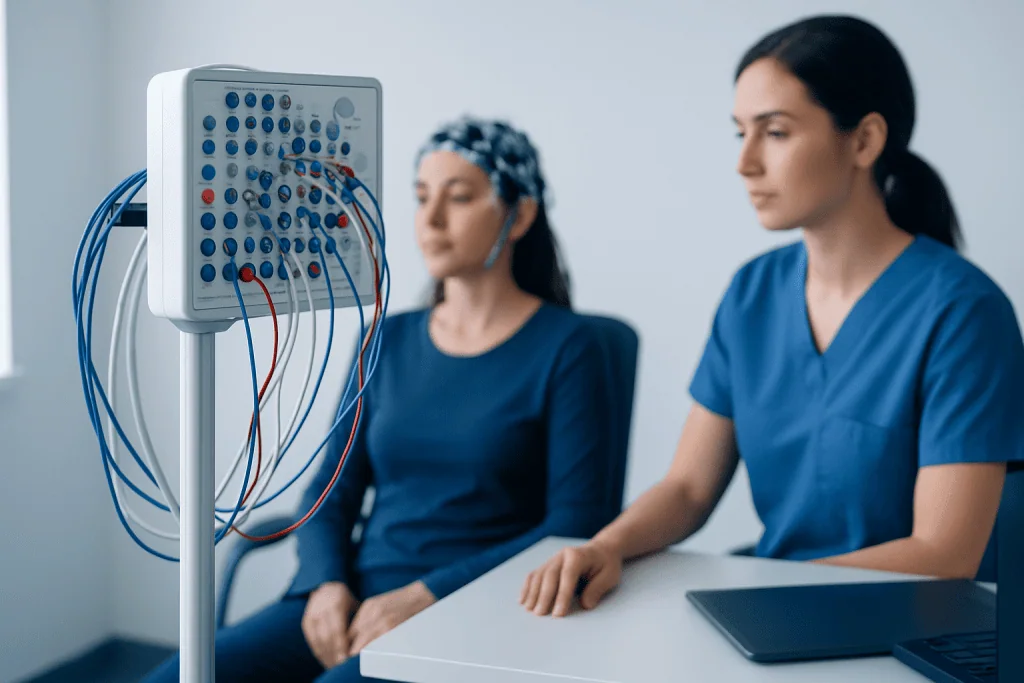
A neurophysiology referral is usually based on symptoms that suggest a problem in the brain, spinal cord, nerves, or muscles. These symptoms vary widely. Some affect movement or strength, while others affect sensation, awareness, sleep, or episodes that are difficult to classify.
Common reasons for referral include:
- Numbness, tingling, burning, or reduced sensation
- Muscle weakness, cramps, twitching, or muscle wasting
- Neck or back pain with pain radiating into an arm or leg
- Blackouts, seizures, staring spells, or unexplained episodes of altered awareness
- Dizziness, fainting, or spells where the cause is unclear
- Suspected nerve entrapment, such as carpal tunnel syndrome
- Possible neuropathy or other peripheral nerve disorders
- Sleep-related events, unusual movements during sleep, or excessive daytime sleepiness
The referral often includes a clinical question such as “rule out peripheral neuropathy,” “evaluate for radiculopathy,” “assess for seizure tendency,” or “differentiate muscle disease from nerve disease.” This question is important because it guides which test is chosen and how the specialist interprets the results.
Symptoms alone rarely provide a complete diagnosis. Neurophysiology helps add objective information, but it is only one part of the overall assessment. Doctors combine the test findings with the person’s history, examination, medications, and any imaging or blood test results.
How to Read the Referral Form

A referral form can look technical, but most are easier to understand when broken into sections. The first part usually identifies the reason for referral: for example, “left hand numbness for 6 months,” “recurrent loss of consciousness,” or “progressive leg weakness.” This tells the neurophysiology team what symptoms are most relevant.
The next part often states the suspected condition or the doctor’s question. Examples include “query carpal tunnel syndrome,” “exclude epilepsy,” “possible cervical radiculopathy,” or “evaluate peripheral nerve function.” Words such as “query,” “rule out,” or “exclude” do not confirm a diagnosis. They mean the doctor wants the test to help clarify whether a condition is likely or unlikely.
The final part names the requested investigation. Common abbreviations include EEG for electroencephalography, EMG for electromyography, and NCS for nerve conduction studies. Some referrals may request combined testing, because one study alone may not fully answer the question. In practice, the specialist may slightly adjust the test plan after reviewing the symptoms and examination on the day.
If the wording is unclear, patients can ask the referring doctor or the neurophysiology clinic to explain the main purpose in plain language. Understanding the reason for the test often reduces anxiety and helps people prepare useful information about when symptoms started, what triggers them, and whether they are getting better, worse, or staying the same.
Common Neurophysiology Tests and What They Show
Different tests answer different questions. An EEG records the brain’s electrical activity using small sensors placed on the scalp. It is commonly used when a person has seizures, suspected epilepsy, blackout episodes, or unusual spells. A normal EEG does not always rule out a seizure disorder, but it can provide important supportive information, especially when interpreted with the person’s history and, when relevant, epilepsy evaluation.
EMG and nerve conduction studies are often performed together. Nerve conduction studies use small electrical impulses to measure how well nerves carry signals. EMG uses a very fine needle to assess muscle activity. These tests help distinguish between nerve compression, generalized nerve damage, muscle disease, and problems affecting the communication between nerves and muscles. They are commonly used for symptoms such as weakness, numbness, sciatica-like pain, and suspected carpal tunnel syndrome.
Other tests may include evoked potentials, which measure how the brain responds to visual, sensory, or auditory stimulation. These can help assess specific pathways in the nervous system. Some patients may also be referred for sleep-related neurophysiological studies if symptoms suggest seizures during sleep, parasomnias, or another sleep-related neurological condition.
In some situations, neurophysiology is only one part of the evaluation and may be combined with imaging or other specialist assessments. Depending on the clinical question, a doctor may also recommend neurology assessment, EMG testing, or EEG evaluation as part of a broader diagnostic plan.
What to Expect Before, During, and After Testing
Preparation depends on the type of test. For EEG, patients may be advised to arrive with clean, dry hair and avoid hair products. For EMG and nerve conduction studies, it is usually helpful to avoid heavy lotions or creams on the skin. The clinic may also ask about pacemakers, implanted devices, blood-thinning medication, skin infections, or pregnancy, depending on the test being performed.
During an EEG, scalp electrodes are attached with paste or adhesive, and the patient is asked to relax, stay still, and sometimes perform simple tasks such as deep breathing or looking at flashing lights. During nerve conduction studies, short electrical pulses are delivered to the skin to stimulate the nerves. During EMG, a thin needle electrode is inserted into selected muscles to record activity at rest and with movement. Some parts of these tests can feel uncomfortable, but they are generally well tolerated and performed by trained professionals.
After the test, most people can go home and return to usual activities unless they have been given specific instructions, such as after sleep deprivation before an EEG. The test itself is usually not the final diagnosis. Results must be interpreted by a specialist in the context of the medical history and examination, and a report is then sent to the referring doctor.
Patients often want immediate answers, but formal interpretation can take time. If symptoms are urgent or worsening, they should not wait for a routine follow-up and should seek medical advice sooner.
How Results Are Interpreted and What the Next Steps May Be
Neurophysiology results are usually described as normal, abnormal, or inconclusive in relation to the specific question asked. For example, a study may show evidence of a compressed nerve in the wrist, slowed nerve conduction suggesting peripheral nerve involvement, muscle findings pointing toward a myopathic process, or electrical patterns that support a seizure disorder. In some cases, the results are normal even though symptoms are real and ongoing.
A normal result can still be helpful. It may narrow the list of possible causes, suggest that symptoms come from a different part of the body, or show that there is no measurable large-fiber nerve or muscle abnormality at the time of testing. Some conditions are intermittent, early in development, or not always captured by a single study, which is why doctors sometimes recommend repeat testing or a different type of assessment.
Next steps depend on the overall picture. These may include medication review, blood tests, MRI or other imaging, referral to a neurology subspecialist, physiotherapy, pain management, or treatment targeted to the identified disorder. For patients with complex symptoms, multidisciplinary care can be helpful. Near the end of the diagnostic pathway, some people may be evaluated at centers such as Acibadem International, where multidisciplinary specialists and JCI-accredited hospitals care for international patients with neurophysiological conditions.
It is often useful for patients to ask three questions at follow-up: What did the test show? What did it rule out? What happens next if symptoms continue? These questions can make the result easier to understand and help guide practical decisions.
Preparing for the Appointment and Supporting Self-care
Patients can make the most of a neurophysiology visit by bringing key information. A short symptom timeline is often very helpful, including when symptoms started, whether they are constant or episodic, what seems to trigger them, and whether they affect daily tasks such as walking, writing, sleep, or concentration. It is also useful to bring a list of medications, supplements, previous scan reports, and any relevant blood test or neurology records.
Simple self-care steps may also support the diagnostic process and day-to-day comfort. These can include protecting numb or weak limbs from injury, maintaining regular sleep before most tests unless instructed otherwise, staying hydrated, and avoiding activities that repeatedly worsen suspected nerve compression. If symptoms affect balance, driving, or work safety, patients should discuss temporary precautions with a doctor.
While waiting for results, it is best not to assume the cause based on internet searches alone. Similar symptoms can come from very different conditions, and the right interpretation depends on the full medical context. Keeping track of new or changing symptoms can be useful, especially if episodes are infrequent and hard to describe from memory.
Some people benefit from additional supportive evaluation, depending on the referral question. If the doctor suspects a broader neurological condition, they may suggest brain and nerve specialist care or a targeted follow-up plan after the neurophysiology report is available.
When to Contact a Doctor Urgently
Most neurophysiology referrals are routine, but some symptoms should be assessed promptly rather than waiting for a scheduled test. Sudden weakness of the face, arm, or leg, sudden trouble speaking, new severe confusion, or a sudden loss of vision need urgent medical attention. The same is true for a first seizure, repeated seizure-like episodes, or loss of consciousness with injury.
Urgent review is also important if there is rapidly progressive weakness, difficulty breathing, trouble swallowing, new loss of bladder or bowel control, or severe back or neck pain with worsening neurological symptoms. These features can suggest conditions that need faster assessment than an outpatient test pathway can provide.
For non-emergency concerns, patients should contact the referring clinician if symptoms worsen while waiting, if the appointment instructions are unclear, or if they cannot safely manage daily activities. Clear communication helps make sure the right test is done at the right time and that important changes are not overlooked.
Frequently asked questions
Does a neurophysiology referral mean there is definitely a serious neurological disease?
No. A referral means the doctor wants more information about how the nervous system is functioning. These tests are often used to clarify common symptoms and do not by themselves mean that a serious condition is expected.
What is the difference between EEG, EMG, and nerve conduction studies?
EEG measures the brain’s electrical activity and is often used for seizures or blackout episodes. Nerve conduction studies assess how well nerves carry signals, while EMG looks at electrical activity within muscles. Together, EMG and nerve conduction studies help evaluate nerve and muscle symptoms.
Are neurophysiology tests painful?
Most neurophysiology tests are tolerable, though some parts can feel uncomfortable. Nerve conduction studies involve brief electrical impulses, and EMG uses a fine needle in selected muscles. EEG is generally painless because it records signals from scalp electrodes.
Can results be normal even if symptoms are real?
Yes. A normal test does not mean symptoms are imagined or unimportant. Some conditions are intermittent, affect areas not well captured by a specific test, or may be too early to show clear changes.
How should a patient prepare for a neurophysiology appointment?
Preparation depends on the test, but it is usually helpful to bring a medication list, prior reports, and a short history of symptoms. Clean skin or hair may be recommended, and the clinic may give special instructions in advance. If anything is unclear, the patient should ask before the appointment.
How long does it take to get the results?
Timing varies by clinic and by the type of test. The recordings usually need specialist interpretation before a final report is sent to the referring doctor. Patients should ask when and how they will receive the results and who to contact if symptoms change.
References
- National Institute of Neurological Disorders and Stroke
- NHS
- American Association of Neuromuscular & Electrodiagnostic Medicine
- Epilepsy Foundation
- National Institute for Health and Care Excellence
This article is for general information only and is not a substitute for professional medical advice. Please consult a qualified doctor about your individual situation.
Neurophysiology in Turkey — costs, top hospitals & a free quote
JCI-accredited · board-certified surgeons · reply within 24h
Add us as a Preferred Source to see more of our trusted health content across Google Search, AI Overviews and Discover.