Hyperextended Elbow — Explained by Medical Evidence, Not Myths

Some people naturally extend their elbows slightly beyond straight without having an injury. A painful hyperextended elbow commonly involves stretched ligaments, the joint capsule, tendons, or muscles around the elbow.
Key Takeaways
- Some people naturally extend their elbows slightly beyond straight without having an injury.
- A painful hyperextended elbow commonly involves stretched ligaments, the joint capsule, tendons, or muscles around the elbow.
- Falls, contact sports, and a direct force through an outstretched arm are frequent causes.
- Early protection, ice, gentle movement when advised, and rehabilitation can support recovery from uncomplicated injuries.
- A visible deformity, severe swelling, numbness, weakness, or a cold or pale hand requires urgent medical attention.
A hyperextended elbow happens when the elbow is forced to straighten beyond its normal range of motion. It may cause a mild soft-tissue strain, but significant pain, swelling, deformity, numbness, or loss of movement can indicate a more serious injury that needs prompt assessment.
Overview: what is a hyperextended elbow?
A hyperextended elbow occurs when the elbow joint is pushed backward beyond its usual straightened position. This can stretch or tear tissues that stabilize the joint, including ligaments, the joint capsule, muscles, and tendons. In some injuries, the force may also cause a fracture or elbow dislocation.
Importantly, an elbow that appears to bend slightly backward is not always injured. Some people have natural joint laxity and can extend one or both elbows a few degrees beyond neutral without pain or functional problems. Hyperextension becomes a medical concern when it follows an injury or is associated with pain, swelling, bruising, instability, or reduced movement.
The elbow is a complex hinge joint formed by the upper-arm bone (humerus) and the two forearm bones (radius and ulna). It allows bending and straightening, while nearby structures help control rotation and stability. A forceful backward movement can affect more than one of these structures, so the severity of a hyperextension injury varies widely.
How a hyperextended elbow may feel

Pain is often felt at the front, back, or inner side of the elbow soon after the incident. It may be sharp at first and then become sore or aching, especially when trying to fully straighten the arm, lift an object, push up from a chair, or bear weight through the hand.
Swelling can develop around the joint within hours, and bruising may appear over the following days. Some people notice stiffness, a feeling that the elbow is blocked, tenderness to touch, or reduced confidence in using the arm. A mild injury may still allow movement, whereas a more significant injury can make the elbow difficult or impossible to move normally.
A popping sensation at the time of injury can occur, but it does not by itself confirm a tear or fracture. Similarly, the absence of major swelling does not rule out an injury. Symptoms should be considered alongside how the injury happened and whether hand sensation, circulation, and arm strength are normal.
- Common features include pain with straightening, localized tenderness, swelling, stiffness, and bruising.
- Possible signs of a more significant injury include instability, obvious shape change, inability to use the arm, or a catching or locking sensation.
- Tingling, numbness, weakness in the hand, or changes in hand color or temperature need urgent evaluation.
What causes elbow hyperextension?
A hyperextended elbow most often results from a fall onto an outstretched hand. The force travels up the forearm into the elbow, driving it beyond its normal extension. This can happen during everyday slips and trips, cycling accidents, or falls during exercise.
Sports are another common setting. Contact, a fall, a sudden impact, or an awkward landing may force the elbow backward in activities such as football, rugby, gymnastics, martial arts, basketball, skiing, or skateboarding. In throwing and overhead sports, repeated stress can also irritate elbow structures, although this is not the same as an acute hyperextension event.
Risk may be greater when the arm is locked straight during a fall, when a person has had previous elbow injuries, or when joint laxity is present. Children and adolescents can have injuries involving growth areas near the joint, while older adults may be more vulnerable to fractures after a fall because bone strength can decline with age.
The injury may involve a simple sprain, but clinicians also consider associated injuries such as an elbow dislocation, a fracture of the radial head or other elbow bones, tendon injury, or damage to nerves and blood vessels. This is why significant trauma should not be diagnosed solely by appearance.
How clinicians assess the injury
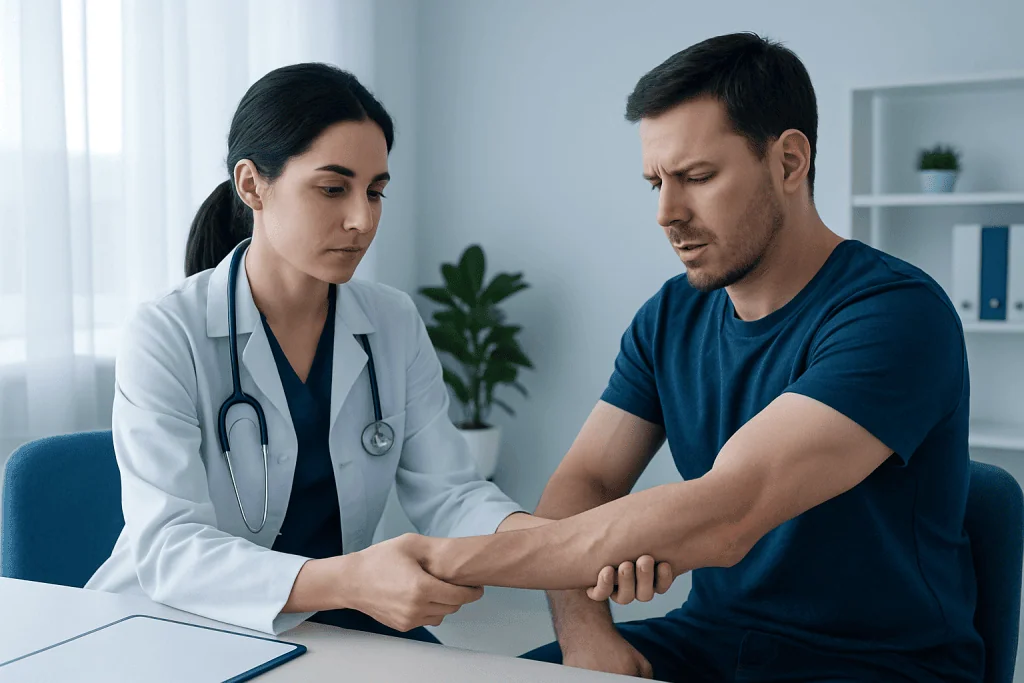
Assessment begins with questions about the mechanism of injury, the direction of force, immediate symptoms, previous elbow problems, and current ability to move the arm. A clinician examines the elbow for swelling, bruising, tenderness, alignment, range of motion, and signs that the joint is unstable.
The hand and forearm are also checked carefully. This includes sensation, muscle strength, pulses, skin color, and warmth, because nerves and blood vessels pass close to the elbow. Comparing the injured arm with the other side can help distinguish an individual’s natural range of motion from a new problem.
An X-ray may be recommended after a notable fall, direct impact, severe pain, marked swelling, limited movement, or tenderness over bone. X-rays help identify fractures and confirm whether the joint is aligned. They may not show ligament or tendon injuries clearly, so ultrasound, magnetic resonance imaging (MRI), or other imaging may be considered if symptoms persist, instability is suspected, or surgical planning is needed.
It is best not to repeatedly test the elbow by forcing it straight or trying to “pop” it back into place. Repeated stress can worsen pain and may aggravate an underlying injury. A suspected dislocation should be treated as an urgent medical issue and should only be reduced by appropriately trained clinicians.
Treatment and recovery
Treatment depends on the tissues involved and the stability of the joint. For a mild sprain or strain without fracture or dislocation, initial care usually focuses on protecting the elbow from further force, using a sling or brace if advised, applying a wrapped cold pack for short intervals, and keeping the arm comfortably elevated when swelling is present. Non-prescription pain relief may be suitable for some people, but a pharmacist or clinician can advise based on medical history and other medicines.
Complete rest for a prolonged period is usually not ideal unless a clinician recommends it. Once serious injury has been excluded and pain allows, gradual, gentle movement can help limit stiffness. The timing and range of exercises should be individualized, particularly after a dislocation, fracture, tendon injury, or surgery.
Physical therapy may be useful when movement, strength, coordination, or confidence has not returned. Rehabilitation commonly progresses from restoring comfortable bending and straightening to strengthening the forearm, upper arm, shoulder, and muscles that help protect the elbow during activity. Return to sport, manual work, or weight-bearing exercise should be gradual and based on function rather than on the calendar alone.
Fractures, unstable ligament injuries, tendon ruptures, and dislocations may require immobilization, a brace with controlled movement, reduction of the joint, or surgery. Follow-up is important because the elbow can become stiff after injury. Acibadem International’s multidisciplinary specialists and JCI-accredited hospitals assess and treat elbow injuries for international patients when specialist care is required.
Protecting the elbow during healing and preventing another injury
In the first days after an uncomplicated injury, it is sensible to avoid heavy lifting, pushing, pulling, contact activities, and movements that force the elbow into its painful end range. A brace should be worn only as directed; using one for longer than necessary can contribute to stiffness and weakness.
As symptoms settle, regular clinician- or therapist-guided exercises can improve movement and build stability. Strengthening should include the arm and shoulder region rather than focusing only on the elbow. Good shoulder and trunk control can help reduce excess force through the arm during sports and falls.
Practical prevention includes using sport-specific protective equipment where appropriate, learning safe landing techniques, warming up before demanding activity, and avoiding training through significant elbow pain. People returning to a sport that involves falls or upper-limb impact may benefit from a supervised return-to-play plan.
Reducing fall risks also matters, particularly for older adults. Supportive footwear, good lighting, clear walkways, corrected vision, and discussion of balance concerns with a healthcare professional can all be helpful. People with repeated joint hyperextension or frequent sprains may wish to ask whether joint hypermobility or another underlying factor is contributing.
When to seek medical care
Urgent medical care is needed after an elbow injury if the arm looks deformed, the elbow appears out of place, pain is severe, or the person cannot move the elbow. The same applies if the hand or fingers become numb, weak, pale, blue, cold, or unusually swollen. These findings can indicate a dislocation, fracture, or injury affecting circulation or nerves.
A prompt medical assessment is also appropriate after a fall or sports injury when there is significant swelling, bruising, pinpoint bone tenderness, a popping sensation followed by loss of function, or pain that does not improve over the next few days. Children, older adults, and people with known bone fragility should have a low threshold for evaluation after an elbow injury.
Even mild symptoms deserve review if the elbow feels unstable, repeatedly catches or locks, cannot fully bend or straighten after the early recovery period, or continues to limit work, sleep, daily activities, or sport. Early assessment can clarify whether imaging, bracing, rehabilitation, or referral to an orthopedic specialist is appropriate.
Frequently asked questions
Can a hyperextended elbow heal on its own?
A mild elbow sprain or soft-tissue strain may improve with appropriate protection, symptom relief, and gradual return to movement. However, it is important to seek assessment if pain is substantial, movement is limited, or there is concern for fracture, dislocation, instability, or nerve symptoms. Recovery time depends on the severity and structures involved.
How do I know if my elbow is hyperextended or naturally flexible?
Natural hyperextension is usually present on both sides, has been present for a long time, and does not cause pain, swelling, weakness, or loss of function. An injury is more likely when the extra backward movement starts after a fall or impact and is accompanied by symptoms. A clinician can assess the joint and compare it with the other elbow.
Should a hyperextended elbow be kept straight or bent?
The most comfortable position varies with the injury, and a clinician may recommend a sling, brace, or a specific range of movement. Forcing the elbow fully straight or deeply bent when it is painful should be avoided. Medical evaluation is especially important if the elbow cannot be positioned comfortably or looks misaligned.
Can I exercise with a hyperextended elbow?
Exercises that load the arm, such as push-ups, weight lifting, throwing, or contact sports, should generally be avoided until pain, swelling, movement, and strength have improved. Gentle motion may be recommended for some uncomplicated injuries, but the right timing depends on the diagnosis. A physiotherapist or clinician can provide a safe progression.
Does a popping sound mean the elbow is fractured?
No. A pop can occur when ligaments or other soft tissues are stretched, but it can also occur with more serious injuries. Because sound alone cannot identify the cause, the associated symptoms and injury mechanism are more important. Severe pain, deformity, swelling, or inability to move the arm warrants urgent assessment.
How long does a hyperextended elbow take to recover?
Minor soft-tissue injuries may improve over days to several weeks, while more substantial ligament injuries, fractures, or dislocations can take longer and may require structured rehabilitation. Stiffness can persist if recovery is rushed or if the elbow is immobilized longer than necessary. Return to demanding activity should be guided by comfortable full movement, strength, and medical advice.
References
- American Academy of Orthopaedic Surgeons
- American Society for Surgery of the Hand
- National Health Service
- Mayo Clinic
- Merck Manual Consumer Version
This article is for general information only and is not a substitute for professional medical advice. Please consult a qualified doctor about your individual situation.
Joint and spine care in Turkey — expert assessment & treatment
JCI-accredited · board-certified surgeons · reply within 24h
Add us as a Preferred Source to see more of our trusted health content across Google Search, AI Overviews and Discover.

More from the Health Library



Related Specialists

Assoc. Prof. Dr. Engin Çelik
Gynecology & Obstetrics
Prof. Dr. Ramazan Yavuz Akman
Urology
Fzt. Demet Orhan
Physical Medicine & Rehabilitation
Dr. Feyza Arslan
Physical Medicine & Rehabilitation