Images of ringworm infection: Common Causes, Warning Signs, and When to Worry

Ringworm is a fungal infection, not a worm infestation. Typical images show a ring-shaped, scaly rash, but many cases do not form a perfect ring.
Key Takeaways
- Ringworm is a fungal infection, not a worm infestation.
- Typical images show a ring-shaped, scaly rash, but many cases do not form a perfect ring.
- Appearance varies by body site, age, skin tone, and whether the area has been scratched or treated.
- Other conditions such as eczema, psoriasis, and pityriasis rosea can resemble ringworm.
- Medical care is important if the rash is spreading, involves the scalp or nails, or does not improve with standard treatment.
Images of ringworm infection often show a circular or oval rash with a scaly edge and some central clearing, but the pattern can look different on the scalp, feet, groin, nails, or darker skin tones. Recognizing the visual clues can help a person know when ringworm is likely, what else can mimic it, and when medical assessment is the safest next step.
What images of ringworm infection usually show
Images of ringworm infection most often show a round or oval rash with a slightly raised, scaly border and a center that may look less red or less inflamed than the edge. This classic pattern is why it is called “ringworm,” although the condition is caused by a fungus and has nothing to do with worms. The rash may itch, burn mildly, or simply feel dry and rough.
Not every case looks like a perfect ring. In early stages, the rash may start as a small scaly patch and slowly expand outward. On some skin tones, ringworm may appear pink or red; on darker skin, it may look brown, gray, or darker than surrounding skin. Because of this variation, online images can be helpful for general comparison, but they cannot confirm a diagnosis on their own.
Ringworm is also known as tinea. The name changes depending on location, such as tinea corporis on the body, tinea capitis on the scalp, tinea pedis on the feet, and tinea cruris in the groin. Images from one body area may not match how the infection looks in another, so it helps to compare the rash with pictures from the correct site.
How ringworm can look on different parts of the body

On the body, ringworm often appears as one or more circular patches with a flaky border. These patches can enlarge over days to weeks, and the center may become smoother as the edge remains active. Sometimes several rings overlap, creating irregular shapes rather than a single neat circle.
On the scalp, ringworm may look quite different. Instead of a ring, it can cause scaly patches, dandruff-like flaking, tenderness, and areas of broken hairs or hair loss. In children especially, scalp involvement needs medical attention because it often requires oral medication rather than cream alone. A related overview of hair loss may help explain why scalp infections can lead to patchy shedding.
On the feet, ringworm may cause peeling, cracking, itching, or scaling between the toes or on the soles rather than a ring-like lesion. In the groin, it often causes a red-brown, itchy rash that spreads along the inner thighs while usually sparing the scrotum. Nail involvement can make nails thicken, crumble, discolor, or lift from the nail bed, which can overlap with other nail diseases.
Common symptoms and warning signs to notice
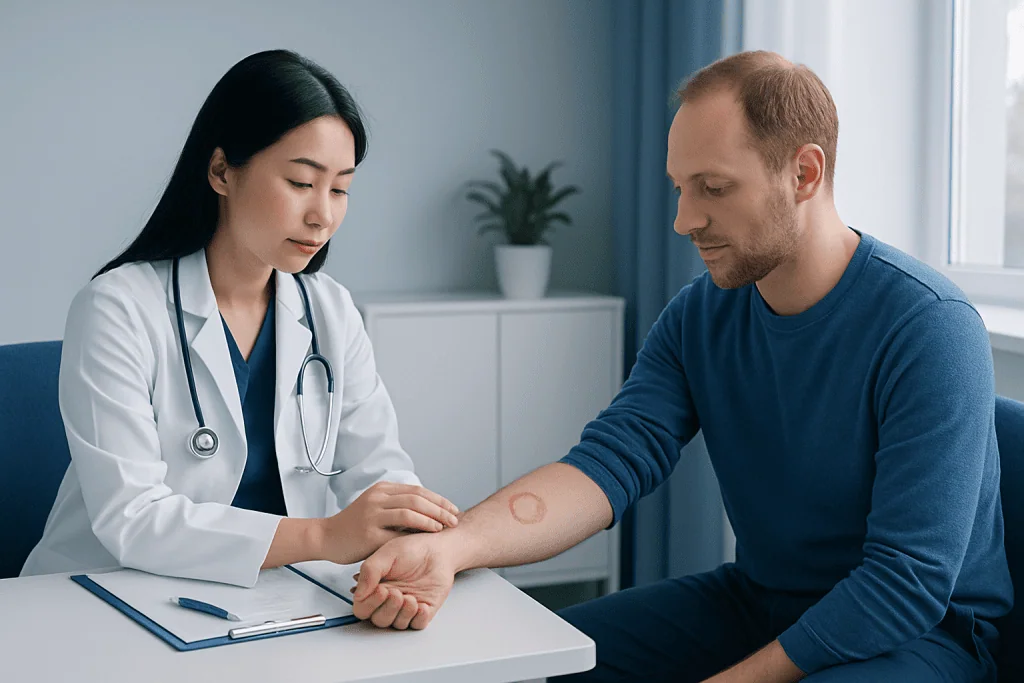
The most common symptoms are itching, scaling, and a gradually expanding rash. The border may be more noticeable than the center, and the skin can feel dry, flaky, or irritated. Some people develop multiple spots, especially if the fungus spreads through scratching, close skin contact, or shared personal items.
Warning signs that deserve closer attention include scalp involvement, nail changes, swelling, pain, drainage, or a rash that is rapidly spreading. Ringworm can sometimes become inflamed, especially after self-treatment with steroid cream, which may mask the border and make the infection appear less typical. This altered appearance is sometimes called tinea incognito and can be more difficult to recognize from images alone.
Another clue is persistence. If a rash thought to be eczema or dry skin continues to expand despite moisturizers, or briefly improves and then returns, a fungal infection becomes more likely. A doctor may also consider related skin conditions such as eczema because several rashes can look similar in photographs.
Causes, spread, and risk factors
Ringworm is caused by dermatophyte fungi that live on the outer layers of skin, hair, and nails. It spreads through direct skin-to-skin contact, contact with contaminated objects such as towels, hairbrushes, or gym surfaces, and sometimes from infected animals. Warm, moist environments help these fungi grow, which is why sweaty skin folds and shared changing areas can increase risk.
Some people are more likely to develop ringworm or to have recurrent infection. Risk factors include close-contact sports, communal showers, excessive sweating, tight or non-breathable clothing, minor skin injury, and a weakened immune system. Children are particularly prone to scalp ringworm, while athletes commonly develop infections of the body, groin, or feet.
Household spread can happen when one person has untreated infection. Pets, especially kittens and puppies, can carry fungal infections and pass them to family members. If several people in a home develop similar rashes, or if a person has repeated episodes, it can be useful to consider environmental sources as well as personal treatment.
What can be mistaken for ringworm
Many skin conditions can resemble images of ringworm infection. Eczema can cause itchy, dry patches; psoriasis can produce sharply defined, scaly plaques; pityriasis rosea can create oval lesions on the trunk; and contact dermatitis can cause irritated red areas after exposure to a trigger. Insect bites, granuloma annulare, and some bacterial rashes may also cause circular or ring-like marks.
Visual comparison online has limits because lighting, skin tone, scratching, and previous treatments can change a rash significantly. A fungal infection that has been treated with over-the-counter steroid cream may lose its classic border and spread more widely, making it look less like ringworm. By contrast, some non-fungal conditions can appear surprisingly ring-like in photographs.
This is one reason diagnosis matters when a rash is atypical, recurrent, or not improving. A dermatologist or other qualified clinician can often recognize the pattern during an exam and may perform simple tests to confirm whether a fungus is present.
How doctors diagnose ringworm
Diagnosis usually begins with a clinical examination of the skin, scalp, or nails. A doctor will ask how long the rash has been present, whether it itches or spreads, whether there has been contact with infected people or animals, and what treatments have already been tried. In many straightforward cases, the appearance and location are enough to make ringworm likely.
When confirmation is needed, a clinician may gently scrape some scale from the rash or collect nail or hair samples for microscopic testing or fungal culture. These tests help distinguish ringworm from conditions that look similar and can guide treatment if the infection is stubborn or extensive. Scalp and nail infections are especially likely to need formal diagnosis because they often require longer or different treatment approaches.
If symptoms suggest a broader skin problem, the doctor may also evaluate for other causes. In specialist settings, assessment may involve a dermatologist and, when needed, support from dermatology evaluation and care to choose the most appropriate management plan.
Treatment options and practical self-care
Treatment depends on the location and extent of infection. Many mild cases on the body, groin, or feet improve with antifungal creams, lotions, or sprays used as directed for the full recommended time. Keeping the skin clean and dry, changing socks regularly, avoiding tight damp clothing, and not sharing towels or razors can help treatment work and reduce spread.
Scalp ringworm and most nail infections usually need prescription oral antifungal medication because creams alone do not penetrate deeply enough. If the scalp is inflamed, there is hair loss, or the nails are thickened and crumbling, self-treatment should not be the only plan. In some cases, doctors may also recommend supportive skin care and dermatology measures to reduce irritation and protect the surrounding skin.
It is generally best to avoid using steroid creams alone on a suspected fungal rash unless a doctor specifically advises it. Steroids can reduce redness for a short time while allowing the fungus to continue spreading. If symptoms are persistent or the diagnosis is uncertain, formal dermatology assessment can help clarify what the rash is and what treatment is most suitable.
When to seek medical care
Medical care is advisable if the rash involves the scalp, face, beard area, nails, or large areas of the body. A person should also seek care if the rash is painful, swollen, oozing, rapidly spreading, or associated with fever or significant tenderness. These features may suggest inflammation, secondary infection, or a diagnosis other than simple ringworm.
A doctor should also be consulted if symptoms do not begin to improve after an appropriate trial of antifungal treatment, or if the rash keeps returning. Children with suspected scalp ringworm, people with diabetes or a weakened immune system, and anyone with uncertain diagnosis benefit from professional evaluation sooner rather than later.
For international patients who need specialist evaluation, Acibadem International’s multidisciplinary teams in JCI-accredited hospitals diagnose and treat skin, scalp, and nail fungal infections as part of broader dermatologic care. Timely assessment can help confirm the diagnosis, reduce spread, and prevent avoidable discomfort or complications.
Frequently asked questions
Do images of ringworm infection always show a perfect circle?
No. While many people expect a neat ring with central clearing, ringworm can look oval, irregular, or simply scaly and expanding. Its appearance also changes depending on the body area, skin tone, and whether the rash has been scratched or treated.
Can ringworm look different on darker skin tones?
Yes. On darker skin, ringworm may appear brown, gray, violet-toned, or darker than the surrounding skin rather than obviously red. The scaling and border may still be the most useful visual clues.
How can someone tell ringworm from eczema?
Ringworm often has a more defined, active-looking border and tends to spread outward over time. Eczema is usually drier, may be less sharply outlined, and often occurs with a history of sensitive skin or allergies. Because they can overlap in appearance, medical evaluation is sensible if the rash is unclear or not improving.
Is ringworm contagious?
Yes. It can spread through direct skin contact, shared personal items, contaminated surfaces, and sometimes pets. Good hygiene, prompt treatment, and avoiding shared towels, combs, or clothing can reduce transmission.
Can ringworm go away without treatment?
Some mild infections may improve slowly, but many persist, spread, or recur without proper treatment. Early treatment usually shortens the course and lowers the risk of passing it to others.
When is ringworm serious enough to see a doctor?
A doctor should be consulted for scalp or nail involvement, widespread rash, significant pain, swelling, drainage, or no improvement after standard antifungal treatment. Medical advice is also important for young children, people with weakened immune systems, and anyone unsure whether the rash is actually ringworm.
References
- American Academy of Dermatology
- Centers for Disease Control and Prevention
- National Health Service
- Mayo Clinic
- Merck Manual Consumer Version
This article is for general information only and is not a substitute for professional medical advice. Please consult a qualified doctor about your individual situation.
Hair transplant in Turkey — costs, graft counts & a free assessment
JCI-accredited · board-certified surgeons · reply within 24h
Add us as a Preferred Source to see more of our trusted health content across Google Search, AI Overviews and Discover.

More from the Health Library



Related Specialists

Dr. Halil Ertürk
Internal Medicine
Dr. Erkan Adnan Kelebek
Coronary Intensive Care Unit
Assoc. Prof. Dr. Günseli Bozdoğan
Pediatrics
Beyza Nur Gündüz
Physical Medicine & Rehabilitation