Infantile Spasms — Explained by Medical Evidence, Not Myths

Infantile spasms are a type of seizure seen most often in babies between about 3 and 12 months of age. The movements often come in clusters and may look like brief head drops, body stiffening, or sudden bending at the waist.
Key Takeaways
- Infantile spasms are a type of seizure seen most often in babies between about 3 and 12 months of age.
- The movements often come in clusters and may look like brief head drops, body stiffening, or sudden bending at the waist.
- Early diagnosis and treatment matter because ongoing spasms can affect brain development and learning.
- Diagnosis usually involves a detailed history, video of events if available, EEG, and often brain imaging.
- Parents should seek urgent medical care if they suspect infantile spasms, even if episodes are brief or the baby seems well afterward.
Infantile spasms are a serious seizure disorder of infancy, usually beginning in the first year of life. They can be subtle and easily mistaken for reflux, startle, or colic, so prompt medical assessment is important if unusual repeated jerking or bending episodes are noticed.
Overview: what infantile spasms are
Infantile spasms are a form of epilepsy that causes brief, repeated seizures in babies. They are not simply strong startle reflexes or ordinary jerky movements. In many infants, the episodes happen in clusters, meaning several spasms occur close together over a few minutes.
This condition is sometimes associated with a pattern on an electroencephalogram (EEG) called hypsarrhythmia and with developmental slowing or regression. When these features occur together, clinicians may use the term West syndrome. However, not every child has every classic feature at the same time, which is one reason diagnosis can be delayed.
Infantile spasms are considered a neurologic emergency because faster recognition can lead to earlier treatment. Early treatment does not guarantee a specific outcome, but it may reduce ongoing seizure activity and support the best possible developmental progress. Because the episodes can be subtle, families often play an essential role by describing what they see and, if safe, recording events on video.
How infantile spasms can look in real life
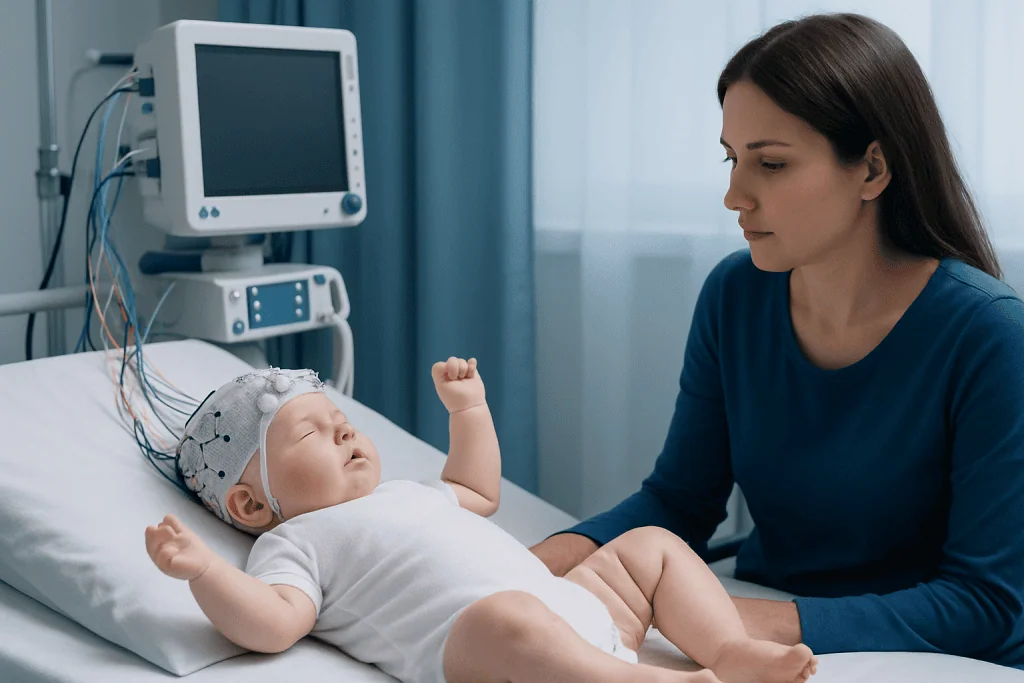
One reason infantile spasms are often misunderstood is that they do not always look like the dramatic shaking many people associate with seizures. A spasm may last only a second or two. The baby may suddenly bend forward, throw the arms outward, stiffen, tuck the knees up, or briefly drop the head. Some infants have more subtle facial or eye movements.
The timing of the episodes can offer an important clue. Spasms commonly happen in clusters, especially when a baby is waking up or becoming sleepy. A cluster may include a few spasms or many in a row, with short pauses between them. During or after a cluster, the infant may seem startled, cry, become briefly quiet, or appear less interactive.
Because these seizures can resemble reflux, colic, Moro reflex, or normal stretching, families may not realize at first that they are seeing a seizure disorder. Features that raise concern include repeated identical episodes, clustering, and loss of previously gained skills such as smiling less, reduced eye contact, or weaker head control.
- Brief sudden bending forward or arching back
- Head drops or repeated nodding movements
- Arm stiffening or flinging outward
- Clusters of events, often around sleep-wake transitions
- Changes in alertness or development
Causes and risk factors

Infantile spasms can have many causes. In some babies, they are linked to a structural difference in the brain, a prior brain injury, genetic conditions, metabolic disorders, infections affecting the nervous system, or reduced oxygen around the time of birth. In others, no clear cause is identified even after careful evaluation.
Doctors often group causes into broad categories such as structural, genetic, metabolic, infectious, immune-related, or unknown. This matters because the underlying cause can influence treatment planning, prognosis, and whether additional therapies or long-term follow-up are needed. In some children, infantile spasms are part of a wider epilepsy condition such as epilepsy.
Risk factors vary depending on the child’s medical history. A baby may be at higher risk if there is a known neurologic condition, developmental concerns before the spasms begin, or an earlier brain abnormality found on ultrasound or MRI. Still, infantile spasms can also occur in infants who seemed healthy beforehand, which is why new repetitive seizure-like movements should never be dismissed without medical review.
Why early diagnosis matters
Infantile spasms deserve prompt attention because they can be associated with ongoing abnormal brain activity during an important stage of development. The concern is not only the visible movements themselves, but also the effect that uncontrolled seizures and abnormal EEG patterns may have on learning, attention, and developmental progress.
Many parents notice that something changes before diagnosis: the baby may stop doing things they had already learned, become less engaged, smile less, or seem harder to console. These signs do not confirm infantile spasms on their own, but they can help doctors understand the overall picture and urgency.
Early treatment aims to stop spasms and improve the EEG as quickly as safely possible. This is why clinicians often recommend urgent neurologic assessment rather than a wait-and-see approach. If an infant is thought to have infantile spasms, evaluation by specialists in pediatric neurology is often appropriate.
How doctors diagnose infantile spasms
Diagnosis usually begins with a careful history. Doctors ask what the movements look like, how long they last, how often they happen, whether they occur in clusters, and whether there have been developmental changes. A video recorded by a caregiver can be extremely helpful, especially if the event is brief and difficult to describe.
The most important test is typically an EEG, which records the brain’s electrical activity. In infantile spasms, the EEG may show a pattern called hypsarrhythmia or other abnormalities linked with epileptic spasms. Because spasms may happen at particular times of day, doctors may recommend prolonged or video EEG monitoring to capture both the movements and the brain-wave changes during an episode.
Further testing often includes brain imaging, usually MRI, to look for structural causes. Blood tests, urine tests, and genetic testing may be recommended when the cause is not already known. Depending on the child’s presentation, doctors may also assess vision, hearing, feeding, and development to build a complete care plan. Some infants benefit from MRI imaging and specialized EEG evaluation as part of diagnosis.
Treatment options and follow-up care
Treatment for infantile spasms is individualized and depends on the child’s age, overall health, EEG findings, and possible underlying cause. Common evidence-based approaches include specific anti-seizure therapies used for infantile spasms and, in selected children, treatment directed at an identified cause. Doctors monitor the response closely because stopping the visible spasms alone is not always enough; they also want to see improvement on follow-up EEG.
If a baby has an underlying structural brain lesion or another clear trigger, management may involve a broader team that includes pediatric neurologists, neuroradiologists, geneticists, rehabilitation specialists, and developmental therapists. In some situations, additional epilepsy treatments or surgical evaluation may be considered for difficult-to-control seizures, using services such as epilepsy surgery when appropriate and carefully selected.
Follow-up is an important part of care. Even after spasms improve, children often need ongoing assessment for development, feeding, movement, sleep, and future seizure risk. Early supportive therapies can help address delays in motor, language, and social development. Near the end of the care pathway, families may also seek multidisciplinary assessment at centers such as Acibadem International, where JCI-accredited hospitals support international patients with neurologic diagnosis and treatment.
Support at home and when to seek medical care
At home, caregivers should focus on observation, safety, and clear communication with the medical team. If possible, they can record a video of the episodes, note the time of day, how many occur in a cluster, and whether the baby seems sleepy or less interactive afterward. This information can help clinicians recognize patterns and judge treatment response.
Parents should not try to diagnose infantile spasms on their own or assume the episodes are harmless reflux or normal startle. Home care does not replace medical treatment. The priority is prompt professional evaluation, especially if the baby is having repeated suspicious movements or seems to be losing developmental skills.
Medical care should be sought urgently if a baby has repeated clusters of sudden jerking, stiffening, bending, or head-dropping episodes. Immediate emergency help is needed if a seizure lasts several minutes without recovery, breathing appears abnormal, the baby turns blue, there is poor responsiveness, or an injury occurs during an episode. After diagnosis, families should follow the treatment plan closely and attend all follow-up visits.
Frequently asked questions
Are infantile spasms the same as normal baby startle reflexes?
No. A normal startle reflex is usually triggered by sound, movement, or position change and tends to become less noticeable as a baby grows. Infantile spasms are seizures that often happen in repeated clusters and may occur without a clear trigger.
At what age do infantile spasms usually begin?
They most often begin in the first year of life, commonly between about 3 and 12 months. However, timing can vary, so any repeated unusual movements in an infant should be discussed with a doctor.
Can infantile spasms be mistaken for reflux or colic?
Yes. Because the movements can be brief and may involve bending, stiffening, or crying, they are sometimes confused with reflux, colic, or normal stretching. Clustering of similar episodes and developmental changes make seizure evaluation especially important.
How is infantile spasms diagnosis confirmed?
Doctors usually combine the history, a caregiver’s description or video, and an EEG to confirm the diagnosis. Brain MRI and other tests may be needed to look for the underlying cause.
Do infantile spasms go away on their own?
They should not be expected to go away without medical attention. Even if the episodes seem brief, infantile spasms require urgent specialist assessment because delayed treatment may affect development and seizure control.
What should a parent do if they suspect infantile spasms?
They should contact a doctor urgently and seek prompt evaluation, ideally by a pediatric neurologist. If safe, recording a video of the event and noting the timing and pattern can be very helpful for diagnosis.
This article is for general information only and is not a substitute for professional medical advice. Please consult a qualified doctor about your individual situation.
Persistent digestive symptoms? Get evaluated in Turkey
JCI-accredited · board-certified surgeons · reply within 24h
Add us as a Preferred Source to see more of our trusted health content across Google Search, AI Overviews and Discover.

More from the Health Library

Duodenalulcus: A Complete Medical Overview

Nephrology: A Complete Medical Overview

Thyroglobulin Antibody: What Patients Need to Know

Elizabth Talor — Explained by Medical Evidence, Not Myths

Collagen: What Patients Need to Know