Interventional Neurology in Turkey: How to Choose the Right Hospital for Complex Vascular Care

The best hospital choice depends on the condition, urgency, and the experience of the neurointerventional team. 24/7 emergency stroke pathways, angiography suites, and advanced brain imaging are essential for time-sensitive care.
Key Takeaways
- The best hospital choice depends on the condition, urgency, and the experience of the neurointerventional team.
- 24/7 emergency stroke pathways, angiography suites, and advanced brain imaging are essential for time-sensitive care.
- Complex vascular care often requires coordinated input from neurology, neurosurgery, neuroradiology, anesthesia, and intensive care specialists.
- Patients should ask about hospital accreditation, complication management, rehabilitation planning, and follow-up after discharge.
- Clear explanations, interpreter support, and organized international patient services can make treatment safer and less stressful.
Choosing a hospital for complex vascular care involves more than location or cost. For interventional neurology in Turkey, patients should look for experienced specialists, rapid emergency pathways, advanced imaging, intensive care support, and clear communication throughout diagnosis and treatment.
Overview: What Interventional Neurology Means
Interventional neurology is a field focused on diagnosing and treating disorders of the brain, spine, and blood vessels using minimally invasive, image-guided techniques. Instead of traditional open surgery, specialists often use thin catheters inserted through a blood vessel, usually in the wrist or groin, to reach the affected area. These procedures can help restore blood flow, close abnormal blood vessels, or support precise diagnosis.
People may need this type of care for emergencies such as acute ischemic stroke, or for planned treatment of conditions such as certain aneurysms, arteriovenous malformations, carotid artery disease, and other vascular abnormalities. Because many of these conditions can affect brain function, timing, accuracy, and team coordination are especially important.
When considering interventional neurology in Turkey, patients and families often focus first on travel, convenience, or cost. These practical factors matter, but they should come after the most important question: whether the hospital is equipped to deliver safe, rapid, expert care for a complex neurological vascular problem. The right hospital is one that can diagnose the condition accurately, treat it without delay when needed, and manage recovery with close monitoring and rehabilitation support.
Which Conditions Need Complex Vascular Care
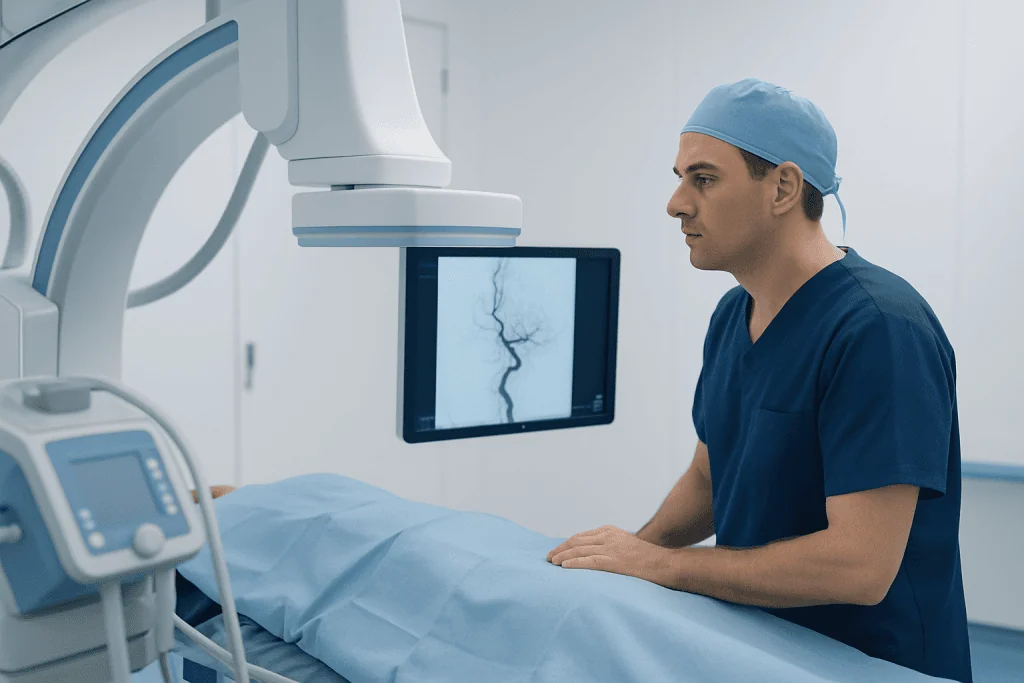
Complex vascular care refers to treatment for conditions involving the blood vessels of the brain, neck, or spinal cord. Some are emergencies that require immediate treatment, while others are found during evaluation for headaches, dizziness, transient weakness, or imaging done for another reason. Not every vascular condition needs an intervention, but every suspected case should be assessed by an experienced team.
Common examples include acute ischemic stroke caused by a blocked artery, brain aneurysms, carotid or vertebral artery narrowing, dural arteriovenous fistulas, and certain arteriovenous malformations. Hospitals that provide neurointerventional services may also perform diagnostic catheter-based imaging to clarify whether a vessel problem is truly present and how serious it is. For some patients, the key question is whether they are a candidate for stroke treatment or another endovascular procedure.
A good center should be able to assess related conditions as part of the same care pathway, including stroke, transient ischemic attack, and selected aneurysm cases. This matters because symptoms can overlap, and the safest plan depends on understanding the exact diagnosis, the patient’s overall health, and whether treatment is urgent or elective.
How to Evaluate a Hospital Before Choosing

One of the most helpful ways to compare hospitals is to look at the entire care pathway, not just the procedure itself. A strong hospital for interventional neurology should offer 24/7 emergency assessment, rapid brain imaging, an on-call neurointerventional team, operating room and intensive care backup, and post-procedure neurological monitoring. If a patient arrives with sudden stroke symptoms, minutes matter, so systems and workflow are just as important as individual technical skill.
Patients can ask practical questions such as whether the hospital has a dedicated stroke unit, how quickly imaging can be performed, whether angiography suites are available around the clock, and whether the team regularly manages complex vascular emergencies. It is also reasonable to ask who will be involved in the case, including neurologists, interventional neuroradiologists or endovascular specialists, neurosurgeons, anesthesiologists, and critical care physicians.
Hospital accreditation and quality processes are also worth reviewing. Internationally recognized accreditation does not guarantee outcomes, but it can show that the hospital follows established standards for patient safety, infection control, and coordinated care. For international patients, it also helps to know whether interpreter services, treatment planning support, medical record review, and discharge coordination are available in a structured way.
Finally, patients should be cautious about making decisions based only on promotional language. The best hospital choice is usually supported by clear answers about expertise, facilities, emergency readiness, and follow-up. A trustworthy team explains both benefits and limitations of treatment and is willing to discuss alternatives when intervention may not be necessary.
The Importance of Specialist Experience and Teamwork
Interventional neurology is highly team-based. Even when one physician performs the procedure, safe care depends on close collaboration between specialists before, during, and after treatment. This is particularly important in difficult cases, such as large vessel stroke, ruptured aneurysm, complex carotid disease, or vascular malformations near sensitive brain areas.
Experienced hospitals usually bring together vascular neurologists, neurointerventional specialists, neurosurgeons, neuroradiologists, intensive care experts, rehabilitation professionals, and specialized nursing staff. This multidisciplinary approach supports careful decision-making. For example, one patient may benefit from urgent clot removal, while another may need medical management, surgery, or observation instead.
Patients should also consider whether the hospital treats enough similar cases to maintain strong expertise. It is appropriate to ask whether the team routinely performs diagnostic angiography, thrombectomy, embolization, and related procedures, and whether there are established protocols for complications, anesthesia choices, and neurological observation after treatment. Expertise includes not only technical procedure skills but also knowing when not to intervene.
In some cases, related evaluations such as brain MRI or advanced vascular imaging may be part of planning. If surgery becomes necessary, access to comprehensive neurosurgery services within the same hospital can be reassuring, especially for patients with unstable or complex findings.
Imaging, Technology, and Emergency Readiness
Advanced imaging is central to complex vascular care. Hospitals should be able to perform and interpret non-contrast brain CT, CT angiography, MRI, MR angiography, ultrasound when appropriate, and catheter angiography. These tests help the team identify a blocked or weakened vessel, estimate how much brain tissue may be at risk, and decide whether an intervention is suitable and safe.
Technology matters, but only when paired with a well-organized emergency pathway. For example, in acute stroke, a hospital should be able to move quickly from triage to imaging to treatment decision-making. The angiography suite should be ready for endovascular procedures such as mechanical clot removal in selected patients. Intensive care or high-dependency monitoring should also be available after the procedure.
Patients considering travel for planned vascular treatment should ask how emergency care is handled if the situation changes before or after the procedure. A well-prepared center should have blood bank support, anesthesia coverage, neurosurgical backup, and the ability to repeat imaging promptly if symptoms change. These details can be just as important as the procedure itself, especially in conditions where bleeding or vessel re-occlusion is a concern.
Hospitals may also use diagnostic tests such as cerebral angiography to better define a vascular problem when noninvasive imaging does not provide enough detail. Because this test is invasive, patients should receive a clear explanation of why it is needed, what it may show, and what the possible next steps could be.
What Patients Should Ask About Safety, Recovery, and Follow-Up
Before choosing a hospital, patients should understand how risks are assessed and explained. Every interventional procedure has potential complications, such as bleeding, vessel injury, allergic reaction to contrast dye, kidney strain in susceptible patients, or neurological changes. A careful hospital will review medical history, medications, allergies, kidney function, and any need for blood-thinning medicines before treatment.
Recovery planning is another key factor. Some patients go home quickly after a diagnostic procedure, while others need observation in a stroke unit or neuro-intensive care setting. The expected recovery time depends on the underlying condition, whether the procedure was urgent, and whether there was any neurological injury before treatment. Good hospitals explain what level of monitoring is needed and who will be responsible for follow-up after discharge.
International patients should also ask about communication after they return home. Useful questions include whether written reports and imaging can be shared with the home physician, whether remote follow-up is possible when appropriate, and when repeat imaging may be needed. This is especially relevant for aneurysm care, carotid disease, and patients recovering from brain aneurysm treatment or stroke intervention.
Near the end of the decision process, practical support also matters. Organized transfer planning, interpreter services, medication instructions, rehabilitation guidance, and emergency contact pathways can reduce confusion. Acibadem International’s multidisciplinary specialists and JCI-accredited hospitals diagnose and treat complex neurovascular conditions for international patients, with coordinated evaluation and follow-up planning.
When to Seek Urgent Help and How to Prepare
Some neurological vascular problems require urgent medical attention. Sudden weakness on one side, facial drooping, difficulty speaking, loss of vision, severe sudden headache, confusion, dizziness with neurological symptoms, or loss of coordination can be warning signs of stroke or bleeding in the brain. These symptoms should never be ignored, and emergency care should be sought immediately rather than delayed for travel planning or routine consultation.
For non-emergency situations, preparation can help patients choose wisely. It is useful to gather prior brain scans, discharge summaries, medication lists, allergy information, and a brief timeline of symptoms. Patients with kidney disease, diabetes, prior stroke, heart conditions, or use of blood thinners should mention this early because it may affect imaging choices and procedure planning.
Families may also want to prepare a list of questions for the hospital. Helpful topics include the likely diagnosis, whether treatment is urgent, what alternatives exist, who will lead the case, what monitoring will be needed after the procedure, and what signs should prompt immediate medical review after discharge. Clear communication often reflects clear systems of care.
Ultimately, choosing a hospital for interventional neurology in Turkey should be based on safety, expertise, readiness, and continuity of care. A well-qualified center will focus on the patient’s individual condition, explain the reasoning behind each test or treatment, and support informed decision-making at every stage.
Frequently asked questions
What is interventional neurology?
Interventional neurology uses minimally invasive, image-guided procedures to diagnose and treat disorders affecting the brain and its blood vessels. It is often used for stroke, aneurysms, vessel narrowing, and other neurovascular conditions.
How do patients choose the right hospital for complex vascular care?
Patients should look for a hospital with 24/7 emergency stroke services, advanced imaging, experienced neurointerventional specialists, and intensive care support. It is also important to ask about multidisciplinary teamwork, rehabilitation planning, and follow-up after discharge.
Is interventional neurology in Turkey suitable for emergency stroke care?
It can be, but suitability depends on the hospital’s ability to provide immediate assessment, imaging, and treatment around the clock. In stroke care, speed is critical, so emergency readiness is one of the most important factors to confirm.
What tests are commonly used before treatment?
Common tests include brain CT, CT angiography, MRI, MR angiography, ultrasound in selected cases, and sometimes catheter angiography. The choice depends on the symptoms, the suspected diagnosis, and how urgently treatment decisions must be made.
Are these procedures always a replacement for surgery?
No. Some conditions are best treated with an endovascular procedure, while others may be better managed with medication, open surgery, or careful monitoring. The safest option depends on the exact diagnosis, anatomy, and the patient’s general health.
What should international patients ask before traveling?
They should ask who will review their records, whether the diagnosis can be assessed before travel, what imaging may need repeating, and what recovery time is expected. It is also helpful to ask about interpreter services, discharge planning, and communication with doctors back home.
References
- World Stroke Organization
- American Heart Association
- National Institute of Neurological Disorders and Stroke
- European Stroke Organisation
- Radiological Society of North America
This article is for general information only and is not a substitute for professional medical advice. Please consult a qualified doctor about your individual situation.
Interventional Neurology in Turkey — costs, top hospitals & a free quote
JCI-accredited · board-certified surgeons · reply within 24h
Add us as a Preferred Source to see more of our trusted health content across Google Search, AI Overviews and Discover.