Interventional Neurology in Turkey: How to Choose the Right Hospital

The best hospital choice depends on the condition being treated, the urgency of care, and the hospital’s neurointerventional experience. A strong hospital should offer 24/7 emergency access, advanced brain imaging, intensive care support, and a multidisciplinary team.
Key Takeaways
- The best hospital choice depends on the condition being treated, the urgency of care, and the hospital’s neurointerventional experience.
- A strong hospital should offer 24/7 emergency access, advanced brain imaging, intensive care support, and a multidisciplinary team.
- Patients should ask about specialist training, procedure volume, complication management, and rehabilitation planning.
- International patients benefit from clear coordination for records, travel, translation, and post-treatment follow-up.
- Accreditation and patient safety processes are important, but they should be considered together with clinical expertise.
Interventional neurology in Turkey may offer advanced, minimally invasive care for stroke and other blood vessel conditions affecting the brain and spine. Choosing the right hospital involves looking beyond location or price to evaluate expertise, technology, safety systems, and follow-up care.
Overview: What Interventional Neurology Means
Interventional neurology is a field that uses minimally invasive, image-guided procedures to diagnose and treat conditions affecting the blood vessels of the brain, head, neck, and sometimes spine. Instead of open surgery, a specialist often guides very thin tubes called catheters through blood vessels to reach the area that needs treatment. This approach can be especially important in time-sensitive conditions such as acute ischemic stroke, when blood flow to part of the brain is blocked.
Interventional neurology in Turkey is often sought by people looking for hospitals with modern imaging, round-the-clock emergency services, and teams experienced in complex neurovascular care. Common procedures may include mechanical thrombectomy for stroke, cerebral angiography, embolization of abnormal vessels, and treatment planning for aneurysms or vascular malformations. Because these treatments are highly specialized, the quality of the hospital and team can make a meaningful difference.
Choosing the right hospital is not only about finding a doctor who performs the procedure. It also means confirming that the hospital has the full system needed before, during, and after treatment. This includes rapid imaging, anesthesia support, intensive care, neurological monitoring, rehabilitation, and organized follow-up. For international patients, communication and care coordination are also essential parts of safe treatment.
Which Conditions and Procedures May Be Treated
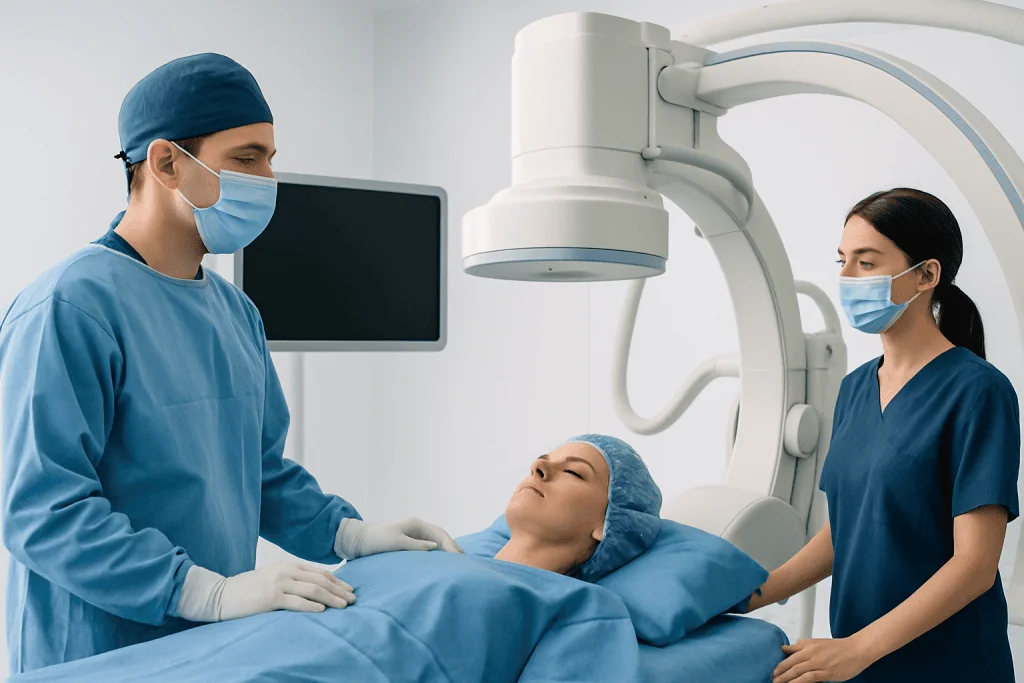
Interventional neurologists most often help manage conditions related to abnormal or blocked blood vessels in the brain. One of the best-known examples is emergency treatment for stroke, especially acute ischemic stroke caused by a large vessel blockage. In selected patients, the blocked artery may be reopened with mechanical thrombectomy, a catheter-based procedure that can improve blood flow to the brain.
Other conditions may include brain aneurysms, arteriovenous malformations, dural arteriovenous fistulas, carotid artery narrowing, and certain types of spinal vascular disorders. Some patients may first need tests such as cerebral angiography to map the blood vessels in detail and guide treatment decisions. In some cases, an abnormal vessel can be closed with embolization treatment using coils, liquid agents, or other devices.
Not every patient needs an interventional procedure, and not every hospital offers the same scope of care. A person with a suspected aneurysm may need input from both neurointerventional and neurosurgical specialists, while a stroke patient may need emergency neurology, radiology, and intensive care support within minutes. For that reason, the best hospital is usually one that can offer a full range of evaluations and can move quickly from diagnosis to treatment.
What to Look for in the Right Hospital

When comparing hospitals, one of the most important questions is whether the center has a dedicated neurovascular or stroke program. Strong hospitals usually provide 24/7 access to emergency brain imaging, catheter laboratories, neurologists, neurointerventional specialists, anesthesiologists, and intensive care teams. In urgent conditions, delays can affect outcomes, so organized systems matter as much as individual expertise.
Experience is another key point. Patients and families can ask whether the hospital regularly performs complex neurointerventional procedures, how often the team manages emergencies, and whether specialists are trained specifically in interventional neurology, neuroradiology, or endovascular neurosurgery. It can also be helpful to know whether treatment decisions are reviewed in a multidisciplinary setting that includes neurology, neurosurgery, radiology, and rehabilitation.
Technology should support, not replace, clinical judgment. A suitable hospital often has high-quality CT, MRI, angiography suites, and neurocritical care monitoring. It should also have protocols for infection control, bleeding management, contrast reactions, and transfer to intensive care if needed. Patients may ask practical questions such as:
- Is emergency care available around the clock?
- How quickly can imaging and treatment begin?
- Is there a dedicated stroke or neurocritical care unit?
- Can the hospital manage complications without transferring the patient elsewhere?
- What rehabilitation and follow-up services are available?
How to Assess Safety, Quality, and Accreditation
Hospital accreditation can be a useful sign that a center follows recognized standards for safety and quality. International patients often look for hospitals with well-established quality systems, transparent communication, and clear policies for consent, infection prevention, medication safety, and emergency response. Accreditation alone does not guarantee that a hospital is the best choice for a specific condition, but it is one helpful part of the overall picture.
Patients should also look for evidence of coordinated care pathways. For example, in stroke treatment, a well-prepared hospital usually has a process for triage, immediate brain imaging, specialist review, and rapid movement to treatment if appropriate. In planned procedures, there should be structured pre-procedure assessment, review of medications, and post-procedure neurological monitoring.
It is reasonable to ask how the hospital handles complications and whether there is access to neurosurgery, vascular surgery, cardiology, and critical care if needed. A hospital that can manage complex cases in one place may be especially reassuring. Near the end of the care journey, international patients may also appreciate support from multidisciplinary specialists and internationally experienced services; Acibadem International, for example, coordinates care for international patients through JCI-accredited hospitals and relevant specialty teams.
Questions International Patients Should Ask Before Choosing
International patients often need more than a medical opinion. They may need help sending scans in advance, understanding whether treatment is urgent, arranging travel, and planning for recovery away from home. Before making a decision, it helps to request a clear explanation of the diagnosis, the proposed procedure, the expected hospital stay, and the possible need for rehabilitation or follow-up imaging.
Practical questions can make the process easier and safer. Patients may ask whether the hospital offers translation services, written treatment plans in English, airport or local transfer support, and assistance with appointment scheduling across several specialties. It is also useful to ask who will be the main contact person before arrival and after discharge.
Another important topic is continuity of care. Patients should ask how records, images, procedure reports, and discharge summaries will be shared with doctors in their home country. If a procedure such as carotid artery stenting is planned, the patient may also need guidance on medicines, activity restrictions, and imaging checks after returning home. Clear communication across borders helps reduce stress and supports safer recovery.
Preparing for Treatment and Recovery
Preparation depends on whether the procedure is planned or performed as an emergency. In urgent cases such as stroke, the priority is immediate evaluation and treatment. In planned cases, patients may undergo blood tests, medication review, neurological assessment, and imaging to confirm the safest treatment approach. They should always tell the medical team about blood thinners, allergies, kidney problems, prior strokes, and any implanted devices.
After a neurointerventional procedure, monitoring usually focuses on neurological status, blood pressure, the catheter entry site, and any signs of bleeding or vessel complications. Some patients go home within a short period, while others need intensive care or a longer inpatient stay, especially after major stroke or treatment of a complex vascular condition. Recovery may include repeat imaging, medication adjustment, and support from physical, occupational, or speech therapy.
Families should ask what symptoms are expected during recovery and which warning signs need urgent attention. They can also ask about driving, travel, work, and exercise restrictions. A hospital with a structured aftercare plan is often a better choice than one that focuses only on the procedure itself, because long-term neurological recovery can depend on follow-up and rehabilitation.
When a Second Opinion or Urgent Care Is Needed
A second opinion can be helpful when the diagnosis is uncertain, the recommended procedure is complex, or more than one treatment approach is possible. This may be particularly useful for aneurysms, vascular malformations, carotid disease, or cases in which both open surgery and endovascular treatment are being considered. A careful review of existing scans by an experienced neurovascular team can sometimes clarify whether intervention is needed now, later, or not at all.
At the same time, some symptoms should be treated as urgent rather than something to research over several days. Sudden weakness, facial drooping, trouble speaking, severe new imbalance, loss of vision, or a very sudden severe headache can require emergency assessment. In these situations, the right hospital is one that can provide rapid stroke or neurovascular care immediately.
For non-emergency decisions, patients can compare centers thoughtfully and request detailed answers. The most suitable hospital is usually one that combines specialist expertise, modern imaging, continuous emergency readiness, rehabilitation support, and clear communication for international patients. A careful choice can help patients feel informed, supported, and prepared for each stage of treatment.
Frequently asked questions
What is interventional neurology?
Interventional neurology is a specialty that treats certain brain and blood vessel conditions using minimally invasive, image-guided procedures. A specialist typically reaches the affected area through the blood vessels rather than using open surgery.
Why do patients seek interventional neurology in Turkey?
Many patients look for hospitals that combine specialist expertise, advanced imaging, and organized international patient services. Turkey is also known for large multidisciplinary hospitals that can provide emergency care, intensive care, and rehabilitation in one setting.
How can someone tell if a hospital is experienced in stroke treatment?
It helps to ask whether the hospital offers 24/7 stroke services, emergency brain imaging, and mechanical thrombectomy when appropriate. A dedicated stroke pathway and access to neurocritical care are also important signs of readiness.
Is accreditation enough to choose a hospital?
Accreditation is useful because it reflects recognized quality and safety standards, but it should not be the only factor. Patients should also look at specialist experience, emergency capability, technology, and aftercare planning.
What should international patients prepare before traveling?
They should gather medical records, imaging files, a medication list, and a summary of previous treatments. It is also wise to confirm who will coordinate appointments, translation, discharge documents, and follow-up after returning home.
When is treatment urgent rather than planned?
Symptoms such as sudden weakness, speech difficulty, facial drooping, vision loss, or a sudden severe headache need urgent medical attention. In these situations, immediate hospital evaluation is more important than comparing options online.
References
- World Stroke Organization
- American Heart Association
- National Institute of Neurological Disorders and Stroke
- Society of NeuroInterventional Surgery
- World Health Organization
This article is for general information only and is not a substitute for professional medical advice. Please consult a qualified doctor about your individual situation.
Interventional Neurology in Turkey — costs, top hospitals & a free quote
JCI-accredited · board-certified surgeons · reply within 24h
Add us as a Preferred Source to see more of our trusted health content across Google Search, AI Overviews and Discover.