Inverted Rows: A Complete Medical Overview

Inverted rows train the upper back, rear shoulders, core, and arm muscles using body weight. Proper body alignment and controlled movement help reduce strain on the neck, shoulders, and lower back.
Key Takeaways
- Inverted rows train the upper back, rear shoulders, core, and arm muscles using body weight.
- Proper body alignment and controlled movement help reduce strain on the neck, shoulders, and lower back.
- People with shoulder pain, recent injury, or spine problems may need technique changes or medical advice before starting.
- Progression should be gradual, with easier angles and fewer repetitions at first.
- Pain during or after exercise is not the same as normal muscle fatigue and should be assessed if it persists.
Inverted rows are a bodyweight pulling exercise that can help strengthen the upper back, shoulders, and arms when done with good technique. From a medical perspective, they are generally safe for healthy people, but form, progression, and existing shoulder, neck, or back problems matter.
Overview: what inverted rows are and why they matter
Inverted rows are a horizontal pulling exercise performed under a bar, suspension trainer, or similar support. The person grips the bar, keeps the body in a straight line, and pulls the chest toward the hands. Because the feet stay on the ground, the exercise uses body weight in a way that can be adjusted for different fitness levels.
From a health and movement standpoint, inverted rows help strengthen muscles that support posture, shoulder stability, and everyday pulling tasks. They are often used as an alternative or stepping-stone to pull-ups because they place less total load on the body while still training important pulling mechanics.
Unlike many gym discussions that focus only on performance, a medical overview also considers joint loading, muscle balance, and injury prevention. Inverted rows can be useful in general conditioning and rehabilitation programs when they are selected appropriately and matched to a person’s health status, mobility, and strength.
How inverted rows work in the body
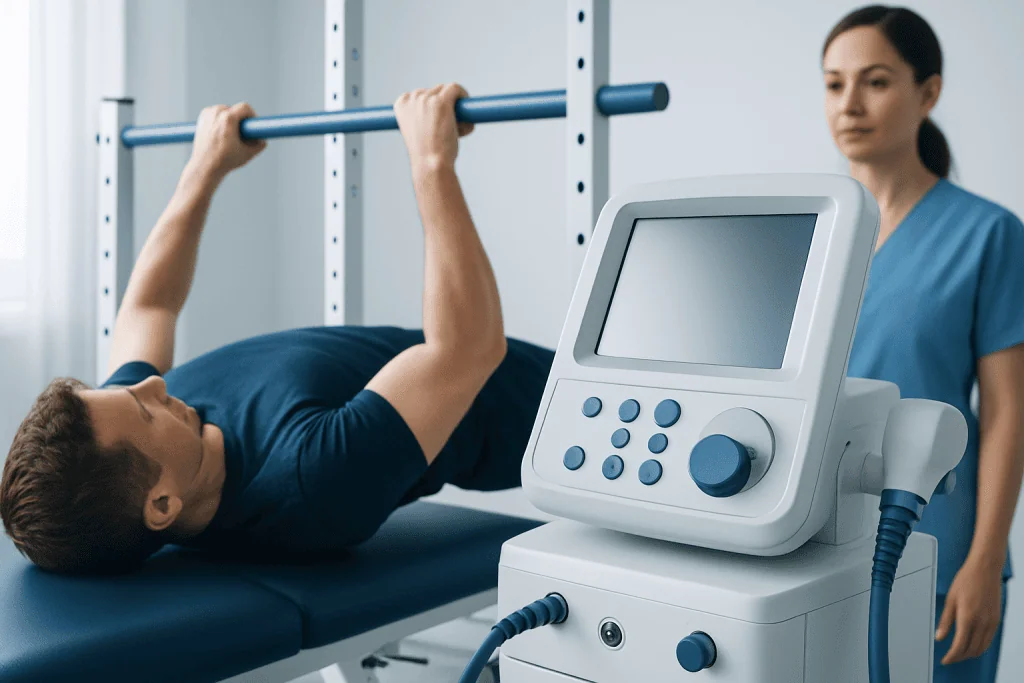
The main muscles worked during inverted rows are the latissimus dorsi, rhomboids, trapezius, posterior deltoids, and elbow flexors such as the biceps. The core, gluteal muscles, and legs also contribute by helping keep the body rigid and aligned throughout the movement.
The exercise trains scapular retraction and shoulder extension, which are important for balanced upper-body function. Many people spend long periods sitting or working at screens, which can contribute to rounded shoulders and reduced upper-back endurance. Pulling exercises like inverted rows may help address this imbalance as part of a broader activity program.
Because the movement occurs with the body suspended under a fixed or supported grip, the shoulders and spine need to coordinate well. Good control of the shoulder blades is especially important. People with weakness, poor posture, or previous pain may benefit from learning this pattern slowly before moving on to more demanding pulling exercises.
Benefits and common uses

Inverted rows can improve upper-body strength, postural endurance, and movement control. They are especially helpful for people who want a pulling exercise without the full difficulty of a pull-up. The angle of the body can be changed easily, making the exercise accessible for beginners and still challenging for more advanced exercisers.
Clinicians and exercise professionals may use inverted rows to build strength in people returning to activity after a period of deconditioning, provided there is no contraindication. They may also fit into programs designed to support shoulder health, trunk stability, and general musculoskeletal fitness.
As part of a balanced routine, inverted rows may complement pushing exercises such as push-ups and resistance training for the chest. Balancing pushing and pulling can help reduce overuse patterns around the shoulder. In people with ongoing shoulder symptoms, however, any exercise plan should be individualized and may overlap with assessment for shoulder pain.
- Can be scaled by changing body angle
- Requires limited equipment
- Supports upper-back and core conditioning
- May help improve exercise variety and movement balance
Proper form, progression, and common mistakes
Proper inverted row form starts with a secure bar or straps, a firm grip, and a straight body position from head to heels. The chest should move toward the hands while the shoulders stay away from the ears. The movement should be controlled in both directions, without jerking or swinging.
A helpful cue is to keep the neck neutral and the ribs gently drawn down, rather than lifting the chin or arching the lower back. At the top of the movement, the shoulder blades should come together naturally, but the person should avoid forcing an exaggerated squeeze that creates neck tension. The lowering phase is equally important because it builds control and reduces sudden strain.
Common mistakes include sagging through the hips, shrugging the shoulders, flaring the ribs, or pulling with momentum. People sometimes set the bar too low too early, which makes the exercise harder than their current capacity and increases compensation. Starting with a more upright angle, fewer repetitions, or supervised instruction can make the exercise safer and more effective. If needed, a clinician may recommend a broader rehabilitation plan that includes physical therapy and rehabilitation.
Risks, limitations, and who should be cautious
For many healthy adults, inverted rows are safe when performed with good technique and appropriate progression. Still, no exercise is risk-free. The most common problems are overuse discomfort, poor movement mechanics, and aggravation of a pre-existing shoulder, elbow, neck, or lower back condition.
People who have recent surgery, acute injury, joint instability, severe osteoporosis, uncontrolled pain, or significant balance limitations should speak with a qualified clinician before starting. The same applies to those with radiating arm pain, numbness, marked weakness, or symptoms that suggest a nerve or spine problem rather than simple muscle fatigue.
Grip position and equipment choice also matter. A very rigid grip, poor wrist position, or unstable setup may increase stress on the wrists, elbows, or shoulders. If a person already has pain related to tendon irritation or overuse, such as a rotator cuff problem or strain pattern, assessment may be needed before continuing. In some cases, evaluation overlaps with care for sports injuries.
Diagnosis of exercise-related pain and what doctors assess
Inverted rows themselves are not a disease, so diagnosis focuses on the cause of pain or limitation associated with the exercise. A doctor or physical therapist typically asks when symptoms began, where the pain is located, whether there was a sudden injury, and what movements make it better or worse. They also review training volume, recent changes in exercise routine, and any previous shoulder, neck, or back problems.
The physical examination may include posture, range of motion, strength, shoulder blade control, and signs of joint or tendon irritation. Depending on symptoms, the clinician may examine the cervical spine, elbows, wrists, and lower back as well. This is important because pain felt during pulling exercises is not always coming from the area where it is noticed.
Imaging is not always necessary. However, if there is significant weakness, persistent pain, limited motion, suspected structural injury, or a history of trauma, doctors may use MRI or other tests to clarify the problem. A careful assessment helps distinguish temporary overload from conditions that need targeted treatment.
Treatment options, recovery, and safe return to exercise
Treatment depends on the cause and severity of symptoms. Mild overuse irritation often improves with temporary modification of activity, improved technique, adequate rest, and a gradual return to training. This may include reducing the row angle, lowering repetition volume, improving warm-up habits, and avoiding painful ranges of motion until symptoms settle.
For persistent or more limiting problems, structured rehabilitation may be recommended. Treatment can include mobility work, strengthening of the shoulder stabilizers and core, and retraining of movement patterns. When inflammation or tissue injury is suspected, clinicians may also advise short-term pain management and a phased exercise plan.
If there is concern about a more serious injury, further evaluation by orthopedic or sports medicine specialists may be appropriate. Depending on the underlying issue, care may include orthopedic assessment or a supervised rehabilitation program. Near the end of recovery, the person usually returns first to easier pulling variations before progressing back to standard inverted rows.
For international patients needing coordinated assessment, Acibadem International’s multidisciplinary specialists and JCI-accredited hospitals diagnose and treat musculoskeletal exercise-related problems with individualized care plans.
Prevention, self-care, and when to seek medical care
Prevention begins with realistic progression. A person should choose a setup that allows smooth, pain-free repetitions with stable alignment, then gradually increase difficulty over time. Warm-up should include light movement for the shoulders, upper back, and core, and training plans should leave enough time for recovery between sessions.
It also helps to maintain a balanced routine. Combining pulling work with mobility, lower-body exercise, and other forms of strength training reduces repetitive strain and supports overall fitness. Good sleep, hydration, and nutrition also influence muscle recovery and exercise tolerance.
Medical care should be sought if pain is sharp, severe, or associated with a pop, swelling, deformity, weakness, numbness, tingling, or pain that spreads down the arm. Evaluation is also appropriate if symptoms last more than a few days despite rest, keep returning during exercise, or limit daily activities. Shortness of breath, chest pain, or dizziness during exercise should be treated as urgent symptoms.
Frequently asked questions
Are inverted rows good for beginners?
Yes, inverted rows can be very suitable for beginners because the difficulty is easy to adjust. Raising the bar or using a more upright body angle reduces the load and helps a person learn proper pulling mechanics safely.
What muscles do inverted rows work the most?
They mainly work the upper back, including the rhomboids, trapezius, and latissimus dorsi, along with the rear shoulders and biceps. The core and gluteal muscles also help stabilize the body during the movement.
Can inverted rows cause shoulder pain?
They can aggravate the shoulder if form is poor, the exercise is progressed too quickly, or an underlying shoulder condition is already present. Pain is not a normal sign of effective exercise, so persistent discomfort should be assessed.
Are inverted rows better than pull-ups?
They are not necessarily better, but they are often more accessible and easier to scale. Pull-ups place a greater demand on strength, while inverted rows are useful for building a foundation and improving control.
Should the body stay straight during inverted rows?
Yes, keeping the body aligned from head to heels helps distribute load more evenly and supports good technique. Sagging hips or excessive arching can increase stress on the lower back and reduce exercise quality.
When should someone stop doing inverted rows?
A person should stop if the exercise causes sharp pain, joint instability, dizziness, numbness, or symptoms that continue after the workout. It is also sensible to pause and seek advice if technique breaks down repeatedly despite reducing difficulty.
References
- American College of Sports Medicine
- National Institute of Arthritis and Musculoskeletal and Skin Diseases
- American Academy of Orthopaedic Surgeons
- National Health Service
- MedlinePlus
This article is for general information only and is not a substitute for professional medical advice. Please consult a qualified doctor about your individual situation.
Joint and spine care in Turkey — expert assessment & treatment
JCI-accredited · board-certified surgeons · reply within 24h
Add us as a Preferred Source to see more of our trusted health content across Google Search, AI Overviews and Discover.

More from the Health Library

Carbs in Tomatoes: What Patients Need to Know

Garlic Substitute: An Evidence-Based Guide for Patients

Proliferative Endometrium — Explained by Medical Evidence, Not Myths

Picture of Tea: An Evidence-Based Guide for Patients

Nutmeg Benefits, Uses, and Safe Amounts