Leukemia Cutis: Diagnosis, Outlook, and Modern Treatment Approaches
Leukemia cutis occurs when leukemia cells infiltrate the skin. It can appear as new bumps, plaques, nodules, or rash-like lesions of varying colors.
Key Takeaways
- Leukemia cutis occurs when leukemia cells infiltrate the skin.
- It can appear as new bumps, plaques, nodules, or rash-like lesions of varying colors.
- Diagnosis typically requires a skin biopsy plus tests to define the type and extent of leukemia.
- Treatment mainly targets the underlying leukemia rather than the skin alone.
- Prompt medical assessment is important, especially in a person with known or suspected leukemia.
Leukemia cutis is a condition in which leukemia cells spread into the skin, causing visible lesions such as papules, nodules, plaques, or rashes. It usually signals active blood cancer and is diagnosed with a skin biopsy and blood cancer evaluation, with treatment focused on the underlying leukemia and, in selected cases, local skin-directed therapy.
Overview
Leukemia cutis is the term used when leukemia cells enter and grow within the skin. In practical terms, this means a blood cancer that usually starts in the bone marrow or bloodstream becomes visible on the skin surface as new lesions. Although it is uncommon overall, it is clinically important because it may appear in someone with a known leukemia, accompany the first diagnosis, or, less often, be the first clue that a blood cancer is present.
The appearance can be varied, which is one reason leukemia cutis may be confused with other skin conditions at first. Lesions may look like small bumps, firm nodules, thicker plaques, bruise-like patches, or a nonspecific rash. Because many skin disorders are far more common, doctors usually confirm the diagnosis with a biopsy rather than relying on appearance alone.
Leukemia cutis is not a separate skin cancer. It is a manifestation of an underlying leukemia, and its significance depends on the leukemia subtype, the person’s overall health, and whether the disease is newly diagnosed, relapsed, or already being treated. Management therefore focuses on the blood cancer as a whole, not only on the skin findings.
What leukemia cutis looks and feels like
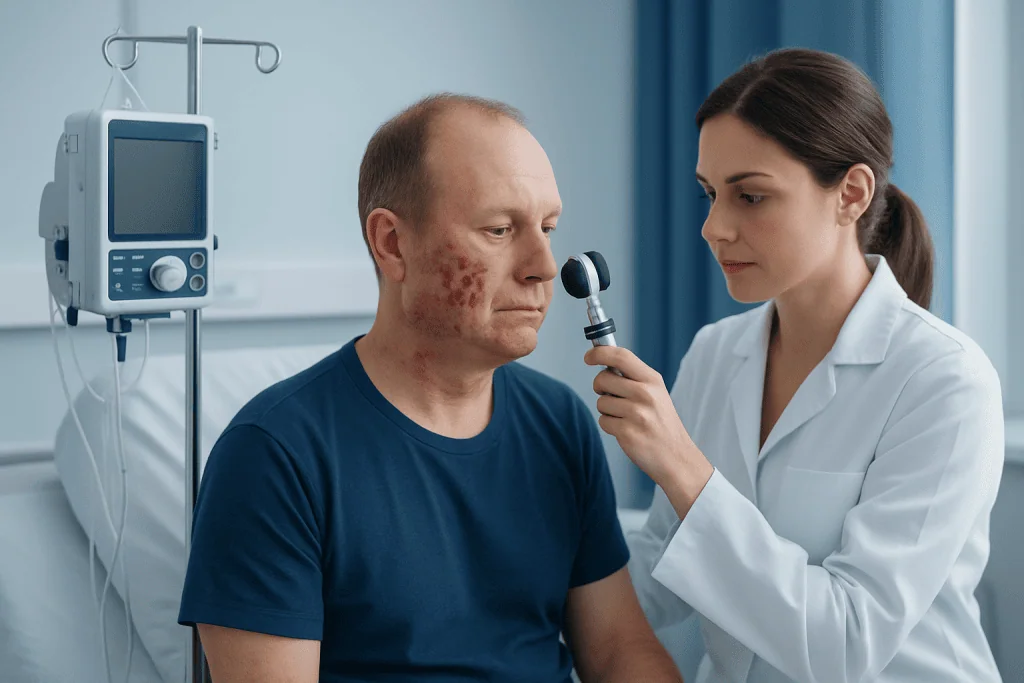
There is no single “classic” look for leukemia cutis. The skin changes may be red, purple, brown, or skin-colored. Some lesions are flat, while others are raised and firm. They may develop on the trunk, arms, legs, scalp, or face, and can appear in one area or at multiple sites.
Many people notice painless lesions, but some may experience tenderness, itching, or a feeling of skin tightness. In some cases, the lesions enlarge over days to weeks. A person who already has leukemia may recognize that the spots are unusual because they do not behave like common rashes, bruises, or insect bites.
Features that may be seen include:
- Small papules or bumps
- Firm nodules under or within the skin
- Thicker, plaque-like raised areas
- Purple or bruise-like patches
- Lesions that persist despite routine skin treatments
Because the skin findings are not specific, similar-looking lesions can also be caused by infections, medication reactions, inflammatory skin disease, bleeding under the skin, or other cancers involving the skin. That is why a careful examination and tissue diagnosis are so important.
Causes, leukemia types, and risk factors
Leukemia cutis develops when malignant white blood cells migrate from the blood or bone marrow into the skin. The exact biological reasons vary by leukemia subtype, but the process involves cancer cells acquiring the ability to travel, adhere to skin tissues, and survive there. It is therefore best understood as a sign of leukemia spread outside the bone marrow.
It can occur with several forms of leukemia, but it is more often associated with acute myeloid leukemia and certain other myeloid disorders than with many chronic leukemias. In some people it appears alongside bone marrow disease; in others, it may become noticeable during relapse or progression. Rarely, skin involvement can precede clear evidence of leukemia in the blood or marrow, a presentation sometimes called aleukemic leukemia cutis.
Risk is linked mainly to the presence and biology of the leukemia itself rather than to lifestyle factors. Important considerations include:
- The specific leukemia subtype and its molecular features
- Active, advanced, or relapsed disease
- Prior history of leukemia or related blood disorders
- Possible spread of leukemia beyond the bone marrow to other organs
People with related blood cancers may also hear overlapping terms or evaluations involving leukemia more broadly, especially when doctors are working to identify the exact subtype. In some situations, specialists also consider whether skin findings could relate to disorders such as lymphoma or other hematologic malignancies, which can sometimes affect the skin in different ways.
How leukemia cutis is diagnosed
Diagnosis begins with a detailed clinical assessment. A doctor reviews the appearance and timing of the skin lesions, any history of leukemia or bone marrow disease, current treatments, and symptoms such as fatigue, fever, bruising, infections, or weight loss. The skin examination may be followed by blood tests, but blood results alone cannot confirm leukemia cutis.
The key test is a skin biopsy. A dermatologist, hematologist, or surgeon removes a small sample of the lesion so a pathologist can examine it under the microscope. Special laboratory techniques, including immunohistochemistry and sometimes flow cytometry or molecular tests, help determine whether the cells in the skin match a leukemia subtype.
Because skin involvement reflects an underlying blood disorder, doctors usually perform a broader workup to define the full picture. This may include:
- Complete blood count and peripheral blood smear
- Bone marrow aspiration and biopsy
- Immunophenotyping and genetic or molecular testing
- Imaging when there is concern for involvement of other organs
Accurate classification matters because treatment decisions depend on the leukemia type, disease burden, prior therapy, and whether the skin lesions are part of initial presentation or recurrence. In complex cases, review by a multidisciplinary team can help coordinate dermatology, pathology, hematology, and oncology expertise.
Treatment options and modern care approaches
Treatment for leukemia cutis is usually directed at the underlying leukemia rather than the skin alone. This often means systemic therapy, because the skin lesions are a sign that leukemia cells are present beyond one isolated spot. The exact approach depends on the leukemia subtype, the person’s age and health, prior treatments, and whether the disease is newly diagnosed or relapsed.
Systemic treatment may include chemotherapy, targeted therapy, immunotherapy, or other leukemia-specific regimens. In eligible patients, doctors may also discuss advanced options such as bone marrow transplantation when this is appropriate for disease control. Supportive care is equally important and may include infection prevention, symptom management, and monitoring for treatment side effects.
Local therapy can have a role in selected situations. For example, radiation therapy may be considered for troublesome, bulky, painful, or cosmetically significant skin lesions, especially if a rapid local response is needed. Some patients are evaluated within a broader cancer program that includes medical oncology and radiation oncology as part of coordinated care.
The outlook is influenced more by the underlying leukemia than by the appearance of the skin lesions themselves. Even so, skin findings provide valuable information about disease activity and treatment response. Follow-up usually includes repeated skin examinations and blood cancer monitoring to see whether lesions are improving, stable, or recurring.
Outlook and what prognosis depends on
The outlook for leukemia cutis varies widely. It is not possible to estimate prognosis from the skin alone, because outcomes depend primarily on the leukemia subtype, genetic features, overall disease stage, response to treatment, and the person’s general health. In many cases, leukemia cutis indicates clinically significant disease that requires prompt specialist care.
For some people, the lesions improve when the underlying leukemia responds well to systemic treatment. For others, skin involvement may be associated with relapsed or more aggressive disease. This is why doctors usually treat leukemia cutis as an important sign that should be assessed in the full context of the blood cancer.
Patients and families often find it helpful to ask focused questions during care planning, such as whether the skin lesions reflect new disease, relapse, or residual disease; how treatment response will be measured; and what symptoms should prompt urgent review. Clear communication can make a complicated diagnosis easier to understand and follow.
Near the end of the treatment journey, long-term follow-up may include checks for recurrence, management of treatment-related side effects, and support for skin comfort and appearance. For international patients, Acibadem International’s multidisciplinary specialists and JCI-accredited hospitals diagnose and treat complex blood cancers and related skin involvement as part of coordinated oncology care.
Self-care and skin support during treatment
Self-care cannot treat leukemia cutis on its own, but it can help protect the skin and improve comfort during medical treatment. Gentle skin care is usually advised, especially if lesions are irritated or if cancer treatment causes dryness or sensitivity. Patients should avoid harsh scrubs, very hot water, and unapproved creams on active lesions unless a doctor recommends them.
Helpful general measures may include using fragrance-free moisturizers, protecting the skin from excessive sun exposure, and wearing soft, non-irritating clothing. If lesions are tender, easily traumatized, or located where they rub against clothing, practical steps to reduce friction can help. Any broken skin, drainage, or signs of infection should be reported promptly.
Because leukemia and its treatment can affect immunity and blood counts, it is wise not to self-diagnose persistent new rashes or bumps. Over-the-counter treatments may delay proper diagnosis if they mask symptoms without addressing the cause. A qualified doctor can advise whether a skin issue is treatment-related, infectious, inflammatory, or due to leukemia involvement itself.
When to seek medical care
Medical review is advisable whenever a person with known leukemia develops new, persistent, or changing skin lesions. Prompt assessment is especially important if lesions are rapidly increasing, painful, bleeding, or associated with fever, fatigue, infections, unusual bruising, or swollen lymph nodes. A biopsy may be needed to clarify the cause.
Someone without a leukemia diagnosis should also seek care for unexplained skin nodules, bruise-like patches, or rash-like lesions that do not improve as expected, particularly if they occur along with broader symptoms such as tiredness, recurrent infections, pallor, or easy bleeding. These symptoms do not always mean leukemia cutis, but they deserve professional evaluation.
Urgent care may be needed if there are signs of severe infection, uncontrolled bleeding, shortness of breath, confusion, or sudden clinical deterioration. Early diagnosis helps doctors identify whether the skin changes are related to leukemia, treatment effects, or another condition, and then guide the most appropriate next steps.
Frequently asked questions
Is leukemia cutis the same as a skin cancer?
No. Leukemia cutis is not a primary skin cancer. It happens when leukemia cells from a blood cancer infiltrate the skin, so treatment focuses on the underlying leukemia rather than treating it as a separate skin-only disease.
Can leukemia cutis be the first sign of leukemia?
Yes, although this is uncommon. In some people, skin lesions appear before leukemia is clearly found in the blood or bone marrow, which is one reason a skin biopsy can be so important.
What does leukemia cutis usually look like?
It can look like red, purple, brown, or skin-colored bumps, nodules, plaques, or bruise-like patches. The appearance is variable, so it cannot be diagnosed reliably by appearance alone.
How is leukemia cutis confirmed?
The diagnosis is usually confirmed with a skin biopsy examined by a pathologist. Doctors also use blood tests, bone marrow studies, and specialized laboratory testing to identify the leukemia subtype and extent of disease.
Does every skin rash in a person with leukemia mean leukemia cutis?
No. People with leukemia can develop rashes for many reasons, including infections, medication reactions, bleeding under the skin, or inflammatory skin conditions. That is why a medical assessment is needed rather than assuming the cause.
Can leukemia cutis be treated successfully?
Many patients see improvement in skin lesions when the underlying leukemia responds to treatment. The overall outlook varies, however, and depends mainly on the type of leukemia, its biology, and how well it responds to therapy.
References
- World Health Organization
- National Cancer Institute
- American Cancer Society
- National Comprehensive Cancer Network
- American Academy of Dermatology
This article is for general information only and is not a substitute for professional medical advice. Please consult a qualified doctor about your individual situation.
Leukemia in Turkey — costs, top hospitals & a free quote
JCI-accredited · board-certified surgeons · reply within 24h
Add us as a Preferred Source to see more of our trusted health content across Google Search, AI Overviews and Discover.

Medical Oncology Department
Medical treatment of cancer with chemotherapy, immunotherapy and targeted therapies under a multidisciplinary tumor board.
60 specialists in this unit