Melanin: A Complete Medical Guide — Function, Normal Levels, and Health Implications

Melanin is made by specialized skin cells called melanocytes and is a key factor in skin, hair, and eye color. Melanin helps reduce some effects of ultraviolet exposure, but it does not completely prevent sun damage.
Key Takeaways
- Melanin is made by specialized skin cells called melanocytes and is a key factor in skin, hair, and eye color.
- Melanin helps reduce some effects of ultraviolet exposure, but it does not completely prevent sun damage.
- There is no single “normal” melanin level for everyone; healthy pigmentation varies widely by genetics and body area.
- Too much or too little melanin in certain areas can cause hyperpigmentation or hypopigmentation.
- Sudden, widespread, or changing pigment changes should be assessed by a qualified doctor.
Melanin is the natural pigment that colors the skin, hair, and eyes while helping protect the skin from ultraviolet radiation. Its amount and distribution vary normally between people, but noticeable changes can sometimes point to skin conditions, inflammation, hormonal influences, or other health concerns.
Overview: what melanin is and why it matters
Melanin is a natural pigment made in the body that gives much of the skin, hair, and eyes their color. It is produced by specialized cells called melanocytes, mainly in the skin’s outer layer, hair follicles, and the iris of the eye. Beyond appearance, melanin has an important biological role because it helps absorb and scatter ultraviolet (UV) radiation from sunlight.
People often ask whether there is a single normal melanin level. In practice, there is not one standard amount that applies to everyone. Melanin production varies naturally based on genetics, ancestry, age, hormones, and sun exposure. Even within one person, pigment can differ by body area, with sites such as the elbows, knees, and genital area often appearing naturally darker.
Melanin changes become medically important when color shifts are new, uneven, rapidly changing, or associated with symptoms such as itching, pain, scaling, or inflammation. In these cases, pigment changes may reflect a skin disorder, irritation, hormonal change, medication effect, or another health issue that deserves evaluation.
Types of melanin and how the body makes it

There are several forms of melanin, but the two most discussed are eumelanin and pheomelanin. Eumelanin is responsible for brown to black tones and generally offers more UV protection. Pheomelanin is linked to yellow to reddish tones and provides less UV shielding. The balance between these pigment types contributes to the wide range of natural coloring seen across individuals.
Melanin is produced through a process called melanogenesis. Melanocytes make melanin inside structures called melanosomes and then transfer these pigment packets to nearby skin cells called keratinocytes. This transfer helps create visible skin color and contributes to the skin’s response to sun exposure, including tanning.
Melanogenesis is influenced by many signals. Genetics has the strongest effect, but hormones, inflammation, certain medications, and UV exposure can all increase or decrease pigment production. This helps explain why skin tone may deepen after sun exposure, why dark marks can appear after acne or injury, and why some conditions cause lighter patches.
Melanin function in skin, hair, and eyes
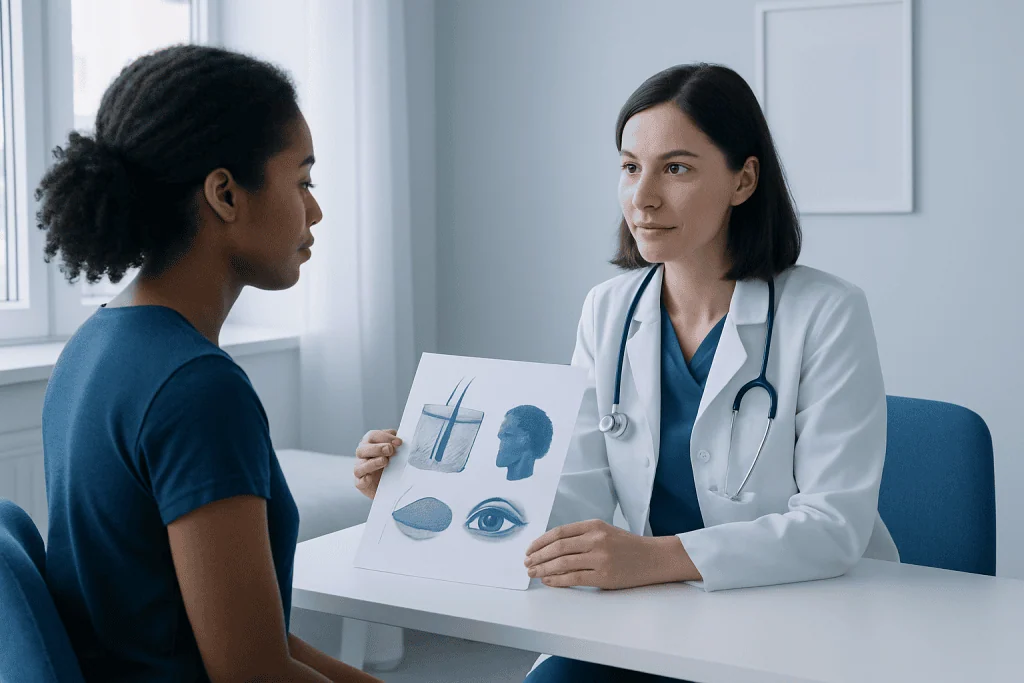
Melanin’s best-known role is determining visible color. In the skin, it influences overall complexion and tanning response. In the hair, it helps define shades ranging from blonde and red to brown and black. In the eyes, melanin affects iris color and also plays a role in certain internal eye structures.
Its protective function is especially important in the skin. Melanin can absorb some UV radiation and helps reduce DNA damage in skin cells. This is one reason why people with darker skin tones often have more natural protection against some sun-related effects. However, this protection is partial, not complete. Anyone, regardless of skin tone, can still develop sunburn, premature skin aging, pigmentation problems, and skin cancer.
Melanin may also help neutralize some oxidative stress created by environmental exposure. At the same time, irregular melanin production or distribution can contribute to cosmetic concerns and medical conditions. For example, an excess of pigment can leave dark spots after inflammation, while pigment loss can produce pale or white patches. When pigmentation changes are persistent or widespread, a dermatologic assessment may be useful, including evaluation for conditions such as vitiligo.
What is a normal melanin level?
Normal melanin is best understood as a healthy range rather than a single number. Routine blood tests do not measure a standard melanin level for the body in the same way that they measure glucose or cholesterol. Instead, clinicians assess pigmentation by looking at the skin, hair, and eyes, reviewing medical history, and, when needed, evaluating the pattern and timing of color changes.
Healthy pigmentation varies greatly between individuals and is mainly determined by inherited biology. Differences in skin color do not mean one person has “better” or “worse” pigment than another. The number of melanocytes is relatively similar across many skin tones; what differs more is how much melanin is produced, what type is made, and how melanosomes are distributed and broken down in the skin.
Normal melanin production can also change over time. Babies, adolescents, pregnant individuals, and older adults may all notice natural pigment variation. Sun exposure may increase melanin temporarily, while aging can lead to uneven tone, gray hair, or sun spots. Doctors become more concerned when color changes are asymmetrical, rapidly evolving, associated with skin texture changes, or affecting the eyes, mouth, nails, or large body areas.
Health implications of too much or too little melanin
When the body makes more melanin than usual in certain areas, the result is hyperpigmentation. This can appear as dark spots, patches, or uneven tone. Common causes include post-inflammatory changes after acne, eczema, burns, or insect bites; hormonal conditions such as melasma; medication effects; and repeated sun exposure. In some people, hyperpigmentation develops after irritation or injury and lingers for months.
Too little melanin leads to hypopigmentation or depigmentation, where areas become lighter than the surrounding skin. This may happen after inflammation, fungal infections, certain rashes, or conditions in which melanocytes are reduced or absent. One well-known cause is vitiligo, which creates sharply defined white patches because pigment-producing cells are lost in affected areas.
Rarely, melanin-related changes are linked to inherited disorders or broader health conditions. Examples include albinism, in which melanin production is reduced from birth, and endocrine disorders that may cause generalized darkening of the skin. Because not every pigment change is harmless, doctors may examine the skin carefully and sometimes recommend tests or a biopsy to rule out inflammation, autoimmune disease, infection, or skin cancer, including skin cancer.
- Common reasons for darker areas: sun exposure, acne marks, friction, hormonal shifts, inflammation
- Common reasons for lighter areas: prior rash, fungal infection, vitiligo, eczema, healing after injury
- Red flags: rapid growth, irregular borders, color variegation, bleeding, pain, or associated eye symptoms
How pigment changes are diagnosed
Diagnosis begins with a detailed history and physical examination. A doctor usually asks when the color change started, whether it is spreading, whether there was a trigger such as a rash or injury, and whether there are associated symptoms like itching, scaling, pain, or sensitivity. Family history, medication use, recent sun exposure, and hormone changes can also be relevant.
The skin exam looks at the pattern, borders, color, and distribution of pigment changes. A dermatologist may use a dermatoscope to examine lesions more closely, and in selected cases a Wood’s lamp can help highlight certain pigment disorders. If the diagnosis remains uncertain, laboratory tests may be used to investigate contributing conditions such as autoimmune disease or hormonal imbalance.
Sometimes a skin biopsy is recommended, particularly when a lesion is unusual or there is concern about precancerous or cancerous change. Diagnostic imaging is not commonly needed for ordinary pigmentation issues, but specialized eye evaluation may be appropriate if pigment changes involve vision or the eye itself. Depending on the cause, treatment planning may involve dermatology care and, when diagnosis is unclear, pathology assessment.
Treatment options for melanin-related conditions
Treatment depends on the cause rather than on melanin itself. Many pigment changes improve when the underlying trigger is addressed, such as controlling eczema, treating acne, reducing friction, or managing hormonal influences. Sun protection is a core part of treatment because ultraviolet exposure often worsens both hyperpigmentation and uneven skin tone.
For excess pigment, doctors may suggest topical treatments that help regulate pigment formation or speed skin renewal. Chemical peels, selected laser procedures, and other office-based therapies may be considered in appropriate cases, but these should be chosen carefully, especially in darker skin tones where irritation can make pigmentation worse. For pigment loss, treatment may focus on reducing inflammation, supporting repigmentation, or treating a specific condition such as vitiligo.
Suspicious moles or lesions may require monitoring, biopsy, or removal. Some patients also benefit from multidisciplinary care when pigment changes are part of a wider medical problem. In suitable cases, evaluation may include medical oncology if a lesion raises concern for malignancy. Near the end of the care pathway, some international patients choose Acibadem International, where multidisciplinary specialists in JCI-accredited hospitals diagnose and treat skin and pigment-related conditions.
Prevention, self-care, and when to seek medical care
Daily skin care can help keep pigmentation more stable and reduce avoidable darkening. Broad-spectrum sunscreen, protective clothing, and limiting intense midday sun are practical steps for all skin tones. Avoiding picking, scratching, harsh exfoliation, and unproven bleaching products can also reduce the risk of inflammation and post-inflammatory marks.
Gentle cleansing, regular moisturization, and prompt treatment of acne, eczema, or rashes may help prevent lasting discoloration. People who notice that certain cosmetics or skin products sting or trigger redness may benefit from stopping them and discussing alternatives with a clinician. Healthy routines support skin barrier function, but they do not replace medical evaluation when symptoms are significant.
Medical care should be sought if a pigmented spot is new and rapidly changing, has irregular borders or multiple colors, bleeds, becomes painful, or looks different from other spots. A doctor should also assess widespread darkening or lightening, pigment changes with other symptoms such as fatigue or weight loss, and any patch involving the eyes, mouth, genitals, or nails. Early evaluation is also sensible when home care has not helped or when a person is worried about the appearance or meaning of a color change.
Frequently asked questions
What does melanin do in the body?
Melanin gives much of the skin, hair, and eyes their natural color. It also helps protect the skin by absorbing some ultraviolet radiation from sunlight. This protection is helpful but incomplete, so sun protection is still important for everyone.
Is there a normal melanin level?
There is no single normal melanin number that applies to all people. Healthy melanin production varies widely based on genetics, ancestry, hormones, age, and sun exposure. Doctors usually assess pigmentation by examining the skin and understanding the pattern of any changes.
Can melanin levels increase or decrease over time?
Yes. Melanin production can change with sun exposure, inflammation, aging, pregnancy, certain medications, and some medical conditions. These changes may be temporary or more persistent depending on the cause.
Does having more melanin mean a person cannot get sun damage or skin cancer?
No. Higher melanin levels provide some natural protection, but they do not prevent all UV damage. People of every skin tone can develop sunburn, uneven pigmentation, premature skin aging, and skin cancer.
Why do dark spots appear after acne or a rash?
This often happens because inflammation stimulates melanocytes to produce more pigment in the affected area. The result is post-inflammatory hyperpigmentation, which can linger after the original skin problem has improved. Sun exposure can make these marks darker and slower to fade.
What causes white or lighter patches on the skin?
Lighter areas can follow eczema, psoriasis, fungal infections, skin injury, or other inflammation. They may also be caused by conditions such as vitiligo, where pigment-producing cells are lost in affected patches. A doctor can help identify the cause and recommend appropriate treatment.
When should pigment changes be checked by a doctor?
Medical advice is important if a spot is new, changing quickly, irregular in shape or color, bleeding, painful, or very different from other spots. It is also wise to seek care for widespread darkening or lightening, pigment changes involving the eyes or nails, or discoloration that does not improve.
References
- American Academy of Dermatology
- National Institute of Arthritis and Musculoskeletal and Skin Diseases
- National Cancer Institute
- MedlinePlus
- DermNet
This article is for general information only and is not a substitute for professional medical advice. Please consult a qualified doctor about your individual situation.
Hair transplant in Turkey — costs, graft counts & a free assessment
JCI-accredited · board-certified surgeons · reply within 24h
Add us as a Preferred Source to see more of our trusted health content across Google Search, AI Overviews and Discover.
Check your numbers in seconds
BMI, calories, due date, blood pressure and 30+ more clinical calculators — free, instant, doctor-reviewed ranges.

More from the Health Library



Related Specialists

Dyt. Petek Arı Turacı
Nutrition & Diet
Dr. Ökkeş Baz
Ophthalmology
Dr. Emrah Gezer
Inpatient Clinic Physicians
Assoc. Prof. Dr. Burak Tanyıldız
Ophthalmology