Microtia — Explained by Medical Evidence, Not Myths

Microtia is present at birth and affects the development of the outer ear. It can occur on one side or both sides and may range from mild to severe.
Key Takeaways
- Microtia is present at birth and affects the development of the outer ear.
- It can occur on one side or both sides and may range from mild to severe.
- Many children with microtia need hearing testing because ear canal problems can occur at the same time.
- Treatment may include monitoring, hearing support, and ear reconstruction depending on the child’s needs.
- Early evaluation by specialists helps guide hearing, speech, and long-term care.
Microtia is a congenital condition in which one or both outer ears do not fully develop before birth. Medical care focuses on hearing evaluation, related facial or jaw differences, and if needed, reconstructive options that support both function and appearance.
What is microtia?
Microtia is a congenital difference in which the outer ear, also called the pinna, does not form completely during fetal development. It may affect one ear or both ears, and the appearance can vary from a slightly small ear to a nearly absent outer ear. In some children, the ear canal is also narrow or closed, which can affect hearing on that side.
Medical evidence shows that microtia is a structural birth difference, not something caused by myths, parenting choices, or routine day-to-day activities during pregnancy. It may happen on its own or as part of a broader craniofacial or genetic condition. Because the outer ear and middle ear structures develop early in pregnancy, careful assessment after birth is important.
Doctors often describe microtia by degree. Mild forms may leave most ear features recognizable, while more severe forms may leave only a small remnant of tissue. The condition is commonly discussed together with aural atresia, which means the ear canal is absent or closed. Even when the outer ear shape is clearly different, the child’s overall health can otherwise be normal.
How microtia may look and what symptoms it can cause
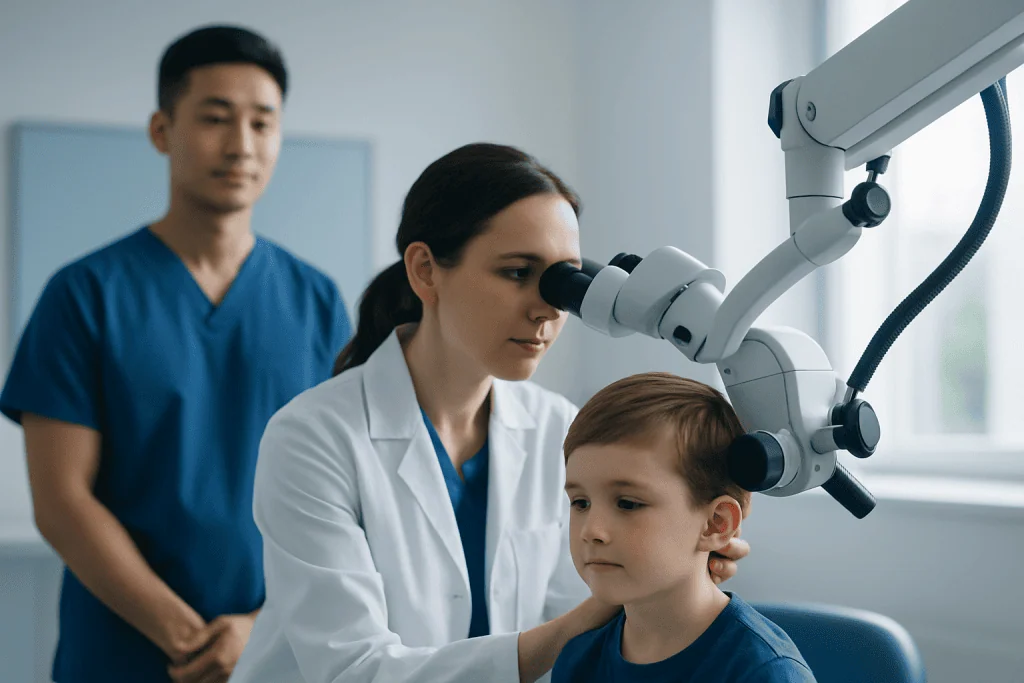
The most visible sign of microtia is an outer ear that is smaller, differently shaped, or missing normal folds. Some children have a peanut-shaped ear remnant, while others have a mildly underdeveloped ear. One side is more commonly affected than both, but bilateral microtia can occur and usually needs especially prompt hearing assessment.
The main functional concern is hearing. If the ear canal is narrow or absent, sound may not travel normally to the middle and inner ear, leading to conductive hearing loss. Many children still hear well in the unaffected ear if only one side is involved, but single-sided hearing loss can still affect sound localization, classroom listening, and speech development in noisy environments.
Microtia itself is not usually painful. However, a child may also have associated differences involving the jaw, face, or middle ear bones. Parents may first notice the ear shape at birth, while hearing concerns are confirmed with newborn hearing screening and follow-up audiology tests.
- Small, misshapen, or absent outer ear
- Closed or very narrow ear canal
- Hearing loss, especially conductive hearing loss
- Difficulty locating sounds or hearing in noise
- Occasional association with jaw or facial asymmetry
What causes microtia and who is at risk?

Microtia develops before birth when the tissues that form the outer and middle ear do not develop in the usual way. In many cases, no single clear cause is found. It is often considered multifactorial, meaning that both genetic and environmental influences may play a role.
Some cases occur as part of a syndrome or a wider craniofacial condition, while others are isolated. Doctors may look for related conditions if there are differences in the jaw, cheek, eyes, or other body systems. Relevant associated conditions can include hemifacial microsomia or other craniofacial syndromes, although not every child with microtia has one of these diagnoses.
Possible risk factors discussed in medical literature include family history, certain genetic changes, maternal diabetes, and some medication or exposure-related factors during early pregnancy. Still, risk factors do not mean certainty, and many pregnancies with microtia have no identifiable trigger. Families should not assume blame; the most helpful step is a careful evaluation and a clear long-term care plan.
How microtia is diagnosed
Microtia is usually recognized at birth during the newborn physical examination. The diagnosis begins with careful observation of the ear shape and whether the ear canal appears open. Doctors then assess hearing because the appearance of the outer ear does not always show how much hearing is affected.
Newborn hearing screening is an important first step, but many babies with microtia need more detailed testing by a pediatric audiologist. Specialized hearing tests help determine whether hearing loss is present in one ear or both. These results guide decisions about hearing devices, speech monitoring, and school support.
Imaging is not always needed right away. In some cases, especially when surgery is being considered later, doctors may request a CT scan to evaluate the ear canal and middle ear structures. A child may also be assessed by specialists in ENT, audiology, genetics, plastic surgery, and craniofacial care to look for associated findings and coordinate treatment.
Treatment options: hearing support and reconstruction
Treatment for microtia is individualized. The best plan depends on whether one or both ears are affected, the degree of hearing loss, the child’s age, and family preferences. Care often starts with protecting language development and hearing access, especially in bilateral cases where both ears are involved.
Hearing support may include observation, classroom strategies, or bone conduction hearing devices when appropriate. For some children, specialists may consider procedures related to the ear canal or middle ear, while others benefit more from external hearing technology. Evaluation by an hearing implant team may be helpful in selected cases with complex hearing needs, although microtia itself does not automatically mean a cochlear implant is needed.
Reconstruction of the outer ear can be done using the child’s own rib cartilage or a synthetic implant, depending on the anatomy, age, and surgical approach. Some families also consider a prosthetic ear. Reconstructive planning is usually timed carefully because ear growth, chest cartilage development, and the child’s readiness all matter. When facial differences are present, a broader craniofacial surgery evaluation may be part of care. In centers with coordinated expertise, specialists in ear reconstruction and ear surgery work alongside audiology and ENT teams to balance function and appearance.
No single treatment is right for every child. Some children need hearing support only, while others pursue reconstruction later in childhood. The goal is to support hearing, speech, development, and well-being with a plan that fits the child and family.
Living with microtia: daily care, development, and emotional support
Children with microtia can thrive with appropriate follow-up and support. If hearing is reduced, early intervention helps language development, learning, and social confidence. Families may be advised to position the child so the stronger-hearing ear faces the speaker, reduce background noise, and work closely with teachers.
Emotional support also matters. Visible differences can affect self-image, especially as children grow older and become more aware of appearance and peer reactions. Open, age-appropriate conversations can help a child understand the condition without shame or fear. Support groups and counseling may be useful for some families.
Routine care includes follow-up with audiology, ENT, and any reconstructive specialists involved. If the ear canal is present but narrow, doctors may monitor for wax buildup or infection. Families should avoid inserting objects into the ear and should ask a clinician before using over-the-counter ear products. When needed, coordinated programs can provide hearing, speech, and reconstructive care in one pathway. Acibadem International’s multidisciplinary specialists and JCI-accredited hospitals also diagnose and treat microtia for international patients.
When to seek medical care
Medical review is appropriate whenever a baby is born with an ear that looks unusually small, misshapen, or absent. Prompt hearing evaluation is especially important if both ears are affected or if newborn hearing screening is not passed. Early specialist input can help protect speech and language development.
Parents should also seek care if a child with microtia seems not to respond to sound, has delayed speech, struggles to hear in school, or develops drainage, redness, swelling, or discomfort around the ear. These issues do not always mean something serious, but they deserve assessment by a qualified clinician.
If microtia appears along with facial asymmetry, jaw differences, feeding concerns, or other birth differences, a broader specialist evaluation may be advised. Families do not need to navigate this alone; pediatricians, ENT doctors, audiologists, and craniofacial teams can explain the options step by step.
Frequently asked questions
Is microtia a birth defect?
Microtia is a congenital condition, which means it is present at birth. It involves underdevelopment of the outer ear and may also affect the ear canal. The term "birth defect" may be used medically, but many families prefer "congenital ear difference."
Can a child with microtia hear normally?
Some children with microtia have near-normal hearing, especially if the ear canal and middle ear are formed well. Others have conductive hearing loss because sound cannot pass through the outer or middle ear normally. A hearing test is needed to understand the child’s specific hearing profile.
Does microtia always need surgery?
No. Surgery is not always necessary, and treatment depends on hearing needs, ear anatomy, and family goals. Some children mainly need hearing support and monitoring, while others choose reconstruction later in childhood.
At what age is microtia reconstruction done?
The timing depends on the surgical method and the child’s development. Reconstruction with the child’s own rib cartilage is often planned when the child is older and has enough cartilage for shaping. A reconstructive surgeon can explain the timing for each option.
Is microtia genetic?
It can be. Some cases are linked to genetic factors or to broader syndromes, while many happen without a clear inherited cause. If other physical differences are present or there is a family history, genetic evaluation may be recommended.
Can microtia affect speech development?
It can, particularly if hearing loss is present and not addressed early. Children learn speech through hearing, so reduced sound access may affect language development. Early audiology care and hearing support can lower this risk.
References
- American Academy of Pediatrics
- National Institute on Deafness and Other Communication Disorders
- Centers for Disease Control and Prevention
- American Academy of Otolaryngology–Head and Neck Surgery
- MedlinePlus
This article is for general information only and is not a substitute for professional medical advice. Please consult a qualified doctor about your individual situation.
Explore treatments in Turkey — costs, top hospitals & a free quote
JCI-accredited · board-certified surgeons · reply within 24h
Add us as a Preferred Source to see more of our trusted health content across Google Search, AI Overviews and Discover.

More from the Health Library
Iodine: A Complete Medical Overview

Doggystyle: What Patients Need to Know

Candida Glabrata: An Evidence-Based Guide for Patients

Lavender oil benefits: A Complete Medical Guide for Patients

Russian Twists: What Patients Need to Know