Nervous System Disorders That Affect Muscles: How Doctors Narrow the Diagnosis

Muscle symptoms may begin in the nerves, neuromuscular junction, or muscles rather than in the muscles alone. A careful history and neurological examination are often the most important first steps in diagnosis.
Key Takeaways
- Muscle symptoms may begin in the nerves, neuromuscular junction, or muscles rather than in the muscles alone.
- A careful history and neurological examination are often the most important first steps in diagnosis.
- Tests such as blood work, EMG, nerve conduction studies, MRI, and genetic testing help identify the underlying cause.
- Treatment depends on the diagnosis and may include medication, rehabilitation, lifestyle support, or specialist procedures.
- Early assessment is important when weakness is progressive, affects breathing or swallowing, or appears suddenly.
Nervous system disorders affecting muscles can cause weakness, fatigue, cramps, twitching, or changes in movement. Doctors narrow the diagnosis step by step, using the person’s symptoms, neurological examination, and targeted tests to find whether the problem starts in the brain, spinal cord, nerves, neuromuscular junction, or muscles themselves.
Overview: Why muscle symptoms can come from the nervous system
When a person notices muscle weakness, fatigue, twitching, cramps, or difficulty with balance and movement, the problem is not always in the muscles themselves. Muscle function depends on a pathway that begins in the brain, travels through the spinal cord, continues along peripheral nerves, crosses the neuromuscular junction, and finally activates the muscle fibers. A disorder at any point along this pathway can lead to symptoms that feel similar at first.
Doctors use the term neuromuscular disorders to describe conditions that affect the nerves controlling muscles, the communication point between nerves and muscles, or the muscles directly. Examples include peripheral neuropathies, motor neuron diseases, myasthenia gravis, inflammatory myopathies, muscular dystrophies, and some inherited nerve disorders. The challenge is that many of these conditions overlap in early symptoms, so the diagnosis is usually narrowed down methodically rather than made from one symptom alone.
The goal of evaluation is to identify where the problem is located, how quickly it is progressing, and what may be causing it. Some disorders are inherited, some are autoimmune, some are related to metabolic or hormonal problems, and some can be triggered by infections, medications, or nutritional deficiencies. A clear diagnosis helps guide treatment and can also help predict whether symptoms are likely to improve, stabilize, or need long-term management.
Common symptoms doctors look for
The pattern of symptoms often gives the first clue. Some people mainly have weakness, while others notice numbness, burning pain, muscle wasting, stiffness, double vision, drooping eyelids, swallowing problems, or severe tiredness with repeated movement. Doctors ask whether symptoms began suddenly or gradually, whether they are constant or fluctuate during the day, and whether they started in the hands, feet, face, shoulders, hips, or breathing muscles.
Different symptom patterns suggest different parts of the neuromuscular system. For example, numbness and tingling may point more toward peripheral nerve disease, while fluctuating weakness that worsens with use can suggest a problem at the neuromuscular junction, such as myasthenia gravis. Symmetric weakness in the hips and shoulders may raise concern for a muscle disease, whereas weakness with muscle wasting and abnormal reflexes may lead doctors to consider motor neuron disorders or spinal causes.
Doctors also ask about symptoms beyond movement. Changes in speech, swallowing, breathing, bladder function, vision, memory, or sensation can help separate one condition from another. Even details that seem unrelated, such as recent infection, new medications, unexplained weight loss, rash, or heat intolerance, may be important because they can point toward autoimmune, infectious, endocrine, or systemic causes.
- Weakness when climbing stairs or lifting the arms
- Frequent tripping, foot drop, or balance problems
- Muscle cramps, twitching, or visible wasting
- Numbness, burning, or tingling in the limbs
- Double vision, drooping eyelids, or trouble swallowing
- Shortness of breath or difficulty taking a deep breath
How the medical history and examination narrow the diagnosis

A detailed history is one of the most useful tools in neuromuscular medicine. Doctors ask when symptoms began, what makes them better or worse, whether there is pain or sensory loss, and whether anyone else in the family has similar problems. They also review medications, alcohol use, exposure to toxins, previous illnesses, and medical conditions such as diabetes, thyroid disease, autoimmune disease, or cancer, all of which can affect nerves or muscles.
The neurological examination helps localize the problem. Doctors assess muscle strength in different muscle groups, reflexes, muscle tone, coordination, walking pattern, and sensation. They may look for muscle atrophy, involuntary twitching, eyelid drooping, facial weakness, or signs that one side of the body is more affected than the other. The exam can show whether weakness is proximal, distal, symmetrical, asymmetrical, upper motor neuron, lower motor neuron, or fatigable.
This step-by-step approach matters because not all weakness is neurological. Problems such as joint disease, severe fatigue, heart or lung disease, depression, or medication side effects can also reduce physical performance. By combining the story with the exam, doctors can decide which tests are most useful and avoid unnecessary investigations.
Tests used to identify nerve, junction, and muscle disorders
After the examination, testing is tailored to the likely cause. Blood tests may look for muscle enzymes such as creatine kinase, markers of inflammation, thyroid problems, vitamin deficiencies, diabetes, electrolyte disturbances, autoimmune antibodies, or signs of infection. In some people, these tests strongly suggest a muscle disease or an immune-mediated condition, while in others they help rule out common reversible causes.
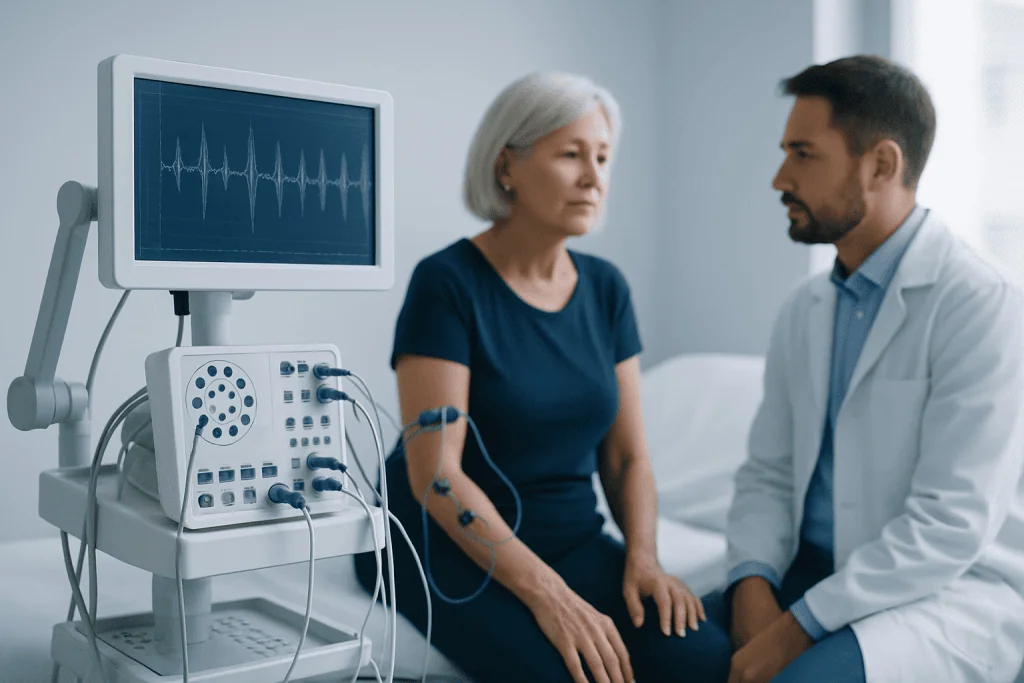
Electrodiagnostic testing is often central to diagnosis. Nerve conduction studies measure how well electrical signals travel along peripheral nerves, while electromyography (EMG) evaluates the electrical activity of muscles. Together, these tests can help distinguish neuropathy from myopathy, identify disorders of the motor neurons, and detect problems at the neuromuscular junction. If a central nervous system cause is possible, doctors may also request MRI scanning of the brain or spinal cord to look for structural or inflammatory changes.
Additional tests depend on the situation. Genetic testing can help confirm inherited neuropathies, muscular dystrophies, or metabolic muscle disorders. Pulmonary function testing may be used when breathing muscles are involved. Some patients need a lumbar puncture, repetitive nerve stimulation, single-fiber EMG, or a sleep evaluation. In selected cases, a muscle biopsy or nerve biopsy provides direct tissue information that cannot be obtained in other ways.
Test results are interpreted together rather than in isolation. A mildly abnormal blood test does not always mean a serious disease, and a normal result does not completely exclude every condition. Neuromuscular diagnosis is often like assembling a puzzle, with each test adding one more piece.
Conditions doctors commonly consider
There are many possible diagnoses, so doctors first sort them by where the dysfunction appears to begin. Brain or spinal cord disorders may cause weakness with increased muscle tone, brisk reflexes, or other neurological changes. Peripheral nerve disorders often produce weakness together with sensory symptoms, reduced reflexes, or pain. Diseases affecting the neuromuscular junction usually cause weakness that fluctuates or worsens with repeated activity. Primary muscle diseases tend to produce weakness, especially in the shoulders, hips, neck, or thighs, sometimes with muscle pain or elevated muscle enzymes.
Examples of peripheral nerve disorders include inherited neuropathies, diabetic neuropathy, and inflammatory neuropathies such as Guillain-Barré syndrome or chronic inflammatory demyelinating polyneuropathy. Neuromuscular junction disorders include myasthenia gravis and Lambert-Eaton myasthenic syndrome. Muscle disorders include inflammatory myopathies, metabolic myopathies, and various forms of muscular dystrophy. Some motor neuron disorders, including ALS, may also be considered when weakness is accompanied by muscle wasting, twitching, and upper or lower motor neuron signs.
Doctors also keep reversible causes in mind. Low vitamin B12, thyroid disease, kidney or liver problems, medication toxicity, autoimmune disease, and electrolyte imbalance can mimic more complex neuromuscular disorders. This is why the final diagnosis may require more than one visit, particularly when symptoms are early or evolving.
Treatment options and supportive care
Treatment depends on the exact diagnosis. Some conditions improve with treatment of the underlying cause, such as correcting a vitamin deficiency, adjusting a medication, or managing diabetes or thyroid disease. Autoimmune neuromuscular disorders may respond to corticosteroids, other immune therapies, plasma exchange, or intravenous immunoglobulin. In inherited conditions, treatment often focuses on symptom control, rehabilitation, and preserving independence.
Rehabilitation is important in many neuromuscular disorders. Physical therapy can help maintain mobility, balance, and joint range of motion, while occupational therapy can support hand function, daily activities, and energy conservation. Speech and swallowing therapy may be helpful when facial, throat, or bulbar muscles are affected. Some people also benefit from braces, mobility aids, breathing support, or structured exercise plans designed by clinicians familiar with neuromuscular disease.
When symptoms are complex, care is often multidisciplinary. A person may see a neurologist, physiotherapist, pulmonologist, rehabilitation specialist, genetic counselor, or nutrition professional depending on the condition. In selected cases, doctors may arrange EMG testing as part of follow-up or refer for advanced therapies. Near the end of the diagnostic pathway, some patients seek assessment at experienced centers such as Acibadem International, where multidisciplinary specialists in JCI-accredited hospitals evaluate and treat neuromuscular conditions for international patients.
Because treatments vary widely, self-treatment is not recommended for unexplained weakness. Starting supplements, intense exercise programs, or stopping prescribed medicines without medical advice can delay diagnosis or make symptoms harder to interpret.
Self-care, monitoring, and when to seek medical attention
Self-care does not replace diagnosis, but it can support daily function while evaluation is underway. People are often advised to pace activities, prioritize sleep, eat balanced meals, stay hydrated, and keep a simple symptom diary noting weakness, falls, numbness, triggers, or swallowing and breathing changes. This information can help doctors see patterns that are not obvious during a short clinic visit.
Safety matters when weakness affects walking, grip, or balance. Removing trip hazards, using handrails, wearing supportive footwear, and avoiding overexertion may reduce the risk of falls. If swallowing is difficult, a clinician should advise on safe eating strategies. Exercise can be helpful in many conditions, but it should be tailored to the diagnosis because too much strain may worsen some muscle disorders.
Medical attention is especially important if weakness is worsening, spreading, or interfering with daily activities. Urgent care is needed for trouble breathing, choking, rapidly progressive weakness, sudden paralysis, new facial drooping, severe back pain with weakness, or loss of bladder or bowel control. These symptoms do not always mean a serious neurological emergency, but they should be assessed promptly to protect breathing, mobility, and overall health.
Frequently asked questions
What does it mean if muscles feel weak but the problem is in the nervous system?
Muscles only work properly when signals travel normally from the brain and spinal cord through the nerves to the muscle fibers. If that pathway is disrupted anywhere along the way, a person may feel weak even when the muscles themselves are not the main problem. That is why doctors evaluate both the nervous system and the muscles.
How do doctors tell the difference between a nerve problem and a muscle problem?
Doctors look at the pattern of weakness, whether sensation is affected, and what the reflexes show on examination. They often use EMG and nerve conduction studies, along with blood tests and sometimes imaging or biopsy, to identify where the problem is located. No single test answers every question, so the full picture is important.
Can blood tests alone diagnose neuromuscular disorders?
Blood tests can provide helpful clues, such as elevated muscle enzymes, vitamin deficiencies, thyroid abnormalities, or autoimmune markers. However, they rarely give the complete answer on their own. Many people need a combination of examination findings and specialized tests for an accurate diagnosis.
Are nervous system disorders affecting muscles always progressive?
No. Some are temporary or treatable, especially when caused by inflammation, infection, medication effects, metabolic problems, or nutritional deficiencies. Others are chronic and require long-term management, which is why a precise diagnosis is important.
When is muscle weakness an emergency?
Emergency assessment is important if weakness appears suddenly, worsens rapidly, affects breathing, causes choking, or comes with facial drooping or loss of bladder or bowel control. These symptoms can have several causes, including urgent neurological conditions. Prompt medical care helps protect safety and function.
What if tests are normal but symptoms continue?
A normal test does not always rule out every neuromuscular disorder, especially early in the disease course. Doctors may repeat tests later, order different studies, or monitor symptoms over time. Follow-up is important if weakness, fatigue, numbness, or balance problems persist.
References
- National Institute of Neurological Disorders and Stroke
- National Institute of Arthritis and Musculoskeletal and Skin Diseases
- Muscular Dystrophy Association
- World Health Organization
- American Academy of Neurology
This article is for general information only and is not a substitute for professional medical advice. Please consult a qualified doctor about your individual situation.
Joint and spine care in Turkey — expert assessment & treatment
JCI-accredited · board-certified surgeons · reply within 24h
Add us as a Preferred Source to see more of our trusted health content across Google Search, AI Overviews and Discover.

More from the Health Library



Related Specialists

Dr. Maşallah Candemir
Pediatrics
Prof. Dr. Taner Korkmaz
Medical Oncology
Dt. Gülçin Doğusal İşgüder
Dentistry
Prof. Dr. Necdet Sağlam
Orthopedic Surgery & Traumatology