Neuwave Ablation: Procedure, Recovery and Results

Neuwave ablation is a form of microwave ablation that destroys targeted tumor tissue with heat. It may be used for selected tumors in the liver, lung, kidney, bone or soft tissues, often when surgery is not suitable or as part of a wider treatment plan.
Key Takeaways
- Neuwave ablation is a form of microwave ablation that destroys targeted tumor tissue with heat.
- It may be used for selected tumors in the liver, lung, kidney, bone or soft tissues, often when surgery is not suitable or as part of a wider treatment plan.
- CT, ultrasound or other imaging guides placement of the neuwave ablation probe and helps confirm treatment coverage.
- Most people return home the same day or after an overnight observation period, depending on the treatment site and health needs.
- Follow-up scans are essential because they assess the treated area and check for remaining or recurrent tumor tissue.
Neuwave ablation is an image-guided microwave ablation technique used to treat selected tumors by delivering controlled heat through a small probe. Recovery is often shorter than with open surgery, but suitability, expected results and aftercare depend on the tumor location, size, number and a person’s overall health.
Overview: what is neuwave ablation?
Neuwave ablation is a type of microwave ablation, a minimally invasive procedure that uses microwave energy to heat and destroy selected areas of tumor tissue. A doctor places a thin, needle-like neuwave ablation probe through the skin and into the target under imaging guidance. The treatment is usually performed by an interventional radiologist, sometimes in close coordination with surgical, oncology and organ-specific specialists.
The term Neuwave is often used to describe a microwave ablation system and its probes. The aim is to create a planned zone of heat around the tumor, including a small margin of surrounding tissue where appropriate. This may offer a local treatment option for carefully selected tumors, but it does not replace a full cancer assessment or other treatments when those are needed.
Microwave ablation is commonly considered for tumors in organs such as the liver, lung and kidney, and for some painful bone or soft-tissue lesions. The best role for ablation differs between individuals. It may be used alone, alongside surgery, or with systemic cancer treatments such as chemotherapy, immunotherapy or targeted therapy.
How the neuwave ablation system works
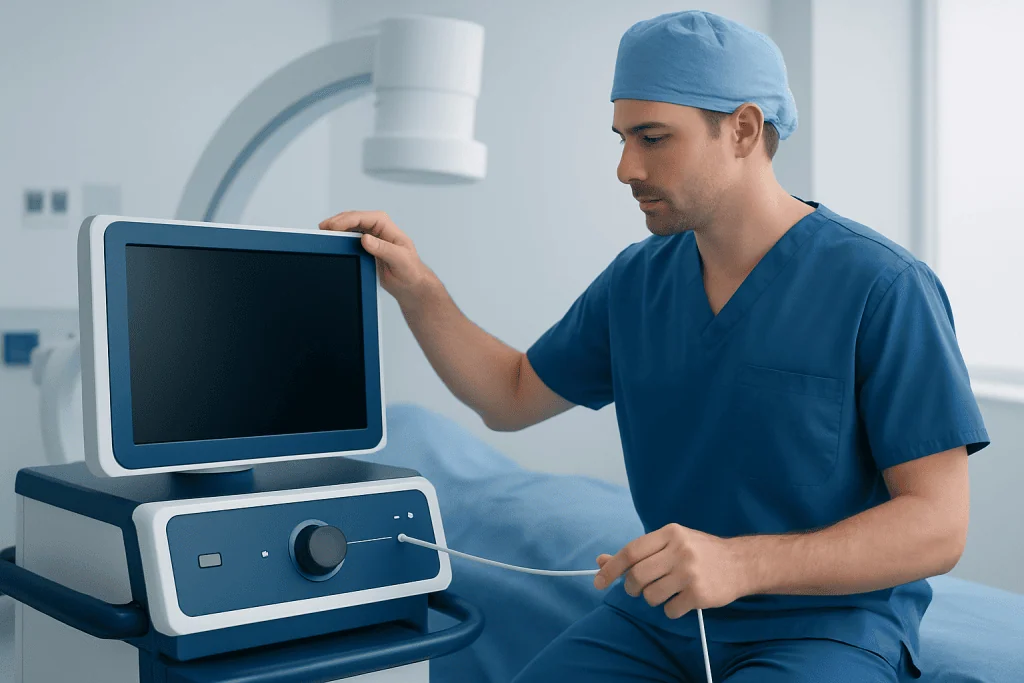
The neuwave ablation system sends microwave energy through the probe into the target tissue. Water molecules within tissue respond to this energy, producing heat that causes irreversible cell injury in the intended treatment zone. Compared with some other thermal techniques, microwave energy can create relatively large and predictable treatment zones in a short time, although the actual result depends on the tissue and nearby blood vessels.
Imaging is central to safe planning. Ultrasound, CT or sometimes MRI may be used to identify the tumor, plan the safest route for the probe and avoid important structures. During or after treatment, the team may use imaging and procedural records sometimes described as a neuwave ablation chart to document probe position, energy delivery and the planned ablation zone.
Neuwave ablation confirmation means checking that the treatment zone adequately covers the target and any planned safety margin. Confirmation may occur immediately using imaging, but the most reliable assessment is often a scheduled contrast-enhanced CT or MRI scan after the body has begun to heal. Imaging changes after ablation can be expected and should be interpreted by the treating team.
Who may be a candidate for neuwave ablation?

Candidacy is determined by more than the name of the cancer. Specialists consider the number, size and location of tumors; whether disease has spread; prior treatments; liver, lung or kidney function; bleeding risk; and a person’s general health and treatment goals. Ablation is often most useful when tumors are limited in number and can be reached safely with an imaging-guided probe.
For liver tumors, ablation may be discussed for selected primary liver cancers or tumors that have spread to the liver. For lung or kidney tumors, it may be an option when surgery would carry higher risk, when preserving organ tissue is important, or when a tumor is small and accessible. It can also be used in selected cases for local control of cancer-related pain, especially in bone.
Some situations may make ablation less appropriate, such as tumors very close to vulnerable structures, widespread disease requiring systemic treatment, active infection or an uncorrected bleeding disorder. A multidisciplinary review helps determine whether ablation, surgery, radiation therapy, medication treatment or surveillance is the most appropriate next step.
People considering local treatment for tumors may benefit from discussing the wider care pathway for liver cancer or kidney cancer with their specialist. The recommendation should be individualized rather than based on tumor size alone.
What happens during the procedure?
Before neuwave ablation, the care team reviews scans, medical history, medicines and blood tests. People may need to temporarily stop medicines that affect bleeding, but only under instructions from their prescribing clinician. Fasting may be required before sedation or anesthesia, and arrangements for transport home are usually needed.
On the procedure day, an intravenous line is placed and monitoring begins. Depending on the organ treated, procedure complexity and patient needs, ablation may be performed with conscious sedation, deep sedation or general anesthesia. The skin is cleaned and numbed, and imaging is used to guide the probe through a small skin puncture to the planned target.
Once probe placement is confirmed, microwave energy is delivered for a carefully selected time. More than one probe position or treatment cycle may be needed for larger or irregularly shaped targets. The team then removes the probe, applies a small dressing and monitors the person in a recovery area. Most procedures take several hours in total when preparation, anesthesia and recovery are included, while the ablation itself may take less time.
For people considering an image-guided local cancer treatment, microwave ablation information can help frame questions for the interventional radiology and oncology teams.
Recovery timeline, benefits and possible risks
Recovery varies with the organ treated, anesthesia type and the extent of ablation. Many people are observed for several hours and go home the same day; others stay overnight, particularly after lung, liver or more complex procedures. Tiredness, mild pain at the insertion site, temporary nausea and a low-grade fever or flu-like feeling can occur for a few days as the body responds to the treated tissue.
People are generally advised to rest on the day of treatment, avoid driving for the period specified after sedation or anesthesia, and avoid heavy lifting or strenuous activity for several days. The care team gives individualized instructions about showering, wound care, work and follow-up. Full energy may return over days to a couple of weeks, though some people need longer.
Potential benefits include treatment through a small skin puncture, preservation of more healthy organ tissue than may be possible with surgery, and a shorter initial recovery for appropriate candidates. However, results depend on cancer biology and complete treatment coverage. Ablation may not be suitable for every tumor, and additional treatment or repeat ablation can sometimes be needed.
Risks depend on the treatment site and can include bleeding, infection, pain, injury to nearby organs or structures, skin burns, blood clots and anesthesia-related complications. Lung ablation can cause a collapsed lung, while liver and kidney procedures have organ-specific risks. The treating team explains the individual risk profile before consent.
How long is bed rest after an ablation?
Bed rest after neuwave ablation is usually short and is mainly needed while sedation wears off and the team checks for bleeding, pain or other early complications. Many patients rest in a recovery unit for several hours, and may be asked to lie in a particular position depending on where the probe entered the body.
The required duration is not the same for every procedure. A person having a liver, kidney or lung ablation may need closer observation than someone undergoing a simpler treatment. If an arterial access site has been used for another part of care, longer bed rest may be required, but this is not routine for every percutaneous microwave ablation.
Once home, resting quietly for the remainder of the day is common. Gentle walking is usually encouraged when the clinical team says it is safe, as prolonged complete bed rest is generally not necessary unless specifically advised.
How long should you rest after nerve ablation?
Nerve ablation and neuwave tumor ablation are different procedures, so their recovery instructions should not be assumed to be the same. Nerve ablation, often called radiofrequency ablation, is used in selected pain-management settings to interrupt pain signals from specific nerves. It does not treat tumors in the same way as microwave ablation.
After nerve ablation, many people rest for the day of the procedure and resume light routine activities within one to several days. Temporary soreness, bruising or a short-lived increase in pain can occur. Strenuous exercise and heavy lifting are commonly delayed until the treating clinician approves them.
Recovery after neuwave ablation should instead follow the instructions given by the interventional radiology team, because abdominal, chest and kidney procedures have different considerations. Anyone unsure which type of ablation they are scheduled to have should ask their clinician before making activity plans.
When to seek medical care
Contact the treating team promptly if there is worsening pain that is not controlled by the prescribed plan, increasing redness or drainage at the puncture site, persistent vomiting, new swelling, or fever that is high or does not settle as instructed. These symptoms do not always indicate a serious problem, but they need clinical assessment after an ablation procedure.
Urgent medical care is needed for severe shortness of breath, chest pain, fainting, confusion, coughing up blood, heavy bleeding, severe abdominal pain or signs of a serious allergic reaction. People who have had lung ablation should be particularly attentive to new breathing difficulty because it can occasionally signal a collapsed lung.
Scheduled follow-up is also important even when recovery feels uncomplicated. Follow-up imaging assesses treatment response and guides any next steps. Acibadem International’s multidisciplinary specialists and JCI-accredited hospitals diagnose and treat suitable cases for international patients, coordinating interventional radiology with oncology and surgical care where needed.
Frequently asked questions
Is neuwave ablation the same as microwave ablation?
Neuwave ablation refers to microwave ablation performed using the Neuwave system and compatible probes. Microwave ablation is the broader medical technique, which uses electromagnetic energy to heat and destroy a planned area of tissue. The suitability of any system depends on the clinical setting and the treating team’s expertise.
How long does it take for your heart to fully heal after an ablation?
This question usually refers to cardiac catheter ablation for an abnormal heart rhythm, not neuwave microwave tumor ablation. Heart tissue healing after cardiac ablation may take several weeks, and rhythm symptoms can occur during an early healing period. A cardiologist or electrophysiologist should provide individualized activity and follow-up advice.
Do you pee a lot after an ablation?
Frequent urination is not a typical expected effect of neuwave tumor ablation itself. It may occur temporarily because of intravenous fluids, anxiety, medicines or an unrelated urinary issue. New burning with urination, fever, inability to pass urine, blood in urine or persistent urinary frequency should be reported to a clinician.
Is neuwave ablation painful?
The procedure is performed with local anesthetic plus sedation or anesthesia, so patients should not feel the full treatment pain during ablation. Mild soreness or discomfort at the probe entry site is common afterward, and some people have temporary pain related to the treated organ. The care team provides an appropriate pain-management plan.
How soon are neuwave ablation results known?
The team can often assess probe placement and the immediate treatment area during the procedure. However, the final assessment of treatment response usually relies on follow-up CT or MRI imaging, because the treated tissue changes as it heals. The timing of scans depends on the tumor type, organ and overall treatment plan.
Can neuwave ablation cure cancer?
For some carefully selected small, localized tumors, complete ablation can provide durable local control and may be used with curative intent. However, whether it can cure a particular cancer depends on cancer type, stage, tumor biology and whether disease is present elsewhere. A cancer specialist can explain the realistic goal of treatment in each case.
References
- National Cancer Institute
- Society of Interventional Radiology
- Radiological Society of North America
- American Cancer Society
- National Comprehensive Cancer Network
This article is for general information only and is not a substitute for professional medical advice. Please consult a qualified doctor about your individual situation.
Oncology care in Turkey — second opinion and treatment plan
JCI-accredited · board-certified surgeons · reply within 24h
Add us as a Preferred Source to see more of our trusted health content across Google Search, AI Overviews and Discover.