Peroneus Tertius: What Patients Need to Know

Peroneus tertius helps with ankle dorsiflexion, meaning lifting the foot upward, and eversion, meaning turning the sole outward. The muscle is a normal anatomical variation and may be absent in some people without affecting everyday movement.
Key Takeaways
- Peroneus tertius helps with ankle dorsiflexion, meaning lifting the foot upward, and eversion, meaning turning the sole outward.
- The muscle is a normal anatomical variation and may be absent in some people without affecting everyday movement.
- Pain in this area may occur after an ankle sprain, repetitive activity, direct impact, or tendon irritation.
- A clinical examination is often enough to begin assessment, while ultrasound or MRI may help clarify persistent symptoms.
- Most mild soft-tissue injuries improve with activity adjustment, rehabilitation, and guidance from a qualified clinician.
The peroneus tertius is a small muscle in the front of the lower leg that helps lift the foot upward and turn it slightly outward. It is not present in everyone and usually causes no problems, but irritation or injury around its tendon can contribute to pain at the front or outer part of the ankle.
What Is the Peroneus Tertius?
The peroneus tertius, also called fibularis tertius, is a small muscle located in the front and outer portion of the lower leg. It begins near the lower part of the fibula, the smaller bone of the lower leg, and its tendon travels across the front of the ankle. The tendon commonly attaches near the base of the fifth metatarsal, the long bone leading to the little toe.
Its main actions are dorsiflexion and eversion of the foot. In simple terms, it helps raise the front of the foot toward the shin and assists with turning the sole of the foot outward. These movements contribute to walking, running, climbing stairs, and clearing the toes from the ground during the swing phase of a step.
Although the name may sound similar, the peroneus tertius is different from the peroneus longus and peroneus brevis muscles. Those two muscles run along the outer side of the lower leg and primarily help turn the foot outward and support foot stability. The peroneus tertius lies more toward the front of the ankle and has a somewhat different role in movement.
Why This Muscle Varies From Person to Person
One notable feature of the peroneus tertius is that it is not found in every person. Anatomical studies have shown that its size, shape, tendon attachment, and even its presence can vary. Some people have a well-defined muscle and tendon, while others have a very small structure or no distinct peroneus tertius at all.
This variation is usually normal and does not mean there is a health problem. People who do not have a recognizable peroneus tertius generally compensate through the coordinated work of other lower-leg and foot muscles. Everyday walking, recreational exercise, and balance can remain entirely normal.
For clinicians, understanding this variation matters when interpreting scans, assessing ankle pain, or planning surgery around the foot and ankle. A tendon seen on imaging may have an unusual attachment that is still a normal variant. Conversely, symptoms should not automatically be attributed to the peroneus tertius simply because the structure is visible on a scan.
What Peroneus Tertius Pain Can Feel Like

Symptoms related to the peroneus tertius may include discomfort at the front or outer-front part of the ankle, particularly where the tendon crosses the ankle joint. Pain can be noticed during walking uphill, running, kicking, climbing stairs, or repeatedly lifting the foot. Some people describe tenderness when pressing over the front of the ankle or near the outer side of the midfoot.
If the tendon or surrounding soft tissues are irritated, there may be mild swelling, stiffness, or a feeling of weakness when lifting the foot. Symptoms may develop gradually with repeated loading, especially after a change in training intensity, footwear, terrain, or activity level. A sudden injury may cause more immediate pain, bruising, or difficulty putting weight through the foot.
These symptoms are not specific to the peroneus tertius. Front or outer ankle pain can also arise from an ankle sprain, joint inflammation, stress injury, tendon problems involving nearby muscles, nerve irritation, or footwear-related pressure. A careful assessment is useful when pain persists, recurs, or affects normal movement.
Common Causes and Risk Factors
Peroneus tertius irritation may occur after an ankle inversion injury, often called a rolled ankle. Although the ligaments on the outside of the ankle are more commonly affected in this type of injury, nearby tendons and muscles can also be stretched or overloaded. Pain may remain after the initial swelling of an ankle sprain has improved.
Repetitive activity can also contribute. Running, football, dance, court sports, hiking on uneven ground, and exercises involving frequent ankle flexion may place repeated demand on the front and outer ankle. A rapid increase in exercise duration, intensity, hills, or speed may make tendon irritation more likely, particularly when recovery time is limited.
Other contributing factors can include poorly fitting or worn footwear, reduced ankle flexibility, muscle weakness, previous ankle injury, and altered walking mechanics. Some people may also notice symptoms after a direct blow to the front of the ankle. In many cases, there is more than one contributing factor rather than a single clear cause.
- Recent ankle sprain or twist
- Sudden increase in running, jumping, or hill training
- Sports requiring rapid changes of direction
- Previous ankle instability or incomplete rehabilitation
- Footwear that rubs, restricts movement, or provides inadequate support
How Doctors Assess a Possible Injury
A clinician usually begins by asking about the onset of pain, recent injuries, activities, footwear, and any previous ankle problems. The physical examination may include checking swelling, tenderness, ankle movement, strength, balance, and the ability to walk or rise onto the toes. Specific movements can help identify whether pain is linked to lifting the foot or turning it outward.
The examination also considers other common causes of ankle symptoms. The clinician may assess the ankle ligaments, nearby peroneal tendons, the front of the ankle joint, bones of the foot, and nerve function. This broader approach is important because a single painful location does not always identify the exact injured structure.
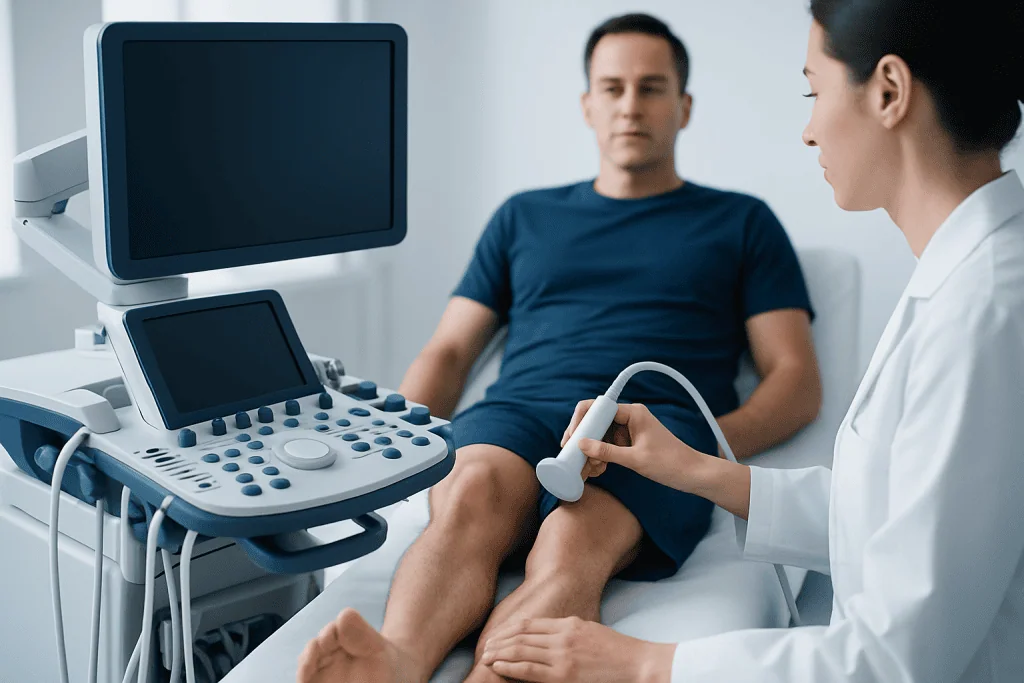
Imaging is not always needed for mild, improving symptoms. However, an X-ray may be considered after significant trauma or when a fracture is possible. Ultrasound can show tendons dynamically while the foot moves, and MRI can provide more detailed information about tendons, muscles, ligaments, bones, and surrounding soft tissues when symptoms are persistent or the diagnosis remains uncertain.
Treatment and Recovery Options
Treatment depends on the cause, severity, and duration of symptoms. For a mild overuse problem or minor soft-tissue injury, a clinician may recommend temporarily reducing activities that trigger pain while maintaining comfortable movement. Relative rest does not necessarily mean complete inactivity; it means avoiding loading that worsens symptoms while allowing the affected area time to settle.
Supportive measures may include comfortable footwear, temporary ankle support when appropriate, and cold packs wrapped in a cloth for short periods after activity if swelling or soreness is present. Pain-relieving medicines may be suitable for some people, but the choice should take account of other health conditions, allergies, and current medicines. A pharmacist or doctor can provide individual guidance.
Rehabilitation is often an important part of recovery. A physiotherapist may recommend gradual exercises to restore ankle range of motion, strengthen the lower-leg and foot muscles, improve balance, and safely return to sport or higher-impact activities. Progression should be guided by symptoms rather than by rushing back to a previous training level.
Surgery for an isolated peroneus tertius issue is uncommon. It may be discussed only in selected situations, such as a significant associated injury, persistent mechanical symptoms, or pain that has not improved after a thorough assessment and appropriate non-surgical care. Treatment decisions should be individualized with an orthopedic foot-and-ankle specialist.
Self-Care and Reducing the Chance of Recurrence
When symptoms are improving, a gradual return to activity can help reduce the risk of recurrence. Increasing distance, speed, hills, or jumping volume one change at a time gives the muscles and tendons a chance to adapt. Sudden changes in exercise routine are a common reason that lower-leg and ankle symptoms return.
Regular ankle and calf conditioning may support movement control. Exercises prescribed by a physiotherapist can include gentle ankle mobility work, resistance exercises for the muscles that lift and turn the foot, calf strengthening, and single-leg balance activities. The right exercises depend on the person’s injury, fitness level, and movement pattern.
Footwear should be comfortable, appropriate for the intended activity, and replaced when it is noticeably worn. People who repeatedly sprain an ankle may benefit from a professional assessment of balance, ankle stability, and sport-specific technique. Returning to activity is usually more successful when walking and daily tasks are comfortable before higher-demand exercise is resumed.
When to Seek Medical Care
Medical assessment is recommended after a significant ankle injury, especially if there is severe pain, rapid swelling, visible deformity, inability to take several steps, numbness, or a cold or pale foot. These features can indicate a more serious injury and should not be managed with self-care alone.
It is also sensible to arrange a non-urgent appointment if ankle or foot pain lasts longer than a few days without improvement, repeatedly returns with activity, causes limping, or limits work, exercise, or sleep. Persistent tenderness over a bone, ongoing swelling, or a feeling that the ankle gives way should also be assessed.
Acibadem International’s multidisciplinary specialists and JCI-accredited hospitals assess and treat foot and ankle conditions for international patients. A qualified clinician can determine whether symptoms relate to the peroneus tertius, a ligament injury, another tendon, or a different cause requiring targeted care.
Frequently asked questions
Is the peroneus tertius a tendon or a muscle?
The peroneus tertius is a muscle with a tendon. The muscle is located in the lower leg, while its tendon passes across the front of the ankle to attach in the outer part of the foot. Both the muscle and tendon may be involved when this area is injured or irritated.
Is it normal not to have a peroneus tertius?
Yes. The peroneus tertius is a variable structure, and some people do not have a distinct muscle or tendon. Its absence is usually a normal anatomical difference and does not typically cause symptoms or require treatment.
Can a rolled ankle affect the peroneus tertius?
It can. A rolled ankle may stretch or overload tissues around the front and outer ankle, including the peroneus tertius tendon. However, ankle ligaments and other nearby tendons are often involved as well, so an examination may be needed if symptoms continue.
How long does peroneus tertius pain take to improve?
Recovery time varies according to the cause and severity of the problem. Mild irritation may improve over days to a few weeks with suitable activity changes and rehabilitation, while more substantial injuries can take longer. Persistent or worsening pain should be evaluated by a healthcare professional.
Can I exercise with peroneus tertius pain?
It is generally best to avoid activities that clearly increase pain, swelling, or limping. Lower-impact activity may sometimes be possible, but this depends on the injury and should be guided by a clinician or physiotherapist. A gradual return is safer than trying to train through ongoing pain.
Does peroneus tertius pain always need an MRI?
No. Many mild ankle soft-tissue problems can be assessed through a medical history and physical examination. MRI may be useful when symptoms do not improve, when there is concern for a more significant injury, or when the diagnosis is unclear after initial assessment.
References
- American Academy of Orthopaedic Surgeons
- American Orthopaedic Foot & Ankle Society
- National Institute of Arthritis and Musculoskeletal and Skin Diseases
- MedlinePlus, U.S. National Library of Medicine
This article is for general information only and is not a substitute for professional medical advice. Please consult a qualified doctor about your individual situation.
Joint and spine care in Turkey — expert assessment & treatment
JCI-accredited · board-certified surgeons · reply within 24h
Add us as a Preferred Source to see more of our trusted health content across Google Search, AI Overviews and Discover.