PET Scan Radiation Exposure to Family: How It Works, Results and What to Expect

Most PET scans use a short-lived radiotracer, commonly fluorodeoxyglucose (FDG), that decreases rapidly after the examination. Brief everyday contact, including a short hug, is usually safe after a routine PET scan.
Key Takeaways
- Most PET scans use a short-lived radiotracer, commonly fluorodeoxyglucose (FDG), that decreases rapidly after the examination.
- Brief everyday contact, including a short hug, is usually safe after a routine PET scan.
- For several hours, avoid prolonged close contact such as holding a baby on the lap or sleeping very close to a young child, unless the imaging team gives different advice.
- Drinking fluids and urinating regularly after the scan can help the tracer leave the body.
- Pregnancy, breastfeeding, the type of tracer used, and the purpose of the scan can change aftercare advice.
- The nuclear medicine team’s written instructions should always take priority over general guidance.
PET scan radiation exposure to family is generally low because the radiotracer loses radioactivity quickly and leaves the body through urine. Most people can return home and have normal brief contact with others, although the imaging team may recommend temporary precautions around infants, young children, pregnant people, or breastfeeding babies.
PET Scan Radiation Exposure to Family: The Short Answer
PET scan radiation exposure to family is usually very low after a routine scan. The injected tracer gives off a small amount of radiation for a limited time, but it decays quickly and is eliminated mainly in urine. Brief normal contact with other people is generally considered safe.
For the first several hours after the test, the nuclear medicine team may advise reducing prolonged, very close contact with infants, young children, pregnant people, or breastfeeding babies. This is a practical precaution rather than a sign that the person is dangerous to others. Instructions vary according to the radiotracer, scan type, and individual circumstances.
A positron emission tomography (PET) scan is a type of nuclear medicine imaging test. It may be combined with CT or MRI to show how tissues are functioning as well as where they are located. PET is commonly used to assess cancer, some heart conditions, and selected neurological conditions.
How a PET Scan Works and Why Radiation Is Used
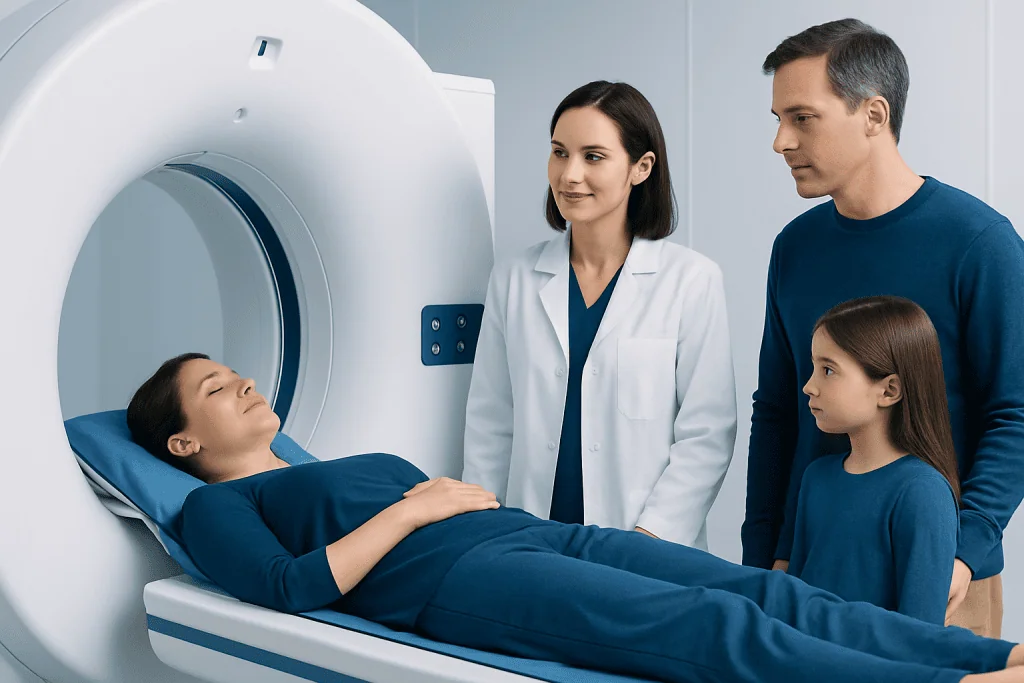
Before the scan, a clinician injects a radiotracer into a vein. The most frequently used tracer is FDG, a glucose-like substance labelled with a radioactive form of fluorine. Active cells take up the tracer at different rates, allowing the PET scanner to create images of metabolism and tissue activity.
The tracer produces signals that the scanner detects; it does not make the person contagious. Radiation cannot be passed from one person to another through touch, sharing a room, food, or clothing. Instead, the amount of radiation outside the body gradually falls as the tracer naturally decays and is cleared from the body.
PET findings are interpreted alongside the person’s symptoms, medical history, laboratory results, and other imaging. In cancer care, PET imaging can help with staging, treatment planning, and monitoring, including as part of cancer assessment and follow-up when clinically appropriate.
Who May Need Extra PET Scan Aftercare Guidance

People having a PET scan are commonly well enough to leave shortly after the examination. However, the care team should know in advance if the person is pregnant, could be pregnant, or is breastfeeding. The team can decide whether imaging should be delayed, adapted, or performed with specific safety measures.
Extra planning is also useful for people who provide close care to babies or young children, such as feeding, carrying, bathing, or putting a child to sleep. The concern is not casual contact; it is the total time spent very close to someone who is more sensitive to radiation. A specialist can give individualized advice based on the exact tracer used.
People with diabetes need particular preparation because blood glucose levels can affect FDG-PET images. Kidney problems, difficulty lying still, claustrophobia, and certain medicines may also need discussion before the appointment. The referring clinician and imaging department will provide preparation instructions tailored to the scan.
What Happens During a PET Scan
Preparation often includes fasting for several hours before an FDG-PET scan, although water may be allowed. The imaging department will give precise instructions about eating, exercise, medications, and blood sugar checks. It is important not to change prescribed medicines unless a clinician specifically advises it.
At the appointment, staff review medical information, check blood glucose when needed, and inject the tracer. There is usually a quiet waiting period of about an hour while the tracer circulates and is taken up by tissues. During this time, the person may be asked to rest and avoid strenuous movement.
For imaging, the person lies on a padded table that moves slowly through the scanner. The scan itself is painless, although remaining still can be challenging for some people. A PET/CT scan may include a CT component, and the total visit can take a few hours. The result is reviewed by a radiologist or nuclear medicine physician and sent to the referring clinician.
Afterward, staff may recommend drinking water, using the toilet regularly, and washing hands carefully after urinating. These measures help reduce the small amount of tracer remaining in the body and support good hygiene for everyone at home.
Should You Stay Away From Children After a PET Scan?
Most people do not need to completely stay away from children after a routine PET scan. They can usually be in the same home, speak, eat meals, and have brief contact. The usual precaution is to limit long periods of close physical contact with babies and young children for the time specified by the nuclear medicine team.
For example, it may be sensible to avoid holding a child on the lap for a prolonged time, sharing a bed, or spending hours with a child pressed closely against the body shortly after the scan. The recommended timeframe differs among radiotracers and hospitals, so discharge instructions are the most reliable guide.
If a parent or caregiver is unsure how to manage childcare after the scan, they should ask before leaving the imaging department. The team can clarify whether another adult should take on close-care tasks temporarily and when normal routines can resume.
How Long Does Someone Stay Radioactive After a PET Scan?
A person is not permanently radioactive after a PET scan. With the commonly used FDG tracer, radioactivity falls rapidly over hours because the tracer has a short physical half-life, meaning the amount naturally decreases by half at regular intervals. The kidneys also remove much of the tracer in urine.
In practical terms, most of the remaining activity is greatly reduced by the end of the day after a standard FDG-PET scan. However, this timing is not identical for every examination. Some specialized PET tracers remain in the body for a different length of time and may require different precautions.
Hydration, unless a clinician has advised fluid restriction, and regular toilet use can support tracer clearance. After using the toilet, flushing thoroughly and washing hands are sensible steps. Men may be asked to sit to urinate for a short period to reduce the chance of splashing.
Is It Safe to Be Around Others After a PET Scan? Can You Hug Someone?
Yes, it is generally safe to be around other adults after a PET scan. Sitting in the same room, travelling home, speaking with family members, and carrying out ordinary daily activities do not usually create a meaningful risk. The imaging team may offer more specific guidance for close contact with pregnant people and very young children.
A brief hug is usually safe after a routine PET scan. The main reason to limit contact is not a quick embrace but extended close body-to-body time. If a person wants to be especially cautious, they can keep hugs short and avoid having an infant or young child remain closely against their chest or lap for prolonged periods until the advised interval has passed.
There is no need to isolate dishes, towels, bedding, furniture, or clothing after a usual PET scan. Radiation does not contaminate household objects in this setting. Routine hygiene after toileting is the key measure because some tracer leaves the body in urine and, to a lesser extent, other body fluids.
Recovery, Benefits, Risks and When to Seek Medical Care
Recovery after PET imaging is usually immediate. Most people can eat and drink normally after the scan unless they have been given other instructions, and many return to their usual activities the same day. Drinking water can be helpful, but people with heart, kidney, or fluid-balance conditions should follow their clinician’s advice about fluid intake.
The benefits of PET imaging include detailed information that may help clarify a diagnosis, locate areas requiring further assessment, guide biopsies or treatment, and evaluate response to care. Risks are generally small and may include discomfort or bruising at the injection site, rare allergic reactions, and exposure to a controlled amount of radiation. When CT is included, there is additional radiation from the CT portion.
When to seek medical care: A person should seek urgent medical advice for symptoms of a serious allergic reaction after the injection, such as trouble breathing, swelling of the face or throat, widespread hives, fainting, or severe dizziness. They should also contact the imaging department or their clinician if they have significant pain, increasing redness, swelling, or warmth at the injection site.
For questions about PET preparation, results, radiation precautions, or follow-up care, patients should contact their referring clinician or nuclear medicine department. Acibadem International’s multidisciplinary specialists and JCI-accredited hospitals support international patients who need diagnostic imaging and coordinated care.
Frequently asked questions
Should you stay away from children after a PET scan?
Complete separation is usually not necessary after a standard PET scan. Brief everyday contact is generally acceptable, but patients may be advised to avoid prolonged close contact with infants and young children for several hours. The exact instructions depend on the tracer used and should come from the nuclear medicine team.
How long does someone stay radioactive after a PET scan?
The tracer’s radioactivity decreases quickly, and much of it leaves the body through urine. For a common FDG-PET scan, the amount is greatly reduced within the same day, but timing can vary with the tracer and the individual scan. Patients should follow the discharge instructions given by their imaging department.
Is it safe to be around others after a PET scan?
It is generally safe to be around other adults, including being in the same room, travelling home, and following normal household routines. Extra caution may be recommended for lengthy close contact with pregnant people, babies, and young children soon after the test. The person does not become contagious.
Can you hug someone after a PET scan?
A short hug is generally safe after a routine PET scan. Guidance usually focuses on avoiding prolonged close contact rather than brief affection. If the other person is pregnant or a very young child, it is sensible to follow the specific timeframe advised by the imaging team.
Do I need to wash my clothes or separate my dishes after a PET scan?
No special laundering or separate dishes are usually needed after a routine PET scan. The radiotracer does not contaminate household objects through normal contact. Good toilet hygiene, including flushing and handwashing, is the main aftercare recommendation.
Can I breastfeed after a PET scan?
Breastfeeding advice depends on the radiotracer used and may involve a temporary interruption. A breastfeeding patient should tell the imaging team before the scan so they can provide individualized instructions about feeding, expressing milk, and handling stored milk. General online guidance should not replace the instructions for the specific tracer.
References
- International Atomic Energy Agency
- Radiological Society of North America
- Society of Nuclear Medicine and Molecular Imaging
- National Cancer Institute
- U.S. Food and Drug Administration
This article is for general information only and is not a substitute for professional medical advice. Please consult a qualified doctor about your individual situation.
Explore treatments in Turkey — costs, top hospitals & a free quote
JCI-accredited · board-certified surgeons · reply within 24h
Add us as a Preferred Source to see more of our trusted health content across Google Search, AI Overviews and Discover.