Photon-Counting CT: What Makes This Newer Scan Different?

Photon-counting CT detects individual X-ray photons, unlike conventional CT detectors. It can produce sharper images with better contrast and fewer image artifacts in many cases.
Key Takeaways
- Photon-counting CT detects individual X-ray photons, unlike conventional CT detectors.
- It can produce sharper images with better contrast and fewer image artifacts in many cases.
- The technology may allow lower radiation doses for some exams while maintaining high image quality.
- It can be especially useful in areas such as heart, lung, vascular, bone, and complex body imaging.
- Not every patient needs photon-counting CT, and standard CT remains highly effective for many diagnostic questions.
Photon-counting CT is a newer form of computed tomography that measures individual X-ray photons rather than converting them into light first. This design can improve image quality, support more detailed tissue assessment, and may reduce radiation exposure in some situations.
Overview: What Is Photon-Counting CT?
Photon-counting CT is an advanced type of computed tomography scan. Like a standard CT, it uses X-rays and computer processing to create detailed cross-sectional images of the body. The key difference is in the detector technology. Instead of first converting X-rays into visible light and then into an electrical signal, photon-counting CT detects and counts individual X-ray photons directly.
This direct detection method can preserve more of the information carried by the X-ray beam. In practical terms, that can mean clearer images, finer detail, and improved ability to distinguish between different tissues or materials. It also allows the scanner to sort photons by energy, which may help doctors evaluate structures in more specific ways than conventional CT.
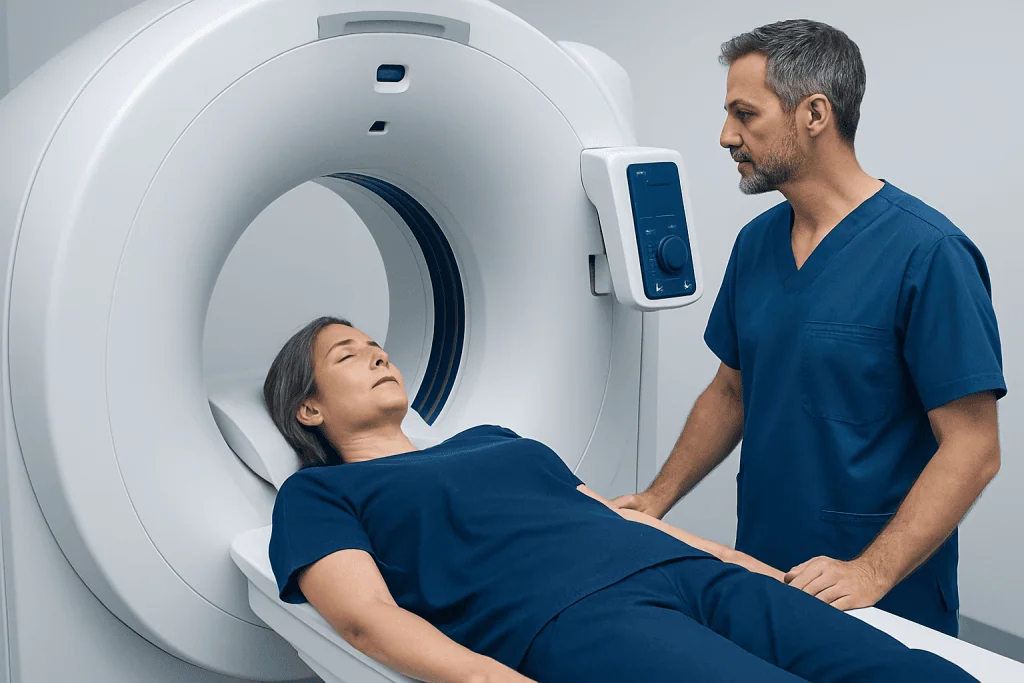
For patients, the scan experience is usually similar to a regular CT. The person lies on a table that moves through a ring-shaped scanner, and the exam is typically quick. Depending on the reason for the test, contrast material may or may not be needed.
How It Differs From Standard CT
Conventional CT scanners use energy-integrating detectors. These detectors collect the total energy from many incoming X-rays over a short period and turn it into an image signal. Photon-counting CT works differently: it registers individual photons and can measure their energy levels. This is the main technological change behind its benefits.
Because of this design, photon-counting CT can reduce some sources of image noise and improve spatial resolution, which means very small structures may appear more clearly. It can also reduce blooming artifacts, where dense materials such as calcium or metal can look larger than they really are and obscure nearby anatomy.
Another important difference is spectral imaging capability. Since photon-counting CT can sort photons by energy, it may help distinguish materials with greater precision. For example, this can support better visualization of iodine contrast, calcifications, or certain tissue characteristics. In the future, this may expand how CT helps doctors characterize disease, not just detect it.
- Directly counts individual X-ray photons
- Can provide higher image sharpness
- May improve contrast between tissues
- Often supports more detailed material analysis
- May lower radiation dose in selected exams
Potential Benefits for Patients

The most commonly discussed benefit of photon-counting CT is better image quality. When images are clearer, radiologists may be able to assess very small blood vessels, tiny lung nodules, subtle bone details, or fine inner-ear structures more confidently. This can be helpful when doctors need precise anatomical information to guide diagnosis or treatment planning.
Another possible benefit is dose efficiency. Because the detector uses X-ray information more effectively, some photon-counting CT exams may be performed with less radiation than older CT systems while still maintaining diagnostic quality. The exact dose depends on the body part being scanned, the patient’s size, the clinical question, and the protocol used by the imaging team.
Photon-counting CT may also improve imaging around metal implants or heavily calcified areas, where conventional CT can sometimes struggle. It can be useful in coronary artery evaluation, complex vascular imaging, and bone assessment. In carefully selected cases, it may complement tests such as coronary CT angiography or other advanced imaging approaches.
Even with these advantages, photon-counting CT is not automatically better for every person or every medical question. The best imaging test depends on what the doctor is trying to find, how urgent the situation is, and whether other methods such as ultrasound or MRI may be more appropriate.
When Doctors May Recommend Photon-Counting CT
Doctors may consider photon-counting CT when they need very high image detail or when standard CT has limitations. One major area of interest is cardiovascular imaging. The technology can help visualize small coronary arteries, plaques, stents, and calcifications with less blurring, which may improve assessment in selected patients being evaluated for coronary artery disease.
It can also be valuable in lung imaging, where small airway changes, interstitial abnormalities, or tiny nodules may need careful evaluation. In bone and joint imaging, higher spatial resolution may reveal fine fractures or subtle structural changes. In vascular studies, clearer definition of blood vessels may support diagnosis and treatment planning.
Oncology and abdominal imaging are additional developing areas. Better contrast and material separation may improve lesion detection or help characterize findings after contrast injection. In some settings, photon-counting CT may be used as part of a broader workup that includes MRI or PET-CT, depending on the condition being investigated.
Availability remains an important factor. Photon-counting CT is newer than standard CT and may not be offered in every hospital or imaging center. For many patients, a conventional CT still provides excellent and appropriate information.
What to Expect Before, During, and After the Scan
Preparation for photon-counting CT is usually similar to preparation for any CT scan. The care team may ask about allergies, kidney function, pregnancy, implanted devices, and current medications. If contrast material is planned, there may be instructions about fasting for a few hours beforehand.
During the exam, the patient lies still on the scanning table while it moves through the CT machine. The scanner is open and short compared with an MRI tunnel, so many people find it easier to tolerate. The technologist may ask the patient to briefly hold their breath to reduce motion and improve image quality.
If intravenous contrast is used, a warm sensation or metallic taste can occur for a short time and usually passes quickly. The scan itself is typically fast, often only a few minutes. Afterward, most people can return to normal activities right away unless they were given specific instructions.
The images are then reviewed by a radiologist, who prepares a report for the referring doctor. Results may guide further testing, follow-up, or treatment decisions. In specialized centers, multidisciplinary teams may use advanced imaging findings alongside other tests to build a more complete picture of a patient’s health.
Safety, Radiation, and Possible Limitations
Photon-counting CT still uses ionizing radiation, so it is important to use the scan only when medically appropriate. The goal in modern imaging is always to obtain the necessary information with the lowest reasonable radiation exposure. In some exams, photon-counting CT may support lower dose imaging, but this is not guaranteed for every situation.
Contrast-enhanced CT also carries considerations. Iodinated contrast material can rarely cause allergic reactions, and it may affect kidney function in some people, especially those with pre-existing kidney disease. The healthcare team reviews these risks before the scan and chooses the safest plan for the individual patient.
There are also practical limitations. Because the technology is relatively new, access may be limited, and not every hospital has this type of scanner. In addition, the best exam is not always the newest one. For some clinical questions, standard CT, ultrasound, MRI, or other tests remain the most suitable choice.
Image interpretation also matters. Advanced scanners work best when experienced radiologists and technologists use protocols tailored to the patient’s needs. Near the end of the care journey, some international patients may choose centers such as Acibadem International, where multidisciplinary specialists and JCI-accredited hospitals diagnose and treat conditions using advanced imaging technologies when appropriate.
How to Know Whether This Scan Is Right for You
Patients do not need to decide on their own whether photon-counting CT is necessary. The decision is usually made by the referring physician and radiology team based on symptoms, medical history, prior imaging, and the specific clinical question. In many cases, the most useful step is simply to ask why a scan is being recommended and what information it is expected to provide.
Helpful questions may include whether the scan needs contrast, whether a standard CT would be enough, and whether radiation dose is an important consideration in the particular case. People who have repeated imaging over time, such as those with chronic disease or cancer follow-up, may especially want to discuss the overall imaging plan with their doctor.
It is also reasonable to ask whether another test might answer the same question. Sometimes an ultrasound or MRI can avoid radiation altogether, while in other situations CT is clearly the best option because it is fast, widely informative, and excellent for visualizing certain structures. The most appropriate imaging choice is individualized.
When symptoms are urgent, speed and availability often matter as much as technical differences between scanners. A promptly performed standard CT may be more useful than waiting for a newer technology. The right scan is the one that safely answers the clinical question in time to support good care.
Frequently asked questions
Is photon-counting CT better than a regular CT scan?
Photon-counting CT can offer important advantages, including sharper images and better tissue contrast in some situations. However, standard CT remains an excellent and appropriate test for many medical needs, so the best choice depends on the reason for the scan.
Does photon-counting CT use less radiation?
It may use less radiation for certain exams because the detector can use X-ray information more efficiently. Still, the actual dose varies by body part, scan settings, and the patient's individual needs.
Is the scan procedure different for patients?
For most patients, the experience is very similar to a conventional CT scan. The exam is usually quick, painless, and may or may not involve an injected contrast dye depending on the purpose of the test.
What conditions can photon-counting CT help evaluate?
It may be especially helpful in heart, blood vessel, lung, bone, and complex body imaging where very fine detail is important. Doctors may also use it in selected cancer, abdominal, and follow-up imaging situations.
Are there any risks with photon-counting CT?
The main considerations are the same as with other CT scans: exposure to ionizing radiation and possible side effects from contrast material if contrast is used. The medical team weighs these risks against the expected benefit before recommending the exam.
Can everyone access photon-counting CT?
Not yet. Because it is a newer technology, photon-counting CT may only be available in certain hospitals or advanced imaging centers, while standard CT is much more widely available.
References
- Radiological Society of North America
- American College of Radiology
- European Society of Radiology
- U.S. Food and Drug Administration
- National Cancer Institute
This article is for general information only and is not a substitute for professional medical advice. Please consult a qualified doctor about your individual situation.
Explore treatments in Turkey — costs, top hospitals & a free quote
JCI-accredited · board-certified surgeons · reply within 24h
Add us as a Preferred Source to see more of our trusted health content across Google Search, AI Overviews and Discover.