

Posterior vs Anterior: Key Differences and How Doctors Tell Them Apart

Anterior refers to the front of the body, while posterior refers to the back. These terms help doctors describe pain, injuries, organ position, and imaging findings accurately.
Key Takeaways
- Anterior refers to the front of the body, while posterior refers to the back.
- These terms help doctors describe pain, injuries, organ position, and imaging findings accurately.
- The same condition can affect anterior or posterior structures and cause different symptoms.
- Clinicians use history, physical examination, and imaging to identify whether a problem is anterior or posterior.
- Treatment depends on the underlying cause, not only on whether it is anterior or posterior.
- New, severe, or persistent symptoms should be assessed by a qualified doctor.
Posterior vs anterior usually means whether a body structure, symptom, injury, or medical finding is located toward the back or toward the front of the body. Doctors tell them apart by combining anatomy terms with the patient’s symptoms, a focused physical exam, and tests such as imaging when needed.
Posterior vs anterior at a glance
Posterior means toward the back of the body, and anterior means toward the front. In everyday medical care, these words help clinicians describe exactly where a symptom, injury, organ, or imaging finding is located.
This matters because the same complaint may mean different things depending on whether it is anterior or posterior. For example, front knee pain and back knee pain often have different causes, and front shoulder pain may be assessed differently from pain felt behind the shoulder blade.
The table below gives a quick side-by-side comparison:
- Anterior: front-facing, toward the belly, chest, face, or front of a limb
- Posterior: back-facing, toward the spine, buttocks, back of the head, or back of a limb
- Used for: describing body parts, pain location, injuries, organ position, posture, and imaging reports
- Common examples: anterior knee pain, anterior shoulder instability, posterior neck pain, posterior hip pain
- How doctors confirm it: history, physical exam, movement testing, and imaging when appropriate
Although these words are simple anatomical directions, they are not diagnoses by themselves. A doctor still needs to determine what condition is affecting the front or back area in question.
What anterior and posterior mean in the body
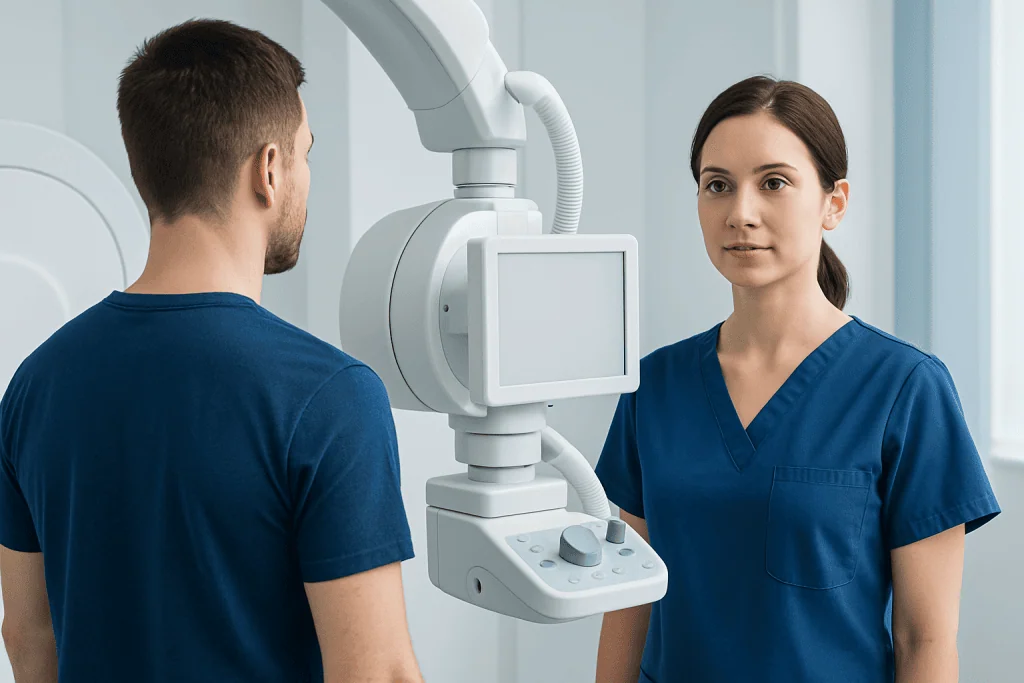
In anatomy, directional terms create a shared language. Anterior refers to the front side of the body in the standard anatomical position, while posterior refers to the back side. This helps healthcare teams describe findings clearly and consistently.
For example, the breastbone is anterior to the spine because it lies in front of it. The shoulder blades are posterior to the ribs in front of the chest. In the limbs, the front of the thigh is generally described as anterior, while the back of the thigh is posterior.
These terms may also appear in imaging reports. A radiologist may describe an anterior disc bulge, a posterior soft-tissue injury, or an organ positioned more anteriorly than expected. The wording tells the clinician where the issue is located, which supports diagnosis and treatment planning.
People sometimes confuse anterior and posterior with left and right, upper and lower, or inside and outside. They describe different directions, so a clinician often uses several terms together, such as “anterior right knee pain” or “posterior lower neck stiffness.”
Why the difference matters for symptoms and diagnosis

Knowing whether a symptom is anterior or posterior can narrow the list of likely causes. Pain in the front of a joint may involve tendons, cartilage, or structures near the body’s front surface, while pain in the back may involve different muscles, ligaments, nerves, or deeper tissues.
For example, front chest symptoms are evaluated differently from upper back symptoms. Front abdominal pain and low back pain may point to very different organ systems. In the spine, an anterior problem may involve structures toward the front of the vertebral column, whereas posterior symptoms may be more related to muscles, facet joints, or nerve compression patterns.
This distinction also matters in neurology, orthopedics, and emergency care. Doctors may use these directional terms when discussing posture, fetal position, spinal structures, blood vessels, and brain circulation. For example, some neurological conditions are described using front and back circulation patterns, and some musculoskeletal complaints overlap with herniated disc symptoms depending on the exact location involved.
Just as importantly, the location helps determine which tests are most useful and what treatment may help. A symptom in the front of the body is not automatically more serious than one in the back, but it may lead the clinician to consider different body systems.
How doctors tell posterior and anterior problems apart
Clinicians start with a careful history. They ask where the symptom is felt, when it began, what makes it better or worse, whether there was an injury, and whether there are associated symptoms such as numbness, weakness, fever, swelling, shortness of breath, or digestive complaints.
Next comes the physical examination. The doctor may inspect posture, compare the front and back of the affected area, check for tenderness, assess range of motion, and perform specific maneuvers to stress certain muscles, joints, ligaments, or nerves. A neurological exam may be needed if there is tingling, radiating pain, or weakness.
When the anatomy is not clear from the examination alone, imaging may help. X-rays can show bone alignment and some joint changes, while MRI scan may be used to assess discs, ligaments, tendons, cartilage, or nerves. CT scan can be useful in certain bone, trauma, or complex anatomical evaluations, and ultrasound may help assess soft tissues near the body surface.
Doctors do not rely only on the words anterior or posterior. They combine location with symptom pattern, exam findings, age, activity level, medical history, and test results. This is what turns a general anatomical description into a meaningful diagnosis.
Common examples in real clinical practice
One of the easiest ways to understand posterior vs anterior is to look at how the terms are used in practice. In the knee, anterior pain often refers to pain around the kneecap or front of the knee, while posterior knee pain may involve hamstring tendons, a cyst, or structures at the back of the joint. In the shoulder, anterior symptoms may involve the biceps tendon or instability toward the front, whereas posterior symptoms may be linked to the rear capsule, muscles, or referred pain from the neck.
In the spine, posterior neck or back pain commonly relates to muscles, joints, posture, or nerve irritation, while anterior neck symptoms may involve the throat, thyroid region, or front soft tissues. In the abdomen and pelvis, front-sided pain may lead a doctor to consider digestive, urinary, or reproductive organs, while posterior discomfort can sometimes point more toward the spine, kidneys, or deep muscular structures.
In cardiology and neurology, directional language can be even more specific. A doctor may discuss anterior or posterior circulation in the brain when evaluating stroke symptoms, or anterior and posterior heart-related findings on an ECG or imaging study. This is not something a person usually diagnoses themselves, but it shows how often the terms guide clinical thinking. Symptoms that raise concern for stroke need urgent assessment, especially if they involve sudden weakness, speech changes, vision loss, or imbalance.
Because location alone does not identify the cause, self-diagnosis can be misleading. Persistent front or back pain, unexplained swelling, nerve symptoms, or symptoms affecting daily life should be reviewed by a qualified healthcare professional.
What to do for each case
The right next step depends on the body area involved and the likely cause. For mild musculoskeletal symptoms, doctors often recommend short-term activity modification, good posture, gentle movement, and measures such as heat or cold depending on the situation. If symptoms are due to overuse, recovery may also include targeted physical therapy and rehabilitation to improve strength, flexibility, and movement patterns.
If the problem affects the front or back of a joint after injury, clinicians may assess for instability, ligament damage, tendon injury, fracture, or cartilage problems. In these cases, treatment may range from rest and supportive care to bracing, rehabilitation, or specialist referral. Back-related nerve symptoms sometimes overlap with conditions such as sciatica, which may require a more focused spine and nerve evaluation.
Anterior symptoms involving the chest, abdomen, throat, or pelvis are approached differently because internal organs may be involved. Depending on the symptoms, the doctor may order blood tests, imaging, or referral to a relevant specialist rather than treating it as a simple muscle strain.
Treatment is always based on the underlying diagnosis, not only the front-versus-back location. That is why new, severe, or unexplained symptoms should not be managed only by guessing whether they are anterior or posterior.
Self-care and prevention
Many anterior and posterior musculoskeletal complaints are related to repetitive strain, weak supporting muscles, prolonged sitting, poor ergonomics, or sudden changes in activity. General preventive steps include regular exercise, gradual training progression, supportive footwear when appropriate, and paying attention to body mechanics during work, sport, and lifting.
For neck, shoulder, and back discomfort, posture and workstation setup can make a meaningful difference. Frequent movement breaks, screen height adjustment, and avoiding long periods in one position may reduce strain on both front and back body structures. Strengthening the core, hips, and upper back can also support more balanced movement.
It is best to avoid prolonged complete rest unless a doctor advises it. Gentle activity is often more helpful than total inactivity for routine aches and pains. However, any self-care plan should be stopped and reassessed if symptoms are worsening, causing numbness or weakness, or interfering with normal function.
People with chronic disease, recent trauma, advanced age, pregnancy, or complex symptoms should seek individualized medical advice rather than relying only on home care. Prevention works best when risk factors are identified early and the true cause of symptoms is understood.
When to seek medical care
Medical care is important if anterior or posterior symptoms are severe, last longer than expected, keep returning, or make everyday activities difficult. A prompt review is also appropriate after a fall, sports injury, lifting injury, or accident, even if the exact source of pain is not obvious at first.
Urgent medical assessment is needed for chest pain, trouble breathing, sudden weakness, loss of sensation, new bowel or bladder problems, high fever, severe abdominal pain, or symptoms that could suggest a neurological emergency. Sudden one-sided weakness, facial drooping, confusion, trouble speaking, or vision changes should be treated as emergency warning signs.
If a doctor needs a more detailed assessment, care may involve imaging, rehabilitation, or specialist evaluation depending on the body system involved. Near the end of the diagnostic process, international patients may also wish to know that Acibadem International’s multidisciplinary specialists and JCI-accredited hospitals diagnose and treat a wide range of musculoskeletal, neurological, and internal medical conditions.
In most cases, the terms posterior and anterior are simply useful guideposts. What matters most is identifying the true cause of the symptom and choosing the safest, most appropriate care.
Frequently asked questions
What is the main difference between posterior and anterior?
Anterior means toward the front of the body, while posterior means toward the back. These are anatomical direction terms that help doctors describe where a structure or symptom is located.
Is posterior the same as back pain?
Not always. Posterior simply means toward the back, so it can describe many body regions, such as the back of the knee, shoulder, head, or neck. It does not automatically mean the spine is the cause.
Can the same condition be anterior or posterior?
Yes. Some conditions can affect either the front or the back of a body part and may cause different symptoms depending on the exact location. That is why doctors use both location and exam findings to make a diagnosis.
How do doctors know whether pain is anterior or posterior?
Doctors ask the patient to point to the exact area of symptoms and then examine the front and back structures around that area. If needed, they may use imaging such as X-ray, ultrasound, CT, or MRI to confirm the location and cause.
Are anterior symptoms more serious than posterior symptoms?
Not necessarily. Severity depends on the underlying cause, the body system involved, and whether there are warning signs such as weakness, chest pain, fever, or severe abdominal pain. Both anterior and posterior symptoms can range from minor strain to a condition needing urgent care.
When should someone seek urgent care for anterior or posterior symptoms?
Urgent care is important for symptoms such as chest pain, trouble breathing, sudden weakness, loss of sensation, severe trauma, confusion, or loss of bladder or bowel control. These symptoms may indicate a serious condition and should be assessed without delay.
References
- Cleveland Clinic
- MedlinePlus
- National Institute of Neurological Disorders and Stroke
- American Academy of Orthopaedic Surgeons
- Merck Manual Consumer Version
This article is for general information only and is not a substitute for professional medical advice. Please consult a qualified doctor about your individual situation.
Joint and spine care in Turkey — expert assessment & treatment
JCI-accredited · board-certified surgeons · reply within 24h
Add us as a Preferred Source to see more of our trusted health content across Google Search, AI Overviews and Discover.

More from the Health Library



Related Specialists

Asst. Prof. Dr. Berkhan Yilmaz
Aesthetic Plastic & Reconstructive Surgery
Assoc. Prof. Dr. Seçkin Satılmış
Cardiology
Prof. Dr. İsmail Mete İtil
Gynecology & Obstetrics
Dr. Halil Buluç
Anesthesiology