Rhomboid Exercises — Explained by Medical Evidence, Not Myths

Rhomboid exercises target the upper back muscles that retract and help stabilize the shoulder blades. They can support posture, shoulder mechanics, and muscular endurance when combined with overall back and shoulder training.
Key Takeaways
- Rhomboid exercises target the upper back muscles that retract and help stabilize the shoulder blades.
- They can support posture, shoulder mechanics, and muscular endurance when combined with overall back and shoulder training.
- Pain during exercise is not the goal; worsening pain, numbness, or weakness should be assessed by a clinician.
- Good technique matters more than using heavy resistance or doing many repetitions.
- People with neck, shoulder, or spine conditions may benefit from individualized guidance before starting.
Rhomboid exercises are movements that strengthen the muscles between the shoulder blades, helping support posture, shoulder control, and upper back comfort. The most helpful programs are not based on myths about “perfect posture,” but on gradual strengthening, mobility, and technique matched to the person’s needs.
Overview: What rhomboid exercises actually do
Rhomboid exercises are movements designed to strengthen the rhomboid major and rhomboid minor, two upper back muscles located between the spine and the shoulder blades. These muscles help pull the shoulder blades slightly inward toward the spine and work together with the middle trapezius, lower trapezius, rotator cuff, and other stabilizing muscles. In practical terms, this means they support controlled shoulder blade movement during daily tasks, desk work, lifting, reaching, and exercise.
Medical evidence does not support the idea that one muscle alone “fixes” posture or eliminates all upper back discomfort. Instead, people usually do best with a balanced program that includes scapular strengthening, thoracic mobility, and attention to work, sport, or lifestyle habits that may overload the neck and shoulders. Rhomboid exercises are useful as part of that broader approach.
These exercises are often recommended for people who spend long periods sitting, feel muscular fatigue around the upper back, or are recovering from mild movement-related shoulder imbalance. They may also be included in rehabilitation programs for certain shoulder conditions, alongside treatments for shoulder impingement syndrome or after assessment of persistent shoulder blade dysfunction. The goal is improved control and endurance, not simply squeezing the shoulder blades together as hard as possible.
How the rhomboid muscles affect posture and shoulder health
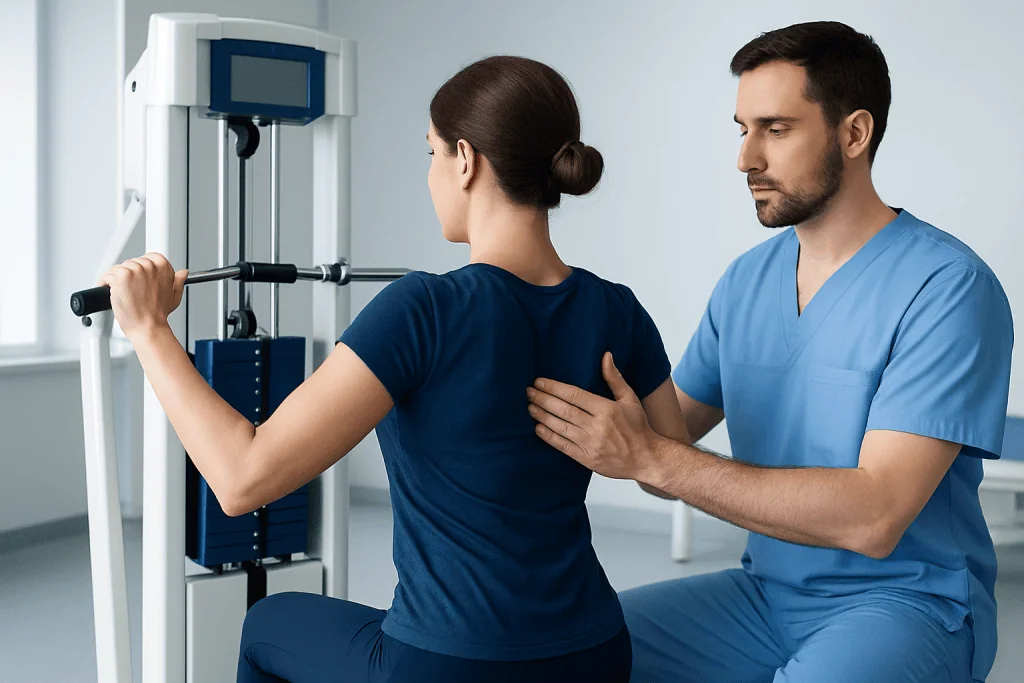
The rhomboids help coordinate the position of the shoulder blades against the rib cage. This is important because the shoulder blade serves as a stable base for the arm. When the scapula moves poorly or tires too quickly, the neck, upper trapezius, and front of the shoulder may compensate. Over time, this can contribute to muscle tension, reduced exercise tolerance, or inefficient movement patterns.
It is helpful to understand that posture is dynamic, not a single fixed position. Healthy posture involves the ability to move comfortably, change positions, and tolerate activity rather than hold a rigid pose all day. Rhomboid exercises can improve upper back endurance and help a person feel more supported during sitting, standing, or lifting, but they work best when combined with mobility, rest breaks, and whole-body conditioning.
In people with shoulder pain, clinicians often assess the entire kinetic chain, including the neck, thoracic spine, shoulder blade muscles, and rotator cuff. If symptoms seem linked to overuse, deconditioning, or mechanics, a rehabilitation plan may include physical therapy and rehabilitation to retrain movement patterns and build strength safely. This is especially relevant when symptoms have lasted several weeks or limit work, sleep, or sport.
Common rhomboid exercises and how to do them safely

Several upper back movements can effectively train the rhomboids. Common examples include rows, band pull-aparts, face pulls, prone T raises, seated cable rows, chest-supported rows, and scapular retraction drills. These exercises usually work best with light to moderate resistance, controlled tempo, and an emphasis on smooth shoulder blade motion rather than shrugging the shoulders upward.
A simple starting strategy is to keep the neck relaxed, gently draw the shoulder blades back and slightly down, and stop before the lower back arches excessively. The movement should feel muscular, not sharp or pinching. Breathing should remain steady, and the ribs should stay relatively controlled rather than flaring forward.
- Band row: Pull the elbows back while keeping the shoulders away from the ears.
- Prone T raise: Lying face down or inclined, lift the arms out to the side with the shoulder blades moving together gently.
- Face pull: Pull a band or cable toward the face with elbows high enough to encourage upper back activation, without forcing the neck.
- Band pull-apart: Separate the hands slowly and pause briefly with the chest open and shoulders relaxed.
Most people benefit from starting with lower resistance and fewer sets, then progressing gradually. If form deteriorates with fatigue, it is usually better to stop than continue with compensations. A clinician or trainer can help adapt exercises if there is a history of neck pain, shoulder instability, or spine problems.
Myths, mistakes, and what the evidence says
One common myth is that rhomboid weakness is the single cause of poor posture or shoulder pain. In reality, these concerns are often multifactorial. Workstation setup, stress, sleep position, overall activity level, thoracic stiffness, rotator cuff weakness, and movement habits can all play a role. Strengthening the rhomboids may help, but it is rarely the entire solution.
Another mistake is over-squeezing the shoulder blades into a rigid position all day. This can increase tension and make movement feel unnatural. Current rehabilitation principles generally favor restoring coordinated, efficient movement rather than holding the shoulders “back and down” at all times. The shoulder girdle needs to move freely for overhead reaching, lifting, and normal arm function.
People also sometimes use too much weight too early. Heavy resistance can shift the work into the neck, lower back, or momentum-based pulling. Better results often come from moderate effort, consistent practice, and attention to quality. If symptoms are related to a more complex problem such as a rotator cuff tear or cervical spine issue, exercise choice and loading may need to be modified after medical evaluation.
Who may benefit most from rhomboid exercises
Rhomboid exercises may be especially helpful for people who spend long hours at a computer, do repetitive forward-reaching tasks, or return to exercise after a period of inactivity. They are often used to improve upper back endurance in office workers, students, and people whose activities place repeated demands on the front of the shoulders and chest.
They may also be useful for recreational athletes, especially those in sports that require shoulder control such as swimming, tennis, climbing, and strength training. In these settings, rhomboid work is usually paired with lower trapezius, serratus anterior, and rotator cuff strengthening for more complete shoulder support.
Not everyone should use the same program. People with recent injury, severe pain, radiating symptoms, marked weakness, or a history of shoulder dislocation may need assessment first. If there is concern about joint or soft tissue damage, a doctor may recommend examination and, when appropriate, orthopedic rehabilitation or imaging to guide treatment safely.
Building an effective routine: progression, recovery, and self-care
An effective rhomboid program is usually simple and sustainable. Two to four sessions per week is often enough for general strengthening, with at least some recovery time between harder sessions. Many people start with one to three exercises and gradually increase repetitions, resistance, or time under tension as control improves.
Recovery matters as much as exercise selection. Short movement breaks during the day, regular walking, shoulder and chest mobility work, and sensible desk ergonomics can reduce repeated strain on the upper back. For some people, adjusting screen height or avoiding prolonged static positions helps more than adding many new exercises.
Self-care should stay practical and symptom-guided. Mild muscular fatigue after exercise can be normal, but pain that lingers, worsens overnight, or limits arm use should not be ignored. If upper back discomfort is persistent, a broader assessment may be needed to rule out related problems in the neck, shoulder, or thoracic region. In selected cases, doctors may use MRI or other tests when symptoms suggest structural injury rather than simple muscle deconditioning.
When to seek medical care
Rhomboid exercises are generally safe for healthy adults when introduced gradually, but medical evaluation is important if pain is severe, follows trauma, or does not improve with rest and modified activity. A person should also seek care if upper back or shoulder symptoms interfere with sleep, daily function, or work despite several weeks of appropriate self-care.
Prompt assessment is especially important for numbness, tingling, radiating arm pain, true weakness, loss of coordination, fever, unexplained weight loss, chest pain, or shortness of breath. These symptoms may point to causes beyond simple muscular strain. Shoulder blade pain can sometimes reflect issues in the neck, shoulder joint, nerves, or, less commonly, non-musculoskeletal conditions.
A clinician may examine posture, range of motion, strength, scapular control, and the neck and shoulder together. Treatment depends on the cause and may include activity modification, rehabilitation, pain-management strategies, or referral to a specialist. Near the end of the care pathway, patients seeking coordinated assessment may find that Acibadem International’s multidisciplinary specialists and JCI-accredited hospitals diagnose and treat shoulder and spine-related conditions for international patients.
Frequently asked questions
What are rhomboid exercises best for?
Rhomboid exercises are best for improving upper back strength and shoulder blade control. They can support posture, exercise tolerance, and comfort during activities that involve prolonged sitting, reaching, or lifting.
Can rhomboid exercises fix poor posture?
They can help, but they are not a complete fix on their own. Posture is influenced by strength, mobility, work habits, fatigue, and how often a person changes position during the day.
Are rhomboid exercises good for shoulder pain?
They may help some types of shoulder discomfort, especially when symptoms relate to muscle imbalance or reduced shoulder blade control. However, shoulder pain has many possible causes, so persistent or worsening symptoms should be assessed by a qualified clinician.
How often should a person do rhomboid exercises?
For general strengthening, many people do them two to four times per week. The right frequency depends on fitness level, symptoms, and whether the exercises are part of a broader rehabilitation program.
What if rhomboid exercises cause pain?
Mild muscle effort or fatigue can be normal, but sharp, pinching, or radiating pain is not the goal. If pain persists, worsens, or comes with numbness or weakness, the exercises should be stopped and medical advice should be sought.
Do people need equipment for rhomboid exercises?
Not always. Some effective options use body weight or simple resistance bands, while others use cables or dumbbells. The best choice is the one that allows controlled movement with good form and no symptom flare.
This article is for general information only and is not a substitute for professional medical advice. Please consult a qualified doctor about your individual situation.
Joint and spine care in Turkey — expert assessment & treatment
JCI-accredited · board-certified surgeons · reply within 24h
Add us as a Preferred Source to see more of our trusted health content across Google Search, AI Overviews and Discover.

More from the Health Library

Acne Scars Topical: What Patients Need to Know

Rifampin — Explained by Medical Evidence, Not Myths

Somatic Yoga — Explained by Medical Evidence, Not Myths

Prazosin — Explained by Medical Evidence, Not Myths

Chocolate Almond Milk: What Patients Need to Know