Skull Base Surgery: Procedure, Recovery and Results

Skull base surgery may be performed through the nose, ear, or an incision in the scalp, depending on the condition’s location. Treatment is usually planned by a multidisciplinary team that may include neurosurgeons, ENT surgeons, neuroradiologists, oncologists, and rehabilitation specialists.
Key Takeaways
- Skull base surgery may be performed through the nose, ear, or an incision in the scalp, depending on the condition’s location.
- Treatment is usually planned by a multidisciplinary team that may include neurosurgeons, ENT surgeons, neuroradiologists, oncologists, and rehabilitation specialists.
- Recovery varies widely, but many people need several weeks to resume routine activities and longer for full recovery.
- Possible risks include cerebrospinal fluid leakage, infection, bleeding, and changes affecting vision, hearing, balance, swallowing, or facial movement.
- Outcomes depend more on the diagnosis and whether complete removal is safe than on one universal success rate.
Skull base surgery is a specialized procedure used to diagnose, remove, or treat tumors and other conditions near the base of the skull, where important nerves and blood vessels are located. The approach, recovery, and likely results depend on the condition’s location, size, behavior, and the person’s overall health.
Overview: What Is Skull Base Surgery?
Skull base surgery is a group of highly specialized operations used to treat conditions located at the bottom of the skull. This area forms the boundary between the brain and the face, nose, ears, neck, and upper spine. It contains major blood vessels and cranial nerves that control functions such as vision, hearing, balance, facial movement, swallowing, and hormone regulation.
Skull base surgery procedures may be used for benign or cancerous tumors, cysts, vascular abnormalities, cerebrospinal fluid leaks, infections, and certain congenital conditions. Some procedures remove a growth completely, while others obtain a biopsy, relieve pressure, repair a leak, or reduce a tumor before radiation or other treatment.
Modern techniques often allow surgeons to reach selected areas through natural openings, particularly through the nose using an endoscope. However, an open approach through the scalp, behind the ear, or another carefully planned route may be safest for some conditions. The goal is to treat the problem while protecting surrounding nerves, blood vessels, and healthy tissue as much as possible.
How Skull Base Surgery Works and Who May Be a Candidate
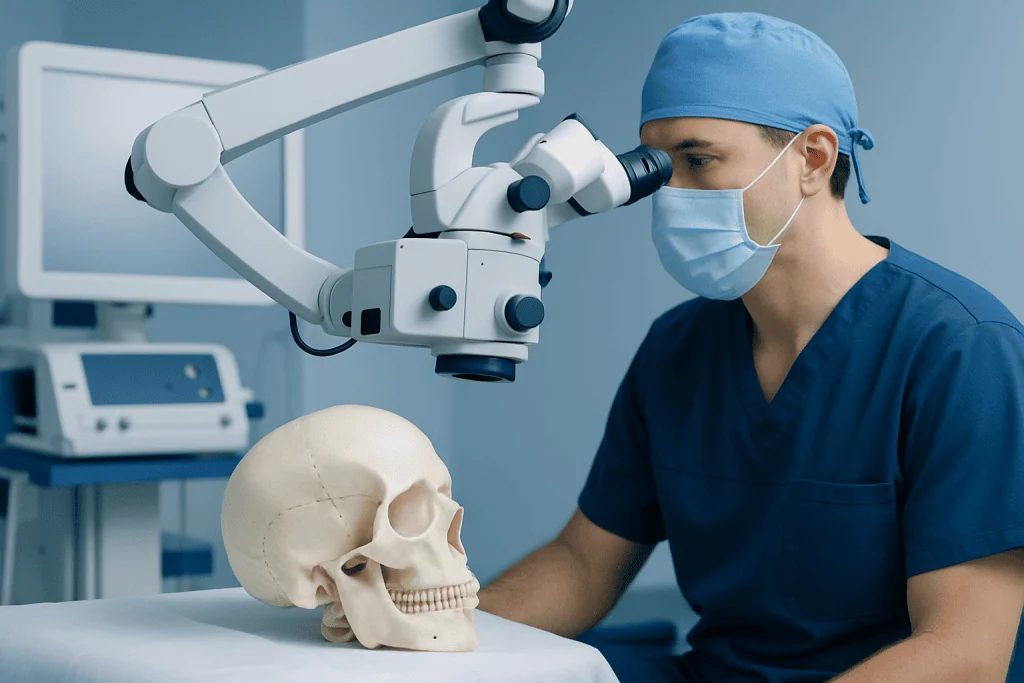
Before recommending surgery, the care team considers the exact diagnosis, the location and size of the lesion, symptoms, rate of growth, and whether it is affecting nearby structures. MRI and CT scans are commonly used to map bone, soft tissue, blood vessels, and nerves. Depending on the concern, testing may also include hearing assessment, eye examination, hormone testing, swallowing evaluation, or biopsy.
A person may be considered for surgery when a lesion is growing, causing symptoms, threatening vision or nerve function, producing excess hormones, leaking cerebrospinal fluid, or requiring tissue diagnosis. Surgery is not always the first or only option. Carefully monitored observation, medicines, radiation therapy, stereotactic radiosurgery, embolization, or a combined treatment plan may be more appropriate in some situations.
Good candidacy also depends on general health, previous treatments, the ability to tolerate anesthesia, and personal treatment goals. A multidisciplinary review is especially valuable because skull base conditions can overlap neurosurgery, ear, nose and throat care, endocrinology, oncology, radiology, and rehabilitation. A surgeon should explain why a particular route is recommended and what alternatives are reasonable.
What Happens During Skull Base Surgery?

The exact steps differ by diagnosis and surgical route. Many operations begin with general anesthesia, followed by detailed positioning and image guidance. Surgical navigation uses preoperative scans to help the team orient instruments precisely during the procedure. Neurophysiological monitoring may also be used to watch the function of selected nerves.
In an endoscopic endonasal procedure, surgeons pass a thin camera and specialized instruments through the nostrils. An ENT skull base surgeon and neurosurgeon may work together, creating a route through the nasal passages and, when necessary, part of the skull base to reach the target. After treatment, the opening may be reconstructed with local tissue, graft material, or a flap to help prevent leakage of cerebrospinal fluid.
Open skull base surgery involves an incision chosen to provide the safest view of the affected area. It may be performed through the scalp, near the ear, around the eye socket, or in another location. The surgical team may remove bone temporarily, treat or remove the lesion, protect or reconstruct nearby structures, and replace the bone or use reconstructive materials as needed.
Skull base surgery duration can range from a few hours to substantially longer for complex lesions. The planned procedure can occasionally change during surgery if the team finds that a different approach is needed for safety. Afterward, the person is monitored closely in a recovery area or intensive care setting, depending on the operation and individual needs.
Benefits, Risks and Skull Base Precautions
The potential benefits of surgery include removing or controlling a tumor, confirming a diagnosis, relieving pressure on the brain or nerves, improving symptoms, repairing a cerebrospinal fluid leak, or preventing further damage. In some cases, surgery can be curative. In others, it is one part of long-term management that may include radiation, medication, imaging follow-up, or additional procedures.
Because this surgery takes place near delicate structures, risks must be considered carefully. Possible complications include bleeding, infection, stroke, blood clots, wound problems, cerebrospinal fluid leakage, meningitis, seizures, or an adverse reaction to anesthesia. Risks specific to the location can include changes in smell, vision, hearing, balance, facial sensation or movement, voice, swallowing, hormone function, or memory and concentration.
Not every risk occurs in every procedure. The likelihood depends on the lesion, surgical route, previous treatment, anatomy, and the person’s medical condition. The surgeon can discuss risks that are most relevant in an individual case, including the possibility that complete removal may not be safe if a lesion is attached to critical nerves or blood vessels.
Skull base precautions are individualized, particularly after endonasal surgery or repair of a cerebrospinal fluid leak. They may include avoiding nose blowing, forceful sneezing, straining, heavy lifting, bending forward, smoking, and certain activities for a defined period. Patients should follow their own surgical team’s instructions, as restrictions and timing vary.
How Long Does It Take to Recover From Skull Base Surgery?
Skull base surgery recovery time varies considerably. A person may spend several days in hospital after a less complex operation, while more extensive open procedures or surgeries involving complications can require a longer stay. In the first days, care focuses on pain control, neurological observation, fluid balance, mobility, nutrition, and watching for signs of leakage, infection, or changes in nerve function.
Many people gradually resume light daily activities over several weeks, but full skull base surgery recovery may take weeks to months. Fatigue is common during early recovery, even when the incision or nasal symptoms appear to be healing well. People who have changes in balance, swallowing, hearing, speech, or facial movement may benefit from physical therapy, occupational therapy, speech and swallowing therapy, or audiology care.
Follow-up appointments commonly include wound or nasal examinations, review of pathology results, and repeat imaging. If a tumor affected hormone-producing structures, endocrinology follow-up and blood tests may be needed. Returning to work, driving, exercise, air travel, and heavy lifting should be discussed with the treating team rather than based on a general timeline.
Is Skull Base Surgery a Major Surgery?
Skull base surgery is generally considered major surgery because it treats conditions close to the brain, cranial nerves, and major blood vessels. Even minimally invasive operations performed through the nose require advanced planning, general anesthesia, specialized equipment, and careful postoperative monitoring.
That said, “major” does not mean the same experience for every person. Some endoscopic procedures avoid a large external incision and may have a shorter hospital stay than traditional open surgery. Other cases require extensive removal and reconstruction, with a longer operation and more involved recovery.
The appropriate level of care depends on the condition rather than the size of the incision alone. A clear discussion of the expected hospital stay, rehabilitation needs, activity limitations, and support at home can help patients and families prepare realistically.
What Is the Success Rate of Skull Base Surgery?
There is no single success rate for skull base surgery. Results vary according to the diagnosis, whether a lesion is benign or malignant, its size and location, its relationship to nerves and blood vessels, the surgical goal, and whether other treatments are used. For example, success may mean complete tumor removal in one case, while in another it may mean preserving vision, controlling growth, repairing a leak, or obtaining a diagnosis safely.
For some benign and well-defined lesions, surgery can provide long-term control or cure. For tumors that involve critical structures, the safest strategy may be subtotal removal followed by imaging surveillance, radiation, or medication. This approach can reduce the chance of serious neurological harm while still managing the disease effectively.
Patients can ask their surgeon about expected outcomes for their specific diagnosis, including the goal of surgery, likelihood of complete removal, chance of recurrence, likely functional changes, and the role of follow-up treatment. Individualized information is more meaningful than a broad percentage drawn from unlike conditions.
How Serious Is a Skull Base Tumor and When to Seek Medical Care?
A skull base tumor can be serious because of where it grows, even when it is benign. A noncancerous tumor may still press on nerves, the brainstem, the pituitary gland, or major blood vessels. Malignant tumors may invade nearby tissues or spread, but seriousness cannot be determined from symptoms alone; imaging, pathology, and specialist assessment are needed.
Medical evaluation is important for persistent or progressive symptoms such as new double vision or vision loss, hearing loss on one side, worsening balance, facial weakness or numbness, difficulty swallowing, unexplained hoarseness, persistent nasal blockage or nosebleeds, or a clear watery nasal drainage after head injury or surgery. These symptoms have many possible causes, but they warrant timely assessment.
Emergency care is appropriate for sudden severe headache, new weakness or numbness, trouble speaking, loss of consciousness, seizure, sudden major vision change, or signs of a serious infection such as fever with neck stiffness or confusion. People recovering from surgery should contact their surgical team promptly for worsening headache, persistent clear drainage from the nose, fever, increasing drowsiness, or new neurological symptoms.
Acibadem International’s multidisciplinary specialists and JCI-accredited hospitals provide evaluation and treatment for international patients with complex skull base conditions, with care plans coordinated across relevant specialties.
Frequently asked questions
How long is the hospital stay after skull base surgery?
Hospital stay depends on the surgical approach, diagnosis, and recovery needs. Some people leave hospital within several days after a straightforward procedure, while complex open surgery or complications may require a longer stay. The care team will monitor neurological function, pain, mobility, fluid balance, and healing before discharge.
Can skull base surgery be done through the nose?
Yes, selected skull base conditions can be treated through the nostrils with an endoscope and specialized instruments. This is called an endoscopic endonasal approach. It is not suitable for every condition, as the safest route depends on the lesion’s location and relationship to nearby structures.
Will skull base surgery leave a scar?
Endoscopic surgery through the nose usually does not leave an external facial scar. Open procedures require an incision, often placed in the scalp or near the ear where it can be less visible. The location and appearance of a scar depend on the approach needed for safe treatment.
What should patients avoid after skull base surgery?
Restrictions are tailored to the procedure, especially if surgery involved the nasal passages or repair of a cerebrospinal fluid leak. Patients may be advised to avoid nose blowing, heavy lifting, straining, forceful sneezing, smoking, and bending for a period of time. The surgical team should provide personalized instructions before discharge.
Can a skull base tumor come back after surgery?
Some tumors can recur or continue to grow after surgery, particularly when complete removal is not safe or when the tumor has an aggressive biology. Regular imaging and specialist follow-up help detect changes early. Additional treatment may include observation, radiation therapy, medication, or further surgery.
When can someone return to work after skull base surgery?
Return-to-work timing varies from a few weeks to several months depending on the procedure, job demands, fatigue, and any effects on balance, vision, swallowing, or concentration. Sedentary work may be possible sooner than physically demanding work. A treating surgeon can give guidance based on healing and follow-up findings.
References
- National Institute of Neurological Disorders and Stroke
- American Association of Neurological Surgeons
- American Academy of Otolaryngology–Head and Neck Surgery
- National Cancer Institute
- Mayo Clinic
This article is for general information only and is not a substitute for professional medical advice. Please consult a qualified doctor about your individual situation.
Joint and spine care in Turkey — expert assessment & treatment
JCI-accredited · board-certified surgeons · reply within 24h
Add us as a Preferred Source to see more of our trusted health content across Google Search, AI Overviews and Discover.