

Sleep Study vs EEG: Which Test Is Needed for Sleep Symptoms?
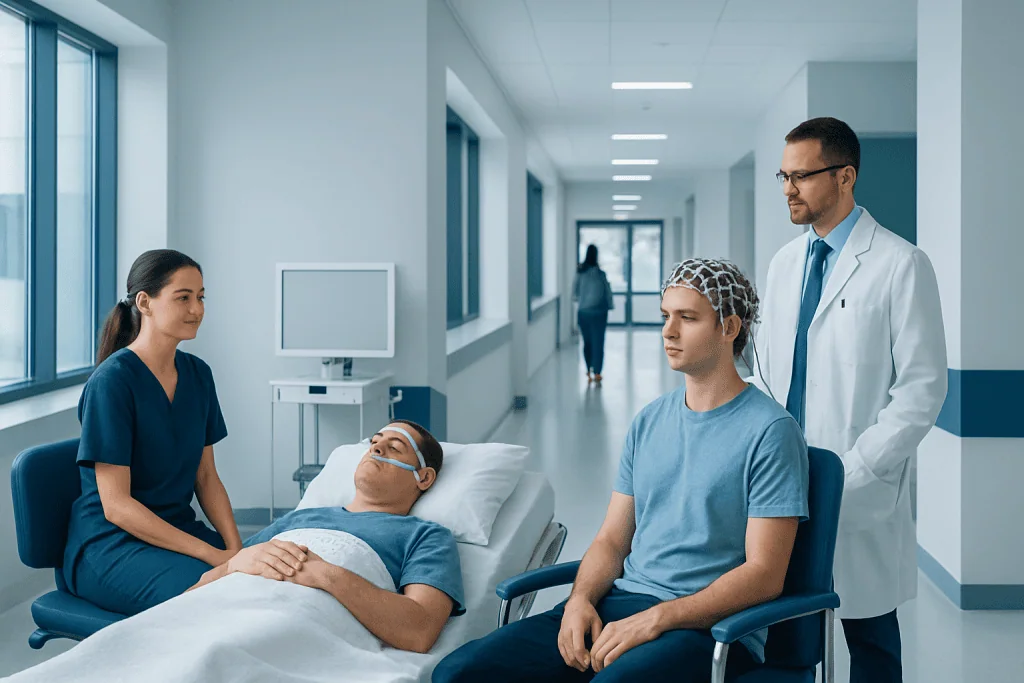
A sleep study and an EEG are not interchangeable tests. A sleep study measures sleep stages, breathing, oxygen levels, heart rhythm, and body movements overnight.
Key Takeaways
- A sleep study and an EEG are not interchangeable tests.
- A sleep study measures sleep stages, breathing, oxygen levels, heart rhythm, and body movements overnight.
- An EEG records the brain’s electrical activity and is commonly used to assess seizures or other neurological concerns.
- Some people need only one test, while others may need both, depending on their symptoms.
- The right test depends on the pattern of symptoms, medical history, and a doctor’s clinical assessment.
A sleep study and an EEG are different tests that answer different questions. A sleep study is usually used for snoring, pauses in breathing, unusual movements, or daytime sleepiness, while an EEG is more often used when seizure-like events or abnormal brain activity are a concern.
Overview: How a Sleep Study and EEG Differ
People with sleep-related symptoms often hear about two tests: a sleep study and an EEG. Although both may involve sensors placed on the head and body, they are designed for different purposes. Understanding this difference can make the testing process feel clearer and less stressful.
A sleep study, also called polysomnography, is an overnight test that looks at what happens in the body during sleep. It typically records breathing, oxygen levels, heart rate, body movements, eye movements, muscle activity, and sleep stages. This makes it especially helpful for conditions such as sleep apnea, restless legs syndrome, and certain unusual nighttime behaviors.
An EEG, or electroencephalogram, focuses on the brain’s electrical activity. It is often used when doctors need to investigate possible seizures, episodes of loss of awareness, or other neurological symptoms. In some cases, a person may have events during sleep that could be either a sleep disorder or a seizure-related event, and that is when the distinction becomes especially important.
In short, the question is not usually which test is better overall, but which test best matches the symptoms. A sleep specialist or neurologist uses the history, the timing of symptoms, and any related medical issues to decide whether a sleep study, an EEG, or both are needed.
When a Sleep Study Is Usually Recommended
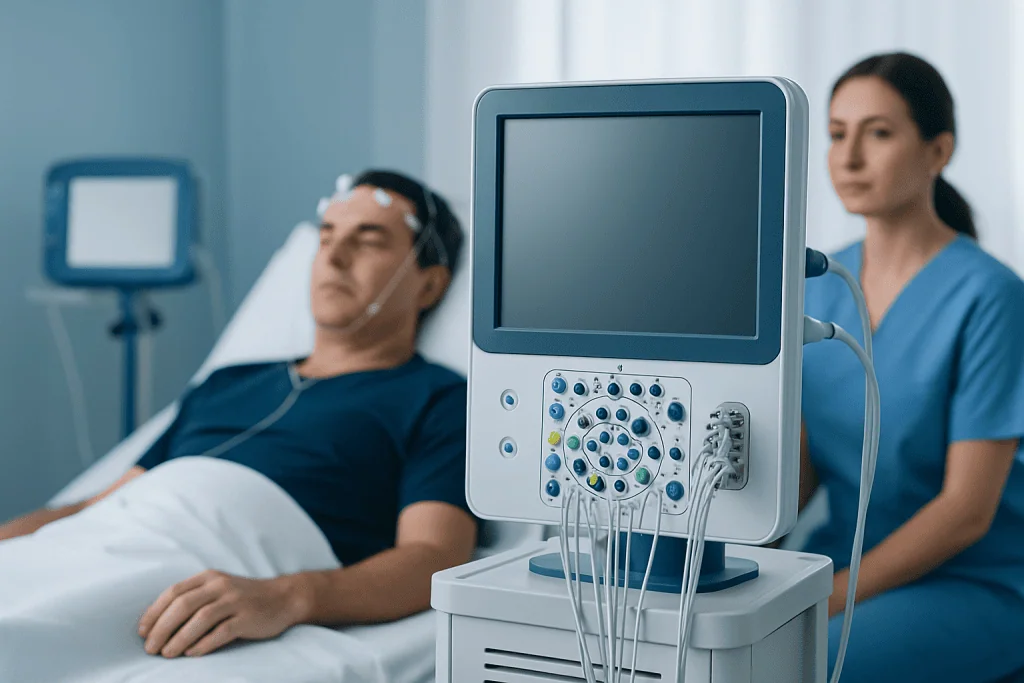
A sleep study is most often recommended when symptoms suggest that the body is struggling during sleep rather than the brain showing seizure-like electrical changes. Common reasons include loud snoring, witnessed pauses in breathing, waking up gasping, poor-quality sleep, and excessive daytime sleepiness. It can also help evaluate repeated awakenings, leg movements during sleep, or unusual behaviors such as sleepwalking.
Because it records several body functions at the same time, a sleep study gives a broader picture of overnight health. Doctors can see whether breathing repeatedly narrows or stops, whether oxygen levels drop, and whether sleep becomes fragmented. This is why the test is central in diagnosing sleep apnea and other common sleep disorders.
A standard in-lab sleep study is more detailed than a home sleep test. In-lab testing may be preferred when symptoms are complex, when unusual nighttime behaviors are involved, or when doctors want to monitor brain waves alongside breathing and movement. Home sleep apnea testing may be sufficient for some adults with a strong suspicion of uncomplicated obstructive sleep apnea, but it does not answer every sleep-related question.
Sometimes a sleep study is combined with specialist evaluation in a dedicated sleep center setting, where results are interpreted in the context of the person’s symptoms, medical history, and daily functioning. This helps make the test more meaningful than a report alone.
When an EEG Is Usually Recommended
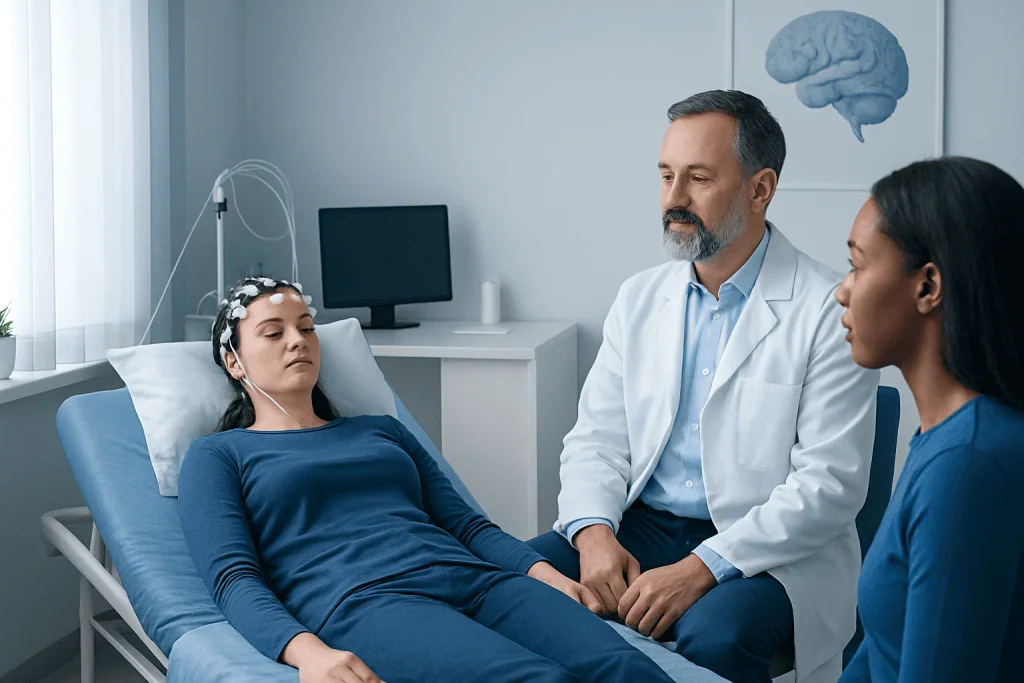
An EEG is usually recommended when symptoms raise concern for a seizure disorder or another condition affecting brain activity. Examples include episodes of staring, sudden jerking, unexplained loss of awareness, confusion after an event, or repeated nighttime spells that are difficult to explain by a typical sleep disorder alone. An EEG may be done while awake, during drowsiness, or after sleep deprivation, depending on the clinical question.
Unlike a full sleep study, an EEG does not primarily assess breathing, oxygen levels, or snoring. Its purpose is to look for abnormal patterns in the brain’s electrical signals. This can help doctors understand whether nighttime events may actually be seizures rather than parasomnias, movement disorders, or disrupted sleep from breathing problems.
Some symptoms can overlap. For example, a person may thrash, vocalize, stiffen, or have repetitive movements during the night. These behaviors may come from a sleep disorder, but they can also sometimes reflect seizure activity. In that setting, a doctor may recommend an EEG or even prolonged video EEG monitoring to capture an event and compare physical behavior with brain wave changes.
If a person already has a known neurological condition, an EEG can be especially useful. It may also be considered when a routine sleep assessment does not fully explain the symptoms or when the history includes daytime events, blackouts, or signs suggestive of epilepsy.
Symptoms That Help Doctors Choose Between the Tests
The pattern of symptoms often provides the strongest clue about which test is needed. Snoring, witnessed pauses in breathing, dry mouth on waking, morning headaches, and feeling unrefreshed after sleep usually point more strongly toward a sleep study. So do symptoms such as frequent nighttime urination, daytime fatigue, and trouble staying awake during quiet activities.
On the other hand, sudden unexplained episodes with shaking, stiffening, blank staring, tongue biting, loss of bladder control, or confusion after an event may suggest the need for an EEG. A person who has brief stereotyped spells, especially both during the day and at night, may also need neurological evaluation. Family observations are often very helpful because many events happen when the person is asleep and unaware.
Some nighttime symptoms fall into a gray area. Sleepwalking, acting out dreams, sitting up suddenly, screaming, or unusual repetitive movements can occur in several different conditions. In these situations, the doctor may need more than one type of test, or may use video-based monitoring to understand exactly what is happening during an episode.
Children may need especially careful assessment because behavioral changes, learning difficulties, restless sleep, enlarged tonsils, nighttime fears, or unusual spells can have more than one cause. The goal is to match the test to the symptom pattern instead of assuming that all nighttime events are the same.
What Happens During Each Test
During a sleep study, the patient usually spends the night in a sleep laboratory or, in selected cases, uses a home testing device. Sensors are placed on the scalp, face, chest, and legs to monitor sleep stages, breathing, heart rhythm, oxygen levels, and movement. The test is painless, and while sleeping in a monitored setting can feel unfamiliar, most people are still able to sleep enough for useful information to be collected.
During an EEG, small electrodes are attached to the scalp to record brain wave activity. The test itself is painless and often takes less time than an overnight sleep study, although longer or repeated monitoring may be needed in some cases. A routine EEG may happen in a clinic or hospital, while prolonged video EEG monitoring is performed when doctors need to capture intermittent events.
Sometimes a sleep study includes EEG leads as part of standard monitoring, but this does not make it the same as a dedicated neurological EEG evaluation. In a sleep study, brain wave recording is mainly used to identify sleep stages and arousals. In a diagnostic EEG, the recording is analyzed in greater detail for patterns that may indicate seizure activity or other neurological abnormalities.
Doctors may also use related tests when appropriate. For example, some people with severe daytime sleepiness may need additional evaluation such as EEG testing or specialized daytime sleep testing after an overnight study. The exact plan depends on the question the medical team is trying to answer.
Can Someone Need Both a Sleep Study and an EEG?
Yes. In some situations, both tests are useful because sleep and brain activity can affect each other. A person may have a true sleep disorder and a neurological condition at the same time, or the symptoms may be unclear enough that one test alone cannot fully explain them.
For example, repeated nighttime events may initially look like parasomnias such as sleepwalking or acting out dreams, but later raise concern for seizures. In other cases, untreated sleep apnea can cause repeated awakenings, body movements, and poor daytime concentration, creating confusion about whether the problem is neurological, sleep-related, or both. Careful testing helps separate these possibilities.
A combined approach may also be needed if a first test is inconclusive. If a sleep study does not show enough breathing disturbance to explain severe symptoms, but there are still suspicious nighttime episodes, an EEG-based evaluation may follow. Likewise, if an EEG does not explain disrupted sleep, a formal sleep study may be the next step.
This is one reason multidisciplinary care can be helpful. Near the end of the diagnostic process, some patients benefit from coordinated review by experts in neurology and sleep medicine so that results from different tests can be interpreted together rather than in isolation.
How Doctors Make the Diagnosis and Plan Treatment
The right diagnosis begins with a detailed history. Doctors usually ask when symptoms happen, how often they occur, whether the person remembers them, and what a bed partner or family member has seen. They also review medications, alcohol use, past neurological issues, breathing problems, mental health history, and sleep habits.
After the appropriate test is completed, treatment depends on the underlying cause rather than on the test itself. If the results show obstructive sleep apnea, care may include weight management, positional strategies, oral appliances, or sleep apnea treatment such as positive airway pressure therapy. If the findings suggest seizures or another neurological condition, treatment may involve further neurological assessment and a personalized management plan.
For movement-related sleep problems, treatment may focus on triggers, iron status, medication review, or sleep routine adjustments. Parasomnias may require safety measures in the bedroom, stress reduction, and treatment of any underlying sleep disruption. When symptoms are complex, follow-up is often just as important as the initial test.
Acibadem International’s multidisciplinary specialists and JCI-accredited hospitals diagnose and treat sleep-related and neurological conditions for international patients, using coordinated evaluation when symptoms may overlap between sleep medicine and neurology.
When to See a Doctor for Sleep Symptoms
It is a good idea to seek medical advice when sleep symptoms are frequent, disruptive, or affecting daytime functioning. Persistent snoring, witnessed breathing pauses, extreme sleepiness, morning headaches, and trouble concentrating all deserve attention. Sleep problems are not always just a matter of stress or poor routine, and effective treatment often begins with identifying the true cause.
A doctor should also be consulted promptly for events that involve loss of awareness, repeated falls from bed, violent movements, injury during sleep, waking confusion, or episodes that resemble seizures. These symptoms do not automatically mean a serious disorder, but they do need proper evaluation. Recording a video of an event, if it can be done safely, may sometimes help the doctor understand what is happening.
Parents should seek assessment for children who snore regularly, pause in breathing, seem unusually sleepy, have restless sleep, or experience repeated unexplained nighttime episodes. Adults and children alike benefit from early, accurate evaluation because the correct test can shorten the path to treatment.
Whether the answer is a sleep study, an EEG, or both, the main goal is simple: to match the test to the symptoms and use the results to guide safe, appropriate care.
Frequently asked questions
Is a sleep study the same as an EEG?
No. A sleep study and an EEG may both use scalp sensors, but they are designed for different purposes. A sleep study looks at breathing, oxygen levels, movement, heart rhythm, and sleep stages, while an EEG focuses on the brain’s electrical activity.
Which test is better for snoring and suspected sleep apnea?
A sleep study is usually the more appropriate test for snoring, pauses in breathing, gasping during sleep, and daytime sleepiness. It can show whether breathing repeatedly narrows or stops during sleep. An EEG does not diagnose sleep apnea.
Which test is used if seizures are suspected during sleep?
An EEG is often recommended when nighttime events may be related to seizures. It helps identify abnormal electrical activity in the brain. In some situations, prolonged video EEG monitoring may be needed to capture an event.
Can a sleep study detect seizures?
A standard sleep study can record brain waves as part of sleep staging, but it is not the same as a dedicated EEG evaluation for seizures. It may raise suspicion if unusual events occur during the night, but further neurological testing is often needed. If seizures are a concern, the doctor may order a formal EEG or video EEG monitoring.
Do people ever need both tests?
Yes, some people do. This may happen when symptoms overlap, when nighttime behaviors are hard to classify, or when one test does not fully explain the problem. Using both tests can help separate sleep disorders from neurological causes.
How should someone prepare for a sleep study or EEG?
Preparation depends on the type of test and the doctor’s instructions. In general, patients may be asked to avoid certain hair products, follow medication guidance, and keep their usual sleep schedule unless told otherwise. The testing team usually provides simple instructions before the appointment.
References
- American Academy of Sleep Medicine
- National Institute of Neurological Disorders and Stroke
- Epilepsy Foundation
- National Heart, Lung, and Blood Institute
- Mayo Clinic
This article is for general information only and is not a substitute for professional medical advice. Please consult a qualified doctor about your individual situation.
Explore treatments in Turkey — costs, top hospitals & a free quote
JCI-accredited · board-certified surgeons · reply within 24h
Add us as a Preferred Source to see more of our trusted health content across Google Search, AI Overviews and Discover.
Check your numbers in seconds
BMI, calories, due date, blood pressure and 30+ more clinical calculators — free, instant, doctor-reviewed ranges.

More from the Health Library



Related Specialists

Prof. Dr. Ayşe Öner
Ophthalmology
Prof. Dr. İsmail Hamzaoğlu
General Surgery
Prof. Dr. Selda Özçirpici
Physical Medicine & Rehabilitation
Assoc. Prof. Dr. Özge Begüm Comba
Ophthalmology