Spinal Stenosis: Leg Pain, Walking Limits, and Surgical Decisions

Spinal stenosis most often affects the lower back and may cause leg pain, tingling, weakness, or walking limits. Symptoms often worsen with standing or walking and improve when sitting or bending forward.
Key Takeaways
- Spinal stenosis most often affects the lower back and may cause leg pain, tingling, weakness, or walking limits.
- Symptoms often worsen with standing or walking and improve when sitting or bending forward.
- Diagnosis is based on medical history, physical examination, and imaging such as MRI when needed.
- Treatment may include activity modification, physical therapy, medication, injections, and, in selected cases, surgery.
- Surgical decisions depend on symptom severity, nerve findings, imaging results, overall health, and personal goals.
Spinal stenosis is a narrowing of the spinal canal that can place pressure on nerves, often causing leg pain, numbness, heaviness, or walking difficulties. Many people improve with non-surgical care, while surgery may be considered when symptoms significantly affect daily life or nerve function.
Overview
Spinal stenosis means that space within the spine has become narrowed. This narrowing can occur in the spinal canal, where the spinal cord or nerve roots travel, or in the openings where nerves exit the spine. When nerves are compressed or irritated, a person may feel pain, numbness, tingling, heaviness, or weakness, most commonly in the legs when the lower back is affected.
The most common form is lumbar spinal stenosis, which occurs in the lower back. It is often related to age-related changes in the spine, such as thickened ligaments, arthritis of the small joints, bulging discs, or bone spurs. Cervical spinal stenosis, in the neck, can affect the arms and sometimes balance or coordination, and it requires careful medical evaluation.
A key feature of lumbar spinal stenosis is that symptoms are often linked to posture and activity. Many people can sit comfortably but develop leg discomfort after standing or walking for a period of time. Leaning forward, such as over a shopping cart, may create more space for the nerves and bring relief. This pattern is called neurogenic claudication.
Symptoms and Walking Limits
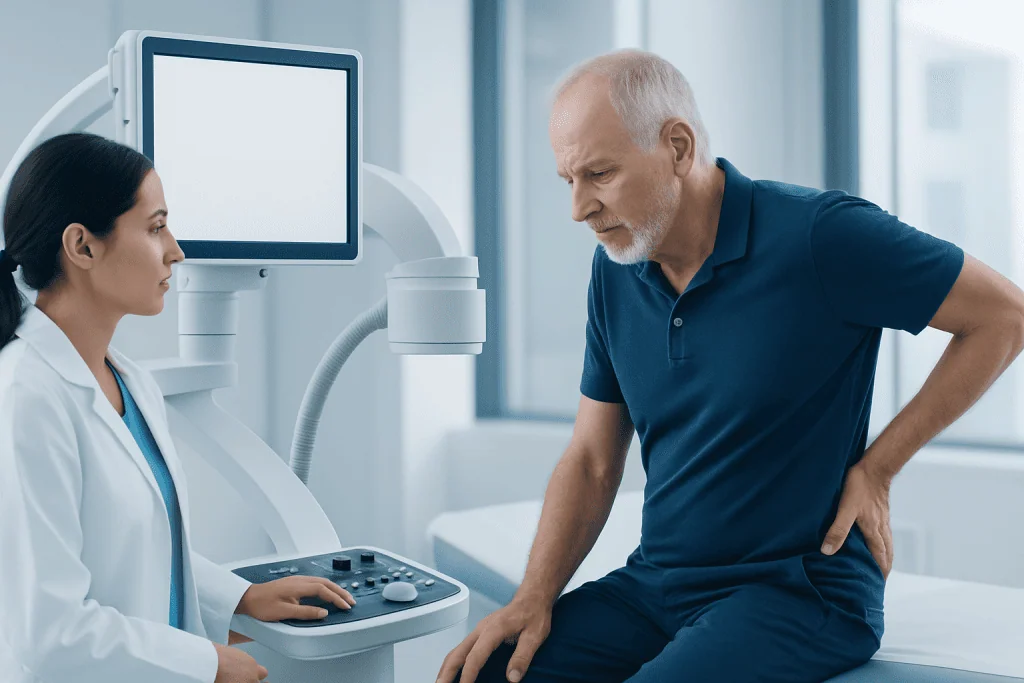
Symptoms vary from mild and occasional to persistent and limiting. Some people describe aching in the buttocks, thighs, calves, or feet. Others notice pins and needles, numbness, cramping, heaviness, or a feeling that the legs become tired quickly. Back pain may be present, but in many cases the leg symptoms are more important than the back pain.
Walking limitations are one of the main reasons people seek medical care. A person may be able to walk only a short distance before needing to sit down, bend forward, or rest. Symptoms can occur on one side or both sides, and the distance a person can walk may gradually decrease over time.
Common features of lumbar spinal stenosis include:
- Leg pain or heaviness that worsens with standing or walking
- Relief when sitting, bending forward, or lying down
- Numbness, tingling, or weakness in the legs or feet
- Difficulty walking uphill or downhill, depending on posture and spinal position
- Reduced ability to shop, travel, exercise, or stand in queues
It is important to distinguish spinal stenosis from circulation problems in the legs, hip or knee arthritis, peripheral neuropathy, and other conditions that can also limit walking. A doctor can help identify the main source of symptoms and guide appropriate treatment.
Causes and Risk Factors
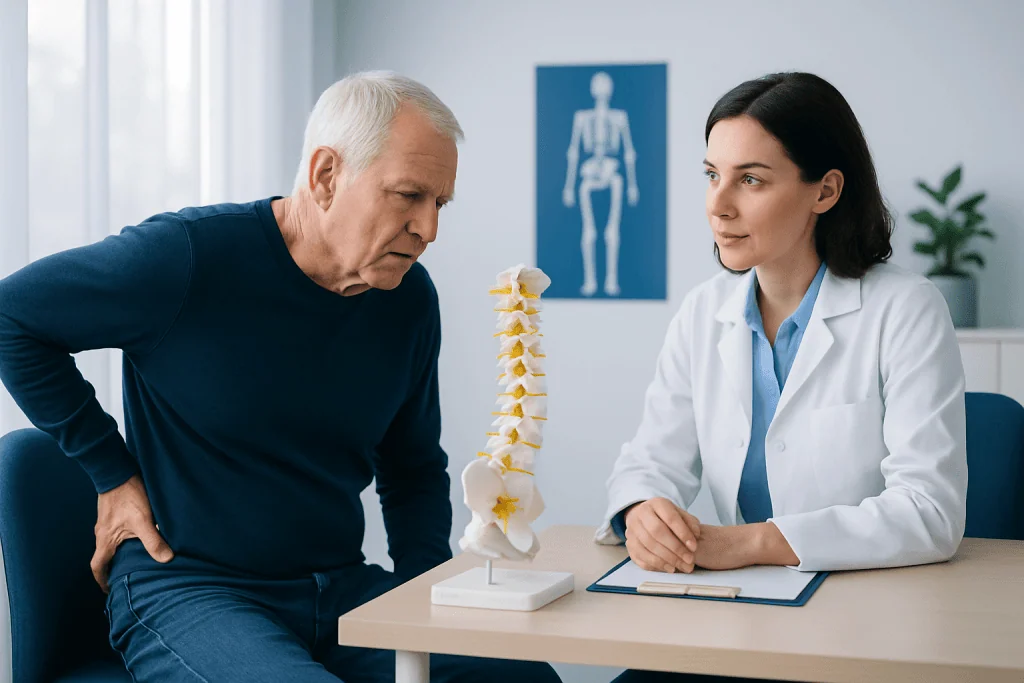
Spinal stenosis most often develops gradually. As people age, the discs between the vertebrae may lose height and bulge, the facet joints may develop osteoarthritis, and ligaments inside the spinal canal can thicken. These changes can reduce the space available for nerve roots. In some people, a small forward slip of one vertebra over another, called degenerative spondylolisthesis, contributes to narrowing.
Not every person with narrowing on an MRI has symptoms. Imaging findings must be interpreted together with the person’s history and physical examination. Some people have severe-looking stenosis but few symptoms, while others have moderate narrowing that strongly affects walking and quality of life.
Risk factors and contributors may include:
- Older age and natural degenerative changes in the spine
- Arthritis of the spine or previous spinal injury
- Congenitally narrow spinal canal, meaning a person was born with less space
- Disc herniation or bulging discs
- Degenerative spondylolisthesis or spinal instability
- Previous spine surgery or, less commonly, tumors, infection, or inflammatory disease
Maintaining strength, flexibility, and a healthy body weight may help reduce strain on the spine, but spinal stenosis is not simply caused by poor habits. Many people develop it as part of normal spinal aging.
Diagnosis
Diagnosis begins with a detailed discussion of symptoms. The doctor will ask where pain is felt, what brings it on, what relieves it, how far the person can walk, and whether there is numbness, weakness, balance change, bladder symptoms, or previous spine problems. The physical examination may include checking posture, gait, reflexes, muscle strength, sensation, hip movement, and pulses in the legs.
MRI is the most commonly used imaging test to evaluate spinal stenosis because it shows nerves, discs, ligaments, and the degree of canal narrowing. X-rays may be used to assess spinal alignment, arthritis, and possible instability, especially with standing or bending views. CT scans can be helpful when MRI is not suitable or when more detail of bone anatomy is needed.
In selected cases, additional tests may be recommended. Electromyography and nerve conduction studies can help evaluate nerve function and distinguish spinal nerve compression from peripheral neuropathy. Vascular tests may be used if leg pain could be related to reduced blood flow rather than nerve compression.
The goal of diagnosis is not only to confirm narrowing but also to determine whether the imaging findings match the symptoms. This careful matching is essential before considering procedures or surgery.
Non-Surgical Treatment Options
Many people with spinal stenosis start with non-surgical treatment, especially if symptoms are mild to moderate and there is no progressive nerve deficit. Treatment is individualized according to pain level, walking capacity, general health, and daily goals. The aim is to improve function, reduce symptoms, and support safe activity.
Physical therapy often focuses on flexion-based exercises, core and hip strengthening, stretching, posture education, and walking strategies. Some people tolerate cycling or walking with slight forward support better than upright walking. A therapist may also help improve balance and reduce fall risk.
Medication may be used to manage pain, but choices should be discussed with a doctor, especially in older adults or people with kidney, stomach, heart, or bleeding risks. Options may include simple pain relievers, anti-inflammatory medicines when appropriate, or medications for nerve-related pain. Heat, ice, pacing activities, and temporary use of a cane or walker may also help some people stay active.
Epidural steroid injections or other image-guided injections may be considered for selected patients. These injections aim to reduce inflammation around irritated nerves and may provide temporary relief, although results vary. They are generally part of a broader treatment plan rather than a permanent cure for structural narrowing.
Surgical Decisions
Surgery may be considered when spinal stenosis causes persistent leg pain, numbness, weakness, or walking limitation despite appropriate non-surgical care, or when symptoms significantly reduce independence and quality of life. Surgery may also be recommended more urgently if there is worsening weakness, severe nerve compression, or concerning neurological findings.
The most common operation for lumbar spinal stenosis is decompression, often called laminectomy or laminotomy, depending on the technique. The purpose is to remove bone, thickened ligament, or other tissue pressing on the nerves, creating more space. In some cases, minimally invasive approaches may be possible, but the best approach depends on the anatomy, number of levels involved, and surgeon assessment.
Fusion may be considered when there is spinal instability, significant deformity, or certain forms of spondylolisthesis. Fusion joins two or more vertebrae to improve stability, but it is a larger procedure than decompression alone. Not everyone with stenosis needs fusion, and the decision should be based on symptoms, imaging, alignment, stability, and patient goals.
A balanced surgical discussion includes expected benefits, limitations, recovery time, medical risks, and the possibility that symptoms may not fully disappear. Leg pain and walking tolerance often improve more reliably than long-standing numbness or weakness. Shared decision-making helps patients choose the option that best fits their health status and daily priorities.
Prevention, Self-Care, and Living Well
Spinal stenosis cannot always be prevented, but self-care can help many people manage symptoms and maintain mobility. Staying active within comfortable limits is usually better than prolonged bed rest. Low-impact activities such as stationary cycling, swimming, water exercise, or walking with rest breaks may be easier than high-impact exercise.
Good self-management often involves planning. People may choose routes with benches, use a shopping cart for support, divide tasks into shorter periods, or alternate standing activities with sitting breaks. Supportive footwear, fall-prevention measures at home, and attention to balance are especially important if leg numbness or weakness is present.
Healthy lifestyle habits can support spine and overall health. These include maintaining a suitable weight, not smoking, managing diabetes or other chronic conditions, and following a strengthening and flexibility program recommended by a healthcare professional. Because symptoms can change over time, follow-up is useful if walking distance decreases or new nerve symptoms develop.
For international patients seeking evaluation, Acibadem International’s multidisciplinary specialists and JCI-accredited hospitals diagnose and treat spinal conditions, including spinal stenosis, with coordinated orthopedic, neurosurgical, rehabilitation, and imaging support.
When to See a Doctor
A medical evaluation is recommended when leg pain, numbness, tingling, or heaviness repeatedly limits walking or standing. It is also appropriate to seek care if symptoms interfere with sleep, work, travel, exercise, or daily independence. Early assessment can clarify the diagnosis and help prevent unnecessary delays in treatment.
Prompt medical attention is important if there is new or worsening leg weakness, frequent falls, increasing numbness in the groin or saddle area, or difficulty controlling bladder or bowel function. These symptoms are uncommon but may indicate significant nerve compression that needs urgent evaluation.
People with known spinal stenosis should also return to their doctor if symptoms change suddenly, become one-sided and severe, or no longer respond to usual self-care. Decisions about injections or surgery are best made after a careful review of symptoms, examination findings, imaging, and overall health.
Frequently asked questions
What does spinal stenosis leg pain feel like?
Leg symptoms may feel like aching, cramping, heaviness, numbness, tingling, or weakness. They often worsen with standing or walking and improve when sitting or bending forward. Some people have back pain as well, but the walking-related leg symptoms are usually the main concern.
Is spinal stenosis the same as a slipped disc?
No. A slipped or herniated disc is one possible cause of nerve compression, while spinal stenosis refers to narrowing of the space around the nerves. In older adults, stenosis is often caused by a combination of disc bulging, arthritis, thickened ligaments, and bone spurs.
Can spinal stenosis improve without surgery?
Yes, many people manage symptoms with physical therapy, activity changes, medication, and sometimes injections. These treatments may not remove the narrowing, but they can reduce pain and improve function. Surgery is usually considered when symptoms remain limiting despite appropriate non-surgical care.
When is surgery recommended for spinal stenosis?
Surgery may be recommended when leg pain, numbness, weakness, or walking limits significantly affect daily life and do not improve with conservative treatment. It may also be considered sooner if there is progressive nerve weakness or other concerning neurological findings. The decision depends on symptoms, examination, imaging, general health, and personal goals.
What is the difference between decompression and fusion?
Decompression surgery aims to remove pressure from the nerves by creating more space in the spinal canal. Fusion joins two or more vertebrae to improve stability and may be added when there is instability, deformity, or certain types of vertebral slippage. Not every patient with spinal stenosis needs fusion.
Is walking good for spinal stenosis?
Walking can be helpful if it is done within comfortable limits and balanced with rest. Many people do better with short walks, slight forward support, or low-impact exercise such as cycling or swimming. If walking distance is decreasing or symptoms are worsening, a doctor or physical therapist can adjust the plan.
Can spinal stenosis cause permanent nerve damage?
Long-standing or severe nerve compression can sometimes lead to persistent numbness or weakness, even after treatment. However, many people have stable symptoms or improve with appropriate care. New weakness, bladder or bowel changes, or numbness in the saddle area should be evaluated urgently.
References
- American Academy of Orthopaedic Surgeons
- North American Spine Society
- National Institute of Neurological Disorders and Stroke
- Mayo Clinic
- NICE
This article is for general information only and is not a substitute for professional medical advice. Please consult a qualified doctor about your individual situation.
Joint and spine care in Turkey — expert assessment & treatment
JCI-accredited · board-certified surgeons · reply within 24h
Add us as a Preferred Source to see more of our trusted health content across Google Search, AI Overviews and Discover.

Orthopedics & Spine
Care for bones, joints and the musculoskeletal system, including joint replacement, sports injuries and trauma.
125 specialists in this unit