Spirometry: A Complete Medical Overview
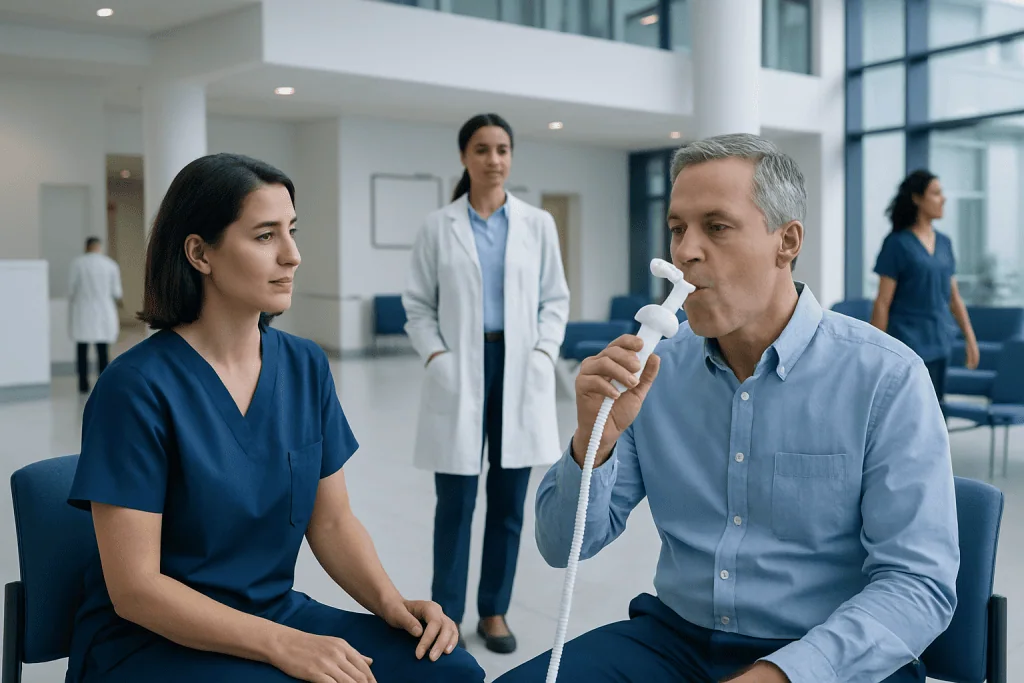
Spirometry measures airflow and lung capacity during guided breathing through a mouthpiece. It is commonly used to help diagnose and monitor asthma, COPD, and other lung conditions.
Key Takeaways
- Spirometry measures airflow and lung capacity during guided breathing through a mouthpiece.
- It is commonly used to help diagnose and monitor asthma, COPD, and other lung conditions.
- The test is usually quick, safe, and performed in an outpatient setting.
- Results are interpreted alongside symptoms, medical history, and sometimes other lung tests.
- Good preparation and effort during the test help improve the accuracy of results.
Spirometry is a simple, noninvasive breathing test used to measure how much air a person can breathe in and out, and how quickly they can exhale. It helps doctors assess lung function, diagnose common respiratory conditions, and monitor how well treatment is working over time.
Overview: what spirometry is and why it is used
Spirometry is a common lung function test that measures how well the lungs move air. During the test, a person breathes into a handheld device called a spirometer, which records how much air is inhaled and exhaled and how fast the air moves. In practical terms, spirometry helps answer a straightforward question: whether the airways and lungs are working as expected.
Doctors often use spirometry when a person has symptoms such as shortness of breath, wheezing, chest tightness, or a long-lasting cough. It is also used to monitor people who already have a diagnosed lung condition and to evaluate how they respond to treatment. Because the test is noninvasive and does not require needles or surgery, it is widely used in clinics, hospitals, and respiratory laboratories.
Unlike general descriptions that focus only on diagnosis, spirometry is also valuable as a follow-up tool. Repeating the test over time can show whether lung function is stable, improving, or declining. This makes it especially useful in long-term respiratory care, where symptoms alone do not always show the full picture.
How the test works and what it measures
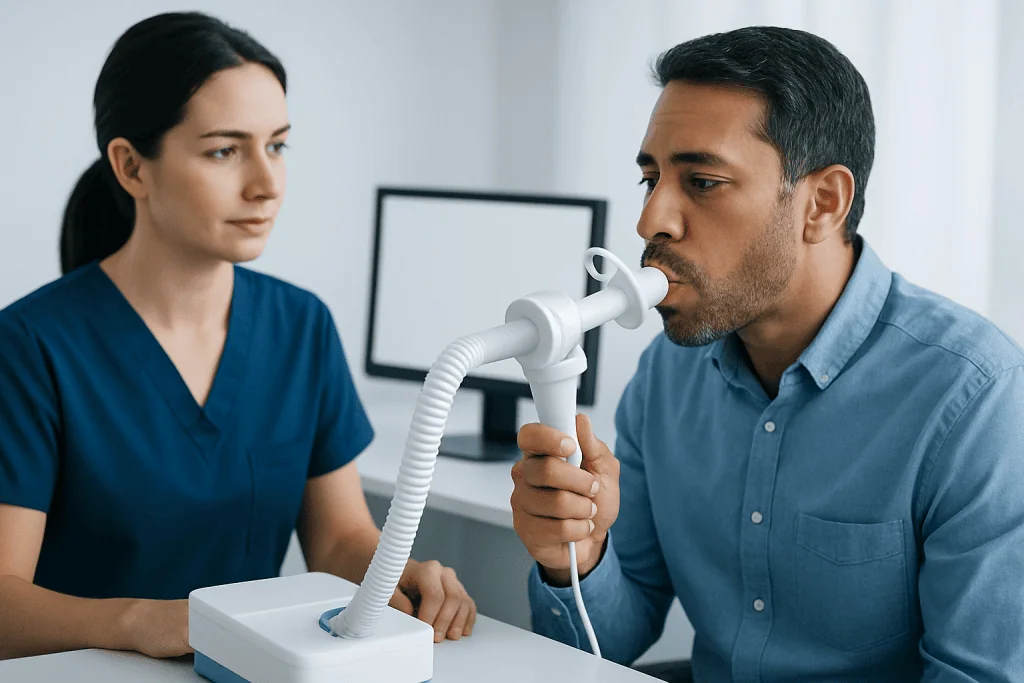
During spirometry, the person places a mouthpiece in the mouth, seals the lips around it, and follows breathing instructions given by a trained healthcare professional. The test usually includes taking a deep breath in and then blowing out as hard and as long as possible. To ensure reliable results, the maneuver may be repeated several times.
The spirometer measures several values, but two are especially important. Forced vital capacity, or FVC, is the total amount of air a person can forcefully exhale after a deep breath. Forced expiratory volume in one second, or FEV1, is the amount of air exhaled during the first second of that effort. Doctors also look at the ratio between these values to help identify patterns of airflow limitation.
These measurements can suggest whether breathing problems are more likely to be obstructive, meaning air has trouble flowing out through narrowed airways, or restrictive, meaning the lungs cannot fully expand. Spirometry alone does not always provide a final diagnosis, but it offers strong clues that guide next steps.
- Measures airflow speed and volume
- Helps compare results with expected values for age, sex, height, and ethnicity
- Can be done before and after a bronchodilator medicine to assess reversibility
- Often forms part of a broader pulmonary function evaluation
When spirometry is recommended
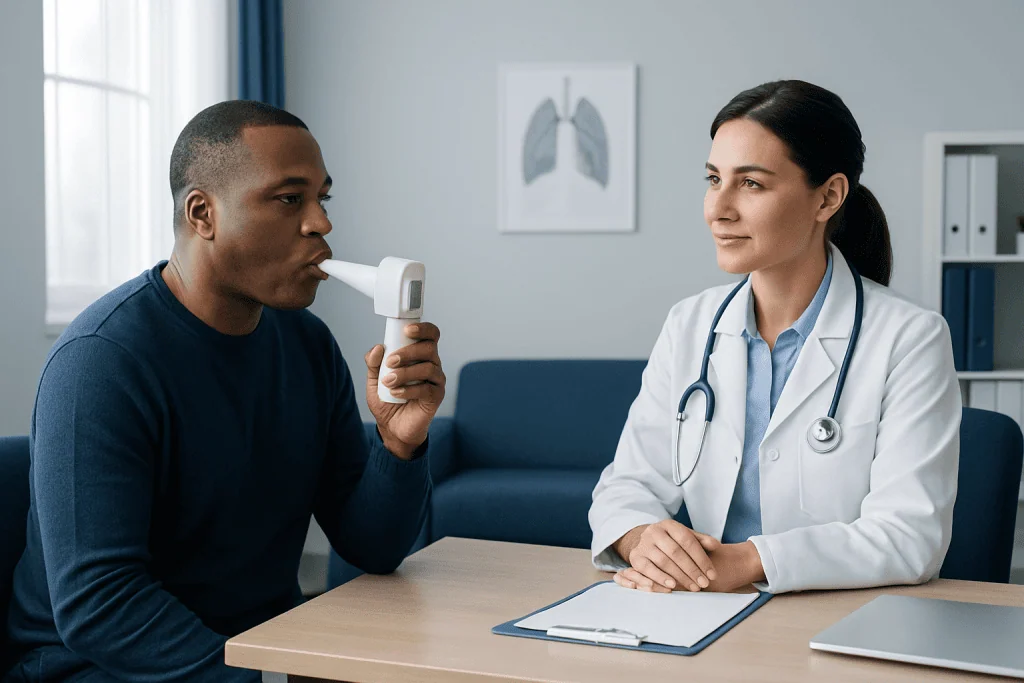
Spirometry may be recommended when a person has symptoms that suggest a lung or airway problem. These include ongoing cough, unexplained breathlessness, wheezing, reduced exercise tolerance, or chest tightness. It may also be requested after respiratory infections if symptoms do not fully settle, or before some operations to assess breathing reserve.
It is commonly used to help diagnose and monitor conditions such as asthma and COPD. In these conditions, spirometry can help confirm airflow obstruction and show whether symptoms are responding to inhaled medicines. In some cases, it is also used in occupational health for people exposed to dust, fumes, or chemicals that may affect the lungs.
Doctors may order spirometry for people who smoke or used to smoke, especially if they have chronic respiratory symptoms. It can also support evaluation in people with certain neuromuscular or chest wall conditions, although additional tests are often needed. The decision to use spirometry depends on the person’s symptoms, age, ability to perform the breathing maneuvers, and overall clinical picture.
Preparing for spirometry and what to expect on the day
Preparation instructions can vary slightly depending on why the test is being done, so it is important to follow the advice given by the healthcare team. A person may be asked to avoid smoking for several hours beforehand and to avoid heavy meals right before the test. Sometimes doctors also ask patients to pause certain inhaled medicines for a short time before testing, but this should only be done if specifically advised.
On the day of the test, it is usually best to wear comfortable clothing that does not restrict breathing. The healthcare professional may record height, weight, age, and other details because spirometry results are compared with expected values for similar individuals. A clip may be placed on the nose so all breathing goes through the mouthpiece.
The test itself is generally brief, but cooperation and effort matter. Some people feel lightheaded for a few moments after blowing out forcefully, though this usually passes quickly. If needed, the test may be repeated after inhaled medicine to see whether lung function improves, which can provide useful information in conditions such as asthma.
Understanding spirometry results
Spirometry results are not read in isolation. Doctors interpret them together with symptoms, physical examination, medical history, and sometimes chest imaging or other lung tests. A result that is lower than expected does not automatically mean a person has a serious disease, and a normal result does not always rule out every breathing condition.
One broad pattern is obstruction, where airflow out of the lungs is reduced. This can be seen in diseases that narrow or inflame the airways, such as asthma and COPD. Another pattern is restriction, where the total amount of air the lungs can hold appears reduced. Restrictive patterns may suggest problems involving lung tissue, the chest wall, or respiratory muscles, but formal confirmation often requires additional tests.
Sometimes a bronchodilator reversibility test is performed as part of spirometry. If airflow improves meaningfully after inhaled medicine, that can support the diagnosis of an airway condition with reversible narrowing. When needed, doctors may recommend further assessment such as bronchoscopy or a fuller set of lung function tests to clarify the cause of abnormal breathing patterns.
Benefits, limits, and possible risks
Spirometry offers several advantages. It is quick, widely available, and does not usually require recovery time. It provides objective measurements that can support diagnosis, guide treatment choices, and track change over time. For many patients, it helps explain symptoms that can otherwise feel vague or difficult to describe.
At the same time, spirometry has limits. The test depends on good technique and strong effort, so results may be less reliable in very young children, frail individuals, or anyone unable to follow the instructions. It may also appear normal between episodes in some people with intermittent symptoms. For that reason, doctors may combine spirometry with other investigations when the clinical picture is unclear.
Spirometry is generally safe, but it is not suitable for everyone at every moment. Forceful breathing may not be advised soon after certain surgeries, a recent heart event, severe chest pain, or some eye or abdominal procedures. The healthcare team checks for safety concerns beforehand and will postpone or modify testing if needed.
What happens after the test and treatment decisions
After spirometry, the doctor reviews the findings and explains what they may mean. If the test is normal, the next step depends on symptoms. Some people need no further testing, while others may need evaluation for conditions that do not always show clearly on standard spirometry, including exercise-related breathing problems or upper airway disorders.
If spirometry suggests an obstructive lung condition, treatment may include inhaled medicines, smoking cessation support, trigger avoidance, vaccines, and follow-up monitoring. For some people, spirometry is repeated to see whether therapy is working or whether the condition is changing. If a more structural problem is suspected, the doctor may arrange imaging such as chest X-ray or referral to a respiratory specialist.
In more complex cases, management may involve a multidisciplinary team that includes pulmonologists, radiologists, and rehabilitation specialists. Near the end of the care pathway, some international patients choose centers such as Acibadem International, where multidisciplinary specialists in JCI-accredited hospitals evaluate respiratory symptoms and plan appropriate treatment based on clinical findings.
When to seek medical care
A person should seek medical advice if they have persistent cough, ongoing wheezing, shortness of breath with normal daily activities, or chest tightness that keeps returning. Spirometry may be one of the tests a doctor uses to understand the cause. Early assessment can help identify treatable conditions and reduce the impact of symptoms on daily life.
Urgent medical attention is important if breathing difficulty is severe, sudden, or accompanied by blue lips, confusion, fainting, high fever, or chest pain. These symptoms may signal a problem that needs immediate evaluation rather than routine testing. Spirometry is not used during an acute emergency; stabilizing the person comes first.
People with known lung disease should also contact their doctor if symptoms are worsening, medicines seem less effective, or flare-ups are becoming more frequent. Regular follow-up and repeat spirometry, when appropriate, can help guide adjustments in care and support safer long-term management.
Frequently asked questions
What is spirometry used for?
Spirometry is used to measure how well the lungs move air in and out. Doctors use it to help diagnose respiratory conditions, monitor known lung disease, and assess how well treatment is working.
Is spirometry painful?
Spirometry is not usually painful. It can feel tiring because the person must take a deep breath and blow out forcefully, and some people briefly feel lightheaded afterward.
How long does a spirometry test take?
The breathing maneuvers themselves are usually completed within a short time, but the full visit may take longer because instructions and repeated efforts are needed for accuracy. If the test includes checking results before and after inhaled medicine, it may take additional time.
Can spirometry diagnose asthma?
Spirometry can strongly support the diagnosis of asthma, especially when it shows airflow limitation that improves after a bronchodilator. However, doctors also consider symptoms, history, and sometimes other tests because asthma can vary from day to day.
What should someone avoid before spirometry?
A person may be asked to avoid smoking, vigorous exercise, or a heavy meal before the test. Some inhalers may also need to be paused for a short period, but this should only be done under medical instruction.
Can spirometry be normal even if symptoms are present?
Yes. Some breathing conditions are intermittent, and lung function may appear normal between episodes. If symptoms continue despite a normal test, a doctor may recommend repeating spirometry or using other investigations.
References
- American Thoracic Society
- European Respiratory Society
- National Heart, Lung, and Blood Institute
- Centers for Disease Control and Prevention
- Global Initiative for Asthma
This article is for general information only and is not a substitute for professional medical advice. Please consult a qualified doctor about your individual situation.
Explore treatments in Turkey — costs, top hospitals & a free quote
JCI-accredited · board-certified surgeons · reply within 24h
Add us as a Preferred Source to see more of our trusted health content across Google Search, AI Overviews and Discover.

More from the Health Library



Related Specialists

Prof. Dr. Bora Peynircioğlu
Radiology
Fzt. Erdem Terzi
Physical Medicine & Rehabilitation
Dr. Ayşe Esra Sırmagül
Physical Medicine & Rehabilitation
Dr. Mehmet Arslanoğlu
Pediatrics