Spirometry Test: Measuring Lung Function and What Results Mean

Spirometry measures how much air a person can breathe out and how quickly it can be exhaled. The main results include FEV1, FVC and the FEV1/FVC ratio, which help identify obstructive or restrictive breathing patterns.
Key Takeaways
- Spirometry measures how much air a person can breathe out and how quickly it can be exhaled.
- The main results include FEV1, FVC and the FEV1/FVC ratio, which help identify obstructive or restrictive breathing patterns.
- The test is usually quick, painless and performed in a clinic, hospital or pulmonary function laboratory.
- Results must be interpreted by a qualified healthcare professional in the context of symptoms, examination and medical history.
- Spirometry can support diagnosis, monitor disease progression and assess response to inhalers or other treatments.
A spirometry test is a common, noninvasive lung function test that measures airflow and lung volume during forced breathing. It helps doctors diagnose, monitor and guide treatment for conditions such as asthma, chronic obstructive pulmonary disease and other respiratory disorders.
Overview
A spirometry test is one of the most widely used lung function tests. It measures how much air a person can breathe in and out, and how quickly air can be pushed out of the lungs. The test is especially useful when a doctor needs to evaluate wheezing, shortness of breath, chronic cough or reduced exercise tolerance.
During spirometry, the person breathes through a mouthpiece connected to a device called a spirometer. After taking a deep breath, the person blows out as hard and as long as possible. The machine records airflow and lung volume, then compares the results with expected values based on age, sex, height and ethnicity.
Spirometry is often used to help diagnose asthma, chronic obstructive pulmonary disease, known as COPD, and other conditions that affect breathing. It can also monitor how well a lung condition is controlled, whether medicines are helping, or whether lung function has changed over time.
What the Spirometry Test Measures
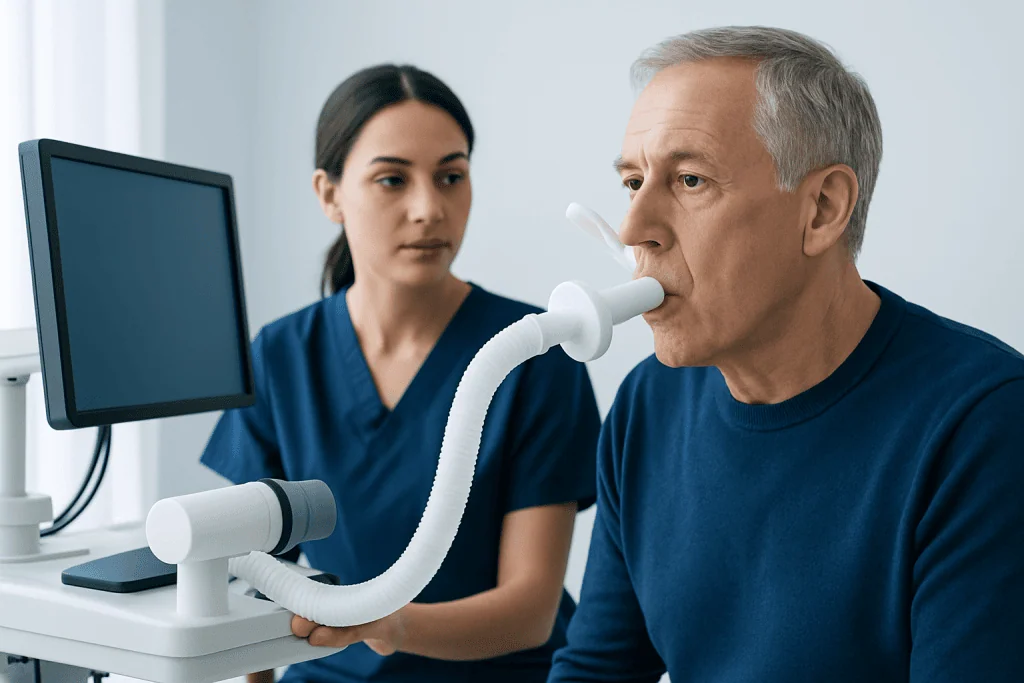
Spirometry provides several measurements, but three are especially important. Forced vital capacity, or FVC, is the total amount of air a person can forcibly breathe out after taking the deepest breath possible. Forced expiratory volume in one second, or FEV1, is the amount of air breathed out during the first second of that forced exhalation.
The FEV1/FVC ratio compares these two values and helps doctors understand the pattern of breathing limitation. In obstructive lung diseases, such as asthma or COPD, air has difficulty moving out of the lungs, so FEV1 is often reduced more than FVC. In restrictive patterns, the total amount of air the lungs can hold or move may be reduced, so FVC may be low while the ratio may be normal or high.
Some spirometry tests are performed before and after a bronchodilator, which is a medicine that helps open the airways. This is called bronchodilator reversibility testing. If lung function improves significantly after the medicine, it may suggest that airway narrowing is at least partly reversible, which is often seen in asthma.
When Spirometry Is Recommended
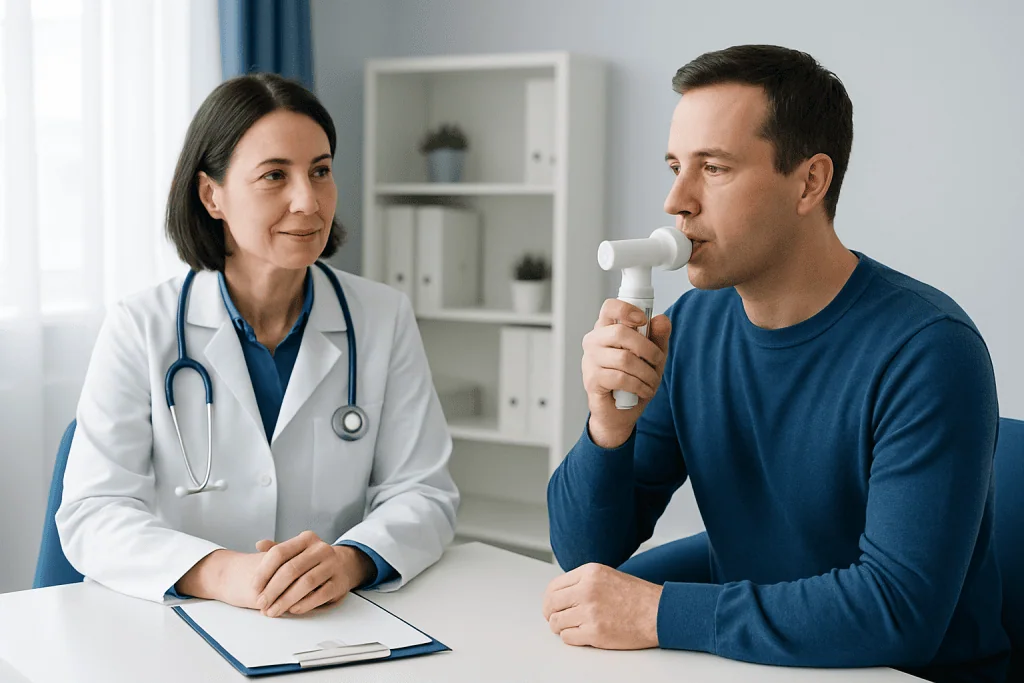
A doctor may recommend a spirometry test when symptoms suggest a breathing or airway problem. These symptoms may include repeated wheezing, persistent cough, chest tightness, breathlessness with activity, or frequent respiratory infections. Spirometry may also be used when symptoms are mild but risk factors are present, such as a history of smoking or workplace exposure to dust, fumes or chemicals.
Spirometry is commonly used in the evaluation and follow-up of several conditions, including asthma, COPD, chronic bronchitis, emphysema, bronchiectasis, pulmonary fibrosis and certain occupational lung diseases. It may also be performed before some surgeries to assess breathing capacity, especially in people with known lung disease.
The test is not only diagnostic. It can help track whether a condition is stable, improving or worsening. For example, a person with asthma may have spirometry to check whether treatment is controlling airway narrowing, while a person with COPD may have periodic testing to monitor lung function over time.
How to Prepare and What Happens During the Test
Preparation for spirometry is usually simple. The healthcare team may ask the person to avoid heavy meals, smoking, vigorous exercise or certain inhalers for a period of time before the test, depending on the reason for testing. Medicines should not be stopped unless the prescribing doctor or testing team gives clear instructions.
At the appointment, a technician or healthcare professional explains the steps and may place a soft clip on the nose so all breathing goes through the mouth. The person seals the lips around the mouthpiece, takes a full deep breath, and then blows out as hard, fast and long as possible. This may be repeated several times to make sure the results are reliable.
The test can feel tiring for a short time because it requires strong effort, but it is generally painless and does not involve needles or radiation. Some people may feel briefly lightheaded, cough, or become short of breath during repeated attempts. The testing team will provide rest breaks and will stop the test if needed.
Understanding Spirometry Results
Spirometry results are usually shown as measured values, predicted values and percentages of predicted values. Predicted values are estimated from healthy people of similar age, sex, height and background. A result that is lower than expected does not automatically confirm a specific diagnosis, but it gives important clues about how the lungs are functioning.
An obstructive pattern means airflow out of the lungs is reduced. This is often reflected by a low FEV1/FVC ratio and may be seen in asthma, COPD or other airway diseases. A restrictive pattern suggests reduced lung volume and may appear as a low FVC with a relatively preserved FEV1/FVC ratio, but full pulmonary function testing is often needed to confirm true restriction.
Results can also be described by severity, often based on how reduced the FEV1 is compared with the predicted value. However, severity on spirometry is only one part of the overall picture. Symptoms, flare-ups, oxygen levels, imaging tests, physical examination and the person’s daily functioning all help determine the most appropriate care plan.
- FEV1: air exhaled in the first second of a forceful breath out.
- FVC: total air exhaled forcefully after a full breath in.
- FEV1/FVC ratio: comparison used to identify airflow obstruction.
- Bronchodilator response: change in results after an airway-opening medicine.
Accuracy, Safety and Limitations
Spirometry is most useful when the person understands the instructions and gives a strong, consistent effort. Because the test depends on cooperation, results may be affected by coughing, air leaking around the mouthpiece, stopping too soon, pain, fatigue or difficulty following instructions. For this reason, several attempts are usually performed and only acceptable, repeatable results are used.
The test is very safe for most people, but it may not be suitable immediately after certain medical events or procedures. A doctor may delay spirometry after a recent heart attack, stroke, chest or abdominal surgery, eye surgery, a collapsed lung, or if the person has severe uncontrolled breathing distress. People who are pregnant or who have heart conditions can often still be tested, but the healthcare team should be informed beforehand.
Spirometry does not show everything about lung health. It does not directly measure oxygen transfer in the lungs, lung tissue scarring, blood clots or all causes of breathlessness. If results are unclear or symptoms continue, doctors may recommend additional tests such as chest imaging, full pulmonary function tests, allergy evaluation, exercise testing or blood oxygen assessment.
Treatment Decisions and Follow-Up
Spirometry results help guide treatment, but they are not treated in isolation. If asthma is suspected, a doctor may consider inhaled medicines, trigger avoidance and an action plan based on symptoms and test results. If COPD is diagnosed, care may include smoking cessation support, inhalers, vaccination guidance, pulmonary rehabilitation, exercise planning and management of flare-ups.
Follow-up spirometry may be used to check whether treatment is working or whether lung function is changing. The timing depends on the diagnosis and the person’s condition. Some patients need repeat testing after starting or adjusting medication, while others may have periodic monitoring as part of long-term respiratory care.
Healthy self-care can support lung function and overall wellbeing. People are encouraged not to smoke, to avoid secondhand smoke, to use prescribed inhalers correctly, to stay physically active as advised, and to keep vaccinations up to date when recommended. Occupational exposures should be discussed with a doctor, especially if symptoms improve away from work.
A person should seek medical advice if breathlessness is new, worsening, interfering with daily activities, or accompanied by chest pain, fainting, blue lips, coughing blood or severe wheezing. Acibadem International’s multidisciplinary specialists and JCI-accredited hospitals diagnose and treat respiratory conditions for international patients, including those who need lung function testing and coordinated follow-up care.
Frequently asked questions
Is a spirometry test painful?
No. Spirometry is a noninvasive and generally painless test. It requires strong breathing effort, so some people may cough, feel briefly lightheaded or become tired, but these effects usually pass quickly.
How long does spirometry take?
The breathing part of the test usually takes only a few minutes, but the full appointment may take longer because instructions, repeated attempts and possible bronchodilator testing are included. If a medicine is given to open the airways, the team may wait before repeating the test.
Can spirometry diagnose asthma?
Spirometry can strongly support an asthma diagnosis when it shows airflow obstruction that improves after a bronchodilator. However, asthma symptoms can vary, and some people have normal spirometry between episodes. A doctor may use additional tests and the medical history before confirming the diagnosis.
What does a low FEV1 mean?
A low FEV1 means the person exhaled less air than expected in the first second of a forceful breath out. This may happen with obstructive lung diseases such as asthma or COPD, but interpretation depends on the FVC, the FEV1/FVC ratio and the clinical situation.
Should inhalers be stopped before spirometry?
Some inhalers may need to be avoided for a specific period before testing, especially if the doctor wants to measure baseline lung function. This should only be done according to instructions from the healthcare team. Patients should not stop prescribed medicines on their own.
What happens if spirometry results are abnormal?
Abnormal results do not always mean a serious problem, but they should be reviewed by a qualified healthcare professional. The doctor may compare results with symptoms, examination findings and previous tests. Further evaluation or treatment may be recommended depending on the pattern and severity.
References
- American Thoracic Society
- European Respiratory Society
- Global Initiative for Asthma
- Global Initiative for Chronic Obstructive Lung Disease
- National Heart, Lung, and Blood Institute
This article is for general information only and is not a substitute for professional medical advice. Please consult a qualified doctor about your individual situation.
Explore treatments in Turkey — costs, top hospitals & a free quote
JCI-accredited · board-certified surgeons · reply within 24h
Add us as a Preferred Source to see more of our trusted health content across Google Search, AI Overviews and Discover.