Squats with Resistance Bands — Explained by Medical Evidence, Not Myths

Resistance bands can add load or provide movement feedback during squats, but they do not replace correct squat technique. Banded squats mainly work the quadriceps, gluteal muscles, hamstrings, and stabilizing muscles around the hips and trunk.
Key Takeaways
- Resistance bands can add load or provide movement feedback during squats, but they do not replace correct squat technique.
- Banded squats mainly work the quadriceps, gluteal muscles, hamstrings, and stabilizing muscles around the hips and trunk.
- A band around the thighs may encourage awareness of knee alignment, but it should not be used to force the knees outward.
- Progress gradually by improving form, range of motion, repetitions, resistance, or external load—rather than changing everything at once.
- Pain, swelling, joint instability, or new neurologic symptoms during exercise should be assessed by a qualified clinician.
Squats with resistance bands are a practical form of strength exercise that can train the thigh, hip, and trunk muscles with portable equipment. The benefits depend less on the band itself than on sound technique, suitable resistance, regular practice, and an exercise plan tailored to the individual’s health and goals.
What are squats with resistance bands?
Squats with resistance bands are squatting exercises performed while an elastic band adds resistance, assistance, or a movement cue. They can be an effective way to strengthen the lower body at home, in a gym, or during rehabilitation when the resistance is appropriate and the movement is comfortable. The most useful version is not necessarily the one that feels hardest; it is the one that allows controlled, repeatable movement with good alignment.
Two common setups have different purposes. In a band-under-the-feet squat, the band runs from under the feet to the shoulders or hands, adding resistance as the person stands up. In a loop-band squat, a small band is placed around the thighs, usually just above the knees, to increase demand on hip muscles and provide feedback about leg position. A long band anchored overhead can also assist a squat by helping balance or reducing the load on the legs.
Medical evidence supports resistance training as part of a general physical-activity plan for improving muscle strength and physical function. However, there is no evidence that bands make a squat inherently safer or “activate” one muscle in a way that eliminates the need for technique, sensible training volume, and recovery. Bands are tools, not corrective devices.
How banded squats affect the body
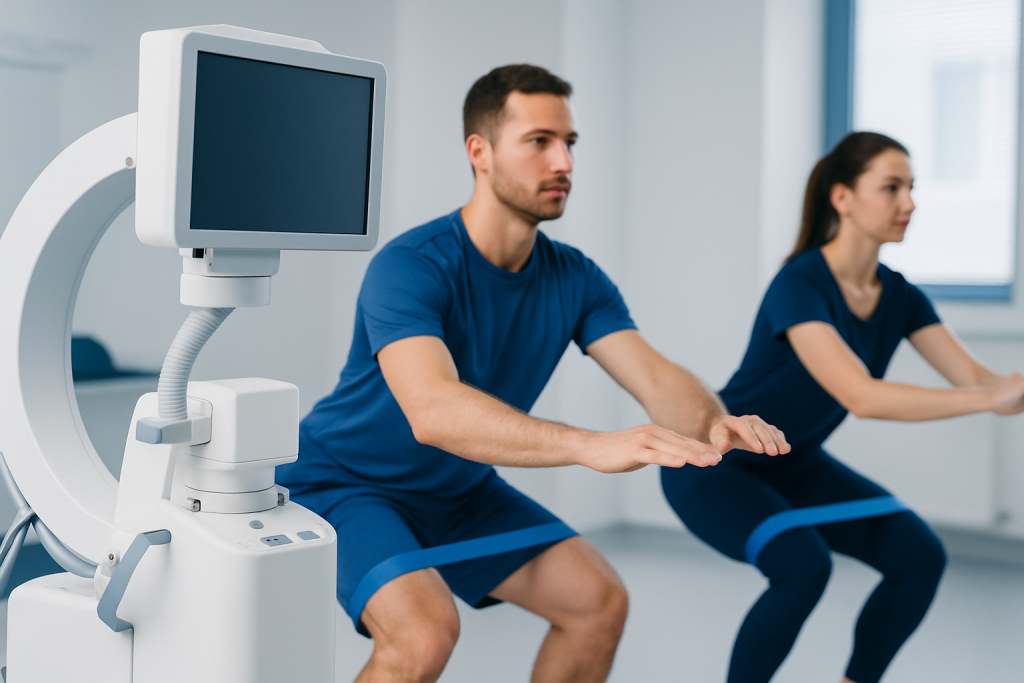
A squat is a multi-joint movement. As the hips, knees, and ankles bend, the quadriceps at the front of the thigh help control the descent and straighten the knees on the way up. The gluteal muscles help extend the hip, while the hamstrings, calf muscles, abdominal muscles, and back muscles contribute to stability. The exact effort shared among these muscles changes with squat depth, stance, torso position, load placement, and individual anatomy.
With a loop band around the thighs, the hip muscles that move the thigh outward and help control pelvic and knee position must work against the band’s inward pull. This may increase demand on some hip muscles, especially when the person maintains steady alignment. It does not mean that the knees should be pushed as far outward as possible. For most people, knees should generally track in the same direction as the toes, without collapsing inward or being forced excessively outward.
A band placed under the feet typically provides variable resistance: tension rises as the band is stretched during the standing phase. This can make the top portion of the squat feel more challenging. Because band tension varies by product, length, and setup, it is harder to measure precisely than a barbell or machine load. This is acceptable for general fitness, provided progression is gradual and the band is checked for damage.
Potential benefits and common myths

For many adults, squats with resistance bands can help build or maintain lower-body strength, support daily tasks such as rising from a chair or climbing stairs, and add variety to an exercise routine. Bands are lightweight, relatively inexpensive, and adaptable to different environments. They can be especially useful for people who prefer a lower-equipment training option or who are learning to tolerate resistance exercise before advancing to heavier loads.
One common myth is that a loop band automatically prevents knee pain or knee injury. A band may help some people notice when their knees drift inward, but pain has many possible causes and is not solved by a single equipment choice. Another myth is that deeper is always better. A useful squat depth is one that can be controlled without pain and that matches the person’s mobility, goals, and clinician or trainer guidance.
There is also no universally correct foot width, toe angle, or band placement. A shoulder-width stance with toes pointed slightly outward is comfortable for many people, but normal anatomy varies. The most important principles are stable foot contact, smooth movement, comfortable joint positions, and a resistance level that does not compromise form. People with ongoing knee, hip, back, or balance concerns may benefit from individualized guidance.
How to perform a resistance band squat safely
Before starting, choose a clear area, supportive footwear if needed, and a band without cracks, thinning, tears, or frayed sections. For a loop-band squat, place the band above the knees unless a clinician or exercise professional recommends another position. Stand with the feet about hip- to shoulder-width apart. Keep the whole foot in contact with the floor, including the heel and the base of the big and little toes.
Begin by gently bracing the abdominal muscles, then sit the hips back and bend the knees together. Keep the chest comfortably lifted rather than excessively upright, and allow the knees to travel in the direction of the toes. Lower only as far as is comfortable and controlled. Exhale as the person presses through the feet to stand, keeping the knees aligned with the toes rather than letting the band pull them inward.
For a band-under-the-feet variation, stand on the center of a long band with even tension on both sides. Hold the ends securely at shoulder level or according to the band design, then perform the same controlled squat. The band should not pull the shoulders forward, snap against the skin, or alter balance. It is often best to begin with body-weight squats, a chair squat, or an assisted version before adding resistance.
- Move slowly enough to maintain control during both the descent and ascent.
- Stop the set when posture, balance, or knee alignment cannot be maintained.
- Avoid holding the breath for prolonged periods, particularly in people with cardiovascular disease or uncontrolled high blood pressure.
- Rest between sets and allow recovery days for muscles that are new to resistance training.
Choosing resistance and progressing appropriately
The appropriate band creates a noticeable challenge while allowing the person to complete repetitions with stable, pain-free technique. Color labels are not standardized: a “medium” band from one manufacturer may differ substantially from another. Starting with a lighter band is usually safer, particularly for beginners, older adults, and anyone returning to exercise after illness, injury, or a long break.
Progression should be gradual. A person may first improve consistency and movement quality, then add repetitions or sets, use a slightly stronger band, increase squat depth if comfortable, or add an external load under professional guidance. Changing only one feature at a time makes it easier to identify what the body tolerates well. Exercise-induced muscle tiredness and mild soreness that improves over several days can be normal, whereas sharp pain or worsening joint symptoms are not a training target.
Frequency depends on overall activity, recovery, age, health conditions, and other training. General physical-activity guidance includes muscle-strengthening exercise on at least two days per week, but individual programs vary. People with osteoporosis, arthritis, recent surgery, pregnancy-related concerns, heart or lung disease, or neurological conditions should ask a healthcare professional which squat variation and training intensity are suitable for them.
Adapting squats for comfort, mobility, and goals
Not everyone needs to perform a full free-standing squat. A chair squat, in which the person lightly reaches toward a chair and stands again, can establish confidence and a consistent depth. Holding a stable support or using a securely anchored band for assistance can reduce balance demands. These options may be helpful for people with reduced mobility, fear of falling, or early-stage return to activity, provided the setup is stable.
If the knees are uncomfortable, reducing squat depth, slowing the movement, lowering resistance, or using a chair may help while the cause is assessed. Hip discomfort may improve with a different stance width or toe angle, but persistent symptoms deserve professional evaluation. Back discomfort can occur when the spine is rounded or excessively arched under load; reducing resistance and practicing a smaller, well-controlled range can be sensible initial adjustments.
For general fitness, banded squats should be one part of a balanced routine that also includes aerobic activity, exercises for the upper body and trunk, and flexibility or mobility work where appropriate. Adequate sleep, nutrition, and rest support training adaptation. A qualified physiotherapist or exercise professional can help tailor movement choices to a specific injury history, functional goal, or sport.
When to seek medical care
Medical assessment is advisable for new or persistent knee, hip, back, or ankle pain that occurs during squats or does not settle with rest and activity modification. A person should stop exercising and seek prompt care for major swelling, visible deformity, inability to bear weight, a joint that locks or gives way, sudden weakness, numbness, or pain after a fall or other injury. Chest pain, severe shortness of breath, fainting, or unusual palpitations during exercise also require urgent medical attention.
People with a known musculoskeletal condition, recent operation, joint replacement, fracture, or inflammatory arthritis should ask their treating team before beginning or substantially progressing resistance exercise. Individual guidance can help distinguish normal training sensations from symptoms that need investigation. Acibadem International’s multidisciplinary specialists and JCI-accredited hospitals can assess musculoskeletal concerns and support individualized rehabilitation planning for international patients.
For most healthy people, discomfort-free banded squats performed with controlled form can be a reasonable component of strength training. The safest approach is to start within current ability, progress patiently, and treat pain or loss of control as useful signals to pause and reassess rather than to push through.
Frequently asked questions
Are squats with resistance bands effective?
They can be effective for strengthening the lower body when performed regularly with enough resistance to challenge the muscles. The results depend on the individual’s form, training frequency, recovery, nutrition, and overall exercise plan. Bands are a useful option, but not the only effective way to train the squat pattern.
Where should a resistance band go for squats?
A loop band is commonly placed just above the knees to provide hip-muscle resistance and feedback about leg alignment. A long band may be placed under the feet and held near the shoulders or in the hands to add resistance during standing. The safest placement depends on the band design and the person’s balance and mobility.
Should the knees go out during banded squats?
The knees should generally track in the same direction as the toes. A loop band should not lead someone to force the knees far outward, as this may be uncomfortable and does not suit every body. The goal is controlled alignment rather than an exaggerated position.
Can resistance band squats help with knee pain?
They may be tolerable for some people, especially when resistance and depth are adjusted, but they are not a universal treatment for knee pain. Knee pain can arise from many structures and conditions. Persistent, worsening, or swelling-associated pain should be evaluated by a healthcare professional.
How often can a person do squats with resistance bands?
Many people include lower-body strengthening on two or more nonconsecutive days each week, allowing time for recovery. The ideal schedule varies with fitness level, band resistance, total exercise volume, and health status. Muscles that remain very sore or fatigued may need additional recovery time.
Are banded squats safe for beginners?
They can be safe for beginners when the band is light, the equipment is undamaged, and the movement is learned gradually. Starting with a body-weight chair squat or supported squat can make technique and balance easier to manage. Anyone with significant joint pain, recent injury, or a chronic medical condition should seek personalized advice before starting.
References
- World Health Organization
- American College of Sports Medicine
- Centers for Disease Control and Prevention
- National Institute of Arthritis and Musculoskeletal and Skin Diseases
This article is for general information only and is not a substitute for professional medical advice. Please consult a qualified doctor about your individual situation.
Explore treatments in Turkey — costs, top hospitals & a free quote
JCI-accredited · board-certified surgeons · reply within 24h
Add us as a Preferred Source to see more of our trusted health content across Google Search, AI Overviews and Discover.

More from the Health Library



Related Specialists

Dr. Lütfullah Çakır
Emergency Service
Fzt. Merve Güvendi
Physical Medicine & Rehabilitation
Prof. Dr. Behice Kurtaran
Infectious Diseases & Clinical Microbiology
Dr. Melahat Yeni
Pediatrics