W Sitting: An Evidence-Based Guide for Patients

W sitting is common in young children and may reflect comfort, flexibility, or a preference for a wider base of support. By itself, W sitting does not always mean a child has a medical condition.
Key Takeaways
- W sitting is common in young children and may reflect comfort, flexibility, or a preference for a wider base of support.
- By itself, W sitting does not always mean a child has a medical condition.
- Assessment is more important if W sitting is frequent and occurs with pain, tripping, clumsiness, toe walking, or delayed gross motor development.
- Doctors and therapists look at the whole child, including posture, hip rotation, muscle tone, strength, coordination, and walking pattern.
- Treatment, when needed, focuses on the underlying issue rather than the sitting position alone.
- Parents can encourage varied sitting positions and active play without making the child feel blamed or anxious.
W sitting is a floor-sitting position in which a child sits with bent knees and feet placed outside the hips, forming a “W” shape. It is often seen in toddlers and young children, and while it is not automatically a sign of a problem, persistent W sitting together with pain, weakness, poor balance, or delayed motor skills may deserve medical evaluation.
What W Sitting Means
W sitting describes a position in which a child sits on the floor with the knees bent, legs turned outward, and feet placed on either side of the hips. From above, the legs resemble the shape of the letter W. Many children move in and out of this posture during play, especially in the toddler and preschool years.
In many cases, W sitting happens because the position feels stable and effortless. It gives a broad base of support, which may make it easier for some children to play with both hands while staying upright. Some children also naturally have more inward hip rotation or generalized flexibility, which can make this posture feel more comfortable than cross-legged sitting.
Importantly, W sitting is not automatically harmful and does not always require treatment. The main question is not whether a child ever uses this position, but whether it is frequent, difficult to change, or linked with other concerns such as pain, unusual posture, poor balance, weakness, or delayed motor milestones.
Why Some Children Prefer W Sitting
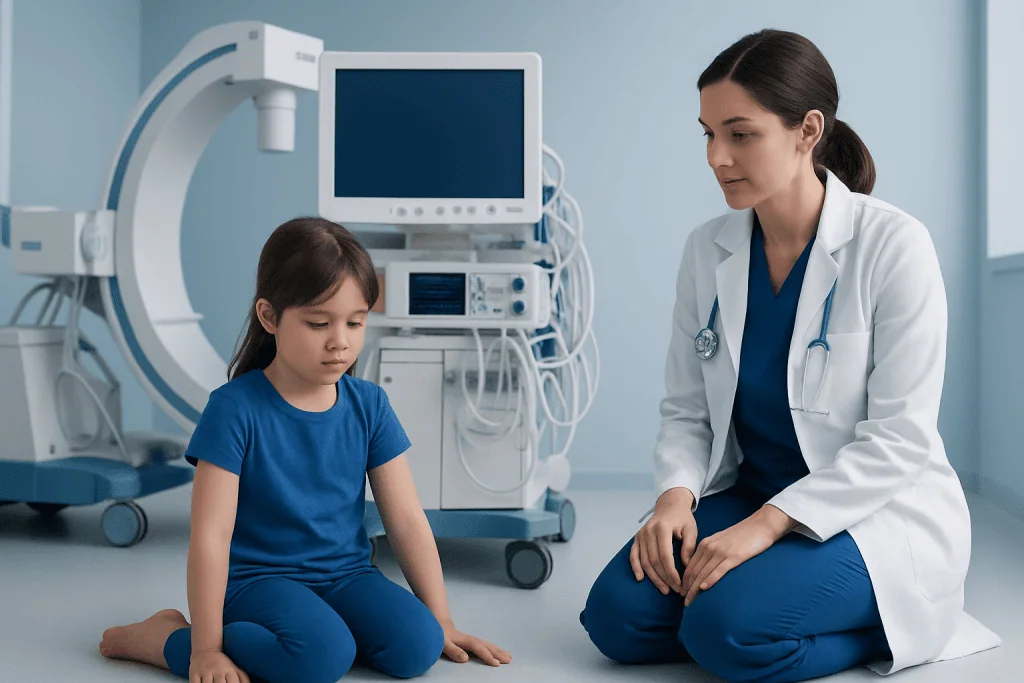
Children may prefer W sitting for several practical reasons. The position reduces the need for core muscle control and balance because the legs create a wide, supportive base. For a child who tires easily when sitting upright, this may feel easier than kneeling, side-sitting, or sitting cross-legged.
Body structure and movement patterns also play a role. Some children have increased internal rotation at the hips, femoral anteversion, ligamentous laxity, or lower muscle tone. These features can make W sitting feel natural. In some children, it is simply one of several positions they use during play and does not cause any functional problem.
At the same time, a strong preference for W sitting may sometimes be a clue that a child is compensating for something else, such as trunk weakness, coordination difficulty, tightness in certain muscle groups, or challenges with postural control. This is why clinicians look at the full pattern of movement rather than judging the sitting posture in isolation.
W sitting can also be seen in children who have broader orthopedic or neurologic concerns, although it is not diagnostic on its own. Depending on the child’s overall symptoms, a doctor may consider whether there is a related issue such as cerebral palsy or a musculoskeletal alignment concern affecting gait and posture.
When W Sitting May Be a Concern

The posture itself is more likely to matter when it is frequent, persistent, and hard for the child to change, especially after the preschool years. A child who almost always sits this way and avoids other positions may benefit from evaluation if there are signs that balance, coordination, or muscle control are affecting daily function.
Parents and caregivers may wish to pay attention if W sitting appears together with any of the following:
- pain in the hips, knees, or ankles
- frequent tripping, falling, or clumsiness
- toe walking or unusual walking pattern
- difficulty running, jumping, climbing, or keeping up with peers
- poor core strength or slumped posture
- one-sided preference, asymmetry, or limited range of motion
- delayed gross motor milestones
Some older warnings about W sitting suggest it directly causes hip damage or major orthopedic problems in otherwise healthy children. Current clinical thinking is more cautious and individualized. There is not strong evidence that occasional W sitting alone causes harm in every child, but frequent use may reinforce less efficient movement patterns in children who already have weakness, tightness, instability, or developmental differences.
How Doctors and Therapists Assess It
Evaluation starts with a medical history and observation. A clinician may ask when the child first started using W sitting, how often it happens, whether there is pain or fatigue, and whether there are concerns about walking, running, coordination, or development. Parents may also be asked about birth history, family history, and any previous orthopedic or neurologic diagnoses.
The physical examination usually includes hip range of motion, leg alignment, muscle tone, strength, reflexes, balance, and posture. The clinician may watch the child move between positions, stand up from the floor, walk, run, squat, and climb. This helps show whether W sitting is simply a preferred posture or part of a wider movement pattern.
In some cases, the child may be referred for pediatric orthopedic, neurologic, or rehabilitation assessment. If there are gait concerns, weakness, or asymmetry, the care team may recommend gait analysis or a structured rehabilitation assessment. If the child has clear developmental or movement concerns, supportive therapies such as physical therapy and rehabilitation may be considered based on the findings.
Imaging is not needed for every child who W sits. X-rays or other tests are generally reserved for situations in which there is pain, injury, significant asymmetry, reduced joint motion, suspicion of hip pathology, or a condition that requires closer orthopedic evaluation.
Treatment and Supportive Management
When treatment is needed, the goal is not simply to stop W sitting at all costs. The main aim is to address the underlying reason the child prefers the position. For example, if the child has low core strength, poor postural control, or balance difficulty, therapy may focus on strengthening, coordination, and movement variety. If there is tightness, asymmetry, or an orthopedic issue, management is tailored accordingly.
Physical therapy may include play-based activities that build trunk strength, hip stability, balance, and transitions between sitting, kneeling, squatting, and standing. Therapists often teach families how to encourage alternative sitting positions such as side-sitting, long-sitting, cross-legged sitting, or kneeling, depending on the child’s abilities and comfort. The approach is usually gradual and positive, not punitive.
For children with associated orthopedic concerns, management may involve pediatric orthopedics or rehabilitation specialists. Some children need only monitoring and home strategies, while others benefit from more structured care, especially if there is a diagnosis such as developmental dysplasia of the hip or a neurologic condition affecting tone and movement.
In selected cases with broader mobility issues, families may be guided toward comprehensive pediatric rehabilitation services. Near the end of the care journey, families may also seek multidisciplinary evaluation; Acibadem International’s JCI-accredited hospitals care for international patients with orthopedic, neurologic, and rehabilitation needs related to child movement and posture.
What Parents Can Do at Home
At home, the most helpful strategy is usually gentle redirection rather than repeated correction. If a child settles into W sitting, a caregiver can calmly suggest another comfortable position and model it during play. The goal is to increase movement variety, not to make the child feel that something is wrong every time they sit on the floor.
Active play can support better posture and motor control. Activities such as crawling through tunnels, climbing, obstacle courses, balance games, squatting to pick up toys, kneeling at a low table, and supervised playground play can help strengthen core and hip muscles naturally. Fine motor play at a small table may also reduce time spent in floor positions that the child overuses.
It can be useful to watch for patterns. If W sitting appears mostly when the child is tired, concentrating, or sitting for longer periods, offering movement breaks and different seating options may help. Parents should avoid forceful stretching or trying to hold the child in a corrected position if this causes distress or pain.
A simple home approach often includes:
- encouraging several sitting positions during play
- supporting active play that builds balance and trunk strength
- noting any pain, asymmetry, or frequent falls
- seeking professional advice if concerns continue or increase
When to Seek Medical Care
Medical advice is appropriate if W sitting is persistent and is accompanied by other symptoms or developmental concerns. Examples include pain, limping, stiffness, one-sided movement, frequent falls, toe walking, delayed milestones, or a walking pattern that seems unusual for the child’s age. An assessment is also reasonable if caregivers are unsure whether the child’s flexibility, posture, or motor development is within a typical range.
Urgent care is needed if a child has sudden pain, cannot bear weight, develops a new limp, or has W sitting together with acute injury or fever. These situations may point to a problem that is unrelated to the sitting posture itself and should not be ignored.
Most cases are not emergencies. However, early evaluation can be helpful when a child repeatedly relies on W sitting because it may identify treatable issues sooner and reassure families when no significant problem is present.
Frequently asked questions
Is W sitting always bad for children?
No. Many young children use W sitting at times, and by itself it does not automatically mean there is a health problem. Concern is greater when the position is frequent and comes with pain, weakness, poor balance, delayed motor skills, or difficulty using other sitting positions.
At what age is W sitting most common?
W sitting is most often seen in toddlers and preschool-aged children. Many children naturally change positions often as they grow and gain strength, balance, and coordination.
Can W sitting cause hip problems?
Occasional W sitting alone does not necessarily cause hip damage in an otherwise healthy child. However, if a child already has an orthopedic or neuromuscular issue, frequent W sitting may reflect or reinforce movement patterns that deserve medical attention.
How can parents discourage W sitting without upsetting the child?
A gentle approach usually works best. Parents can calmly suggest another position, such as cross-legged or side-sitting, and encourage active play that builds core strength and balance rather than repeatedly scolding the child.
Does W sitting mean a child has autism or cerebral palsy?
No. W sitting alone does not diagnose autism, cerebral palsy, or any other condition. It can be seen in children with and without developmental or neurologic differences, so the full clinical picture matters more than the posture itself.
When should a child with W sitting see a doctor or therapist?
Evaluation is sensible if W sitting is constant, hard to change, or linked with pain, limping, frequent falls, toe walking, weakness, asymmetry, or developmental delay. A doctor or therapist can determine whether the child simply prefers the position or has an underlying issue that needs support.
References
- American Academy of Pediatrics
- American Academy of Orthopaedic Surgeons
- National Institute of Neurological Disorders and Stroke
- American Physical Therapy Association
- MedlinePlus
This article is for general information only and is not a substitute for professional medical advice. Please consult a qualified doctor about your individual situation.
Joint and spine care in Turkey — expert assessment & treatment
JCI-accredited · board-certified surgeons · reply within 24h
Add us as a Preferred Source to see more of our trusted health content across Google Search, AI Overviews and Discover.

More from the Health Library
Burning Sensation in Back: An Evidence-Based Guide for Patients

Frog Pose: A Complete Medical Overview
Nail Clubbing: A Complete Medical Overview

Rhus Toxicodendron — Explained by Medical Evidence, Not Myths

Castrated: An Evidence-Based Guide for Patients