What Do Kidney Stones Look Like? Here Is What the Evidence Says

Kidney stones can look like sand, crystals, or small pebbles, but many are too small to notice. Their color may range from yellow or tan to brown, and some may appear pink or red if blood is present.
Key Takeaways
- Kidney stones can look like sand, crystals, or small pebbles, but many are too small to notice.
- Their color may range from yellow or tan to brown, and some may appear pink or red if blood is present.
- Severe side pain, nausea, burning urination, fever, or trouble passing urine should be medically assessed.
- Doctors usually diagnose kidney stones with a history, urine tests, blood tests, and imaging such as ultrasound or CT.
- Hydration, dietary changes, and targeted treatment can help with both symptom relief and prevention.
Kidney stones may look like tiny grains of sand, small jagged crystals, or pebble-like fragments in the urine, often yellow, brown, tan, or occasionally reddish. In many cases, however, a person never sees the stone at all, and doctors confirm it through symptoms, urine testing, and imaging.
Overview: what kidney stones may look like
For many people, kidney stones are harmless once they pass, and the main question is simply what they looked like. The short answer is that kidney stones may appear as tiny sand-like grains, sharp crystals, or small pebble-shaped pieces in the urine. Their color is often yellow, tan, or brown, although some look white or orange, and some may appear pink or red if they are mixed with blood.
It is also very common not to see a stone at all. Some stones are extremely small, pass quickly, or break into fragments that are easy to miss. Others stay in the kidney or ureter and cause symptoms without ever becoming visible in the toilet, on toilet paper, or in a urine strainer.
The appearance of a stone does not reliably show how serious it is. A tiny stone can cause significant pain if it blocks urine flow, while a larger stone may remain unnoticed for some time. That is why doctors focus not just on what a stone looks like, but also on symptoms, urine findings, and imaging results.
How kidney stones can vary in size, color, and texture

Kidney stones do not all look the same. Some are as small as grains of salt or sand. Others are more like rough flakes, jagged chips, or small rounded pebbles. When passed, they may look smooth, spiky, glassy, chalky, or crystal-like depending on the minerals they contain and how they formed.
Color can vary as well. Many stones are yellow-brown or tan. Some appear darker brown. Others may seem pale cream or off-white. If a stone has irritated the urinary tract, traces of blood can make urine look pink, red, or tea-colored, and the stone fragment itself may have red staining.
Common descriptions people give include:
- Sand-like particles at the bottom of the toilet or urine cup
- Tiny glittering crystals
- Small rough pebbles
- Sharp-edged fragments
- Soft-looking but firm chalky bits
Even so, it is important not to try to identify a stone by appearance alone. Other material in urine, such as blood clots, tissue, mucus, or crystals related to dehydration, can sometimes look similar. If a person catches a suspected stone, a doctor may ask for it to be analyzed in a laboratory to determine its type.
What a person may notice when a stone is passing
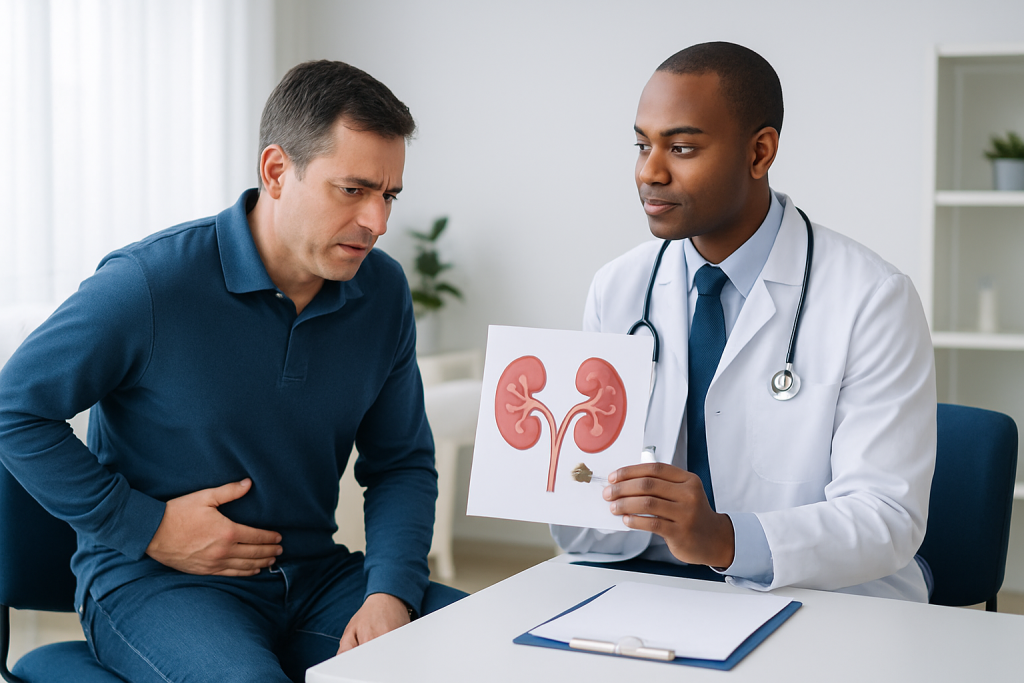
Most people do not first notice a kidney stone by seeing it. They notice it because of symptoms. A stone moving from the kidney into the ureter often causes sudden pain in the side, back, lower abdomen, or groin. The pain may come in waves as the muscles of the urinary tract contract around the blockage.
Urine may also change in appearance. It can become cloudy, darker than usual, pink, or red. Some people notice urgency, frequent urination, or burning when urinating, especially if the stone has moved lower in the urinary tract. Nausea and vomiting can happen as the body reacts to severe pain.
When the stone finally passes, there may be a brief increase in discomfort followed by relief. The passed material may be seen in the toilet or in a strainer provided by a doctor. If possible, collecting the stone can be helpful because stone analysis may guide prevention and help doctors understand whether it is linked to calcium, uric acid, cystine, or infection-related stone formation.
Kidney stones are one possible cause of these symptoms, but not the only one. Urinary tract infection, blood in the urine from another source, and other urologic problems can look similar. Related conditions such as kidney stones and urinary tract infection may overlap in symptoms, so medical evaluation is sometimes needed to tell them apart.
Why kidney stones form and who is more likely to get them
Kidney stones form when certain minerals and salts in the urine become concentrated enough to crystallize. Over time, those crystals can join together and grow into a stone. Dehydration is one of the most common contributors because low fluid intake makes urine more concentrated.
Stone formation can also be influenced by diet, family history, and certain medical conditions. Some people absorb or excrete higher amounts of calcium, oxalate, or uric acid. Others develop stones because of recurrent urinary infections, digestive disorders that change nutrient absorption, or rare inherited conditions that affect urine chemistry.
Risk factors may include:
- Not drinking enough fluids
- Previous kidney stones
- Family history of stones
- High sodium intake
- Diets high in animal protein in some individuals
- Obesity or metabolic conditions
- Certain medications or supplements
- Repeated urinary tract infections
Knowing what the stone looks like can be interesting, but preventing future stones usually depends more on understanding why the stone formed. That is why doctors may recommend stone analysis, urine testing, and a review of eating habits, hydration, and other health conditions after a stone episode.
How doctors confirm whether it is a kidney stone
If symptoms suggest a kidney stone, a doctor usually starts with questions about the pain, urine changes, past stone history, fluid intake, and any fever or infection symptoms. A physical examination may help assess tenderness and rule out other causes of abdominal or flank pain.
Urine testing is commonly used to look for blood, signs of infection, crystals, or concentrated urine. Blood tests may check kidney function and measure substances linked with stone formation. If a person has passed a suspected stone, laboratory analysis can identify its composition.
Imaging is often the most direct way to confirm a stone and see where it is located. Depending on the situation, doctors may use ultrasound or CT imaging. Imaging helps show the size of the stone, whether it is causing blockage, and whether there are features that suggest another diagnosis. In some cases, further evaluation by specialists in urology care may be appropriate.
Because many people worry after seeing something unusual in the urine, it is reassuring to know that doctors do not rely on appearance alone. They look at the whole clinical picture to decide whether a stone is likely, whether urgent treatment is needed, and what the safest next step should be.
Treatment options and what happens after diagnosis
Treatment depends mainly on the stone’s size, location, symptoms, and whether it is causing infection or blockage. Small stones often pass on their own with time, fluids, pain management, and careful monitoring. A doctor may also advise straining the urine so the stone can be collected for analysis.
If a stone is larger, very painful, unlikely to pass, or affecting kidney drainage, a procedure may be recommended. Common approaches include breaking the stone into smaller pieces or removing it through minimally invasive techniques. In selected cases, specialists may discuss kidney stone treatment options tailored to the stone’s size and position.
When an infection is present together with a blocked urinary tract, prompt treatment is important. This may involve antibiotics and urgent drainage of the kidney to protect kidney function and general health. Although this situation is more serious, it is treatable when recognized early.
After the immediate problem is managed, prevention becomes the focus. Some people benefit from a metabolic evaluation or follow-up with nephrology assessment if they have recurrent stones, reduced kidney function, or complex medical causes for stone formation.
Prevention and self-care after a stone
The most widely recommended self-care step is good hydration. Drinking enough fluid helps dilute the urine and reduces the chance that crystals will form. The right amount varies by person, climate, activity level, and medical conditions, so it is best to ask a doctor what is appropriate.
Dietary prevention depends on the type of stone. In general, reducing excess sodium can be helpful, and some people may be advised to moderate animal protein or high-oxalate foods. It is important not to make major dietary restrictions without guidance, because prevention plans should match the individual’s stone type and overall health needs.
Other practical steps include keeping follow-up appointments, taking prescribed medications as directed, and saving any passed stone for analysis if possible. People with recurrent stones may be asked to complete a 24-hour urine collection to measure factors such as calcium, oxalate, citrate, uric acid, and urine volume.
Near the end of treatment planning, some patients may need coordinated specialist care. Acibadem International’s multidisciplinary specialists at JCI-accredited hospitals diagnose and treat kidney stone disease for international patients when further evaluation or procedural management is needed.
When to seek medical care
Many stone episodes are manageable and resolve without long-term problems, but some symptoms should not be ignored. Medical care is important if side or back pain is severe, if there is repeated vomiting, or if a person cannot keep fluids down. Care is also recommended if pain lasts, keeps returning, or there is visible blood in the urine without a clear explanation.
Urgent assessment is especially important if symptoms are accompanied by fever, chills, confusion, weakness, or difficulty passing urine. These can suggest infection or urinary blockage, which may need prompt treatment. A single functioning kidney, pregnancy, older age, or significant chronic illness can also lower the threshold for seeking care.
Even when the situation is not urgent, a doctor should review repeated stone symptoms, recurrent urinary infections, or any passed stone that raises concern. Early evaluation can clarify the diagnosis, relieve symptoms, and reduce the chance of future episodes.
Frequently asked questions
Do kidney stones always look like hard little rocks?
No. Some kidney stones do look like tiny pebbles, but others look more like grains of sand, crystal fragments, or chalky particles. Many are so small that they pass without being clearly seen.
Can a kidney stone be red or bloody-looking?
Yes, it can appear pink or red if blood is mixed with it or if it has irritated the urinary tract. However, blood in the urine can also happen for other reasons, so it is not specific to stones.
If a person cannot see a stone, can it still be there?
Yes. Many kidney stones are never seen directly because they remain in the urinary tract, break into tiny fragments, or pass unnoticed. Doctors often confirm stones with urine tests and imaging rather than sight alone.
What is the best way to catch a kidney stone?
A doctor may recommend urinating through a fine strainer to collect any stone fragments. If a stone is caught, it can be placed in a clean container and taken for medical review or laboratory analysis.
Does the color of a kidney stone show what kind it is?
Not reliably. Some stone types may have typical appearances, but color and shape alone do not accurately identify the stone's composition. Laboratory analysis is the most useful way to determine the type.
When should a person worry that a kidney stone is serious?
Medical review is important if there is severe pain, fever, chills, vomiting, reduced urine output, or difficulty urinating. These symptoms can suggest blockage or infection and should be assessed promptly.
References
- National Institute of Diabetes and Digestive and Kidney Diseases
- American Urological Association
- European Association of Urology
- National Kidney Foundation
This article is for general information only and is not a substitute for professional medical advice. Please consult a qualified doctor about your individual situation.
Explore treatments in Turkey — costs, top hospitals & a free quote
JCI-accredited · board-certified surgeons · reply within 24h
Add us as a Preferred Source to see more of our trusted health content across Google Search, AI Overviews and Discover.

More from the Health Library



Related Specialists

Dr. Işıl Avcı
Physical Medicine & Rehabilitation
Dr. Mehriban Allahverdiyeva
Inpatient Clinic Physicians Clinical Service
Dr. Ülkü Yılmaz Tıraş
Pediatrics
Dr. Bilginar Kovancı
Emergency Service