What Does Precision Oncology Mean? Biomarkers, Testing, and Treatment Fit

Precision oncology uses tumor biomarkers, genetics, and other test results to guide treatment decisions. Biomarkers may come from tumor tissue, blood tests, or laboratory analysis of cancer cells.
Key Takeaways
- Precision oncology uses tumor biomarkers, genetics, and other test results to guide treatment decisions.
- Biomarkers may come from tumor tissue, blood tests, or laboratory analysis of cancer cells.
- Not every cancer has a targetable biomarker, but testing can still help clarify options.
- Treatment may include targeted therapy, immunotherapy, standard chemotherapy, surgery, or radiation.
- Results should be interpreted by an oncology team in the context of the cancer type, stage, and overall health.
- Questions about benefits, limits, timing, and costs of testing are important parts of shared decision-making.
Precision oncology is an approach to cancer care that uses biomarkers and molecular test results to help choose treatments that may fit a person’s tumor more closely. It does not replace standard cancer care, but it can add important information for diagnosis, treatment planning, and monitoring.
Overview: What Precision Oncology Means
Precision oncology is a way of planning cancer care using detailed information about a person’s tumor. Instead of choosing treatment based only on where the cancer started in the body, doctors may also look at the cancer’s molecular features, such as gene changes, proteins, and other biomarkers. This can help identify therapies that are more likely to work for that specific tumor.
The term sometimes overlaps with “personalized cancer treatment,” but it is important to keep expectations realistic. Precision oncology does not mean every treatment plan is unique in every detail, and it does not guarantee that a targeted option will be found. Rather, it means using the best available biological information to make treatment decisions more informed and more tailored.
This approach can be helpful in many situations, including newly diagnosed cancers, advanced cancers, cancers that return after treatment, and cases where standard therapies have limited benefit. It may involve pathology review, genetic testing of tumor tissue, blood-based testing, and discussions in multidisciplinary tumor boards. For many patients, precision oncology is one part of a broader treatment plan that may still include surgery, radiation, chemotherapy, or supportive care.
Biomarkers in Cancer Care
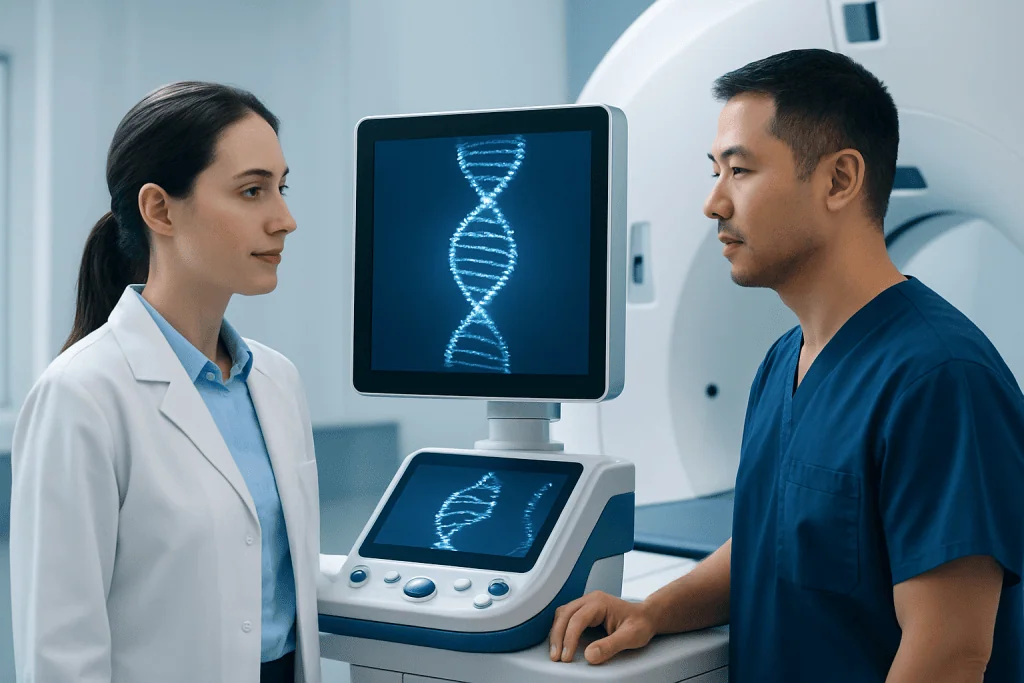
Biomarkers are measurable features that provide information about a cancer. In precision oncology, a biomarker might be a mutation in a gene, an abnormal protein on the surface of cancer cells, a pattern of gene activity, or a feature of the immune environment around the tumor. Some biomarkers help confirm a diagnosis, while others help predict which treatments may be useful.
Doctors often divide biomarkers into a few practical categories. Diagnostic biomarkers help identify the type of cancer. Prognostic biomarkers give information about how a cancer may behave over time. Predictive biomarkers suggest whether a treatment is more or less likely to help. In daily practice, one biomarker may play more than one role.
Examples vary by cancer type. Certain breast, lung, colon, melanoma, and blood cancers may have well-known biomarkers that influence treatment choices. Some biomarkers can point to the possible use of targeted therapy, while others may support use of immunotherapy. The meaning of any biomarker depends on the full clinical picture, so results should always be reviewed with an oncology team rather than interpreted in isolation.
- Biomarkers may be found in tumor tissue, blood, bone marrow, or other samples.
- Some are inherited, but many are changes that arise only in the cancer itself.
- A useful biomarker must be accurately measured and clinically relevant for that cancer type.
How Testing Is Done

Testing in precision oncology often begins with a sample collected during biopsy or surgery. A pathologist examines the tissue under a microscope and may order additional laboratory tests. These can include immunohistochemistry, fluorescence in situ hybridization, polymerase chain reaction, and next-generation sequencing. Each method answers different questions, so the choice depends on the cancer type and the clinical need.
Genomic profiling looks for changes in genes within the cancer cells. These changes may include mutations, insertions, deletions, amplifications, rearrangements, or fusions. Some tests focus on a small set of well-known cancer genes, while broader panels examine many genes at once. In selected cases, broader profiling may help identify treatment options or clinical trial opportunities, especially in advanced disease.
Blood-based testing, sometimes called liquid biopsy, can detect fragments of tumor DNA circulating in the bloodstream. This can be useful when tumor tissue is difficult to obtain, when there is not enough tissue for complete analysis, or when doctors want to monitor changes over time. However, liquid biopsy does not replace tissue testing in every case, because some tumors do not shed enough DNA into the blood to be detected reliably.
Testing may also assess markers such as mismatch repair deficiency, microsatellite instability, tumor mutational burden, or hormone receptor status, depending on the cancer. Results usually take time because laboratories must process the sample carefully and interpret findings in a clinical context. A clear discussion of what is being tested, what the test can and cannot show, and how the result might change treatment is an important part of care.
Who May Benefit and What the Limits Are
Precision oncology may be considered for many people with cancer, but it is especially relevant when treatment decisions depend on molecular findings. This can include metastatic or recurrent cancers, rare tumors, cancers with several approved biomarker-based treatments, and situations where standard treatments have already been used. Some early-stage cancers also use biomarker testing routinely to guide therapy.
Even when testing is recommended, results do not always lead to a new treatment option. A tumor may not have a targetable change, or a detected change may not yet have an approved therapy for that specific cancer type. In some cases, the result may be uncertain, meaning a gene change is found but its importance is not fully known. This is one reason specialist interpretation matters.
Another limit is that cancers can change over time. A treatment that initially works can stop working if the tumor develops resistance. For this reason, repeat biopsy or additional molecular testing may sometimes be needed later in care. Precision oncology is therefore not a one-time label, but an evolving process that may be updated as the cancer changes.
It is also important to distinguish tumor testing from inherited genetic testing. Tumor testing looks at changes in the cancer itself. Inherited testing looks for gene variants present in the body’s cells from birth that may increase cancer risk in a family. Sometimes one kind of test suggests the need for the other, and genetic counseling may be advised when hereditary risk is a concern.
How Results Help Guide Treatment Fit
The main goal of precision oncology is to improve treatment fit. A “fit” treatment is one chosen not only for the cancer type and stage, but also for the tumor’s biology and the patient’s overall health, preferences, and treatment goals. If a biomarker suggests likely benefit from a certain medicine, that therapy may be considered earlier. If a biomarker suggests low benefit, a different strategy may be more appropriate.
Targeted drugs are one of the clearest examples. These medicines are designed to interfere with specific pathways that cancer cells use to grow or survive. If testing finds a matching alteration, systemic cancer treatment planning may include a targeted medicine rather than relying only on broader treatments such as conventional chemotherapy. In other cases, biomarker results may support immunotherapy, hormone therapy, or combinations of treatments.
Precision information can also help avoid unnecessary treatment. If a tumor lacks a key marker, a certain drug may be unlikely to help, and its side effects may not be worthwhile. This can make care more efficient and may reduce exposure to treatments with limited expected benefit. At the same time, standard treatments remain essential in many cancers and often work alongside biomarker-guided approaches.
For some patients, molecular results may help identify eligibility for a clinical trial. Clinical trials are carefully designed research studies that test new treatments or new ways of using existing treatments. They can be especially important when standard options are limited or when a promising biomarker is present but the therapy is not yet widely available.
Questions to Discuss Before and After Testing
Patients often find precision oncology easier to navigate when they know what questions to ask. Before testing, it can help to ask why the test is being recommended now, whether tissue or blood testing is more suitable, and how the result could affect treatment decisions. It is also reasonable to ask how long results may take and whether enough sample is available from an earlier biopsy.
After testing, discussion usually focuses on what was found, whether the findings are actionable, and how confident doctors are that a result should influence treatment. Some reports contain highly technical language, so a plain-language explanation is important. Patients may also ask whether a result suggests a need for inherited genetic counseling or family testing.
Practical issues matter too. Availability of certain treatments can depend on local approvals, prior therapies, and the patient’s overall condition. Some patients may be referred for advanced imaging, repeat biopsy, or review by a specialist center. In complex cases, multidisciplinary teams may bring together medical oncologists, pathologists, geneticists, surgeons, and radiation oncologists to interpret findings more completely.
When patients are receiving care abroad or seeking a second opinion, organized records are especially helpful. Pathology reports, imaging results, prior treatment summaries, and test reports can all support a more complete review. Near the end of the care pathway, centers such as Acibadem International may help international patients access multidisciplinary specialists and JCI-accredited hospitals for diagnosis and treatment planning in oncology, including biomarker-guided care when appropriate.
When to See a Doctor and What to Expect Next
Anyone with a new cancer diagnosis, a recurrence, or cancer that is not responding as expected should discuss whether biomarker testing is relevant. The need for testing depends on the cancer type, stage, prior treatments, and whether the result could meaningfully influence care. A doctor can explain which tests are standard for that cancer and whether broader profiling may be useful.
It is also worth asking about precision oncology when a tumor is rare, when treatment options are limited, or when the patient is considering a second opinion. People who have a strong family history of cancer should mention this as well, because inherited cancer risk evaluation may be appropriate alongside tumor testing. Patients should not feel they need to understand every technical term before raising the topic with their doctor.
If testing is ordered, the next steps usually include sample review, laboratory analysis, and a follow-up consultation to discuss the findings. Treatment may then proceed with surgery, chemotherapy, radiation, targeted therapy, immunotherapy, or a combination, depending on the overall plan. Precision oncology works best when test results are integrated with expert clinical judgment and open communication about goals, benefits, and possible side effects.
Frequently asked questions
Is precision oncology the same as personalized medicine?
The terms are closely related and are often used in similar ways. In cancer care, precision oncology usually refers to using biomarkers and molecular test results to help choose treatment more accurately for a specific tumor.
Does every person with cancer need biomarker testing?
No. Testing depends on the cancer type, stage, and whether results are likely to change treatment decisions. For some cancers, biomarker testing is routine, while for others it may be used only in selected situations.
What is the difference between tumor testing and inherited genetic testing?
Tumor testing looks for changes in the cancer cells themselves. Inherited genetic testing looks for gene variants a person is born with that may raise cancer risk and sometimes affect family members as well.
Can a blood test replace a tissue biopsy?
Sometimes a blood-based liquid biopsy can provide useful molecular information, especially when tissue is hard to obtain. However, it does not replace tissue biopsy in all situations, because some cancers may not release enough DNA into the bloodstream for reliable testing.
If a biomarker is found, does that mean a targeted treatment will work?
Not always. A biomarker may suggest that a treatment is worth considering, but response can still vary from person to person. Doctors also look at the cancer type, previous treatments, overall health, and available evidence before recommending a therapy.
What happens if testing finds no actionable result?
This can happen and does not mean there are no treatment options. Standard treatments such as surgery, radiation, chemotherapy, hormone therapy, or supportive care may still be appropriate, and clinical trials may also be considered.
References
- World Health Organization
- National Cancer Institute
- American Society of Clinical Oncology
- European Society for Medical Oncology
- National Comprehensive Cancer Network
This article is for general information only and is not a substitute for professional medical advice. Please consult a qualified doctor about your individual situation.
Oncology care in Turkey — second opinion and treatment plan
JCI-accredited · board-certified surgeons · reply within 24h
Add us as a Preferred Source to see more of our trusted health content across Google Search, AI Overviews and Discover.

Medical Oncology Department
Medical treatment of cancer with chemotherapy, immunotherapy and targeted therapies under a multidisciplinary tumor board.
60 specialists in this unitMore from the Health Library



Related Specialists

Fzt. Sena Durmaz
Physical Medicine & Rehabilitation
Dr. Arzu Oran
Clinical Laboratory
Assoc. Prof. Dr. Bahar Temur
Cardiovascular Surgery
Fzt. Neslihan Yıldızdağı
Pediatric Rehabilitation